2027 Online Ed.D. in Leadership and Learning in Organizations: Clarifying the Partner's Expectations Before Project Approval
Audited and Verified:
Our Editorial and Data Verification Process
Research.com uses government datasets, official education statistics and primary institutional information to support its career and degree guides. Our review process checks factual accuracy, occupational definitions, source dates and the requirements associated with the credentials discussed.
How This Article Was Fact-Checked
Our editorial team verifies salary estimates, employment projections, education requirements and program information against original data providers and official organizations. Salary figures are checked against the relevant occupational definitions and reporting periods. Information about licensure, accreditation and required in-person training is reviewed separately.
Fact-checked and verified on:

Co-Founder and Chief Data Scientist
An organization may welcome your Ed.D. capstone idea without understanding the time, data access, staff involvement, or public reporting it could require. That gap can delay approval - or leave you with a project you cannot complete.
For working leaders and doctoral applicants planning an organizational project, this guide explains what to settle with a partner before seeking faculty approval, how to separate organizational permission from academic and ethical review, and when to narrow the project or find another site.
Key Things You Should Know
- A partner's enthusiasm is not project approval: confirm organizational authority, the program's academic requirements, and any required research or privacy review separately.
- Before approval, agree on the decision the project will inform, feasible evidence and access, staff time, deliverables, confidentiality, and what happens if access changes.
- Keep the proposed work small enough to finish within the doctoral timeline; an Ed.D. does not require a partner to adopt your recommendations.
What Is an Online Ed.D. in Leadership and Learning in Organizations?
An online Ed.D. in leadership and learning in organizations is a practice-oriented doctorate concerned with how people learn, how organizations change, and how leaders use evidence to improve practice. Programs with similar names can differ substantially: one may require a team capstone with an external organization, while another requires an individual dissertation in practice. Neither arrangement should be assumed from the degree title.
If access to a workplace problem is central to your choice, compare the actual project requirements before comparing course titles. A guide to comparing academic focuses within Ed.D. programs can help you distinguish organizational learning from school-administration or other tracks, but the program must confirm its specific approval rules.
How Does an Online Ed.D. Compare With a Campus-Based Program?
Online delivery may let you work with a partner near your home or job, but it does not make partner meetings, faculty check-ins, team coordination, or site visits optional. A campus-based program may offer more in-person collaboration while making travel or relocation a larger constraint. In either format, ask whether the program permits remote data collection and whether the partner can accommodate the required schedule.
Travel can also change the financial comparison: examine required convenings and project-site visits alongside tuition. Listings of online doctorates in education with affordable study routes are a starting point, not evidence that a particular program or partner project can be completed remotely.
What Accreditation Should an Online Ed.D. Program Have?
Check that the university holds institutional accreditation recognized by the U.S. Department of Education or the Council for Higher Education Accreditation, and confirm that the accreditation covers the institution awarding the doctorate. Ask the program whether any additional approval applies to its specific degree. Accreditation does not mean a proposed capstone partner, project site, or data-use plan has been approved.
A general leadership and learning Ed.D. also should not be mistaken for a state-approved route to principal, superintendent, or teacher licensure. If licensure matters to your career goal, check the program's disclosures and the relevant state authority before enrolling.
Relevant study may include adult learning, organizational diagnosis, change leadership, research methods, program evaluation, and research ethics. The useful question for a prospective capstone student is whether coursework provides enough preparation to define a manageable problem, select appropriate evidence, and interpret findings without promising a causal result the design cannot support.
Request the course sequence and project handbook. Find out when students select a partner, whether a faculty advisor must approve the question before data collection, and whether the final product is an individual dissertation, a team capstone, or another deliverable. A course assignment conducted at work is not automatically an approved doctoral project.
Requirements vary by institution and may include a completed graduate degree, professional experience, recommendations, a statement of purpose, or an interview. Relevant leadership evidence can come from education, business, healthcare, government, or nonprofit work; a particular job title or education master's degree is not a universal requirement.
If an application asks for a proposed organizational problem, describe your actual responsibilities and a plausible inquiry, not a partner commitment you have not obtained. Ask admissions whether a partner is required at application or only later, and ask the project coordinator what documentation the latter stage requires. An employer's encouragement should not be presented as permission to use its records.
Both depend on the program's required credits, enrollment pace, fees, and project structure. A partner's approval process can affect completion time: delayed access to records, staff, or a project site may postpone work even when courses remain on schedule. Request the program's published time-to-completion rules and ask what happens if a project must be rescoped.
For a realistic budget, separate tuition and fees from required travel, software or data-security expenses, and time away from paid work. Employer tuition assistance is distinct from employer permission to conduct a capstone; verify both in writing. When comparing low-cost doctoral study in organizational leadership, account for the cost of sustaining the project, not just advertised tuition.
The partner's role is to establish that the organization has a real use for the proposed inquiry and can support it within defined limits. The partner does not approve the academic capstone on the university's behalf. Before seeking approval, the student, faculty advisor, and authorized organizational contact should be working from the same description of the problem, proposed activities, and boundaries.
Use the following sequence to turn a promising conversation into a proposal each party can evaluate:
- Define the decision. Ask what the organization needs to decide or improve, who owns that decision, and whether the issue is suitable for inquiry rather than an already-chosen training solution.
- Set the scope. Identify the unit or process involved, a feasible question, a proposed timeline, and a deliverable the partner could use even if it does not implement recommendations.
- Confirm authority and capacity. Identify who may authorize the work, which staff would participate, how much time they can offer, and whether legal, HR, data, or other offices must review the plan.
- Specify evidence and access. Name proposed records, interviews, observations, or aggregate measures; identify who controls them; and distinguish hoped-for access from access actually granted.
- Agree on boundaries. Discuss confidentiality, secure storage, organizational review for disclosure, ownership or permitted use of materials, and what may appear in a submitted or public-facing project.
- Plan for change. Decide whom to contact if a sponsor leaves, access is reduced, the organization changes priorities, or the student needs to narrow or replace the site.
A short written project brief can capture these expectations without pretending to be a university approval or data-use agreement. Give the partner the proposed question, activities, requested resources, deliverables, timing, and unresolved permissions. Then ask the faculty advisor whether that scope meets academic requirements before committing the organization to a particular design.
Keep the approval gates separate. An authorized partner may permit site participation, but access to identifiable employee or learner information can require further organizational authorization and safeguards.
The university determines academic suitability and whether institutional review or another ethics process is required. FERPA may apply to covered education records; employment-data rules and organizational policies may impose different restrictions. Do not collect data merely because a contact has verbally agreed to the project, and do not assume every workplace evaluation is automatically human-subjects research - or automatically exempt from review.
If the partner cannot identify an authorized sponsor, offer realistic access, or accept the program's reporting requirements, pause approval and narrow the inquiry, use permitted aggregate or existing evidence, or seek another setting. A smaller, authorized project is more defensible than an ambitious proposal dependent on permissions no one can grant.
Depending on prior experience, graduates may pursue or advance in learning and development, organizational development, program evaluation, consulting, nonprofit leadership, or higher-education administration. These roles differ: a training manager directs learning operations, while an organizational consultant diagnoses problems and advises clients.
A capstone can demonstrate careful scoping, stakeholder collaboration, and evidence use, but it does not substitute for management experience or an employer's hiring requirements.
If your target is college administration, compare online Ed.D. pathways for college organizational leadership against the specific responsibilities you want. Choose a partner problem that builds relevant experience without assuming that a college project guarantees a higher-education appointment.
There is no single salary for online Ed.D. graduates. The U.S. Bureau of Labor Statistics reports a May 2025 median annual salary of $133,000 for training and development managers. That is an occupational median, not a graduate starting salary or a return promised by the degree; relevant experience, sector, location, and management responsibility matter.
Compare the cost of study with a specific role or advancement opportunity, not with the highest-paying occupation a graduate might pursue. If college leadership is your goal, consider evaluating aid eligibility for higher education leadership doctorates alongside your employer's reimbursement terms and the likely demands of your proposed project.
What Job Outlook and Certifications Apply to Ed.D. Graduates?
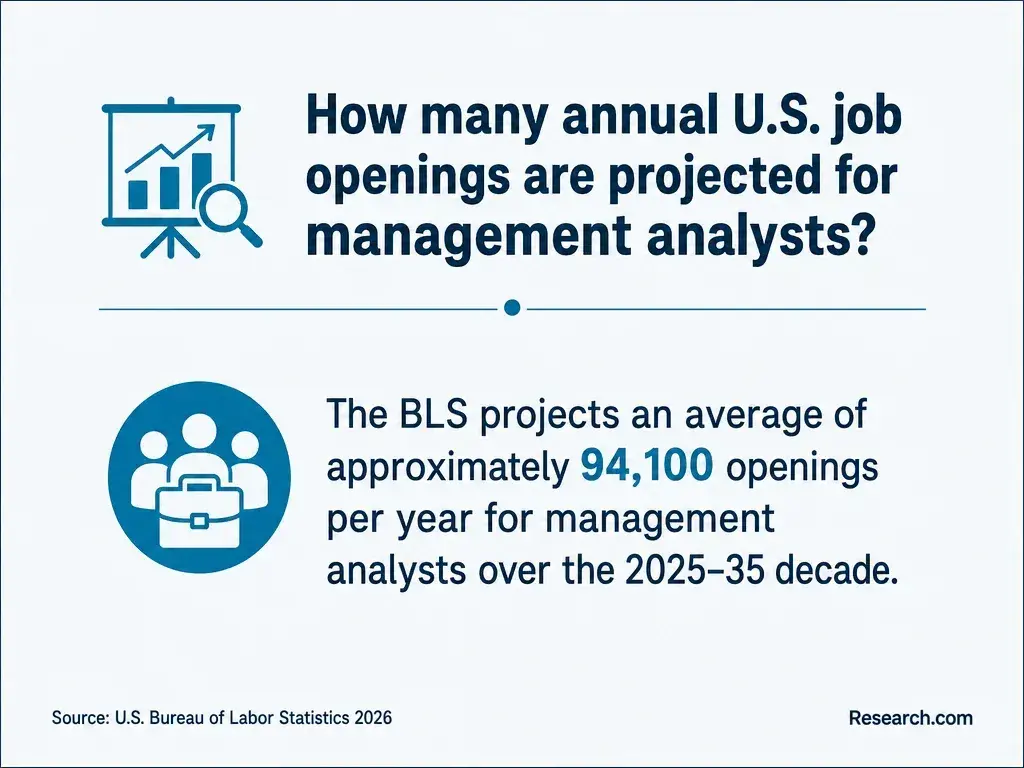
The U.S. Bureau of Labor Statistics projects 10.1% employment growth for management analysts from 2025 to 2035. That projection describes an occupation - not demand for Ed.D. holders - and consulting work still calls for credible sector expertise and the ability to manage client expectations.
An Ed.D. does not automatically confer a change-management certification, professional license, or school-administrator credential. Check the requirements of the occupation and employer you want. If your immediate need is to lead a bounded improvement project rather than complete doctoral research, supervised workplace experience or targeted professional training may be a more direct next step.
Other Things You Should Know About EdD Leadership
Possibly, but a supervisor's support does not establish authority over every dataset, employee request, or disclosure. Ask who can approve each part of the project and whether the program has rules about your relationship to participants.
Ask the program before agreeing. The university may require submission, assessment, or publication that conflicts with the partner's restrictions. Resolve that conflict through an approved reporting or redaction plan before collecting information.
Not ordinarily as a general condition of applied inquiry, but check the specific program's requirements. Define success in terms of the approved academic work and useful evidence, not an organizational decision the student cannot control.
Yes, if the program and organization permit appropriate acknowledgment. Agree in advance on review, credit, and confidentiality; contributing staff time does not automatically establish authorship or permission to disclose their names.
- 2 PROJECT INITIATION | ny.gov https://its.ny.gov/project-initiation
- IRBs | ORI https://ori.hhs.gov/content/chapter-3-The-Protection-of-Human-Subjects-IRBs
- Institutional Review Boards Frequently Asked Questions | fda.gov https://www.fda.gov/regulatory-information/search-fda-guidance-documents/institutional-review-boards-frequently-asked-questions
- Things You Need to Know - Division of Research https://research.charlotte.edu/departments/office-research-protections-and-integrity-orpi/human-subjects/things-you-need-know/
- Where leaders learn: Inside Vanderbilt's online Leadership and Learning in Organizations doctoral program https://news.vanderbilt.edu/2025/05/13/where-leaders-learn-inside-vanderbilts-online-leadership-and-learning-in-organizations-doctoral-program/
- 2026 UNC Online EdD in Organizational Learning & Leadership https://online.unc.edu/online-doctoral-programs/online-edd-organizational-learning-and-leadership/
- IRB FAQs - Cornell Research Services https://researchservices.cornell.edu/resources/irb-faqs
- When Do External Organizations Need IRB Approval? | Human & Animal Research Compliance https://irb.stanford.edu/for-researchers/when-do-external-organizations-need-irb-approval
- Data Security Guidelines | Research Ethics & Compliance https://research-compliance.umich.edu/data-security-guidelines%20
- Leadership and Learning in Organizations Online Ed.D. | Peabody College of Education and Human Development https://peabody.vanderbilt.edu/academics/edd-programs/online-leadership-learning-organizations/