2027 Online Ed.D. in Leadership and Learning in Organizations: Keeping a Capstone from Becoming an Unpaid Consulting Engagement
Audited and Verified:
Our Editorial and Data Verification Process
Research.com uses government datasets, official education statistics and primary institutional information to support its career and degree guides. Our review process checks factual accuracy, occupational definitions, source dates and the requirements associated with the credentials discussed.
How This Article Was Fact-Checked
Our editorial team verifies salary estimates, employment projections, education requirements and program information against original data providers and official organizations. Salary figures are checked against the relevant occupational definitions and reporting periods. Information about licensure, accreditation and required in-person training is reviewed separately.
Fact-checked and verified on:

Co-Founder and Chief Data Scientist
An organizational partner may welcome your Ed.D. capstone - then ask for a training rollout, executive presentation, or months of follow-up that your degree does not require. For working leaders and learning professionals, that shift can turn applied doctoral study into unpaid consulting. This article explains how to define the academic project, secure appropriate permissions, protect independent findings, and set limits on deliverables. It also shows what to check before choosing a program or partner, so you can pursue a useful organizational project without promising work you cannot responsibly complete.
Key Things You Should Know
- Prevent scope creep before data collection: agree in writing on the question, access, academic deliverables, timeline, decision rights, and work that is explicitly out of scope.
- A partner's willingness to host a project is not faculty approval, data authorization, ethical clearance, or permission to publish findings; each may require a separate decision.
- Budget for project labor as well as tuition. If a sponsor expects implementation or ongoing advisory services, ask whether that work can be removed, performed within your paid job, or separately compensated.
What Is an Online Ed.D. in Leadership and Learning in Organizations?
An online Doctor of Education in leadership and learning in organizations is a practice-oriented doctorate focused on how people learn and how organizations improve. Depending on the institution, students may study adult learning, organizational change, leadership, and applied inquiry. The culminating requirement might be a capstone, dissertation in practice, or another approved project; the label alone does not establish its format.
That distinction matters when approaching a workplace or external partner. An academic project must answer to faculty assessment criteria, even when its findings could inform an employer's decisions. Before comparing programs, use a guide to comparing Doctor of Education program types, then request each institution's actual project handbook. A general organizational leadership Ed.D. should not be mistaken for a school-administrator licensure program.
How Does an Online Ed.D. Differ From a Ph.D. in Education?
An Ed.D. commonly emphasizes using research to address a problem of practice; a Ph.D. generally places greater emphasis on producing scholarly research. Neither description replaces a review of a particular program's curriculum and final-project rules. Both can require substantial methods training, and an Ed.D. project still needs defensible evidence and honest reporting.
For a leader who wants to investigate an organizational learning problem, the practical distinction is who defines success. A partner may value an immediately deployable solution, while a doctoral committee may value a well-supported analysis, including findings that show a proposed solution is not justified. If your primary aim is to deliver a client-specified intervention, paid consulting or an employer-sponsored improvement assignment may fit better than either doctorate.
How Can You Evaluate an Online Ed.D. Program's Accreditation?
Confirm the institution's accreditation with its recognized accreditor and check that the institution is authorized to offer the degree in your location. Then verify the exact Ed.D. award and any claims about specialized accreditation or licensure with the university. Institutional accreditation does not, by itself, establish eligibility for principal or superintendent licensure.
Accreditation is only the first screen for this article's decision. Ask the program coordinator for the capstone handbook, partner-site requirements, research-review procedures, and a sample project agreement or approved scope template. A credible program should be able to explain who resolves disagreements when a sponsor wants more work than the academic project requires. If those boundaries are unclear before enrollment, the project risk remains unclear too.
Relevant study may include adult learning, organizational diagnosis, change leadership, program evaluation, and qualitative or quantitative methods. For capstone purposes, the most valuable preparation connects a decision to a feasible question: Is a performance problem caused by a learning gap, or by workflow, incentives, staffing, or authority? Training is not a sound recommendation merely because a sponsor requests it.
Look for opportunities to practice defining measures, interpreting incomplete evidence, communicating limitations, and handling confidential organizational information. Check the required course sequence rather than assuming an elective or a course title provides advanced evaluation expertise. Faculty guidance on project scoping and methods may matter more to this decision than an appealing list of leadership topics.
Make the academic scope explicit before accepting the partner's problem. A capstone can serve a legitimate organizational need without obligating the student to implement every recommendation. Consulting becomes the better description when a sponsor controls the questions and conclusions, adds deliverables as needs change, or expects continuing operational support beyond the approved doctoral work.
Use a short, faculty-reviewed project charter before collecting data. It should settle the following points with the organization and, where applicable, the student team:
- Define the problem and question. Identify the decision the findings could inform, the project's organizational boundaries, and what evidence would challenge the sponsor's preferred explanation.
- Name the academic deliverables. Specify what the program assesses and what the partner receives, such as an agreed executive summary. State that implementation, new training materials, repeat analyses, and post-submission support are excluded unless separately approved.
- Assign authority and labor. Identify the faculty advisor, organizational sponsor, data steward, student responsibilities, and any team members' contributions. Record who can request changes and who approves them academically.
- Set access and ethics conditions. List proposed data sources, permissions, storage and retention rules, confidentiality protections, and the process for determining whether institutional research review or consent is required.
- Plan the exit. Set review dates, a final handoff, and a procedure for narrowing, pausing, or relocating the project if access disappears or the sponsor changes.
For example, evaluating how an existing onboarding process is experienced is a different commitment from designing and running a replacement program. The former could support a bounded inquiry if the program approves its methods and deliverable. The latter adds operational labor, coordination, and accountability that should not be assumed to come with a student project.
Separate permissions that are often mistakenly bundled together. Faculty approval establishes academic fit; employer or partner permission authorizes activity at the site; a data steward may control records; institutional review procedures determine applicable research oversight; and publication or portfolio use may require another agreement. Employee, learner, or customer records can trigger privacy and contractual restrictions. In education settings, check applicable FERPA obligations. Do not promise identifiable data, unrestricted access, or public release before the responsible parties decide.
Protect intellectual independence in the charter. Offer the sponsor a chance to check factual errors and confidential disclosures, but not a veto over unfavorable findings. If the partner requests substantial new work, document the request and ask your advisor whether it fits the approved scope. Work outside it can be declined, handled as part of a separately defined paid job responsibility, or considered for a separate consulting arrangement - subject to university and employer conflict-of-interest rules.
Requirements vary by institution. Programs may review prior graduate study, transcripts, professional experience, recommendations, a statement of purpose, and evidence that an applicant can undertake applied inquiry. Some ask applicants to describe a workplace problem; describing one does not mean the employer has approved a capstone or granted data access.
If a project partner is central to your application, explain your actual decision-making role and identify access still to be negotiated. Ask admissions whether a current employer is required, whether an external partner is allowed, and what happens if you change jobs. Before accepting an offer, compare the financing terms alongside grant and scholarship options for higher education leadership research study. An employer's interest in the project is not a promise of tuition reimbursement or paid project time.
Duration and price depend on required credits, enrollment pace, tuition structure, fees, and the time allowed for the final project. Obtain a written estimate for your entry term that includes required travel, technology, and continuation charges. An Ed.D. tuition comparison guide can help create a shortlist, but the institution's current charges and your enrollment plan should control the budget.
Add the less visible capstone costs: time arranging access, evenings spent coordinating with a partner, possible travel, and any reduction in paid work. Ask whether the program funds project expenses and whether employer reimbursement requires continued employment. A lower tuition quote may not be the lower-cost choice if its project model requires extensive unpaid implementation or prolonged enrollment.
Online delivery removes a regular commute, not necessarily scheduled obligations. Live classes, team meetings, campus convenings, and partner availability can determine whether the capstone fits around work and caregiving. A campus-based program may provide easier in-person access to faculty or local partners; an online program may make it possible to investigate a problem in the organization where you already work.
Compare the actual calendar and project support of each program. Ask when meetings occur, how remote students obtain faculty feedback, whether external partners are permitted, and how students continue if employment changes. When comparing education doctoral degrees by tuition level, include travel and the scheduling cost of the required project - not just the advertised delivery format.
An experienced learning and development professional might use the degree to strengthen evaluation, cross-functional change, or leadership-development work. Other potential paths include organizational development, workforce training leadership, consulting, and education administration. Hiring still depends on relevant experience, sector knowledge, and the responsibilities of the specific role; a capstone is evidence of applied work, not an executive appointment.
Choose a project that demonstrates a capability your target role actually uses, while respecting the partner's confidentiality. A redacted explanation of the question, method, limitations, and decision implications may be more useful in a portfolio than a proprietary report. College administrators exploring online organizational leadership Ed.D. choices for college leaders should also check whether a prospective role requires institution-specific experience or a different credential.
What Salaries and Job Outlook Can Ed.D. Graduates Expect?
The U.S. Bureau of Labor Statistics reports a May 2025 median annual salary of $133,000 for training and development managers. That is an occupational median, not an expected salary for Ed.D. graduates. Management responsibility and prior experience are central to that role, so the figure should not be used to justify taking on unlimited unpaid capstone work in hopes of a promotion.
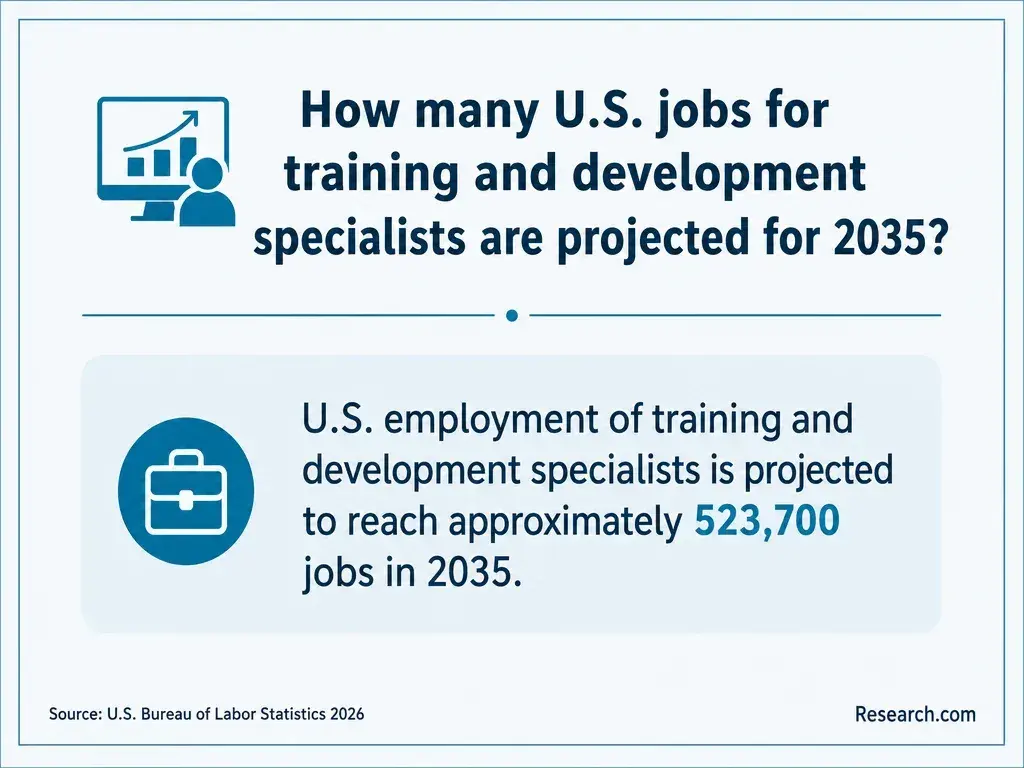
For job outlook, BLS projects 10.8% employment growth for training and development specialists from 2025 to 2035. The projection describes an occupation, not demand for doctorate holders. Compare openings against your existing skills and target job requirements before deciding that doctoral study offers more value than supervised project experience or targeted methods training.
Other Things You Should Know About EdD Leadership
Possibly. Ask your advisor whether public records can answer an approved question without implying that you evaluated the organization's private operations. A redesigned project may need fresh academic approval.
Payment may be possible, but check university rules on conflicts of interest, academic independence, and employment before agreeing. Paid status does not replace project approval or data permissions.
Not automatically. Data-sharing obligations depend on the approved agreement, consent terms, applicable law, and who controls the records. Resolve this before collection, particularly for identifiable responses.
Get explicit permission for the organization's name and any project details you plan to share. If permission is limited, describe your methods and contribution without disclosing confidential information or implying an endorsement.
- Data Ownership | The Office of Research Integrity https://ori.hhs.gov/education/products/n_illinois_u/datamanagement/dotopic.html
- Why Human Subjects Research Protection Is Important - PMC https://pmc.ncbi.nlm.nih.gov/articles/PMC7122250/
- Read the Belmont Report | hhs.gov https://www.hhs.gov/ohrp/regulations-and-policy/belmont-report/read-the-belmont-report/index.html
- Guidance - Human Subject Research Protection https://dhr.research.northeastern.edu/forms-guidance/guidance/
- Use of One's Own Students in Human Subjects Research | Credit for Prior Learning https://umaine.edu/research-compliance/human-subjects/use-of-ones-own-students-in-human-subjects-research/
- What Is a Capstone Project? | Florida National University (FNU) https://www.fnu.edu/what-is-a-capstone-project/
- Leadership and Learning in Organizations Online Ed.D. | Peabody College of Education and Human Development https://peabody.vanderbilt.edu/academics/edd-programs/online-leadership-learning-organizations/
- Intellectual Property Policy | Tulane Policy https://policy.tulane.edu/policy/intellectual-property-policy
- Compensation for Participation in Research | uoregon.edu https://research.uoregon.edu/manage/integrity-compliance/human-subjects-research/guidance-library/compensation-participation-research
- Compensation of Research Subjects - Utah IRB https://irb.utah.edu/guidance-series/compensation-of-research-subjects/