2027 Cheapest Way to Get a Teaching Credential in Colorado: Requirements & Certification

Co-Founder and Chief Data Scientist
Becoming a teacher in Colorado can be affordable, but only if you choose the right licensure route, confirm state approval before enrolling, and budget for fees beyond tuition. The lowest-cost path is often not a traditional four-year teacher preparation program. For many candidates who already hold a bachelor’s degree, Colorado’s alternative teacher licensure pathway can reduce time in school, let you earn experience while completing requirements, and help you avoid paying for a second full degree.
This guide explains the cheapest practical ways to earn a Colorado teaching credential, including alternative licensure, online programs, out-of-state credential options, foreign transcript evaluation, renewal costs, retirement considerations, salary expectations, and related education careers. It is designed for career changers, recent graduates, substitute teachers, international applicants, and educators comparing lower-cost routes into Colorado classrooms.
Quick Answer: What Is the Cheapest Way to Get a Teaching Credential in Colorado?
The most affordable route for many aspiring Colorado teachers is the alternative licensure pathway if they already have a bachelor’s degree from an accredited institution and can secure a teaching position in their endorsement area. This route usually allows candidates to complete an approved alternative program while gaining classroom experience, often within one to two years. Candidates should still budget for license application fees, required exams, fingerprinting, background checks, possible transcript evaluations, and any program tuition charged by the designated agency or provider.
Colorado reported nearly 7,000 teaching positions to fill in 2024, which makes cost-effective preparation especially important for candidates who want to enter the workforce without taking on unnecessary debt. The best strategy is to compare state-approved programs, verify endorsement requirements with the Colorado Department of Education, and ask providers for a full cost breakdown before enrolling.
Key Things You Should Know About the Cheapest Way to Get a Teaching Credential in Colorado
- Colorado’s alternative pathway can be a lower-cost option for candidates who already have a bachelor’s degree and want to complete licensure while working in a school setting.
- To qualify, you generally need a bachelor’s degree from an accredited institution and enrollment in an approved alternative educator preparation program.
- Colorado uses different authorization options, including the Alternative Teacher License for candidates who can demonstrate the required content knowledge and Interim Authorization for candidates still completing certain requirements.
- Fingerprinting and background checks are required for first-time applicants and can add to your total cost, so include them in your budget from the start.
- Your teaching position must align with your endorsement area, and working with a designated agency can make the alternative program process more structured.
- How much does it cost to become a teacher in Colorado?
- Can a foreigner get a Colorado teaching license?
- Can I get my teaching credential online in Colorado?
- Can I teach in Colorado with an out of state credential?
- How many years do you have to teach in Colorado to retire?
- What happens if my Colorado teaching credential expires?
- How many units is a Colorado teaching credential?
- How much do teachers in Colorado make?
- What is the job outlook of teachers in Colorado?
- What other education careers are available in Colorado?
- What is the career path of a teacher in Colorado?
- Tips on Teaching in Colorado’s Private Schools
- How do I start a kindergarten teaching career in Colorado?
- What factors should I consider when choosing an online teaching program in Colorado?
- What are the Colorado teacher certification requirements for educators?
- Are specialized endorsements crucial for advancing your teaching career?
- How can I become a preschool teacher in Colorado?
- How can I build a robust professional network in Colorado's education community?
- What challenges might I face during the Colorado teaching credential process?
- How can I find cost-effective higher education options for my teaching career?
How much does it cost to become a teacher in Colorado?
The total cost to become a teacher in Colorado depends on your starting point. A first-time college student may pay for a full bachelor’s degree and teacher preparation program. A career changer who already has a bachelor’s degree may only need an approved alternative program, testing, application fees, and background checks. That difference can make the alternative pathway the cheaper option for many adults entering teaching.
The mandatory state-level fees are only one part of the budget. Candidates also need to account for tuition or program charges, exams, transcript requests, fingerprinting, transportation to field placements, and lost income if student teaching affects work hours.
| Cost item | Amount stated | What it means for your budget |
| Standard teaching license application | $90 | This is the initial fee for a standard teaching license, which is valid for three years. |
| Alternative teacher license application | $90 | The fee is the same as the standard license fee, though the license length can vary from one to three years depending on the program. |
| Additional endorsement or specialization | $90 | Adding credentials such as a Special Services Provider or Administrator license carries the same stated fee. |
| Substitute authorization | $60 or $90 | A one-year substitute authorization costs $60, while three to five-year options cost $90. |
| Credit card transaction fee | 4% | Colorado requires credit card payment, and the payment processor adds this fee. |
| Teacher licensure exams | Between $90 and $209 | The amount depends on the specific Praxis exam or Colorado Teacher Licensure Exam required for your endorsement. |
How to keep your Colorado teacher credential costs lower
- Start with the route that matches your background. If you already have a bachelor’s degree, compare alternative licensure programs before assuming you need another degree.
- Ask for the full program price in writing. Tuition is not the only expense. Ask about supervision fees, placement fees, textbooks, testing support, and renewal-related costs.
- Use scholarships and aid targeted to future teachers. Teacher preparation scholarships, state grants, federal aid, and institutional awards can reduce out-of-pocket costs.
- Consider location-related expenses. Living costs in parts of Colorado, including Denver, can affect the real affordability of a program, especially if student teaching limits your ability to work.
- Be cautious with out-of-state comparisons. Educators who hold another state credential, such as a West Virginia professional educator license, may still need to meet Colorado’s endorsement and application requirements.
Traditional vs. alternative licensure: which is usually cheaper?
| Pathway | Best for | Potential cost advantage | Important limitation |
| Traditional teacher preparation | Students who have not yet earned a bachelor’s degree | Combines degree completion and educator preparation in one academic path | Can be expensive if it requires several years of tuition before full-time employment |
| Alternative licensure | Candidates who already have a bachelor’s degree | May allow you to work toward licensure while gaining classroom experience | You must meet Colorado requirements and usually need a position aligned with your endorsement area |
| Online teacher preparation | Students who need scheduling flexibility | Can reduce commuting and relocation costs | Still must include required field experience or student teaching approved for Colorado licensure |
| Substitute authorization first | Candidates exploring teaching before committing to full licensure | Lower upfront authorization cost | Substitute authorization is not the same as a full teaching license |
The chart below shows the teacher preparation program route chosen by educators based on the number of enrollments, as reported by the NCTQ in 2023.
Can a foreigner get a Colorado teaching license?
Yes. Internationally educated candidates can pursue a Colorado teaching license, but they must document that their academic preparation is equivalent to U.S. requirements and that they meet Colorado’s licensure standards. The process can still be cost-conscious if you avoid unnecessary duplicate coursework and submit the right documents the first time.
- Foreign degree review: Colorado does not evaluate non-U.S. degrees directly. Applicants with international coursework need a course-by-course equivalency evaluation from a National Association of Credential Evaluation Services (NACES) member.
- Transcript planning: Your evaluation may cover undergraduate coursework, subject-area preparation, or graduate study such as an online master’s in inclusive education. Request exactly what Colorado requires so you do not pay for the wrong evaluation type.
- Program completion documentation: Candidates who completed a teacher preparation program with student teaching may normally need a Verification of Program Completion Form from the institution. This requirement is waived for foreign applicants.
- Testing exemptions: Applicants with three or more years of verified full-time teaching experience may qualify for exemption from certain testing requirements. If testing is required, Colorado accepts specific Praxis content knowledge tests.
- Fingerprinting: First-time applicants must submit fingerprints specifically for Colorado. International applicants should budget for this step along with evaluation and application costs.
Cost-saving advice for international applicants
Before paying for a credential evaluation, compare Colorado’s endorsement requirements against your academic record. If your coursework does not clearly match the endorsement you want, contact the Colorado Department of Education or an approved preparation provider before enrolling in additional classes. The cheapest path is usually the one that avoids preventable rework.
Can I get my teaching credential online in Colorado?
Yes, you can complete substantial parts of Colorado teacher preparation online, but an online program is only a good option if it is aligned with Colorado licensure rules and includes the required practical teaching experience. Online coursework may be flexible and affordable, but it does not remove state requirements for exams, documentation, background checks, or supervised classroom practice.
Steps to earn a Colorado teaching credential online
- Confirm Colorado Department of Education requirements. Start with the license type and endorsement area you want, then check the required coursework, testing, and experience expectations.
- Choose a state-aligned accredited program. Look for programs recognized by the appropriate education authorities and, when relevant, accreditation from bodies such as the Council for the Accreditation of Educator Preparation (CAEP).
- Complete required education coursework. Programs typically include content in pedagogy, child development, classroom management, assessment, and instruction.
- Pass the required exams. Colorado candidates may need Praxis exams or Colorado Teacher Licensure Exams (CTLE), with stated costs between $90 and $209 depending on the exam.
- Complete student teaching or supervised fieldwork. Even if your classes are online, Colorado preparation must include practical experience that meets licensure expectations.
- Submit your licensure application. After finishing the program and exams, you submit transcripts, test scores, field experience records, and other documents through the state process.
Online program checklist
| Question to ask | Why it matters |
| Is this program approved or accepted for Colorado teacher licensure? | A low tuition price is not useful if the program does not lead to the license you need. |
| How is student teaching arranged in Colorado? | Online programs still need local classroom placements or approved supervised experience. |
| What is the total cost beyond tuition? | Exam fees, background checks, textbooks, placement fees, and technology charges can change the real price. |
| Does the program prepare me for my endorsement area? | Your coursework and fieldwork must align with the subject or grade level you plan to teach. |
| What career support is included? | Support with district hiring, resume preparation, and placement can help you move into a teaching role faster. |
After earning your initial credential, some educators later pursue graduate study or advanced qualifications that lead to broader opportunities, including top earning education master’s jobs. Those later choices should be evaluated separately for return on investment.
Can I teach in Colorado with an out of state credential?
You cannot assume that an out-of-state license automatically transfers to Colorado. Colorado reviews whether your license and experience meet its endorsement standards. The process can be straightforward for experienced teachers, but missing documentation or mismatched endorsements can delay approval.
- Standard out-of-state route: Applicants typically need a valid standard license from another state and at least three years of full-time teaching experience in the relevant subject area within the last seven years.
- Endorsement review: Colorado checks whether your previous credential matches the Colorado endorsement you are seeking. A general teaching license from another state may not perfectly align with Colorado’s categories.
- Interim authorization: If you do not meet all requirements, Colorado may offer interim authorization that allows first-time applicants to work while completing exams or other licensure conditions.
- Special services limitation: Interim authorization is not available for special services licenses, which must meet initial or professional license standards.
- Review timeline: The Colorado Department of Education reviews applications within 45 days. If more information is requested, applicants have 60 days to respond or the application may be withdrawn.
Career changers from related education fields may need a different plan. For example, someone coming from library science careers should verify whether prior experience, coursework, and intended endorsement area line up with Colorado educator licensure rules.
How to avoid extra costs as an out-of-state applicant
- Request official records early so you are not paying rush fees later.
- Match your prior license to the Colorado endorsement before applying.
- Do not enroll in additional coursework until the state or an approved provider confirms what is actually missing.
- Track the 60-day response window carefully if CDE asks for more information.
How many years do you have to teach in Colorado to retire?
Colorado teachers participate in the Colorado Public Employees’ Retirement Association (PERA). Retirement timing depends on your age and credited service. The least expensive credential pathway should not be your only financial consideration; long-term retirement benefits also matter when evaluating a teaching career in Colorado.
| Retirement option | Eligibility stated | Benefit impact |
| Full retirement by service | 30 years of service | Teachers can qualify for full retirement benefits regardless of age. |
| Full retirement by age | Age 65 with 5 years of service | Teachers without 30 years of service can still qualify for full benefits at age 65. |
| Early retirement by service | At least 25 years of service | Teachers with 25-29 years of service can retire early with reduced benefits. |
| Early retirement by age and service | Age 60 with at least 20 years of service | Benefits are reduced, with the reduction affected by how close the teacher is to full retirement eligibility. |
PERA calculates monthly retirement benefits using several factors, including years of service, highest average salary, and age at retirement. The longer you work and the higher your salary during the highest three years used in the calculation, the stronger your retirement benefit may be. Retiring early can permanently reduce monthly benefits.
Health care planning is also important. Retired Colorado teachers may qualify for health care benefits through PERA’s health care program. Teachers retiring with at least 20 years of service are eligible for subsidized health insurance coverage, while those retiring with less than 20 years of service must cover the full cost of health insurance.
The chart below illustrates the average annual salary of teachers by years of experience, as reported by the NCES in 2023.
What happens if my Colorado teaching credential expires?
If your Colorado teaching credential expires, you may not be able to continue in a position that requires an active license until you complete the renewal or reinstatement process. Schools generally require current credentials for licensed teaching roles, so it is cheaper and less disruptive to track your renewal deadline before the license lapses.
Colorado expired credential renewal steps
- Complete professional development. To reinstate the license, you need 90 contact hours of professional development completed within the last seven years.
- Gather verification documents. Acceptable proof may include official transcripts or certificates from recognized professional development activities.
- Complete a background check. A current background check is required, and you may need new fingerprints if the credential has been expired for a significant period.
- Apply through COOL. Submit the renewal application through Colorado Online Licensing after collecting the required documents.
- Pay the fee. The renewal application fee is $90 and is non-refundable.
- Watch the review timeline. CDE reviews submitted applications within 45 days. If the state requests corrections or missing documents, you have 60 days to respond.
Common renewal mistakes
- Waiting until a job offer is pending before checking whether the license is active.
- Completing professional development that does not count toward the 90 contact hours requirement.
- Submitting an application before fingerprinting or background check requirements are complete.
- Ignoring a CDE request for more information and missing the 60-day response window.
How many units is a Colorado teaching credential?
For an Initial Teacher License in Colorado, candidates must complete 24 semester hours in relevant subject areas or pass a state-approved content assessment tied to the endorsement they seek. Candidates also need a bachelor’s degree from an accredited institution. A typical bachelor’s degree includes around 120 to 130 semester hours.
The lowest-cost route depends on how many of those requirements you have already completed. A candidate with a bachelor’s degree and strong subject-area coursework may need fewer additional classes than someone changing into a new subject area. Tuition can vary widely, with annual costs ranging from $10,000 to over $30,000, so it is important to compare program requirements rather than only comparing school names.
Ways to reduce the cost of required units
- Ask whether prior coursework can satisfy the 24 semester hours requirement for your endorsement area.
- Use community college courses for lower-division requirements when they are accepted by the preparation program or institution.
- Compare whether passing a state-approved content assessment is cheaper than taking additional coursework.
- Choose an approved teacher preparation program that clearly maps every required course to Colorado licensure requirements.
- Review affordable degree options such as the most affordable online elementary education degrees if you still need a bachelor’s pathway tied to classroom teaching.
How much do teachers in Colorado make?
As of 2024, the average salary for teachers in Colorado is around $63,235. Beginning teachers earn approximately $39,000, with pay increasing based on experience, district compensation systems, advanced qualifications, and role responsibilities. Salary outcomes are not guaranteed, so candidates should compare district salary schedules before committing to a program or relocation.
What can affect a Colorado teacher’s salary?
- Experience: Teachers generally move up salary schedules as they gain years in the classroom.
- Location: District pay can vary across Colorado, and the cost of living may differ substantially between urban, suburban, and rural areas.
- Endorsement area: High-need subjects such as mathematics, special education, STEM, and bilingual education may improve job prospects in certain districts.
- Advanced credentials: National Board Certification can increase pay. Certified teachers in Colorado earn up to $4,800 more annually.
- Benefits: Health insurance, retirement benefits, and paid leave should be reviewed alongside base salary.
Salary and cost decision table
| Candidate situation | Cost concern | Practical move |
| Career changer with a bachelor’s degree | A second degree may be unnecessarily expensive | Compare approved alternative licensure programs first. |
| First-time college student | Four years of tuition can be the largest expense | Compare transfer options, financial aid, and online bachelor’s programs. |
| Substitute teacher considering full licensure | Uncertainty about committing to a full credential | Use substitute experience to confirm grade level, subject fit, and district demand. |
| Teacher seeking higher pay | Graduate credits or certifications may cost money upfront | Check district salary schedules before paying for advanced credentials. |
What is the job outlook of teachers in Colorado?
The national employment outlook for kindergarten and elementary school teachers is projected to decline by 1% from 2023 to 2033, representing about 11,500 fewer positions nationwide. However, job openings still occur because educators retire, relocate, or move into other careers. About 106,500 job openings are expected yearly, primarily from retirements and career transitions.
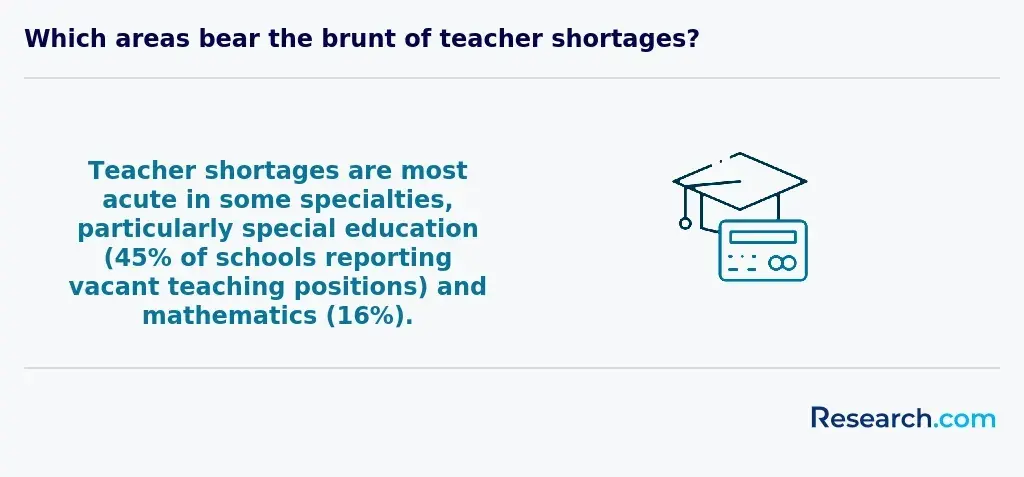
Colorado’s hiring picture depends heavily on district, region, and subject area. The state reported nearly 7,000 teaching positions to fill in 2024, and shortages can be more visible in rural communities, hard-to-staff schools, and specialized endorsement areas.
Where Colorado teaching demand may be stronger
- Rural and underserved districts: Some communities have greater difficulty recruiting and retaining certified teachers.
- Special education: Schools often need educators trained to support students with diverse learning needs.
- STEM fields: Mathematics, science, technology, and related areas can be more competitive for employers to fill.
- Bilingual education: Districts serving multilingual learners may prioritize candidates with relevant language and instructional skills.
The best job-search strategy is to choose an endorsement area based on both your strengths and verified district needs. Do not rely only on statewide averages. Review district openings, salary schedules, and high-need subject lists before choosing your preparation route.
What other education careers are available in Colorado?
Teaching is not the only education career in Colorado. Schools also employ specialists who support student communication, learning, counseling, administration, technology, and intervention services. One example is speech-language pathology, a field focused on helping students with communication and language-related needs. Candidates interested in that route should review the requirements for an SLP license in Colorado, which involves graduate-level preparation and supervised clinical training.
Alternative education careers to compare
| Career direction | Who may prefer it | Credential consideration |
| Classroom teacher | Candidates who want daily instructional responsibility for a class or subject | Requires the appropriate Colorado teaching license and endorsement. |
| Speech-language pathologist | Candidates interested in communication disorders and student support services | Requires specialized education and licensure for SLP practice. |
| School administrator | Experienced educators interested in leadership and school operations | May require additional administrator preparation and licensing. |
| Instructional support or intervention | Educators who want targeted work with students needing additional help | Requirements vary by role, district, and service area. |
What is the career path of a teacher in Colorado?
A Colorado teaching career often begins in the classroom, but it does not have to stay there. Many teachers start as licensed classroom educators, then move into mentorship, curriculum work, department leadership, instructional coaching, administration, district roles, or policy-related positions.
Typical Colorado teacher career progression
| Career stage | Common focus | How to prepare |
| Entry-level teacher | Classroom management, lesson planning, assessment, and student relationships | Use mentorship, observation, and professional development to build core teaching skill. |
| Experienced teacher | Curriculum refinement, family engagement, differentiated instruction, and data-informed teaching | Consider endorsements, advanced training, or leadership in grade-level teams. |
| Lead teacher or mentor | Supporting new teachers and improving instructional practice across a team | Document results, seek coaching experience, and build collaboration skills. |
| School leader | Department leadership, assistant principal roles, and schoolwide improvement | Review administrator licensure requirements and leadership preparation options. |
| District or policy role | Program design, educator development, compliance, and education policy | Develop expertise in assessment, curriculum, special populations, or school operations. |
Tips on Teaching in Colorado’s Private Schools
Private schools in Colorado may operate differently from public schools in hiring, curriculum, compensation, and credential expectations. Some private schools may value a state teaching license, while others may prioritize subject expertise, mission fit, teaching experience, or religious affiliation, depending on the institution.
Private school teaching can offer smaller class settings and more curricular flexibility, but salary schedules, retirement benefits, and job security may differ from public school employment. Before accepting a role, ask for details about pay, benefits, class size, planning expectations, tuition remission, professional development support, and contract renewal policies.
If this route interests you, review the full private school teacher requirements in Colorado before deciding whether public licensure, private school employment, or both should be part of your plan.
What are the requirements for becoming a middle school math teacher in Colorado?
To become a middle school math teacher in Colorado, candidates need to align their preparation with the state’s subject-specific expectations for mathematics instruction. That usually means verifying coursework, content knowledge, testing requirements, and pedagogy for the middle grades before applying for the relevant endorsement.
Because math is a specialized subject area, candidates should not assume that a general education degree is enough. Review the detailed middle school math teacher requirements in Colorado to understand the exact pathway and avoid paying for coursework that does not satisfy endorsement standards.
Common Mistakes That Make a Colorado Teaching Credential More Expensive
- Choosing a program before checking Colorado approval. A cheap program can become expensive if it does not lead to the license or endorsement you need.
- Looking only at tuition. Exams, background checks, fingerprinting, field placement costs, materials, and transaction fees all affect total cost.
- Assuming online means fully remote. Teacher preparation usually still requires supervised classroom experience.
- Ignoring endorsement alignment. Your job placement, coursework, and testing must match the subject or grade level you want to teach.
- Missing state deadlines. Delays can cost money if you need to repeat documents, rush records, or postpone employment.
- Overpaying for extra credits. Some candidates can meet requirements through prior coursework or a content assessment instead of taking more classes.
- Assuming salary outcomes are automatic. Pay varies by district, experience, credentials, and role, so review actual salary schedules.
How can I find cost-effective higher education options for my teaching career?
Start by identifying the minimum education you still need. If you do not yet have a bachelor’s degree, compare transfer-friendly schools, online programs, grants, scholarships, and total completion costs. If you already have a bachelor’s degree, compare alternative licensure before enrolling in another full undergraduate program.
An accredited bachelor of education degree online can be a practical option for students who need flexibility and want to reduce commuting or relocation expenses. However, affordability should be measured by total cost, licensure alignment, transfer credit acceptance, graduation requirements, and field placement support.
Questions to ask before enrolling
- Is the program accepted for Colorado teacher licensure?
- Which endorsement areas does the program support?
- How many of my prior credits will transfer?
- What is the total cost including fees, exams, materials, and field placement expenses?
- Does the program help arrange student teaching or alternative licensure placements in Colorado?
- What financial aid, scholarships, or teacher-specific funding options are available?
- How long do candidates typically take to complete the program?
- What happens if I move, change endorsement areas, or cannot complete student teaching on the original timeline?
How do I start a kindergarten teaching career in Colorado?
Kindergarten teachers need preparation in early childhood development, foundational literacy and numeracy, classroom routines, family communication, and age-appropriate instructional strategies. If you want to work with young learners, confirm that your program and endorsement path align with Colorado expectations for kindergarten classrooms.
Before enrolling, compare early childhood or elementary education routes, supervised classroom experience, and testing requirements. For a focused guide, review How to become a kindergarten teacher in Colorado?.
What should I do after obtaining your Colorado teaching credential?
After receiving your Colorado credential, shift from licensure completion to career development. Build a professional development plan, track renewal requirements, study district salary schedules, and decide whether advanced endorsements or graduate study will support your goals.
You should also start documenting classroom results, mentorship experience, professional learning, and leadership responsibilities. If you want a subject-specific pathway, explore options such as how to become a high school history teacher in Colorado to understand how endorsement and grade-level specialization can shape your career.
What factors should I consider when choosing an online teaching program in Colorado?
An online teacher preparation program should be judged by licensure fit first and convenience second. A flexible schedule is useful, but only if the program prepares you for Colorado’s credential process and supports required fieldwork.
- Accreditation and state recognition: Confirm the program is appropriate for Colorado licensure.
- Total cost: Compare tuition, fees, technology costs, exam preparation, and placement-related expenses.
- Field placement support: Ask how the school arranges student teaching or supervised practice in Colorado.
- Endorsement alignment: Make sure the program supports your intended grade level or subject.
- Flexibility: Check whether courses are asynchronous, synchronous, part-time, or cohort-based.
- Student support: Look for advising, test preparation, career services, and licensure application guidance.
For a more detailed online pathway, see how to become a teacher in Colorado.
What are the Colorado teacher certification requirements for educators?
Colorado teacher certification requirements generally involve the right academic background, approved educator preparation, content knowledge, background checks, and the appropriate license application. Requirements can vary by endorsement, applicant background, and whether the candidate is pursuing a traditional, alternative, out-of-state, or renewal pathway.
Because licensure rules affect both cost and timing, applicants should verify current requirements before paying for exams, coursework, or transcript evaluations. Use official guidance and review Colorado teacher certification requirements when comparing your options.
Are specialized endorsements crucial for advancing your teaching career?
Specialized endorsements can strengthen your teaching profile when they match district demand and your long-term goals. They may help you qualify for additional roles, teach high-need subjects, or move into specialized instructional areas. However, endorsements cost time and money, so they should be chosen strategically.
For example, educators interested in arts education should review music teacher education requirements in Colorado before investing in subject-specific preparation. The best endorsement is one that fits your skills, your students’ needs, and realistic job opportunities in the districts where you want to work.
How can I become a preschool teacher in Colorado?
Preschool teaching in Colorado requires preparation focused on young children, developmental milestones, classroom safety, play-based learning, communication with families, and early childhood instruction. Candidates should look for programs that combine child development coursework with hands-on experience in early learning settings.
If preschool is your goal, compare early childhood pathways carefully because requirements can differ from elementary or secondary teaching routes. Review how to become a preschool teacher in Colorado for a more focused explanation of the steps.
How can I build a robust professional network in Colorado's education community?
A strong education network can help you find mentors, learn which districts are hiring, understand school culture, and identify lower-cost professional development. Networking is especially useful for alternative licensure candidates who need school placements or career changers who are entering education from another field.
- Join state and local educator associations related to your grade level or subject.
- Attend district hiring events, licensure information sessions, and regional education conferences.
- Connect with mentor teachers during fieldwork or substitute teaching assignments.
- Participate in online educator groups focused on Colorado licensure, classroom practice, and district hiring.
- Track labor-market information, including what teachers are most in demand right now?, before choosing endorsements or graduate study.
What challenges might I face during the Colorado teaching credential process?
The most common challenges are administrative rather than academic: incomplete applications, missing transcripts, unclear endorsement alignment, expired background checks, and confusion over alternative versus traditional licensure. These problems can add cost by delaying employment or forcing candidates to repeat steps.
How to reduce credentialing delays
- Create a checklist for application documents, fingerprints, exams, transcripts, and program verification.
- Save copies of all submissions and confirmations.
- Ask CDE or your program advisor to clarify requirements before paying for additional courses.
- Track application timelines, including the 45-day review period and 60-day response window when additional information is requested.
- Use subject-specific guidance, such as how to become a history teacher in Colorado, if your endorsement area has unique preparation needs.
Key Insights
- The cheapest route to a Colorado teaching credential is often alternative licensure for candidates who already hold a bachelor’s degree and can secure a position in the correct endorsement area.
- State fees are only part of the total cost. Budget for exams, fingerprinting, background checks, transcript requests, professional development, placement costs, and credit card transaction fees.
- Online programs can save money and add flexibility, but they must still meet Colorado licensure requirements and include supervised classroom experience.
- Out-of-state and international applicants can qualify, but they should verify endorsement alignment and documentation requirements before paying for extra coursework.
- Colorado teacher pay varies by district, experience, role, and qualifications. As of 2024, the average salary is around $63,235, while beginning teachers earn approximately $39,000.
- Career planning should include retirement, not just licensure. PERA full retirement can be available after 30 years of service or at age 65 with 5 years of service, while early retirement can reduce benefits.
- The smartest cost-saving move is to confirm state approval, endorsement fit, total program price, and field placement support before enrolling in any teacher preparation program.
Related Articles for Nearby States
- 2027 Cheapest Way to Get a Teaching Credential in Wyoming: Requirements & Certification
- 2027 Cheapest Way to Get a Teaching Credential in Nebraska: Requirements & Certification
- 2027 Cheapest Way to Get a Teaching Credential in Kansas: Requirements & Certification
- 2027 Cheapest Way to Get a Teaching Credential in New Mexico: Requirements & Certification
- 2027 Cheapest Way to Get a Teaching Credential in Utah: Requirements & Certification
- 2027 Cheapest Way to Get a Teaching Credential in Oklahoma: Requirements & Certification
- 2027 Cheapest Way to Get a Teaching Credential for Arizona: Requirements & Certification
- 2027 Cheapest Way to Get a Teaching Credential in Texas: Requirements & Certification
- 2027 Cheapest Way to Get a Teaching Credential in South Dakota: Requirements & Certification
- 2027 Cheapest Way to Get a Teaching Credential in Nevada: Requirements & Certification
References:
- Colorado Department of Education (CDE). (2024a). Colorado's Educator Shortage Survey Results. Research and Impact. CDE.
- Colorado Department of Education (CDE). (2024b). Teacher Average Salary Dashboard. Teacher Salary Workbook. CDE.
- Colorado Department of Education (CDE). (n.d.). Complete an Alternative Educator Preparation Program for Teachers or Principals. CDE.
- Colorado PERA. (2024). Colorado PERA Retirement Eligibility. Colorado PERA.
- Colorado PERA. (n.d.). Retirement Benefits. Colorado PERA.
- National Center for Education Statistics (NCES). (2023). Report on the Condition of Education 2023. NCES.
- National Council on Teacher Quality (NCTQ). (2023). Data Brief: How do trends in teacher preparation enrollment and completion vary by state?. NCTQ.
- National Council on Teacher Quality (NCTQ). (n.d). Teacher Pension Policy in Colorado. NCTQ.
- Teach Colorado. (n.d.). Colorado Teacher Salaries. Teach Colorado.
Other Things You Need to Know About Getting a Teaching Credential in Colorado
In 2027, aspiring teachers in Colorado can explore federal grants, state-funded scholarships like the Colorado Opportunity Scholarship Initiative, and loan forgiveness programs such as Public Service Loan Forgiveness. These options can significantly reduce the cost of obtaining a teaching credential.
The Colorado Department of Education, through the Educator Licensing unit, issues teaching licenses in Colorado. Applicants submit materials through the online licensing system, and the department reviews transcripts, exam scores, fingerprints, and program completion before granting an initial license.