2027 Online Ed.D. in Leadership and Learning in Organizations: Degree Fit for Leaders Tackling Conflicting Signals in Workforce Data
Audited and Verified:
Our Editorial and Data Verification Process
Research.com uses government datasets, official education statistics and primary institutional information to support its career and degree guides. Our review process checks factual accuracy, occupational definitions, source dates and the requirements associated with the credentials discussed.
How This Article Was Fact-Checked
Our editorial team verifies salary estimates, employment projections, education requirements and program information against original data providers and official organizations. Salary figures are checked against the relevant occupational definitions and reporting periods. Information about licensure, accreditation and required in-person training is reviewed separately.
Fact-checked and verified on:

Co-Founder and Chief Data Scientist
Training completion is rising, yet employee retention is falling. A workforce survey reports stronger confidence, while managers see little change in performance. For leaders responsible for learning and organizational improvement, conflicting signals can lead to expensive decisions based on the wrong diagnosis. This article examines whether an online Ed.D. in Leadership and Learning in Organizations offers the right preparation to investigate those signals, act on the findings, and evaluate what changes. It also explains when a narrower analytics course, evaluation specialist, or operational fix would be the better choice.
Key Things You Should Know
- An Ed.D. is most useful when conflicting workforce indicators point to a recurring leadership and learning problem that you have the authority and data access to investigate - not when the immediate need is a dashboard repair.
- Compare what each measure captures, who is included, and when it was recorded before treating disagreement as evidence that training worked or failed.
- Training and development managers had a $133,000 median annual salary in May 2025, according to the U.S. Bureau of Labor Statistics; that occupational figure is not a projected salary for Ed.D. graduates.
What is an online Ed.D. in Leadership and Learning in Organizations?
An Ed.D. in leadership and learning is a practice-oriented doctorate concerned with how people develop and how organizations make, implement, and assess decisions. Depending on the program, students may study adult learning, organizational change, leadership, and applied inquiry while continuing to work. "Online" describes where much instruction occurs; it does not establish that classes are self-paced or that campus visits are unnecessary.
For a leader facing contradictory workforce data, the potential value is learning to frame a decision before selecting a metric. A rise in course completions measures participation, not necessarily learning transfer. Lower retention may reflect conditions unrelated to training. Neither observation, on its own, identifies a cause.
Program titles do not guarantee the same curriculum or award. When comparing academic focuses within Ed.D. programs, check whether organizational learning and evaluation are required study, available electives, or simply themes in program descriptions. A leadership Ed.D. is also distinct from an education doctorate designed specifically for school administration.
Is an online Ed.D. in Leadership and Learning worth it for working professionals?
It can be worth the commitment for an experienced leader who repeatedly must reconcile learning, performance, and employee-experience evidence - and can influence the organizational response. Doctoral study is less compelling if the problem is a one-time reporting discrepancy, the leader cannot access suitable evidence, or the employer will not support inquiry and implementation.
The alternatives differ in purpose, not just prestige. This comparison helps separate a sustained leadership-development need from a narrower technical one.
| Path | Primary contribution | Important limitation |
| Practice-oriented Ed.D. | Integrates organizational diagnosis, learning, change, and applied inquiry | Requires substantial time and expense; does not confer decision authority |
| Targeted analytics or evaluation training | Builds a specific measurement or study-design skill | May not address governance, culture, or implementation |
| Evaluation specialist or cross-functional project | Brings focused expertise to an immediate organizational decision | May not develop the leader's long-term research and change capabilities |
If the doctorate fits the work but not the available budget, compare budget-conscious doctoral study in education against the actual program curriculum and project requirements. A lower price is not a bargain if the program cannot support the inquiry you need to conduct.
What careers can you pursue with an Ed.D. in Leadership and Learning?
Relevant paths include learning and development management, organizational development, talent development, workforce program leadership, and organizational consulting. These roles require different evidence of readiness. A training manager may oversee staff, budgets, and program effectiveness; an organizational consultant may diagnose processes across clients. The Ed.D. can strengthen applied inquiry, but employers also look for implementation experience, functional expertise, and results that can be discussed without exposing confidential data.
For leaders already working in higher education, an Ed.D. may support broader institutional learning or workforce responsibilities. It is not, by itself, a promotion requirement or a substitute for experience with university governance and budgets. Those considering this sector should investigate grants for doctoral study in higher education leadership only after confirming that the program's focus fits their target role.
A useful career test is whether you can describe a decision you have helped make, the evidence you weighed, the stakeholders you involved, and what you would evaluate next. A degree may deepen that work; it cannot replace having the opportunity to do it.
Online delivery can let a working leader study without relocating, but the important difference is the schedule and access to collaborators - not the location label. Ask each program about live attendance, group-work hours, faculty meetings, required campus convenings, and what happens to an applied project if you change employers. Campus-based study may make in-person collaboration easier, while an online cohort may better preserve access to your current workplace problem.
Distance also changes the total-cost calculation. If you are using organizational leadership doctorate tuition comparisons, check whether a quoted tuition figure excludes travel, lodging, fees, and time away from work. Verify required visits directly with the program rather than assuming online means no travel.
The most relevant preparation combines organizational diagnosis, adult learning, change implementation, and applied research. To understand conflicting workforce signals, a student should learn to ask whether measures use the same population, time period, and definition of success. A course-completion report may include everyone assigned training, while a retention report may cover only employees eligible for an annual review. Comparing them without checking those definitions can create a false contradiction.
Suppose participation rises while supervisors report little improvement. Plausible explanations include weak transfer of learning, inconsistent supervisor support, a measure taken too soon, or a performance barrier that training cannot remove. These are hypotheses, not findings. A well-scoped inquiry might combine administrative records with appropriately authorized interviews and examine whether conclusions differ across teams or job types.
Before enrolling, request syllabi and ask how students learn measurement validity, qualitative and quantitative reasoning, evaluation limits, and responsible handling of employee data. Confirm the actual capstone or dissertation requirements. Exposure to analytics in one course does not establish advanced research preparation or permission to use workplace records.
Requirements vary by institution and entry term. Programs may request graduate transcripts, a statement of purpose, recommendations, a résumé documenting professional responsibility, and an interview; some specify a completed master's degree or particular experience. Do not assume that an education master's, a senior job title, a publication, or a standardized test is universally required.
For this topic, a strong application can describe a real decision affected by conflicting indicators: what each measure represents, what remains unknown, and why the applicant needs deeper leadership and inquiry skills. Describe your actual authority and access without claiming that your employer has approved a future doctoral project. Ask admissions staff to distinguish credits considered for eligibility from credits that would apply toward the doctorate.
There is no reliable universal completion time or tuition figure for online leadership and learning Ed.D. programs. Required credits, course sequencing, enrollment pace, and the final project determine the schedule; tuition may be charged by credit, term, or program. A proposed workplace study can also slow progress if data permission, faculty approval, or organizational sponsorship takes longer than expected.
Request a written estimate covering tuition, mandatory fees, expected enrollment terms, convening travel, and charges if the project extends beyond the planned schedule. Check employer reimbursement limits and any continued-employment conditions before counting that support. For a broader cost benchmark, use online Doctor of Education tuition planning, then confirm the figures and policies with each institution. Compare the total commitment with a targeted course or employer-supported evaluation project, not just another doctorate's advertised tuition.
Institutional accreditation is a basic verification step: confirm the university's current status and that the doctorate is awarded by that institution. Then evaluate the program separately. Accreditation does not prove that its curriculum teaches workforce measurement well, that its applied project fits your workplace, or that an employer will value the credential for a particular role.
Ask the program for its degree requirements, faculty research or evaluation support, project-oversight process, and any applicable licensure disclosures. These details matter more to this decision than an unsupported claim that an accredited degree will resolve conflicting organizational evidence.
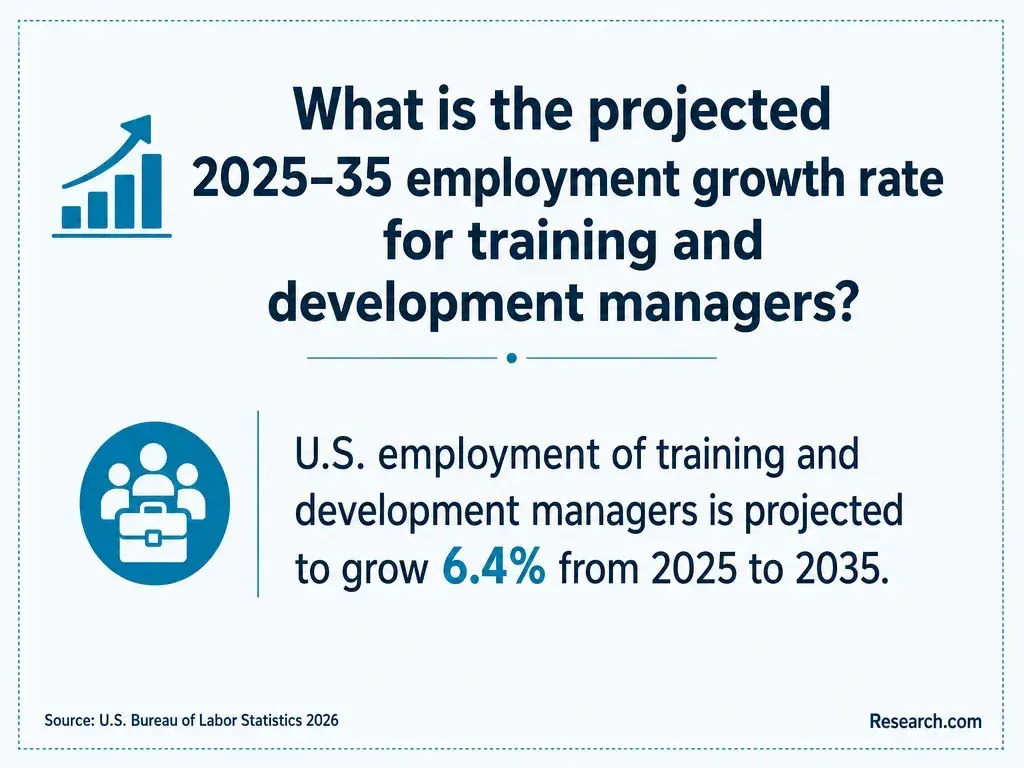
There is no single Ed.D. salary. Pay follows the occupation, sector, location, and level of responsibility. The U.S. Bureau of Labor Statistics reports a May 2025 median annual salary of $133,000 for training and development managers. It projects employment in that occupation to grow 6.4% from 2025 to 2035. Those figures describe an occupation, not the earnings or job prospects of graduates from a particular program.
For an experienced manager, a more useful financial question is whether the degree helps meet a documented requirement or strengthens work the employer already expects. Compare relevant job postings and internal advancement rules with the full cost of study; do not build a repayment plan around an assumed promotion.
Do Ed.D. graduates need licensure or professional certification?
General organizational learning and development roles do not acquire a universal professional license simply because the holder earns an Ed.D. An employer may value a particular certification, but that is separate from the doctoral award. Regulated education roles are different: teacher and school-administrator eligibility depends on the relevant state's rules and the specific program's approved preparation pathway.
If your target job is regulated, obtain written program disclosures and check with the responsible state authority before enrolling. A broadly focused leadership and learning doctorate should not be assumed to qualify you for principal or superintendent licensure.
Other Things You Should Know About EdD Leadership
It can help surface patterns, but it cannot determine whether source definitions are comparable or whether a pattern is causal. Validate the underlying data and the decision the dashboard is meant to support.
Check the reporting windows and workforce composition before interpreting a change. Comparing different seasonal cohorts may explain some apparent disagreement without showing that a learning initiative succeeded or failed.
No. Even records without names can identify people in small groups. Confirm employer authorization, institutional review requirements, applicable privacy rules, and any restrictions on sharing findings.
Not necessarily. A defensible evaluation may document implementation, explore plausible explanations, and state what its design cannot establish. Confirm the program's academic standards before proposing the project.
- Types of Financial Aid: Grants, Work-Study, and Loans | studentaid.gov https://studentaid.gov/understand-aid/types
- Cost of Attendance (Budget) | 2025-2026 Federal Student Aid Handbook https://fsapartners.ed.gov/knowledge-center/fsa-handbook/2025-2026/vol3/ch2-cost-attendance-budget
- Making strides in doctoral-level career outcomes reporting | nih.gov https://pmc.ncbi.nlm.nih.gov/articles/PMC12671987/
- Online Doctorate of Education With a Concentration in Curriculum and Instruction Leadership | UTEP https://www.utep.edu/extendeduniversity/utepconnect/online-programs/doctoral-programs/doctorate-of-education-concentration-in-curriculum-and-instruction-leadership.html
- Organizational Leadership, Learning and Innovation | Wilmington University https://www.wilmu.edu/education/organizational-learning-doctorate-curriculum.aspx
- PhD vs. EdD in Education: Nine expert tips to help you choose [with infographic] | USC Rossier https://rossier.usc.edu/news/phd-vs-edd-in-education-nine-expert-tips-to-help-you-choose-with-infographic/
- EdD vs. PhD in Education: What's the Difference? | Saint Leo University https://onlinedegrees.saintleo.edu/blog/edd-vs-phd
- EdD Organizational Leadership: Is It Right for You? | Meridian University https://meridianuniversity.edu/content/edd-organizational-leadership
- 2026 UNC Online EdD in Organizational Learning & Leadership https://online.unc.edu/online-doctoral-programs/online-edd-organizational-learning-and-leadership/
- Online Doctor of Education in Leadership and Innovation | Purdue Global https://www.purdueglobal.edu/degree-programs/education/doctor-education-leadership-innovation/