2027 Paying for an Online Ed.D. in Leadership and Learning in Organizations: Lost Income During Required Travel
Audited and Verified:
Our Editorial and Data Verification Process
Research.com uses government datasets, official education statistics and primary institutional information to support its career and degree guides. Our review process checks factual accuracy, occupational definitions, source dates and the requirements associated with the credentials discussed.
How This Article Was Fact-Checked
Our editorial team verifies salary estimates, employment projections, education requirements and program information against original data providers and official organizations. Salary figures are checked against the relevant occupational definitions and reporting periods. Information about licensure, accreditation and required in-person training is reviewed separately.
Fact-checked and verified on:

Co-Founder and Chief Data Scientist
An online Ed.D. may let you keep your job, but required campus visits can still cost you paid workdays. For working professionals considering leadership and learning in organizations, the consequential expense may be income lost during travel - not the airfare.
This guide separates direct travel costs from missed earnings, shows how to check attendance and employer policies, and puts those costs in context with tuition, program length, and career goals. You can use it to compare programs before committing to a schedule your paycheck cannot support.
Key Things You Should Know
- Budget required visits as both travel expenses and potential lost income; paid leave, unpaid leave, and missed shifts have different financial effects.
- Get the complete convening calendar and attendance rules before enrolling. An "online" designation does not establish that campus visits are optional or that travel days fit outside work hours.
- Do not justify travel costs with an assumed promotion: the Bureau of Labor Statistics reports a $133,000 median annual wage for training and development managers, not an expected salary for Ed.D. graduates.
What Is an Online Ed.D. in Leadership and Learning in Organizations?
An Ed.D. in leadership and learning in organizations is a practice-oriented doctorate concerned with how people learn, lead, and implement change in workplaces and other institutions. Students may study adult learning, organizational systems, and applied research while continuing to work. The exact degree name, curriculum, and final project vary by university.
"Online" describes where much of the coursework happens, not necessarily where every requirement happens. A program may require live classes, group work, or in-person convenings. For a prospective student whose income depends on being available for shifts, clients, or scheduled workdays, those requirements are part of the degree's financial design.
How Much Does an Online Ed.D. in Leadership and Learning in Organizations Cost?
There is no reliable single price for this degree. Schools may charge by credit, term, or program, and the amount paid depends on required credits, fees, enrollment pace, and any applicable aid. A published tuition figure does not necessarily include travel or income forgone. Compare offers using the same categories:
- Academic charges: Required tuition, university and technology fees, and any continuation charges if the final project takes longer than planned.
- Participation costs: Books or software, required travel and lodging, meals, local transportation, and caregiving during absences.
- Employment effects: Unpaid leave, missed hourly shifts, forgone client work, or lost income if enrollment forces a change in work hours.
- Offsets: Scholarships or employer payments that are confirmed in writing, with their eligibility, timing, and repayment conditions.
Ask the financial aid office whether required travel can be included in your individual cost-of-attendance budget and what aid, if any, may cover it. An allowable budget adjustment is not a grant or a promise of additional loan eligibility. Employer reimbursement is likewise different from an upfront payment: you may have to finance the trip first and remain employed long enough to qualify. Readers comparing tuition support routes for higher education leadership doctorates should confirm that any listed option applies to their actual program and entry term.
How Does Required Travel Affect Online Ed.D. Expenses and Lost Income?
A required visit has two separate costs: what you spend to attend and what you earn less because you attend. For each trip, estimate incremental cost = travel and care expenses you must pay + earnings actually forgone − confirmed employer or school payments. Keep paid time off in a separate column: using vacation days may have a personal cost, but it is not automatically a reduction in that paycheck. Do not count the same missed work twice.
The table distinguishes situations that can look identical on a program calendar but affect income differently. Use the applicable employment arrangement, not an assumed daily wage.
| Work arrangement during travel | Likely income effect | Other cost to recognize |
| Approved paid leave | Usually no immediate lost wages | Leave balance used; travel and care expenses not covered by the employer |
| Unpaid leave | Pay actually withheld | Travel and care expenses |
| Hourly or contract work that cannot be rescheduled | Net earnings from work actually missed | Travel and care expenses; contract terms may affect the estimate |
| Work rescheduled without a pay reduction | No immediate lost earnings from that work | Travel expenses and possible workload or caregiving pressure |
Count travel days as well as days on campus. An early arrival requirement, a flight home after the final session, or a missed shift the following morning can change the result. Calculate per-trip cost and then apply it to the school's complete required-visit schedule; do not assume later visits will have the same length or price.
Before paying a deposit, obtain answers that let you build a realistic trip-by-trip budget:
- Request the dates, locations, daily start and end times, and attendance rules for every required convening through graduation.
- Ask the program whether additional visits may be required for project work, assessment, or a delayed completion date.
- Ask your employer separately about paid leave, schedule changes, travel coverage, tuition reimbursement, and any obligation to repay support after leaving.
- Price transportation, lodging, accessible travel needs, and dependent care using your likely travel dates; record only income you would actually lose.
If the school cannot yet provide future dates, model a feasible range of absences rather than treating the unknown as zero. A program with lower tuition but repeated weekday visits may cost more for someone who cannot take paid leave than a higher-tuition program with fewer required trips.
Confirm that the institution holds recognized institutional accreditation and that it covers the university awarding the Ed.D. Check the institution's published accreditation information and the accreditor's directory. Then confirm the precise degree designation and whether the online offering is authorized where you will enroll.
Institutional accreditation does not mean a leadership doctorate prepares graduates for a regulated school-administrator role. If licensure is your goal, ask the program for its written licensure disclosure and check the relevant state authority. That distinction matters financially: paying for required travel would be a poor trade if the degree does not meet the credential requirement for your intended job.
Relevant study may connect adult learning and leadership theory with organizational diagnosis, change implementation, and evaluation. Applied research courses can help students assess a workplace problem, examine evidence, and communicate a defensible recommendation. Verify the actual course sequence and final-project requirements rather than assuming every program teaches the same methods or offers the same electives.
For the travel decision, look at what must happen in person. A convening built around faculty feedback, collaborative inquiry, or a project milestone may offer a different educational experience from one consisting largely of lectures available online. Ask for a sample agenda and assess whether the activity supports skills you need at work. Educational value matters, but it does not erase a leave or income constraint.
Requirements vary. A program may ask for a completed graduate degree, transcripts, professional experience, recommendations, a statement of purpose, and evidence that the applicant can pursue a practice-focused doctoral problem. Check the specific program's current rules; an education master's, a particular job title, or an entrance test is not universal.
Ask admissions whether it evaluates prior graduate work for eligibility, transfer credit, or both. Those are different decisions, and neither should be assumed to shorten the degree or remove a required visit. Applicants with specialist-level study can review Ed.S. credit considerations for Ed.D. study, then request a written evaluation from the institution they intend to attend.
Admission is also a useful point to raise work constraints. Tell the program which types of weekday absence you can manage and ask whether required attendance is compatible; do not rely on an informal expectation that a future visit can be waived.
Completion time depends on the school's course sequence, enrollment pace, research or project milestones, and limits on how long students may remain enrolled. A cohort schedule can make visits predictable while leaving little room to move one to a later term. Delays may also add continuation charges or require travel beyond the original plan.
Request a term-by-term plan showing required visits through the final project, plus the policies for leave, reentry, and missed convenings. If you have unfinished doctoral work, an ABD-to-Ed.D. program comparison guide can help frame questions, but only the receiving university can determine which work counts and whether any attendance obligation changes.
Not automatically. An online program may avoid a routine commute while concentrating travel into a few mandatory visits. A nearby campus-based program may require frequent attendance but allow you to return home and work between classes. Compare the total work time disrupted, not just the number of campus trips.
Ask each program for class meeting times, attendance rules, visit schedules, and final-project expectations. This matters particularly when comparing intensive online education doctoral pathways: a shorter advertised timeline does not establish a lighter weekly workload or fewer missed workdays. If neither format fits your income or caregiving obligations, a targeted leadership-development program may be the sounder choice for now.
Depending on prior experience, the degree may support work in learning and development management, organizational development, consulting, workforce development, or institutional leadership. These roles differ: leading a training function involves budgets and staff; organizational consulting requires diagnosing client problems and delivering usable recommendations. The degree can strengthen relevant practice, but employers still assess leadership record and sector expertise.
For professionals already working in colleges or universities, practice-focused Ed.D. study for higher education organizational work may be worth comparing with programs aimed at corporate learning. Evaluate whether the curriculum and applied project match your target responsibilities before accepting substantial travel costs. A general leadership Ed.D. does not itself confer educator or school-administrator licensure.
What Salary and Job Outlook Can Ed.D. Graduates Expect?
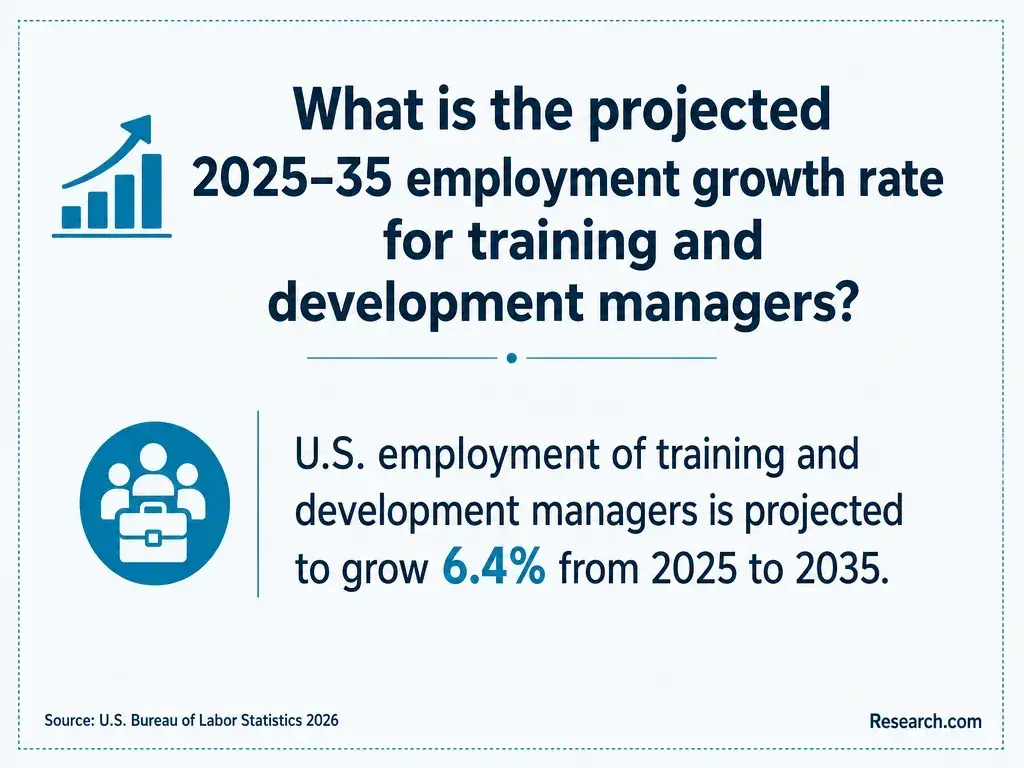
There is no single Ed.D. graduate salary. The U.S. Bureau of Labor Statistics reports a $133,000 median annual wage for training and development managers in May 2025. That is an occupation-wide median, not a starting salary, a doctorate premium, or a forecast of what you will earn after traveling to complete this program.
The BLS projects 6.4% employment growth for training and development managers from 2025 to 2035. Growth describes the occupation, not the chance that a particular student will obtain a management job. For a financial decision, use your current compensation, a plausible role you qualify for, and evidence from employers in your sector. If advancement would require experience you do not yet have, do not count a hoped-for raise as an offset to certain travel costs.
Other Things You Should Know About EdD Leadership
Confirm the date and your required attendance with the program first. Compare potential savings with the cost of changing plans if the schedule or your enrollment changes.
Possibly, if the dates and locations align. Obtain employer approval and separate business expenses from personal education expenses in your records; do not assume the employer will cover the full trip.
Contact the university's accessibility office early to discuss the campus activities and your needs. Ask which arrangements the institution can provide and which transportation or lodging costs remain your responsibility.
Tax treatment depends on the arrangement and applicable rules. Request your employer's written benefits policy and consult a qualified tax professional about your circumstances.
- Your financial path to graduation | consumerfinance.gov https://www.consumerfinance.gov/paying-for-college/your-financial-path-to-graduation/
- Topic no. 511, Business travel expenses | Internal Revenue Service https://www.irs.gov/taxtopics/tc511
- Travel Time | dol.gov https://www.dol.gov/agencies/whd/direct-care/travel-time
- Cost of Attendance (Budget) | 2026-2027 Federal Student Aid Handbook https://fsapartners.ed.gov/knowledge-center/fsa-handbook/2026-2027/vol3/ch2-cost-attendance-budget
- New Benefit: Get reimbursed for certificate and other professional development programs | News | Vanderbilt University https://news.vanderbilt.edu/2025/07/23/vanderbilt-announces-two-new-education-assistance-programs/
- Leadership and Learning in Organizations Online Ed.D. | Peabody College of Education and Human Development https://peabody.vanderbilt.edu/academics/edd-programs/online-leadership-learning-organizations/
- GLI Funding Opportunities - Vanderbilt Graduate School https://gradschool.vanderbilt.edu/student-resources/professional-development/gli/gli-funding-opportunities/
- Absence from Work | umich.edu https://hr.umich.edu/working-u-m/my-employment/staff-handbook/absence-work
- Student Travel Reimbursements | People Experience | Vanderbilt University https://hr.vanderbilt.edu/international-tax/student-travel-reimbursement/
- Accessible Event Resource Guide - Equal Opportunity Programs https://equalopportunityprograms.uchicago.edu/event-guide/