2027 Online Ed.D. in Leadership and Learning in Organizations: Comparing Coursework in Employee Wellbeing
Audited and Verified:
Our Editorial and Data Verification Process
Research.com uses government datasets, official education statistics and primary institutional information to support its career and degree guides. Our review process checks factual accuracy, occupational definitions, source dates and the requirements associated with the credentials discussed.
How This Article Was Fact-Checked
Our editorial team verifies salary estimates, employment projections, education requirements and program information against original data providers and official organizations. Salary figures are checked against the relevant occupational definitions and reporting periods. Information about licensure, accreditation and required in-person training is reviewed separately.
Fact-checked and verified on:

Co-Founder and Chief Data Scientist
An online Ed.D. in Leadership and Learning in Organizations may sound well suited to improving employee wellbeing, but the title alone reveals little about what students actually study. For learning and development professionals and organizational leaders, the useful distinction is between coursework that examines working conditions, learning, and change, and coursework that merely mentions wellness.
This guide compares the courses and applied research opportunities that matter most, then explains how to check program format, cost, and career fit before committing to a doctorate.
Key Things You Should Know
- Prioritize courses that connect organizational systems, adult learning, change, and evaluation; a standalone wellness elective is not a substitute for that combination.
- Check whether wellbeing-related courses are required or reliably available as electives, and whether the doctoral project permits an ethically approved workplace study.
- The Bureau of Labor Statistics reports a $133,000 median annual salary for training and development managers in 2025, but that occupational figure is not an expected salary for Ed.D. graduates.
What is an online Ed.D. in Leadership and Learning in Organizations?
It is a practice-oriented education doctorate focused on how people learn, lead, and adapt within organizations. Programs with this or a similar name may draw students from business, healthcare, government, nonprofits, and education. The exact degree title and curriculum belong to the institution awarding it; a shared phrase does not establish that two programs teach the same courses.
For an employee wellbeing goal, the degree is most relevant when it helps a leader examine work design, management practices, learning opportunities, and organizational change. It is not a clinical mental health qualification.
A PhD may better fit someone seeking a research-centered academic career, while targeted organizational development training may be more efficient for a leader who needs one specific skill. An overview of education doctorate program types and leadership directions can help clarify which doctoral focus matches the intended work.
How does coursework address employee wellbeing and organizational performance?
Employee wellbeing concerns employees' experience of work, including conditions that affect stress, support, and their ability to function. Organizational performance concerns outcomes such as service quality, retention, learning transfer, or operational effectiveness. They can influence each other, but an association does not prove that a wellbeing initiative caused a performance change.
The strongest curricular comparison is not whether a catalog contains the word "wellbeing." It is whether students can learn to diagnose a workplace problem, choose a feasible response, and evaluate its effects. These course connections show what to look for:
| Coursework area | Wellbeing question it can address | What to verify in the syllabus |
| Organizational systems and culture | Are workload, decision authority, or team norms contributing to the problem? | Work-design analysis, stakeholder perspectives, and attention to structural causes |
| Adult learning and leadership development | Can managers learn practices that better support their teams? | Learning transfer, coaching, and assessment beyond course satisfaction |
| Organizational change | Can an intervention be implemented within existing constraints? | Stakeholder engagement, implementation planning, and unintended effects |
| Research methods and evaluation | How would leaders know whether conditions improved? | Appropriate measures, comparison limitations, privacy, and interpretation |
For example, low participation in training might reflect scheduling or managerial incentives rather than a lack of motivation. A useful Ed.D. course would help a student investigate those possibilities before prescribing another workshop.
Any project involving employees also requires attention to organizational permission, confidentiality, and the institution's applicable research-review rules; workplace evaluation is not automatically exempt from oversight.
What courses are included in an online organizational leadership Ed.D.?
Course names vary, but leadership theory, organizational change, adult learning, research methods, and an applied doctoral project are common areas to compare.
A wellbeing-focused applicant should distinguish required courses from electives, specializations formally recorded by the school, and topics a professor might cover within a broader class. An advertised elective may not run during a student's enrollment.
Review the published course sequence and recent syllabi in this order so that an appealing course title does not obscure a gap in preparation:
- Identify required study in organizational diagnosis, adult learning, leadership, and change.
- Check methods courses for qualitative inquiry, quantitative reasoning, and evaluation of workplace interventions.
- Confirm when relevant electives run, who may enroll, and whether they address work design or wellbeing in substantive assignments.
- Verify the final project's format, faculty supervision, site requirements, and permission to study an organizational issue.
Some students will prefer a program built around a practice-focused project rather than a conventional dissertation. Compare the actual deliverable when reviewing education doctorates using alternative research projects. Neither format guarantees access to employee data or approval of a proposed wellbeing study.
Delivery format changes how students participate, not the need for rigorous coursework or faculty guidance. For a working leader studying employee wellbeing, access to colleagues and an organization may matter more to a project than proximity to a campus. The practical differences to confirm are:
| Feature | Online program | Campus-based program |
| Class participation | May combine recorded work with required live meetings and group projects | Usually requires travel to scheduled in-person classes |
| Applied inquiry | May accommodate a local workplace, subject to program and site approval | May offer local partnerships, also subject to project approval |
| Travel | Could still require campus convenings | Regular commuting or relocation may be necessary |
Ask for actual live-session times, attendance rules, group-work expectations, and convening dates. Online location flexibility will not help if required meetings conflict with peak work periods or if a proposed project depends on approvals the employer cannot provide.
Confirm that the degree-awarding institution holds accreditation from an accreditor recognized by the U.S. Department of Education or the Council for Higher Education Accreditation, and check the institution's current accreditation status directly with the accreditor. Then verify that the online Ed.D. is an authorized degree offered by that institution.
Institutional accreditation does not establish that a program offers a wellbeing specialization, meets a particular employer's hiring standard, or prepares graduates for educator or counseling licensure. If a regulated role is the goal, check the relevant state authority and the program's licensure disclosures before enrolling. Most organizational leadership applicants should judge the program's curriculum and applied-project supervision separately from its accreditation status.
Requirements differ by institution. Programs may request a completed graduate degree, transcripts, a statement of purpose, recommendations, a résumé, and evidence of relevant professional responsibility; some also use interviews or additional academic criteria.
Experience leading a learning initiative or organizational change can help an applicant explain the problem they want to study, but a managerial title alone does not demonstrate that experience.
Applicants returning after unfinished doctoral study should not assume prior credits will transfer or that earlier dissertation work meets a new program's requirements. Ask admissions and the doctoral program for separate written decisions about eligibility, transferable coursework, and the required final project. Guidance on planning an online Ed.D. return after ABD status can help frame those questions.
Time to completion depends on required credits, enrollment pace, course sequencing, and the final project. A workplace wellbeing study can take longer than its coursework suggests if access, organizational approval, or research review is delayed. Request a term-by-term plan that shows when methods courses and project milestones occur.
For cost, compare the school's published tuition basis with required fees and the number of credits you must take. Add any convening travel and the cost of continuing enrollment during the project stage. Employer reimbursement is useful only to the extent that its eligibility, payment timing, and continued-employment conditions fit your situation.
Use organizational leadership doctorate tuition comparisons as a starting point, then obtain a current, individualized cost estimate from each school. If your immediate need is to improve one team's practices, a shorter course or employer development program may be a less costly first step.
The degree may support experienced professionals pursuing learning and development leadership, organizational development, talent development, consulting, or institutional administration.
These roles differ: a training manager directs learning programs and staff, while an organizational consultant diagnoses problems and advises clients. A wellbeing-focused doctoral project can provide evidence of inquiry and implementation skills, but it does not replace experience managing people, budgets, or change.
Applicants already working in colleges may also assess organizational leadership doctoral options for college administrators. They should compare those programs against their institution's actual hiring criteria. A broadly focused Ed.D. does not itself confer school-administrator licensure or qualify someone for an executive appointment.
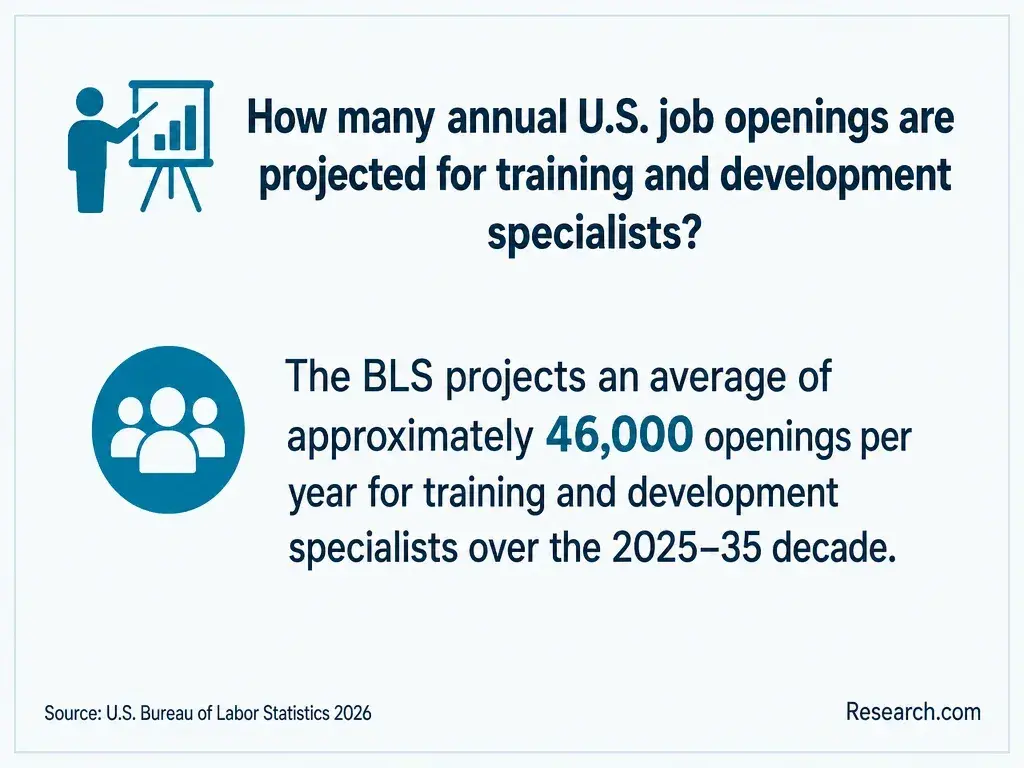
There is no single salary or job-growth rate for graduates of this degree: outcomes depend on the occupation, sector, location, and prior experience. The U.S. Bureau of Labor Statistics reports a 2025 median annual salary of $133,000 for training and development managers and projects 6.4% employment growth from 2025 to 2035. That is a benchmark for an occupation, not a forecast of an Ed.D. graduate's pay or promotion prospects.
For a career decision, compare the roles you could realistically pursue now with the responsibilities you seek after study. Ask employers whether doctoral-level preparation matters for those roles, and weigh that answer against tuition and time away from other career-building work.
How can you choose a reputable online Ed.D. program?
Start with the employee wellbeing problem you want to understand, not a program's marketing language. A strong fit provides substantive coursework on organizational conditions and change, appropriate evaluation methods, and a feasible route to an applied project. Request the current catalog, sample syllabi, project handbook, and a schedule of required meetings before making a decision.
In a conversation with program staff or faculty, ask which wellbeing-related courses are required, which electives are expected to run during your enrollment, and how students secure approval for organizational projects. Also ask what happens if an employer will not release data or you change jobs.
Favor a program that answers these questions clearly over one that simply promises flexibility or career advancement. If your goal is a narrowly defined workplace improvement rather than sustained leadership and inquiry responsibilities, targeted training and a supervised project at work may be the better choice.
Other Things You Should Know About EdD Leadership Programs
Not necessarily. Wellness programs often emphasize individual health activities; wellbeing can also encompass working conditions and employees' experience of support. Check how a course defines and measures the term.
Potentially. Public policies or reports may support an organizational analysis, but they may not answer questions about employees' experiences. A faculty advisor must confirm whether the proposed evidence meets the project requirement.
Possibly, if the project scope, organizational permissions, and applicable review allow it. Do not assume that access or consent arrangements for employees also cover other groups.
Report the finding with its limitations, protect participants' identities, and distinguish observed results from possible explanations. Invite stakeholders to examine what should change rather than presenting the evaluation as a verdict on individual employees.
- Workplace Stress - Understanding the Problem | Occupational Safety and Health Administration http://www.osha.gov/workplace-stress/understanding-the-problem
- Mental health at work | who.int https://www.who.int/news-room/fact-sheets/detail/mental-health-at-work
- Workplace Mental Health & Well-Being | hhs.gov https://www.hhs.gov/surgeongeneral/reports-and-publications/workplace-well-being/index.html
- 5 ways to improve employee mental health | apa.org https://www.apa.org/topics/healthy-workplaces/improve-employee-mental-health
- EdD vs. PhD in Education: Choosing the Right Program | Goodwin College of Professional Studies https://drexel.edu/soe/resources/career-path/edd-vs-phd/
- Are Leaders Responsible for Employee Wellbeing? | Yale Insights https://insights.som.yale.edu/insights/are-leaders-responsible-for-employee-wellbeing
- Leading for Workplace Well-Being and Organizational Health | Harvard Division of Continuing Education Course Browser https://coursebrowser.dce.harvard.edu/course/leading-for-workplace-well-being-and-organizational-health/