2027 Online Ed.D. in Leadership and Learning in Organizations After a Master's in Hospitality Management: Admission and Credit Questions
Audited and Verified:
Our Editorial and Data Verification Process
Research.com uses government datasets, official education statistics and primary institutional information to support its career and degree guides. Our review process checks factual accuracy, occupational definitions, source dates and the requirements associated with the credentials discussed.
How This Article Was Fact-Checked
Our editorial team verifies salary estimates, employment projections, education requirements and program information against original data providers and official organizations. Salary figures are checked against the relevant occupational definitions and reporting periods. Information about licensure, accreditation and required in-person training is reviewed separately.
Fact-checked and verified on:

Co-Founder and Chief Data Scientist
A master's in hospitality management can provide a strong foundation for studying how organizations lead, train, and retain people. It does not, however, settle whether you qualify for a particular online Ed.D. or whether any master's credits will shorten it.
If you are considering a move into organizational learning or broader leadership, this guide separates those decisions. You will learn what evidence to bring to admissions, how to request a meaningful credit evaluation, and when the doctorate is worth pursuing instead of a more direct professional-development route.
Key Things You Should Know
- A hospitality management master's may satisfy an Ed.D. program's graduate-degree requirement even if it is not an education degree; the program must confirm eligibility.
- Credits used to establish admission eligibility are not automatically transferable. Ask which courses, if any, will satisfy specific Ed.D. requirements before estimating savings.
- The U.S. Bureau of Labor Statistics reports a $133,000 median annual salary for training and development managers in May 2025, but that occupational figure is not a salary prediction for Ed.D. graduates.
What Is an Online Ed.D. in Leadership and Learning in Organizations?
An Ed.D., or Doctor of Education, in leadership and learning in organizations is generally a practice-oriented doctorate. It examines how people learn at work, how leaders implement change, and how organizations use evidence to improve performance. "Online" describes where much of the instruction occurs, not necessarily a self-paced schedule or an absence of campus visits.
For a hospitality professional, relevant questions might include whether supervisor development transfers to day-to-day practice across properties or how to evaluate a new employee-training process.
The degree differs from an MBA focused principally on business management and from a research-oriented PhD designed around producing scholarly knowledge. Program titles and requirements vary; comparing Ed.D. tracks before applying can help you distinguish organizational learning from school-administration preparation.
Can You Pursue This Ed.D. After a Master's in Hospitality Management?
Potentially, yes. A hospitality management master's is not inherently disqualifying. The decisive question is whether the specific Ed.D. accepts a completed master's in that field from your institution and whether you meet its other admission conditions. Some programs welcome applicants across industries; others specify education-related preparation, particular graduate coursework, or defined professional experience.
Your background may be especially relevant if you have led onboarding, developed managers, evaluated training, coordinated change across sites, or made staffing decisions. Describe your actual responsibilities and the evidence you used, rather than relying on a hospitality job title.
A candidate seeking to lead organizational learning may have a clearer fit than one seeking only a general promotion in hotel operations. For the latter goal, employer leadership development or targeted management training may be more direct.
What Admission Requirements Apply to Online Leadership Ed.D. Programs?
Requirements differ by institution and entry term. An admissions office may assess your completed degree and transcripts, academic performance, professional experience, recommendations, statement of purpose, and sometimes an interview or writing sample. Do not assume every program requires a GRE score, an education master's, a fixed number of management years, or a published research paper.
Prepare evidence that connects hospitality practice to doctoral study. The following items help an admissions advisor evaluate both formal eligibility and readiness:
- Official graduate transcripts and the exact title of your awarded degree, plus course descriptions for relevant research, training, leadership, or evaluation work.
- A résumé that specifies decisions you owned, teams or functions you supported, and organizational problems you helped address without overstating outcomes.
- A concise statement identifying a learning or leadership problem you want to investigate and explaining why the program's methods and applied-project structure fit it.
If your academic preparation has a gap, ask whether the program recommends or requires bridging coursework and whether a prerequisite can be satisfied before enrollment. Request the answer for your intended entry term in writing.
Online study can eliminate a routine commute while leaving substantial scheduled obligations. A campus-based format offers in-person contact but may be impractical alongside hospitality shifts or multi-property travel. Neither format is automatically more flexible: compare the actual timetable, not the delivery label.
Ask each program which classes meet live, whether attendance is mandatory, when group work occurs, and whether residencies or other campus convenings require travel. Then check whether those obligations conflict with peak operating periods at work. Also compare access to faculty, research support, and potential project partners; these matter more to an applied doctorate than the location of recorded lectures alone.
Curricula commonly address leadership and organizational change, adult learning, research methods, and the use of evidence to improve practice. For a hospitality graduate, the important distinction is between familiar management topics and new capabilities: designing learning for working adults, assessing whether training changes behavior, and examining organizational problems without assuming training is always the solution.
Compare required courses with electives rather than assuming a program offers a formal hospitality or talent-development concentration. Check how qualitative and quantitative methods prepare you for the required final project, and whether that project can address a workplace problem you can realistically study.
Requirements differ among dissertations, dissertations in practice, and capstones; online Ed.D. final project format comparisons are a starting point, not a substitute for the program's degree requirements.
Admission and transfer are separate decisions. A completed hospitality master's may meet an entry requirement while contributing no credits toward the Ed.D. Even a relevant graduate course must satisfy the receiving institution's rules on level, grade, recency, equivalence, and the amount of coursework that must be completed in its own program.
This comparison shows why an initial statement that your credits "count" is not enough to plan tuition or graduation:
| Credit decision | What it establishes | What it does not establish |
| Admission review | Whether prior graduate study meets an entry condition | That an Ed.D. course is waived or transferred |
| Course substitution or prerequisite waiver | Whether prior learning satisfies a particular preparation or course rule | That the degree requires fewer credits |
| Transfer applied to the degree | Which approved credits satisfy specified Ed.D. requirements | That tuition or completion time falls unless the degree plan changes |
To obtain a useful determination, take these steps before committing to a program:
- Collect official transcripts, syllabi, course descriptions, credit units, and grades from every institution whose coursework you want reviewed.
- Ask admissions whether the master's and any additional graduate study establish eligibility; ask the program director or registrar who makes final transfer and substitution decisions.
- Request a written degree audit identifying approved courses, remaining requirements, residency rules, and whether the proposed credit changes your expected schedule.
Quarter credits may require conversion, and nondegree or unfinished graduate work may be treated differently from credits within an awarded master's. If you also have unfinished doctoral study, online Ed.D. study for returning doctoral applicants raises additional policy questions; a hospitality master's by itself is not an all-but-dissertation status.
Time to completion depends on the required curriculum, course sequence, enrollment pace, and final-project milestones. Do not convert a possible transfer-credit award directly into months saved: a cohort may offer required courses only in a set order, and the project may have its own approval timeline.
Request an entry-term cost estimate that separates tuition from mandatory fees, technology charges, required travel and lodging, books, and potential continuation charges during project work. Ask whether tuition is charged per credit or term and what happens if you take a leave or extend enrollment.
Compare that estimate with employer reimbursement rules, including eligibility and repayment conditions. Listings of affordable online Ed.D. programs can narrow the search, but your actual cost depends on the institution's written terms and any approved credits - not an advertised starting price.
A hospitality professional could use doctoral study to strengthen work in corporate learning and development, leadership development, organizational change, or consulting. Advancement within a hotel group may be the most direct route because you already understand its operations. Moving into another industry is possible, but employers may also expect sector knowledge, relevant projects, and experience managing the function.
The roles are not interchangeable. A training and development manager oversees learning strategy and delivery; an organizational consultant diagnoses and advises on operating problems; a senior hospitality operator remains accountable for broader business results.
An Ed.D. can support those responsibilities but does not confer a management position, educator license, or professional certification. If your goal is a near-term move into training, a supervised project and a portfolio showing needs assessment and evaluation may be more useful than enrolling immediately in a doctorate.
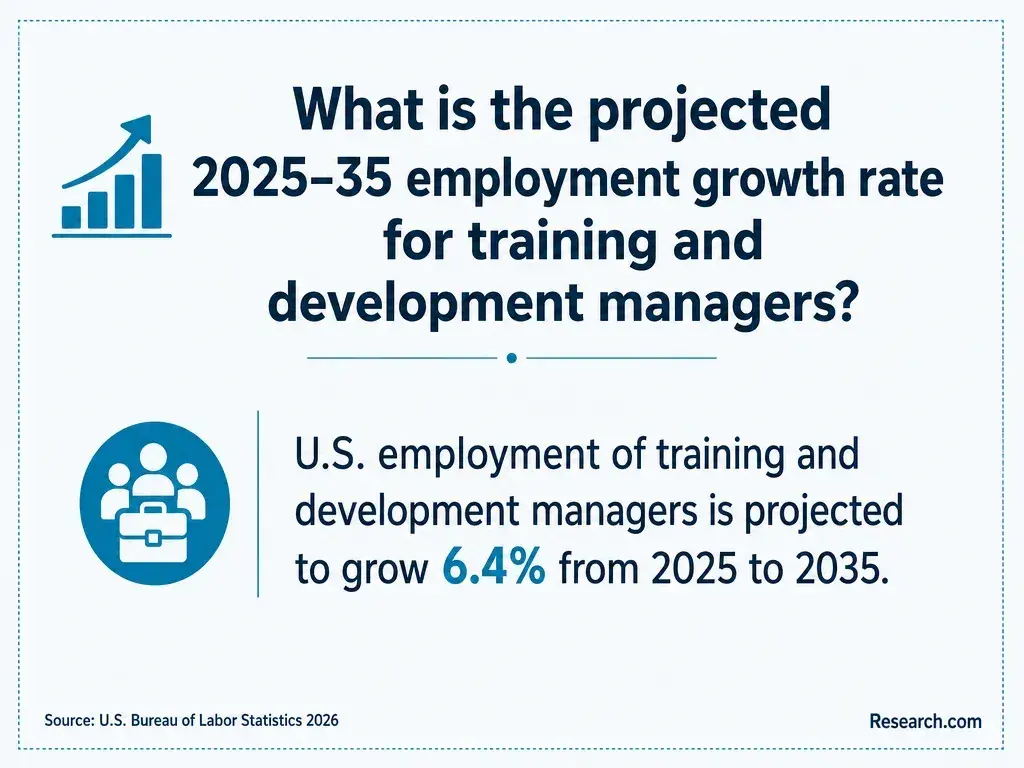
According to U.S. Bureau of Labor Statistics figures for May 2025, training and development managers had a median annual salary of $133,000; employment in that occupation is projected to grow 6.4% from 2025 to 2035. Those figures describe an occupation, not the pay or hiring prospects of hospitality graduates who earn an Ed.D.
Use occupational data to test whether a target role merits further investigation, then examine actual job postings for required experience, responsibilities, and credentials. An applicant moving from hospitality operations into learning and development may need to demonstrate training leadership before qualifying for manager-level openings, regardless of doctoral education.
How Can You Choose an Accredited Online Leadership Ed.D. Program?
First confirm the institution's accreditation with its recognized institutional accreditor and verify the exact degree, curriculum, and delivery requirements with the university. Institutional accreditation does not mean a general leadership Ed.D. prepares you for principal licensure or any other regulated role.
For this particular background, compare programs on three consequential points: whether they accept a hospitality management master's for admission, whether they will apply any prior credits to named requirements, and whether their project structure supports a feasible organizational learning question. Obtain written answers from the appropriate admissions and academic offices before paying a deposit.
You can broaden your cost search with affordable online doctorates in education, but filter the results by curriculum and verified policies rather than price alone.
Other Things You Should Know About EdD Leadership
Do not assume so. Ask the university whether it awards graduate credit for a particular certification and, if it does, whether that credit can satisfy an Ed.D. requirement.
Tell the admissions office and follow its identity-documentation instructions. Request the official transcript through the institution's approved process rather than altering a copy yourself.
Possibly, if the program approves the site and the organization authorizes the proposed work and data access. An informal contact is not a substitute for those approvals.
No. Check whether doctoral study, your chosen institution, and the specific program qualify under the written policy, and whether continued employment or repayment conditions apply.
- Guidelines for Granting Experience Credit | sc.gov https://ed.sc.gov/educators/certification/certification-legislation-and-policy/certification-regulations/exp-guide/
- .14 Evaluation and Review Process for Transfer of Courses and Credits. | Library of Maryland Regulations https://regs.maryland.gov/us/md/exec/comar/13B.06.02.14
- Course Transfer Policy | Official Catalog | Charter Oak State College https://www.charteroak.edu/catalog/current/academic_policies_regulations/course_transfer_policy.php
- UNC EdD Online: Organizational Learning and Leadership https://online.unc.edu/online-doctoral-programs/online-edd-organizational-learning-and-leadership/
- Graduate School: Transfer Credits for Prior Coursework | wisc.edu https://policy.wisc.edu/library/UW-1216
- What qualifications do I need for a doctoral program? | Capella University https://www.capella.edu/blog/phd-doctorate/what-qualifications-do-i-need-for-a-doctoral-program/
- UNC Charlotte Academic Policy: Ed.D. Degree Requirements https://provost.charlotte.edu/policies-procedures/academic-policies-and-procedures/edd-degree-requirements/
- Doctor of Education in Organizational Leadership, Culture and Change | Thomas Edison State University https://www.tesu.edu/degrees-programs/doctoral/edd.php
- Transfer credit for graduate students - VCU Bulletin https://bulletin.vcu.edu/academic-regs/grad/transfer-credit/
- Online Ed.D. in Educational Leadership | sbu.edu https://online.sbu.edu/programs/online-doctor-educational-leadership