2027 Online Ed.D. in Leadership and Learning in Organizations: Comparing Coursework in Causal Reasoning
Audited and Verified:
Our Editorial and Data Verification Process
Research.com uses government datasets, official education statistics and primary institutional information to support its career and degree guides. Our review process checks factual accuracy, occupational definitions, source dates and the requirements associated with the credentials discussed.
How This Article Was Fact-Checked
Our editorial team verifies salary estimates, employment projections, education requirements and program information against original data providers and official organizations. Salary figures are checked against the relevant occupational definitions and reporting periods. Information about licensure, accreditation and required in-person training is reviewed separately.
Fact-checked and verified on:

Co-Founder and Chief Data Scientist
A leadership development program may improve participants' survey scores without changing how they lead. If you are comparing online Ed.D. programs in Leadership and Learning in Organizations, the important curricular question is whether you will learn to tell that difference.
This article explains how causal reasoning connects learning theory, organizational diagnosis, research methods, and applied projects. It also shows what to verify in a program's course sequence so you can choose doctoral study that fits your work—or decide that targeted methods training would serve you better.
Key Things You Should Know
- Strong causal-reasoning coursework moves beyond measuring satisfaction or before-and-after change: it asks what would likely have happened without an intervention.
- Compare the full sequence—measurement, research design, evaluation, ethics, and applied inquiry—not a single course labeled "research methods."
- An Ed.D. can strengthen an experienced leader's evaluation practice, but it does not establish that a workplace initiative caused improvement or qualify its graduate for a particular job.
What is an online Ed.D. in Leadership and Learning in Organizations?
An online Ed.D. in Leadership and Learning in Organizations is a practice-oriented doctorate concerned with how people learn, how organizations change, and how leaders use evidence to improve practice. Program names and requirements vary. Some emphasize workplace learning across sectors; others focus more heavily on educational institutions. The degree is not automatically a school-administrator credential.
For a learning and development professional or emerging organizational leader, its distinctive value is the opportunity to connect a real decision—such as whether to expand a mentoring initiative—with theory, implementation, and credible evaluation. A research-focused PhD may better fit someone seeking sustained preparation for original scholarly research. If the immediate goal is to evaluate one initiative more rigorously, a focused evaluation or research design course may be a more proportionate investment.
How does causal reasoning shape leadership and learning coursework?
Causal reasoning asks whether an action produced an outcome, rather than merely occurring before or alongside it. Its central challenge is the counterfactual: what would have happened to the same people or organization without the action? Leaders cannot observe both possibilities for the same group at the same time, so coursework should teach them to build and assess credible comparisons.
Consider a hypothetical manager-training rollout. Promotion rates rise afterward, but hiring patterns, staffing budgets, or the selection of high-performing employees into training may also have changed. The following comparison shows how different courses can contribute to a defensible interpretation; a course title alone does not establish that a program teaches these skills in depth:
| Coursework area | Contribution to causal reasoning | Limit if studied alone |
| Organizational diagnosis and learning theory | Identifies a plausible mechanism, such as whether managers have opportunities to practice and apply new skills. | A plausible explanation is not evidence that training caused the outcome. |
| Measurement and learning analytics | Distinguishes attendance and satisfaction from valid measures of behavior or performance. | A precise measure cannot remove selection bias. |
| Quantitative research and evaluation | Examines comparison groups, timing, confounding, missing data, and uncertainty. | A design can fail if groups differ in unmeasured ways or implementation changes. |
| Qualitative inquiry and implementation study | Explores how participants experienced an initiative and why delivery varied. | Interviews alone generally cannot establish the size of a causal effect. |
A strong sequence teaches students to match claims to designs. A pre/post survey can describe change but rarely isolates its cause. A comparison between participating and nonparticipating teams may help, provided students investigate why teams entered each group. Where feasible, a carefully planned staggered rollout offers another comparison, but its credibility depends on timing and whether other changes affected the groups differently.
For an applied project, ask who authorizes access to employee or learner records, what data can be used, and whether institutional research review is required. Employer permission and academic approval are separate matters. Coursework should also teach students to report uncertainty and avoid presenting a small evaluation as proof that an intervention will work elsewhere.
What coursework is included in an online organizational leadership Ed.D.?
Programs commonly combine leadership and organizational learning with research preparation and a culminating project, but required courses, electives, and project formats differ. For causal reasoning, the sequence matters more than the number of methods-related course titles: students need to define an outcome before analyzing it and understand threats to a comparison before making an impact claim.
Request a current degree plan and syllabi. Look for substantive work in adult learning and learning transfer; organizational systems and change; measurement and evaluation; quantitative and qualitative methods; and research ethics. Then inspect assignments: Does a student critique a weak causal claim, build an evaluation design, examine alternative explanations, and explain limitations? An elective does not provide the same assurance as a required course that is offered in time for the applied project.
Confirm whether the culminating requirement is a dissertation, dissertation in practice, capstone, or another approved deliverable. Students exploring dissertation-free Ed.D. study options to evaluate should still check how each program assesses research and applied inquiry; "no dissertation" does not mean "no rigorous project."
Delivery mode changes access and logistics, not the standard of evidence needed to support a causal claim. Online students may be able to examine a problem at their own workplace, while campus-based students may find in-person research collaboration easier. Neither advantage is automatic: faculty guidance, course design, and access to an appropriate project setting matter more.
Compare the actual timetable, not the word "online." Live methods classes, group design reviews, campus convenings, and faculty meetings can constrain a working leader's schedule. Ask when these occur, how attendance works, and whether the program supports students whose employer or project site changes. A campus option may be more practical if local research partnerships outweigh travel; an online option may be more practical if it preserves employment and access to organizational data.
Travel also affects the financial comparison. When reviewing education doctoral degrees by tuition level, add required visits and lodging before treating a lower tuition figure as a lower total cost.
Requirements are program-specific. Schools may ask for a qualifying prior degree, transcripts, recommendations, a statement of purpose, professional experience, or an interview. An applicant interested in causal reasoning should also assess readiness to interpret evidence and write about an organizational problem; prior publication or advanced statistical expertise should not be assumed to be a universal requirement.
Use the statement of purpose to describe a decision you have helped make, the evidence available, and what remains uncertain. That demonstrates applied-research judgment without claiming results you have not established. Ask admissions staff whether preparatory statistics or methods work is recommended, which courses are required, and whether a proposed project must have an organizational sponsor.
Returning doctoral learners should distinguish admission eligibility from credit that actually applies to the new degree. ABD education students comparing online doctoral pathways should obtain a written, program-specific evaluation before assuming previous doctoral work will shorten an Ed.D.
Time to completion depends on required credits, course sequencing, enrollment pace, and the culminating project. A delayed methods course or loss of access to a project site can extend study even when classes are online. Ask for the current degree map and how students progress if a course, advisor, or approved organizational partner becomes unavailable.
Compare written cost estimates that include tuition, mandatory fees, required travel, materials, and any continuation charges during the project stage. Employer reimbursement may depend on continued employment, grades, or repayment terms. The relevant decision is whether the full commitment builds capabilities you need—not whether a degree's advertised tuition appears affordable in isolation. For an additional comparison, review tuition-focused choices for a leadership doctorate, then verify charges directly with each institution.
Check the university's current institutional accreditation in the accreditor's directory and the U.S. Department of Education's accreditation records. Confirm that the institution—not merely a similarly named campus or affiliated provider—awards the Ed.D. you are considering. If a school claims additional programmatic recognition, verify its scope with the named organization.
Accreditation does not answer the curriculum question. Request the catalog for your intended entry term and confirm the exact degree title, required methods courses, online attendance rules, and culminating requirement. Nor does institutional accreditation establish eligibility for educator licensure; that is a separate program- and state-specific determination.
The most direct fit is often advancement from existing work in learning and development, talent development, organizational development, program evaluation, or organizational leadership. A graduate might design leadership learning, oversee evaluation, advise on change, or make better-supported decisions about the workforce. Employers will still assess management experience, sector knowledge, implementation record, and the ability to communicate evidence.
A workplace project can demonstrate those abilities if you can explain your role, the decision addressed, the design's limits, and what the organization was authorized to share. It should not be presented as proof of impact when the evaluation cannot support that claim. Professionals targeting university administration can separately explore organizational leadership doctorates for university leadership work, while checking each position's experience and institutional requirements.
U.S. Bureau of Labor Statistics figures put the May 2025 median annual pay for training and development managers at $133,000. That describes an occupation, not the pay of Ed.D. graduates or a likely starting salary; these jobs generally call for substantial relevant experience.
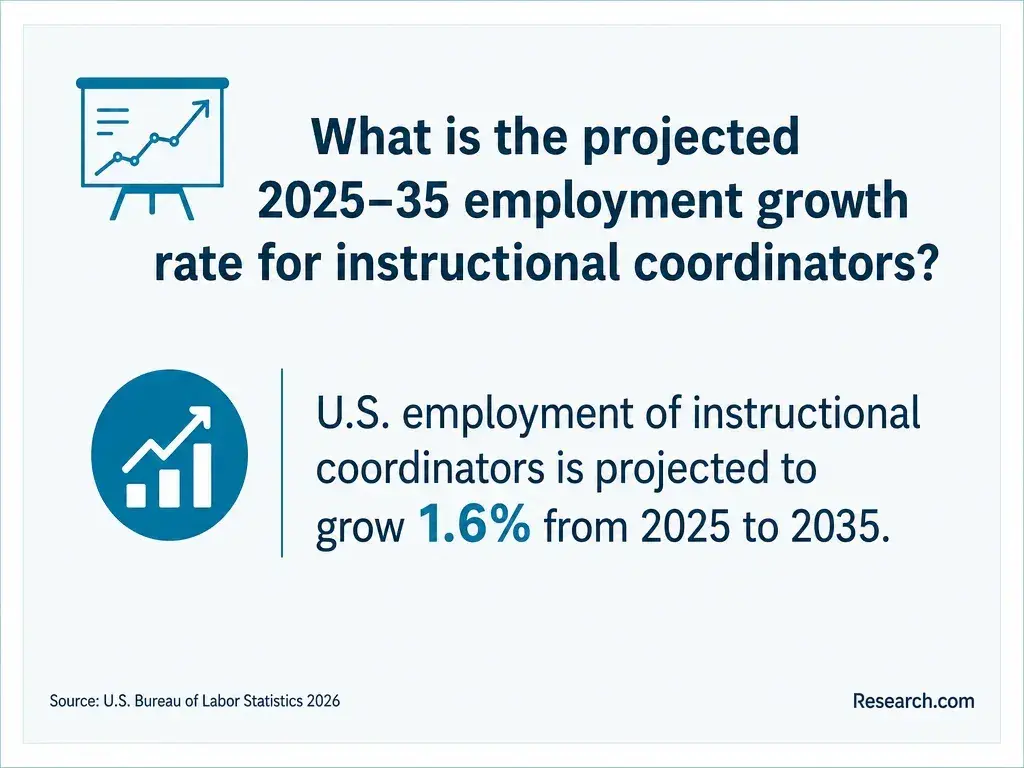
For a different point in the pathway, the BLS projects 10.8% employment growth for training and development specialists from 2025 to 2035. This suggests demand for learning-related work, but growth does not establish that a doctorate is required. Compare job postings in your target sector with your existing responsibilities before attributing potential career gains to the degree.
Which certifications or licenses may Ed.D. graduates need?
Most general organizational learning and leadership roles do not confer a license through an Ed.D. Employers may value role-specific certifications in talent development, evaluation, change management, or project management, but preferences vary and a certification is distinct from the doctoral degree.
School principal and superintendent positions are different: state requirements may include a specified preparation program, experience, examinations, or a credential. A broadly focused organizational leadership Ed.D. should not be treated as approved licensure preparation. Before enrolling for a regulated role, obtain confirmation from the program and the relevant state licensing authority.
Other Things You Should Know About EdD Leadership
Yes, if the program approves the project and you analyze its design, implementation, evidence, and limitations honestly. A favorable outcome is not a substitute for sound inquiry.
Not necessarily. Expectations vary, but interpreting comparisons, measurement, and uncertainty is often more immediately relevant to applied evaluation. Check the actual prerequisites and syllabi.
Only within your organization's permissions and the program's rules. A redacted account of the question, your methods, and limitations may be safer than sharing restricted data or identifiable findings.
Discuss feasible alternatives with faculty before promising a causal conclusion. You may be able to conduct a useful implementation or descriptive evaluation while clearly stating what it cannot prove.
- Improving the teaching of "correlation does not equal... - PMC https://pmc.ncbi.nlm.nih.gov/articles/PMC12488420/
- About Causal Assessment | US EPA https://www.epa.gov/caddis/about-causal-assessment
- Online vs. On-Campus Classes: Which Is Right for You? | Northeastern University Graduate Programs https://graduate.northeastern.edu/knowledge-hub/online-classes-vs-on-campus/
- Causal Inference Methods - Gumberg Library | LibGuides at Duquesne University https://guides.library.duq.edu/causalinferencemethods
- Education (EDUC) - UNC Catalog https://catalog.unc.edu/courses/educ/
- An Introduction to Qualitative Research | sciencedirect.com https://www.sciencedirect.com/science/article/pii/S0022202X20324064
- Synchronous vs. Asynchronous Classes | Hopkins EP https://ep.jhu.edu/news/asynchronous-vs-synchronous-classes/
- Education (ED) | Purdue University Global Academic Catalog https://catalog.purdueglobal.edu/graduate/course-descriptions/ed/
- Experimental Designs for Identifying Causal Mechanisms | oup.com https://academic.oup.com/jrsssa/article/176/1/5/7077805
- Education Policy, Organization & Leadership, EdD | University of Illinois Urbana-Champaign Course Catalog https://catalog.illinois.edu/graduate/education/education-policy-organization-leadership-edd/