2027 Best Stackable Credentials for Career Advancement

Co-Founder and Chief Data Scientist
Choosing between a short certificate, industry certification, associate degree, or degree pathway can be costly if the first credential does not lead to the next step. Stackable credentials let learners build recognized skills in stages while working or testing a career field. For context, the U.S. Bureau of Labor Statistics projects healthcare support occupations to grow 15% from 2024 to 2034, making targeted training especially relevant.
This guide is for career changers, recent graduates, and working adults who want a practical route forward. It explains leading pathways, costs, admissions, online options, quality checks, and realistic job outcomes.
Key Things You Should Know
- Choose a credit-bearing certificate when you may continue to an associate or bachelor's degree; confirm in writing exactly how many credits transfer and whether they expire.
- Industry certifications can strengthen hiring prospects, but they are different from academic certificates and may require separate exams, fees, continuing education, or work experience.
- Compare the complete pathway, not just the first credential. Public two-year colleges charged average published tuition and fees of $4,050 for in-district students in 2024-25, before books, tools, exams, and living costs.
Top 10 Best Stackable Credentials for Career Advancement
Popular Trade School Programs
Trade pathways often stack a short workforce certificate into a diploma or Associate of Applied Science. Common options include electrical technology, HVAC/R, welding, industrial maintenance, automotive service, plumbing, and construction management. Entry certificates teach safety, tools, and foundational theory; advanced coursework adds troubleshooting, code knowledge, and supervised practice.
Apprenticeships can be a better fit where paid work-based learning is available. Confirm whether the program prepares you for a state license, EPA Section 608 examination, or an employer-recognized certification, since program completion alone may not meet every legal or employer requirement.
Healthcare Programs
Stackable healthcare options include nursing assistant certificates, medical assisting certificates, practical nursing diplomas, health information technology certificates, pharmacy technician training, and associate degrees in nursing or radiologic technology. These programs commonly combine coursework with clinical experiences, background checks, immunizations, and drug screening.
A certificate may prepare a student for an external certification examination, but eligibility and licensing rules vary by state and profession. Learners seeking a licensed role should verify clinical-hour requirements and board approval before enrolling. Nonclinical pathways such as medical billing can often be completed online, while patient-care programs usually require in-person practice.
Criminal Justice / Law Programs
Common stackable options include certificates in criminal justice, corrections, homeland security, legal studies, court reporting support, and paralegal studies, followed by an associate degree. These credentials can introduce criminal law, report writing, ethics, evidence procedures, and legal research.
A paralegal certificate may be especially useful for people who already hold a bachelor's degree in another subject, while an associate degree can be a more suitable starting point for new learners. Neither credential authorizes independent legal practice. Police, corrections, and court roles may also have agency-specific fitness, background, age, and training requirements.
Arts & Design Programs
Design pathways can begin with certificates in graphic design, digital media, UX design, photography, web production, animation, or visual communications and build toward an associate degree. Short credentials work best when they produce a focused portfolio and teach current software, typography, layout, accessibility, and client workflow.
An associate degree adds broader studio practice, general education, and more substantial portfolio development. Employers often evaluate demonstrable work more closely than the credential title alone. Before paying for a program, review student portfolios, software costs, instructor experience, and whether the curriculum addresses AI-assisted creative workflows ethically and practically.
What are stackable credentials and how do they work in career advancement?
Stackable credentials are intentionally connected education or training milestones that build toward a larger qualification. A learner might earn a college certificate, apply its credits to an associate degree, and later transfer eligible coursework toward a bachelor's degree. In a different model, a worker may complete vendor training and then add an industry certification that validates specific technical skills.
The key distinction is that a stack should have documented value at each stage. An academic certificate is awarded by a college after completing a program of study; an industry certification is awarded by a certifying body after its requirements are met. A useful stack may include both, but they serve different purposes.
Strong pathways usually have three characteristics: a recognized entry point, a transparent next credential, and employer-relevant skills at every stage. The comparison below helps clarify which route fits different goals.
| Credential type | What it usually represents | Best use | Important limitation |
| College certificate | Completed academic or career curriculum | Building skills and potentially earning transferable credit | Transfer policies vary by receiving institution |
| Industry certification | Validation against an external professional standard | Demonstrating a defined skill to employers | May require an exam, renewal, or prior experience |
| Associate degree | Broader college credential with general education and major coursework | Roles needing more comprehensive preparation | Usually takes longer and costs more than a certificate |
| Apprenticeship | Structured paid work and related instruction | Licensed trades and hands-on occupations | Availability and entry rules differ by sponsor and location |
Do not assume that "stackable" means automatic transfer. Ask whether the first credential's courses are credit-bearing, how many credits apply to the next award, the minimum grade required, and whether the agreement applies only within one college system.
Which industries offer the strongest career paths with stackable credentials?
The strongest stackable path is not necessarily the shortest one; it is the one that matches a role's actual entry requirements and creates a credible next step. Healthcare, skilled trades, information technology, business operations, logistics, and advanced manufacturing commonly use progressive training models because workers can add technical depth over time.
Technology offers substantial advancement potential, but it also changes quickly. The Bureau of Labor Statistics projects information security analyst employment to grow 29% from 2024 to 2034. That outlook supports careful investment in security fundamentals, networking, cloud platforms, and recognized certifications, but it does not mean an entry certificate alone qualifies every learner for analyst work.
Consider a remote-friendly pathway only if the target job is genuinely performed remotely and your curriculum develops evidence of work readiness. Learners comparing technology, business, and communications options can also review degrees for remote jobs to assess whether a longer degree path better fits their target role.
The following comparison identifies where stacking is most practical and where a longer credential may be necessary from the start.
| Industry | Common first credential | Typical next step | When stacking works best |
| Skilled trades | Pre-apprenticeship or technical certificate | Apprenticeship, license, advanced specialty training | When local employers sponsor apprenticeships or recognize the training |
| Healthcare | Support-role certificate | Advanced certificate, associate degree, license where required | When clinical and licensing requirements are verified early |
| IT and cybersecurity | Certificate or entry-level vendor training | Industry certification, associate or bachelor's degree | When projects and job experience accompany coursework |
| Business and logistics | Office, bookkeeping, supply-chain, or project certificate | Associate degree or specialized certification | When the curriculum includes common workplace software and analytics |
How can students verify accreditation and quality of stackable credential programs?
Quality verification starts with the provider, not its marketing claims. For a credit-bearing college program, confirm that the institution holds recognized institutional accreditation and that the program's credits are accepted by the next institution you plan to attend. For career education, examine state authorization, completion requirements, instructor qualifications, facilities, and published student-support policies.
Programmatic accreditation matters in selected fields, especially healthcare and certain technical disciplines. If your goal requires licensure, ask the relevant state licensing board whether the specific program meets educational eligibility requirements. A school's general accreditation does not automatically establish that a particular program qualifies graduates for a license.
Before committing, use this verification sequence to reduce avoidable risk.
- Identify the exact job title, state, and employer type you are targeting.
- Check whether the role requires a license, certification examination, clinical placement, apprenticeship, or background clearance.
- Request the program's credential map showing course numbers, credits, transfer destinations, and time limits.
- Ask for the full cost of tuition, fees, equipment, exams, insurance, uniforms, and required travel.
- Compare completion, placement, and licensure-exam information carefully, including how the school defines each outcome.
Red flags include vague promises of "national recognition," pressure to enroll before reviewing the catalog, unclear transfer language, and claims that a short program guarantees employment. A legitimate provider should answer direct questions about what its credential does qualify you to do.
Employer Confidence in Online vs. In-Person Degree Skills, Global 2024

What admission requirements and prior education are needed for stackable credentials?
Admission requirements depend on the credential type. Many entry-level college certificates require a high school diploma, GED, or equivalent, while noncredit workforce courses may have few formal admission requirements.
Selective or regulated pathways can add placement testing, prerequisite courses, minimum grades, health documentation, criminal background review, or proof of English and math readiness.
Advanced stackable credentials may require prior coursework, an existing degree, documented job experience, or an active professional license. Industry certifications can have separate eligibility rules that are not controlled by the training provider. For example, training may help prepare someone for an exam without automatically making that person eligible to take it.
Applicants should distinguish "open admission to the college" from admission to a limited-enrollment program. Ask whether entry is guaranteed, competitive, first-come-first-served, or based on prerequisites. Also ask whether credits earned elsewhere will be evaluated before you repeat classes.
Working adults who need a rapid academic starting point should compare prerequisites and transfer policies with options such as the fastest associates degree online. Accelerated scheduling can reduce elapsed time, but it often requires heavier weekly coursework and may not suit clinical or lab-based programs.
How do online stackable credential programs compare to campus-based options?
Online stackable programs can be excellent for theory-heavy fields such as business, IT, bookkeeping, coding, legal studies, and health information. They are less complete substitutes for campus-based instruction when learners need labs, clinical placements, shop equipment, or supervised skill demonstrations. Many practical programs use a hybrid model: online lectures with scheduled in-person training.
The right format depends on what must be verified for employment or licensure. Online delivery may lower commuting and scheduling barriers, but it can shift costs to required technology, proctoring, local clinical travel, or unpaid placement time. Campus learning can provide equipment access and in-person support, though schedules may be less flexible.
This comparison focuses on the trade-offs that matter most before choosing a delivery format.
| Factor | Online or hybrid advantage | Campus-based advantage |
| Schedule | Often supports asynchronous study around work | Predictable class and lab times can create structure |
| Hands-on learning | Useful for simulations and theory | Better access to labs, equipment, and immediate coaching |
| Networking | Can connect learners across locations | May offer easier local employer and instructor contact |
| Licensure preparation | Appropriate only when required practical components are arranged | Often simplifies supervised practice and placement coordination |
Before enrolling online, confirm where required practical experiences occur, who secures them, and whether they are available near you. Do not rely on an online program's general statement that it "meets requirements" without confirming requirements in your state.
What is the typical length, cost, and financial aid options for stackable credentials?
Short credentials can take weeks or months, while credit-bearing certificates often take one or two academic terms and associate degrees commonly take about two years of full-time study.
Part-time enrollment, prerequisite courses, clinical schedules, and limited course availability can extend the timeline. The fastest option is worthwhile only when it preserves required hands-on practice and leads to a credential employers recognize.
Cost varies widely by provider, residency, delivery format, and field. Tuition is only one component. Students should calculate the cost of the entire stack, including supplies, tools, software, exam fees, transportation, lost work hours, and later credential renewals.
Use this cost framework to compare programs that advertise similar tuition but have different total expenses.
| Cost category | Why it matters | Question to ask |
| Tuition and mandatory fees | Base price may differ by residency and credit load | What is the total charged for every required term? |
| Equipment and materials | Trades and clinical programs may require substantial supplies | Which tools, uniforms, software, and books are mandatory? |
| Testing and licensure | External exams may not be included in tuition | Does the estimate include exam, fingerprinting, and application fees? |
| Time away from work | Clinical, lab, and internship hours can affect earnings | When are required in-person hours scheduled? |
Eligible students in approved credit-bearing programs may use federal aid, and some workforce programs qualify for state grants, employer tuition assistance, veterans' benefits, or workforce-agency funding. Noncredit training may not qualify for federal student aid.
If speed is your priority, compare total workload and transfer value with accelerated career programs before paying for a standalone course.
What courses and skills are included in common stackable credential pathways?
Common stackable pathways begin with foundational skills and add technical specialization, workplace application, and leadership or advanced analysis. The exact course sequence should reflect the job, not merely what a provider happens to offer.
A well-designed pathway usually combines the following skill layers.
- Foundational skills: communication, digital literacy, math, workplace safety, documentation, and professional ethics.
- Technical skills: field-specific tools, software, procedures, regulations, and troubleshooting methods.
- Applied learning: labs, simulations, projects, clinical practice, internships, apprenticeships, or supervised work.
- Advancement skills: data interpretation, project coordination, customer communication, quality control, and team leadership.
Review the syllabus rather than relying on a program title. In IT, for example, a useful entry pathway may cover networking, operating systems, scripting, security basics, and hands-on projects. In healthcare, the sequence may require anatomy, patient privacy, documentation, clinical safety, and supervised patient interaction.
AI tools are changing workflows in design, administration, coding, and analytics, so learners should seek programs that teach responsible use, verification, privacy, and human judgment rather than treating automation as a substitute for core competence.
What jobs, salary ranges, and promotion opportunities come from stackable credentials?
Stackable credentials can help candidates qualify for entry-level work, change specialties, or document skills for internal advancement, but outcomes depend on local demand, prior experience, licensing rules, portfolio quality, and employer preferences. They are strongest when connected to a defined occupation rather than a broad promise of "career readiness."
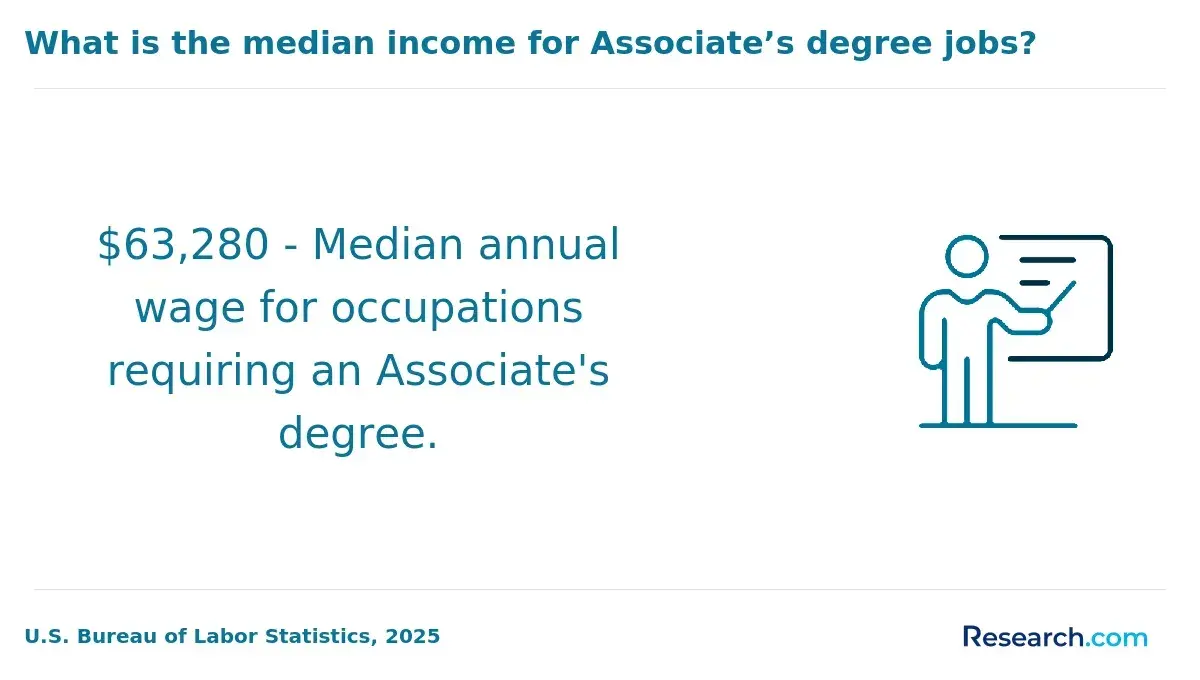
The Bureau of Labor Statistics reported a 2024 median annual wage of $62,350 for electricians and $44,200 for medical assistants. These are occupation-wide figures, not salaries guaranteed to certificate holders; electricians typically learn through apprenticeship, while medical assistants may need employer-preferred certification in addition to training.
This snapshot shows how credential level and occupation requirements interact.
| Career example | Possible stack | Career progression consideration |
| Electrician | Pre-apprenticeship certificate to registered apprenticeship to licensure | State and local licensing rules govern independent work |
| Medical assistant | Certificate to external certification preparation to specialty experience | Scope of duties and employer preferences vary |
| IT support specialist | Technical certificate to industry certification to associate or bachelor's coursework | Projects and experience can be as important as classroom learning |
| Paralegal support professional | Legal studies certificate or associate degree to specialized legal experience | Employers may prefer specific education levels or legal software skills |
For promotion planning, look at job postings from employers you would realistically apply to. Note the education, credentials, software, years of experience, and license language that repeatedly appear. Then select the first stackable credential that closes the most immediate gap without blocking your next educational step.
How can learners choose the best stackable credential path for their career goals?
Choose the best stackable credential path by working backward from a specific target: a job title, employer type, state, and desired advancement point. A short program is a sensible investment when it teaches a hiring-relevant skill, has a clear cost, and either qualifies you for an immediate next step or applies toward a larger credential you genuinely plan to complete.
Use these questions before enrollment to compare pathways fairly.
- What exact job can this first credential help me pursue, and what requirements remain after completion?
- Is the credential academic credit, noncredit training, an external certification, or preparation for a separate examination?
- Which courses apply to the next credential, at what grade, and by what deadline?
- What are the complete costs and likely schedule conflicts across the whole pathway?
- Does the program provide the labs, clinical experience, portfolio work, or employer connections needed for my field?
A certificate is usually best for learners who need a focused skill quickly and can verify its value with employers. An associate degree may be better when the target field requires broader preparation, licensure eligibility, or a stronger transfer foundation.
Learners whose long-term goal is advanced academic leadership or specialized professional practice should assess degree progression early, including options for the cheapest doctorate degree online if a doctoral credential could eventually be relevant.
Common mistakes include selecting a program because it is short, assuming every credential transfers, and comparing tuition without fees or required unpaid hours. Avoid these errors by getting written answers, reviewing current job postings, and choosing the smallest credible first step that keeps future options open.
Other Things You Should Know About the Best Stackable Credentials
They can when the credential is credit-bearing and the receiving college accepts those courses toward the next award. Transfer is not automatic, so confirm the written articulation or degree map before enrolling.
They can be worthwhile when they address a clear hiring requirement, create work samples or practical experience, and fit a larger plan. They are less useful when the provider cannot explain employer recognition or the credential's next step.
A certificate is typically awarded by an educational provider after coursework. A certification is generally issued by an independent professional organization after meeting its standards, often including an examination and continuing requirements.
Possibly. Federal aid generally applies to eligible students in approved programs at eligible institutions, while noncredit and third-party training may not qualify. Ask the provider's financial aid office and check employer, state, and workforce-agency assistance options.
References
- The Credential Unbundling: How Skills-Based Hiring Dismantled the Degree Premium | GuruLink https://www.gurulink.com/blog/credential-unbundling
- Stackable Certificates & Credentials - Complete College America https://completecollege.org/our-approach/structure/stackable-certificates-credentials/
- Stackable Credentials | Learn & Work Ecosystem Library https://learnworkecosystemlibrary.com/topics/stackable-credentials/
- What are Stackable Credentials? https://assess.com/stackable-credentials/
- A Research-Based Look at Stackable Credentials https://www.parchment.eu/blog/podcast-episode-9-a-research-based-look-at-stackable-credentials/
- Should Companies Prioritize Skills Over Credentials? https://wearetrueline.com/should-companies-prioritize-skills-over-credentials/
- 20 Necessary IT Certifications + Salaries I Skillsoft - Skillsoft https://www.skillsoft.com/blog/top-paying-it-certifications