2027 Best Online Certificate Programs With Multiple Start Dates

Co-Founder and Chief Data Scientist
Choosing a certificate is difficult when you need to start soon but cannot sacrifice career value. Online certificate programs with multiple start dates can let working adults begin in several terms each year, rather than waiting for a traditional semester.
The U.S. Bureau of Labor Statistics projects healthcare support occupations to grow 15% from 2024 to 2034, illustrating why short, career-aligned training remains relevant. This guide explains program types, scheduling, cost, credibility, admissions, and realistic job outcomes so you can compare options before enrolling.
Key Things You Should Know
- Multiple start dates mean several enrollment points during the year, but they do not automatically mean self-paced study, shorter completion, or immediate entry into every course.
- Choose a credit-bearing academic certificate when you may later pursue an associate or bachelor's degree; choose noncredit workforce training when the employer-recognized skill or required exam preparation matters more than transferable college credit.
- Career outlook varies sharply by field: BLS projects 15% growth for healthcare support occupations from 2024 to 2034, while some certificate-targeted roles require state licensure, supervised practice, or an employer credential beyond program completion.
Top 10 Best Online Certificate Programs With Multiple Start Dates
Popular Trade School Programs
Online trade certificates commonly cover construction management, HVAC fundamentals, electrical theory, welding technology, industrial maintenance, and logistics. They work best for learners seeking foundational knowledge, estimating skills, safety training, or advancement in a related job.
Hands-on trades usually require campus labs, employer training, apprenticeships, or hybrid sessions; a fully online certificate rarely replaces required field experience. Compare whether the program is credit-bearing, includes lab access, aligns with a union or employer pathway, and prepares you for a separate licensing or certification exam where applicable.
Healthcare Programs
Online healthcare certificates may focus on medical billing and coding, health information technology, pharmacy technician theory, medical assisting coursework, or healthcare administration. Administrative programs can often be completed online, while patient-facing roles typically need in-person clinical placements.
Before enrolling, verify whether the curriculum meets your state's rules and whether it prepares graduates for an external exam, such as a coding or technician certification. A certificate is educational completion; passing a certification exam or obtaining a license may require additional steps. Confirm clinical-site support, background-check costs, immunizations, and exam eligibility.
Criminal Justice / Law Programs
Online certificates in criminal justice, legal studies, paralegal studies, homeland security, and court administration suit learners exploring public safety or legal support work. A legal studies certificate can build research, writing, and procedure knowledge, but it does not authorize someone to practice law.
Paralegal employers may prefer education approved by the American Bar Association, experience, or a degree, depending on the role. For law-enforcement careers, academy attendance, background screening, physical standards, and local agency requirements generally remain separate from online coursework.
Arts & Design Programs
Online arts and design certificates often teach graphic design, UX design, digital media, animation, photography, or web content production. They are most useful when they produce a portfolio with work that matches the jobs you want.
Review software access, instructor feedback, ownership of portfolio pieces, and whether live critiques occur at times you can attend. A short certificate can sharpen a focused skill, but entry into competitive design roles may also depend on portfolio quality, internship experience, and proficiency with employer-used tools.
What makes an online certificate program credible?
A credible online certificate has a clear issuer, stated learning outcomes, transparent cost information, qualified instructors, and a realistic explanation of what completion does and does not qualify you to do. For academic certificates, check that the college or university holds institutional accreditation recognized by the U.S. Department of Education or Council for Higher Education Accreditation. For noncredit training, evaluate employer recognition, curriculum currency, instructor experience, and eligibility for any named industry examination.
Use these warning signs to avoid spending on a credential with limited value:
- Claims that completion guarantees a job, license, salary, or certification exam pass.
- No clear information about the awarding institution, instructor qualifications, refund policy, or total fees.
- Promises of clinical, lab, or apprenticeship eligibility without explaining local placement and licensing requirements.
- Confusion between a school-issued certificate and a professional certification awarded by an independent certifying body.
Ask for the exact credential title shown on completion documents, whether it carries academic credit, and whether credits have a written transfer or stackability policy. These details matter more than marketing labels such as "career certificate" or "professional program."
How do multiple start dates work in online certificate programs?
Multiple start dates are scheduled entry points, such as monthly, every eight weeks, or several times per year. You apply and register for a designated cohort, then follow that cohort's course calendar. This model can reduce the wait to begin, but it may limit course choice and make breaks or missed terms harder to manage.
The comparison below shows why the calendar structure matters as much as the advertised start frequency.
| Schedule model | What it usually means | Best fit | Key trade-off |
| Traditional term | Fall, spring, and sometimes summer entry | Learners needing broad course selection | Longer wait before starting |
| Accelerated term | Several shorter sessions each year | Working adults who can handle focused courses | Weekly workload may be intensive |
| Monthly or rolling cohort | Frequent fixed cohort launches | Learners with urgent enrollment timing | Fewer elective and break options |
| Self-paced training | Progress is largely learner-directed | Independent learners with variable schedules | May not provide academic credit or aid eligibility |
Students who need the earliest available option can compare online colleges starting this month, while still confirming the specific certificate's next cohort date. A school may offer frequent starts overall but only a few starts for a particular program.
Are online certificate programs accredited and career-focused?
Many online certificates are career-focused, but their recognition depends on credential type and field. A college-issued academic certificate may carry college credit and sometimes stack into an associate or bachelor's degree. A noncredit provider's certificate may demonstrate completed training but usually does not transfer as college credit. An industry certification is different: it is awarded by a professional organization after meeting its standards, often through an exam.
Accreditation is most consequential when you need federal student aid, transferable academic credit, clinical placements, or a degree pathway. Programmatic accreditation can also matter in regulated health fields. Before paying, ask whether graduates are eligible for the relevant exam or license in your state; no general online certificate can substitute for requirements set by a licensing board.
What are the admission requirements for online certificate programs?
Admissions requirements depend on the provider and the level of the certificate. Entry-level, noncredit programs may require only an application, payment arrangement, and basic technology access. Undergraduate academic certificates commonly require a high school diploma or equivalent, while graduate certificates usually require a completed bachelor's degree. Selective programs may also request transcripts, prerequisite courses, résumés, or proof of relevant work experience.
Healthcare and public-safety programs can add requirements because of clinical or agency rules. These may include background checks, drug screening, vaccinations, CPR training, physical documentation, or placement eligibility. Do not assume acceptance into coursework guarantees clinical placement, certification eligibility, or eligibility for employment screening.
How long do online certificate programs take?
Completion time ranges from a few weeks for a narrowly focused noncredit course sequence to about one year for many college certificates. The most reliable measure is total required credits or instructional hours, not a headline such as "fast-track." An accelerated eight-week course may cover the same material as a longer term, requiring more weekly reading, assignments, and exams.
Choose an accelerated schedule when you can consistently protect study time and have limited competing obligations. Choose a longer or part-time path when you need stronger retention, clinical scheduling flexibility, or room for work and family demands. If future degree completion matters, verify how long credits remain valid and whether they apply to a named degree program.
How much do online certificate programs cost?
Cost can vary from low-cost noncredit training to college tuition charged per credit, so compare the full price rather than only the advertised tuition. The National Center for Education Statistics reported average tuition and fees of $3,990 for public two-year institutions in 2024. That broad institutional average is useful context, not the price of a particular online certificate.
The table separates common cost categories that can change the actual investment.
| Cost category | May apply to | Why it matters |
| Tuition or program fee | Academic and noncredit certificates | May be charged per credit, course, term, or full program |
| Technology and course materials | Most online programs | Can include software subscriptions, textbooks, equipment, and proctoring |
| Clinical, lab, or residency expenses | Hands-on and healthcare programs | May include travel, uniforms, supplies, and compliance requirements |
| Exam, licensing, or credential fees | Programs tied to external credentials | Often paid separately from school tuition |
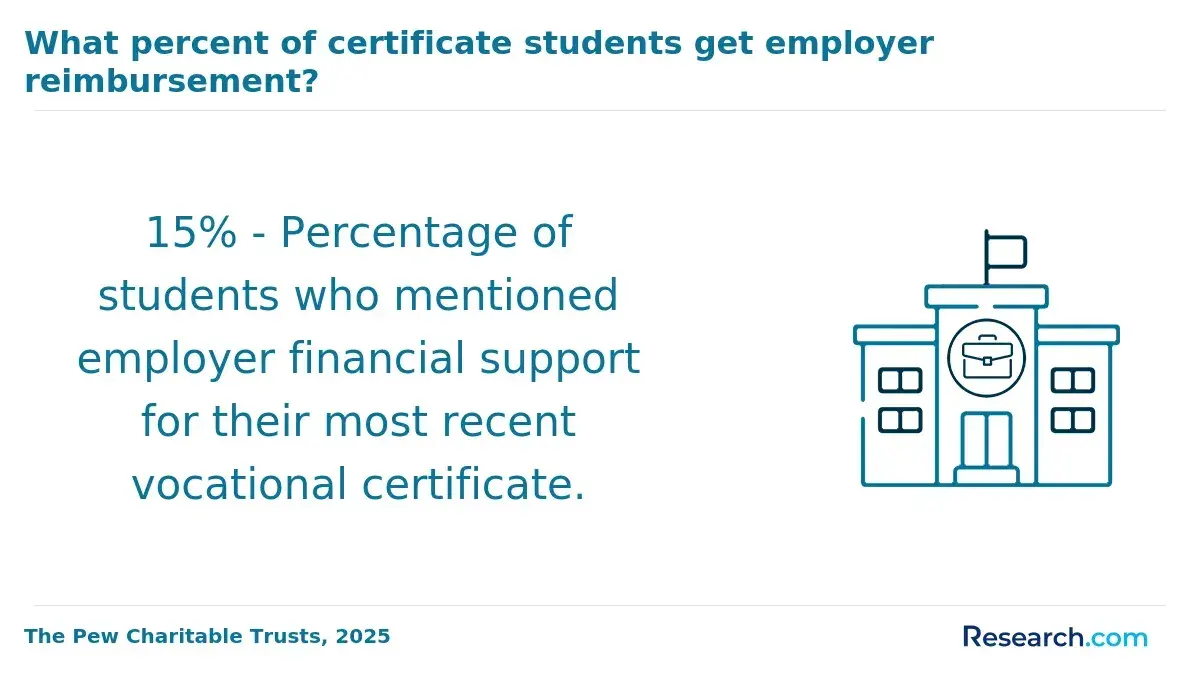
Credit-bearing certificates at eligible institutions may qualify for some federal, state, or institutional aid, but eligibility depends on the program and student circumstances. Noncredit programs often use employer tuition assistance, workforce grants, payment plans, or personal payment instead. If a degree route is more economical over time, compare options at the cheapest accredited online college before committing to a nontransferable program.
Which jobs can online certificate programs prepare you for?
Online certificates can prepare learners for entry-level support roles, targeted technical tasks, or advancement in an existing field. They are most effective when the curriculum maps to a job's actual requirements and includes evidence of skill, such as a portfolio, practicum, lab assessment, or recognized exam preparation. They are less suitable when a target occupation requires a degree, apprenticeship, state license, or extensive supervised experience.
These examples distinguish training relevance from automatic job qualification.
| Certificate focus | Potential job direction | Important limitation |
| Medical billing and coding | Billing specialist or coding support roles | Employers may prefer an external coding certification |
| IT support or cybersecurity fundamentals | Help desk, technical support, or junior security support | Experience and vendor certifications may affect hiring |
| Paralegal studies | Legal assistant or paralegal support | Requirements and employer preferences vary by market |
| Graphic or UX design | Junior designer or production design work | A competitive portfolio remains essential |
| Construction or electrical theory | Estimator support, maintenance support, or apprentice pathway | Hands-on training and licensure rules may still apply |
For roles where an independent credential carries substantial employer value, review certifications that pay well. Match the external credential's eligibility rules to the certificate curriculum before treating the two as a single pathway.
What salary and job outlook should students expect?
Salary and outlook should be evaluated by occupation, location, experience, employer, and required credentials - not by a certificate title alone. In May 2024, the BLS reported a median annual wage of $44,200 for medical assistants. That figure describes the occupation across workers and does not establish what a certificate graduate will earn, particularly because duties and state requirements differ.
For a wider labor-market signal, BLS projects healthcare support occupations to grow 15% from 2024 to 2034, faster than the average for all occupations. Growth can indicate opportunity, but it does not remove local competition, hiring standards, or clinical and credential requirements. Compare job postings in your intended area for recurring requirements, then choose the shortest program that genuinely meets them.
How do you choose the best online certificate program?
The best online certificate with multiple start dates is the one that fits your deadline, target job, budget, and required credential - not simply the program with the fastest enrollment. Start by identifying whether you need academic credit, an external certification exam, a license-qualifying curriculum, or a portfolio-based skill program.
Use this sequence to make a defensible comparison before submitting an application:
- Find several current job postings for your target role and list the repeated education, certification, software, and experience requirements.
- Confirm the exact credential awarded, the next available start date, attendance expectations, and estimated completion date.
- Request the total cost including tuition, materials, technology, travel, exam fees, and required clinical or lab expenses.
- Verify institutional accreditation, program approval, exam eligibility, and state-specific licensing implications when relevant.
- Compare credit transfer, stackability, student support, withdrawal rules, and outcomes information before paying a deposit.
A certificate is often the right choice for a focused skill gap or a low-risk career test. If your goal requires broad theory, long-term advancement, or graduate study, compare it with one of the best degrees for your intended field. Avoid choosing solely on start date: the wrong curriculum can cost more time than waiting for the right cohort.
Other Things You Should Know About
Not always. Multiple start dates usually mean several scheduled cohorts per year, while rolling admission may allow more frequent entry. Confirm the next start date for the exact program, not just the institution.
Often, because they cover a narrower set of skills and require fewer credits or hours. Speed depends on prerequisites, course sequence, part-time enrollment, clinical requirements, and whether you can complete accelerated coursework.
It can strengthen your qualifications when it teaches skills employers request and provides recognized evidence of learning. It does not guarantee employment, and some occupations require a degree, license, apprenticeship, experience, or separate professional certification.
Some academic certificates are designed to stack into associate or bachelor's programs, but transfer is never automatic. Obtain written confirmation of the credit-bearing status, receiving program, and transfer policy before enrolling.
References
- How Long Does IT Certification Take? Training Timelines https://www.acilearningtechacademy.com/blog/how-long-does-it-certification-take/
- Best Online Degrees for Working Adults in 2026 https://www.straighterline.com/blog/degreecompletion-best-online-degrees-for-working-adults-in-2026
- Course Completion Rate Benchmarks: Improve Yours (2026) | Ruzuku https://www.ruzuku.com/learn/articles/course-completion-rates
- Financial Aid For Online Colleges https://www.affordablecollegesonline.org/financial-aid/financial-aid-for-online-colleges/
- How Long to Earn an HR Certificate? | HR Training Timelines https://hrcertification.com/blog/hr-certificate-completion-time-guide-biid1000172
- CourseCareers https://coursecareers.com/blog-posts/how-to-choose-the-right-online-career-training-program
- Article VII. General Requirements for Certificate Programs https://gs.howard.edu/academics/academic-regulations/article-vii-general-requirements-certificate-programs
- Online Degrees With Flexible Start Dates https://www.collegetransitions.com/blog/online-degrees-with-flexible-start-dates/
- 9 Best Online Certificate Programs that Lead to Higher Pay https://blackstone.edu/9-best-online-programs-for-higher-pay/
- Student Loan Options for Certificate Programs https://collegefinance.com/student-loans/student-loan-options-for-certificate-programs