2027 Best Online Certifications With Payment Plans

Co-Founder and Chief Data Scientist
Choosing an online credential is harder when the advertised monthly payment hides the total cost, interest, or career limitations. Online certificates, professional certificates, and industry certifications serve different purposes, so the best choice depends on the job you want and whether licensing is involved. The U.S. Bureau of Labor Statistics projects healthcare occupations to grow much faster than average from 2023 to 2033, highlighting why career-focused training decisions matter. This guide compares flexible payment options, program types, costs, outcomes, and red flags so you can enroll with a realistic plan.
Key Things You Should Know
- Payment plans spread tuition into installments, but they do not necessarily reduce the total price; confirm enrollment fees, finance charges, late-payment rules, and the full amount due before signing.
- Choose an educational certificate, professional certificate, or industry certification based on the employer, exam, or license you need - not on the fastest advertised completion time.
- For occupational context, BLS projects healthcare occupations to add about 1.9 million jobs from 2023 to 2033; many clinical roles still require state-approved education, supervised practice, and licensure beyond an online course.
Top 10 Best Online Certifications With Payment Plans
Popular Trade School Programs
Online trade programs commonly cover HVAC fundamentals, electrical theory, welding technology, construction management, automotive service, and industrial maintenance. They are best for learners who can complete required labs, tool practice, or apprenticeships locally; fully online study rarely substitutes for hands-on competency. A short certificate can build entry-level knowledge, while an associate degree may include broader general education and more transferable credit. Before paying in installments, ask whether tuition includes exam vouchers, tools, lab kits, externships, and preparation for credentials such as EPA Section 608 or manufacturer-specific training.
Healthcare Programs
Online healthcare options include medical billing and coding certificates, health information technology certificates, pharmacy technician training, medical assisting coursework, and healthcare administration programs. Nonclinical administrative certificates can often be completed online, but patient-facing roles usually require in-person skills practice and may require state approval. A program certificate is not the same as national certification from an organization such as AAPC, AHIMA, or NHA. Verify whether the curriculum meets an exam's eligibility rules, whether clinical placement is provided, and whether your state requires a license, registration, or background check.
Criminal Justice / Law Programs
Common online options include criminal justice certificates, paralegal studies certificates, legal studies certificates, cybersecurity investigations, and court-reporting preparation. These programs can suit people seeking foundational knowledge for administrative, compliance, records, or support roles. They do not automatically qualify a learner to practice law, become a police officer, or meet paralegal employer preferences. For paralegal study, check whether the program is approved by the American Bar Association when that matters to local employers; many reputable programs are not ABA-approved, but the distinction should be understood before enrollment.
Arts & Design Programs
Online certificates in graphic design, UX/UI design, digital marketing design, photography, animation, and web design typically emphasize software skills and portfolio development. They can be a practical fit for career changers who need demonstrable work quickly, especially when projects receive instructor feedback. In creative hiring, a strong portfolio often matters more than the certificate name alone. Compare programs by portfolio assignments, software access, critique opportunities, and ownership of completed work. Avoid paying for a long installment plan if the curriculum consists mainly of tutorials you could reasonably complete through lower-cost training.
What types of online certifications offer flexible payment plans and financing options?
Flexible payment plans appear across academic certificates, noncredit career training, professional certificates, and exam-preparation programs. The important distinction is whether the provider offers a no-interest tuition installment arrangement or a separate loan product that can add interest and credit risk. Readers comparing broader online certification programs should first identify the credential required by their target employer or regulator.
This comparison shows where payment flexibility commonly appears and what to verify before committing.
| Program type | Typical provider | Payment approach | Best use |
| Credit-bearing academic certificate | College or university | Term-based installment plan or financial aid when eligible | Students who may later stack credits into a degree |
| Professional certificate | University continuing education unit or training provider | Monthly installments or course-by-course payment | Career changers building job-relevant skills |
| Industry certification preparation | Training provider or professional association | Upfront tuition, installments, or employer reimbursement | Learners preparing for a separate certification exam |
| Licensure-oriented career training | Career school or community college | School plan, private financing, or workforce funding | Roles with mandated education and clinical or practical requirements |
Payment plans make the most sense when the completion timeline is short and the remaining balance is manageable from existing income. A longer repayment term can be a warning sign if the credential has uncertain employer recognition.
How much do online certification programs with payment plans typically cost overall?
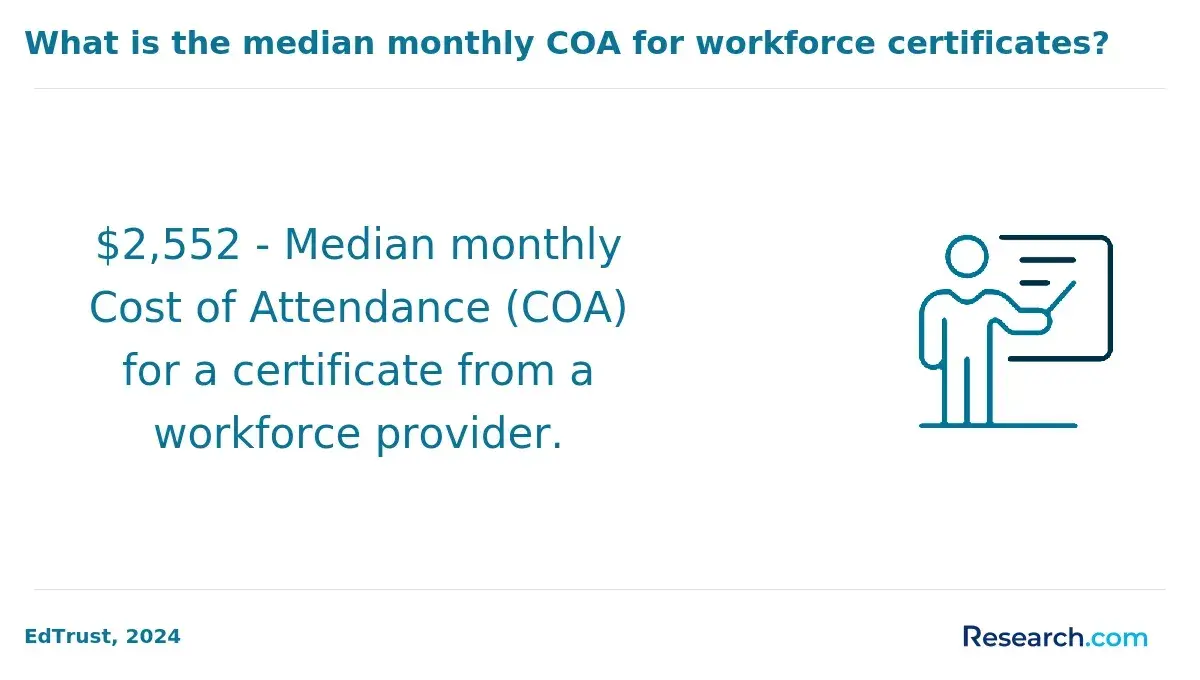
Total cost varies more by provider, credit status, clinical requirements, and included exam materials than by the word "online." A low monthly payment can mask a higher total price, especially when a provider uses third-party financing. Federal Student Aid reported that undergraduate students received an average federal grant of $5,179 in the 2023-24 award year, but eligibility depends on the student and the institution; many noncredit programs do not participate in federal aid.
Use the following cost categories to compare offers on a like-for-like basis.
| Cost category | What may be included | Question to ask |
| Tuition | Courses, learning platform, and instructor access | What is the full tuition, not the monthly amount? |
| Required materials | Books, software, tools, uniforms, or lab kits | Are materials included or purchased separately? |
| Testing | Certification exam, proctoring, practice tests, or retakes | Does tuition include an exam voucher and what are retake costs? |
| Experiential learning | Clinical placement, background checks, drug screening, travel | Who arranges placement and what costs are excluded? |
| Financing | Installment enrollment fee, interest, or late charges | What happens if a payment is missed or enrollment ends? |
Request a written total-cost disclosure and compare it with the expected value of the credential in your local job market. Do not borrow based solely on a provider's salary marketing.
Which accredited schools and platforms provide reputable online certifications with payment plans?
Reputable providers match the credential to the field. For credit-bearing certificates, institutional accreditation matters because it affects federal aid eligibility, transfer policies, and employer confidence. Start by comparing online universities that are accredited, then verify the institution in the U.S. Department of Education database and check program-specific approval where required.
Different provider types are credible for different goals.
| Provider | Most suitable credential | Recognition check |
| Community college | Career certificate or associate degree | Institutional accreditation, state authorization, credit transfer policy |
| University continuing education division | Professional or graduate certificate | University affiliation, instructor expertise, credit or noncredit designation |
| Professional association | Industry certification preparation | Whether employers recognize its certification or exam |
| Career school | Licensure-oriented or skills training | State approval, completion disclosures, clinical or externship terms |
| Online learning platform | Professional certificate or microcredential | Named issuing organization, assessment rigor, employer relevance |
Be cautious when a provider claims "accreditation" without naming the accreditor, promises a job, or will not provide a catalog, refund policy, and complete financing terms.
What admission requirements and prerequisites do online certification programs usually have?
Requirements depend on the credential type. A noncredit professional certificate may require only a payment method and basic computer access, while a college certificate can require an application, high school completion or equivalent, placement testing, and prior coursework. Advanced industry certifications may require documented work experience before a candidate may sit for an exam.
Before enrolling, confirm these requirements in writing because they affect both completion and employability.
- Identify whether the program awards academic credit, a completion certificate, exam preparation, or an industry certification.
- Check prerequisite courses, technical skills, equipment requirements, and the weekly workload expected in an online format.
- For clinical, legal, or regulated fields, verify background checks, immunizations, supervised hours, residency rules, and state-specific eligibility.
- Ask whether previous college credit, military training, or prior learning can reduce required coursework.
- Confirm that admission to a program does not imply eligibility for a licensing or certification examination.
Do not assume a program's admissions standard signals its quality. The more important question is whether its curriculum and practical requirements align with the role you want.
How do online certification formats compare to campus programs for learning and support?
Online certificates can offer the schedule flexibility working adults need, but flexibility is not the same as self-paced learning. Some programs use weekly deadlines, live virtual classes, remote proctored exams, group projects, or required campus sessions. Learners who need broader credit-bearing study may also compare accelerated online degrees if a short certificate would not meet their long-term career target.
This comparison helps match the format to your learning needs rather than assuming one delivery mode is better.
| Factor | Online format | Campus or hybrid format |
| Schedule | Often asynchronous, with variable deadlines | Usually fixed meeting times and locations |
| Hands-on learning | May require local labs, externships, or simulations | Direct access to facilities and instructor observation |
| Support | Virtual advising, tutoring, office hours, and tech support | More face-to-face interaction and campus services |
| Networking | Virtual peers and employer events | Local classmates, faculty, labs, and recruiting events |
| Best fit | Self-directed learners with reliable technology | Learners needing structure, equipment, or in-person coaching |
Ask for a sample week of coursework. If you cannot realistically protect the required study time, a longer part-time schedule may be a better financial choice than withdrawing after payments begin.
What curriculum, coursework, and skills are covered in popular online certification tracks?
Popular tracks teach focused, job-related skills, but curriculum depth varies sharply. A certificate may teach introductory concepts; a professional certificate may include applied projects; and an industry certification usually validates knowledge through an independent exam. Review the syllabus rather than relying on a program title.
Common curriculum patterns include the following.
- Information technology: networking, cloud fundamentals, cybersecurity concepts, scripting, troubleshooting, and certification exam objectives.
- Business and project management: spreadsheets, budgeting, stakeholder communication, process improvement, Agile methods, and project documentation.
- Healthcare administration: medical terminology, coding systems, insurance claims, compliance, electronic health records, and privacy practices.
- Skilled trades: safety, measurement, blueprint reading, codes, equipment theory, diagnostics, and hands-on practice requirements.
- Design and marketing: design principles, user research, content strategy, analytics, portfolio projects, and industry software.
Prioritize assessed work products, simulations, supervised practice, and feedback. These features provide stronger evidence of skill than passive video completion alone.
What careers and job roles can online certification programs help you qualify for?
Online credentials can help candidates build relevant skills for entry-level, support, or career-transition roles, but hiring requirements remain employer-specific. A short program is most useful when it fills a clearly stated gap in job postings, supports an industry exam, or produces a portfolio. People seeking lower-interaction work environments may also explore careers for introverts while evaluating whether the daily duties - not just the training format - fit their preferences.
The table separates realistic entry points from roles that usually require additional education, experience, or licensing.
| Training area | Possible related roles | Important limitation |
| IT support or cybersecurity fundamentals | Help desk technician, technical support specialist, junior security support | Employers may require certifications, experience, or demonstrated technical projects |
| Medical billing and coding | Billing specialist, coding support, claims representative | Employers may prefer national certification and prior healthcare experience |
| Project management | Project coordinator, operations assistant, project support specialist | Management roles typically require experience beyond a certificate |
| Graphic or UX design | Production designer, junior designer, content design support | A portfolio and software proficiency are usually central to hiring |
| Skilled-trade theory | Apprentice or trainee pathway | Hands-on hours, apprenticeship, and licenses may be required |
Search local job ads before enrolling and record repeated requirements. If postings consistently require a degree, license, or two years of experience, treat the certificate as a first step rather than a complete substitute.
What salary ranges and earning potential are realistic after completing an online certification?
Salary information should be used as occupational context, not as a promise attached to a certificate. The BLS reported a May 2023 median annual wage of $48,780 for medical records specialists and $60,810 for computer user support specialists. Those figures describe workers in the occupations, whose education, experience, location, and employer requirements vary; a certificate alone may not qualify an applicant for either role.
When estimating earning potential, compare the occupation - not the school's marketing claim - across these factors.
- Entry requirements: Determine whether employers accept a certificate, expect an associate or bachelor's degree, or require a license.
- Experience progression: Identify what entry-level role can lead to higher-paying work after documented experience.
- Geographic variation: Check wages and job openings in the state or metro area where you intend to work.
- Additional credentials: Price required exams, renewals, continuing education, and memberships into the total investment.
A modest-cost certificate can have better return on investment than a costly program when it directly supports a realistic next job step and does not create burdensome financing.
How can students evaluate job outlook and industry demand before choosing a certification?
Evaluate demand before you enroll by combining national outlook data with local evidence. BLS employment projections for 2023-33 are useful for identifying broad occupational direction, but they do not guarantee openings in a specific city or for a newly trained applicant. Employer demand can also change as software, AI tools, regulation, and outsourcing reshape routine tasks.
Use this practical screening process to reduce the chance of paying for an outdated or poorly aligned credential.
- Collect at least 20 recent job postings in your intended location and list recurring education, certification, software, and experience requirements.
- Compare those requirements with the program syllabus, practical assignments, exam preparation, and career services.
- Check BLS occupational outlook and state workforce information for the role, then distinguish long-term growth from immediate local vacancies.
- Ask the provider for completion, placement, and licensure disclosures when applicable, including how each measure is defined.
- Calculate the full program cost, likely monthly payment, and a backup plan if employment takes longer than expected.
Common mistakes include choosing the lowest monthly payment instead of the lowest total cost, assuming "online" means no in-person requirements, and believing a completion certificate automatically confers professional certification. A transparent provider will answer these questions before requesting a deposit.
Other Things You Should Know About
Many providers offer monthly installments, but terms vary. Confirm the total tuition, number of payments, enrollment fee, interest, late fees, refund policy, and whether missed payments affect course access or credential issuance.
A no-interest school installment plan may cost less than borrowing if you can finish payments quickly. A third-party financing agreement can function like a private loan, so review its interest rate, repayment term, credit reporting, and cancellation terms carefully.
Sometimes, but only when the program meets the rules of the relevant state licensing board and includes required clinical, laboratory, or supervised hours. Always verify eligibility directly with the regulator before enrolling.
Match the credential to actual job postings, confirm its recognition with employers or the certifying body, calculate all costs, and compare the program's curriculum with the skills employers request. Avoid programs that guarantee employment or make vague accreditation claims.
References
- Online Course Pricing Guide: How to Price Your Course in 2026 https://buddyboss.com/blog/online-course-pricing-guide/
- Monthly Payment Plan https://www.umgc.edu/current-students/finances/payments/monthly-payment-plan
- Tuition & Payments Options | CG Spectrum https://www.cgspectrum.com/tuition-payment-options
- Online Certificate Programs | Certifications Programs https://www.uscareerinstitute.edu/online-certificate-programs
- Climb Credit Payment Plans for Certificate Programs | DWC https://digitalworkshopcenter.com/about/financial-aid/payment-plan/
- How Much Should You Charge for an Online Course? 5 Pricing Models With Real Numbers https://oasis-lms.com/post/how-much-should-i-charge-for-an-online-course-a-complete-pricing-guide
- How to Price Your Online Course in 2026 (5 Models) https://www.memberstack.com/blog/online-course-pricing-models-how-to-price-your-online-course-with-webflow
- How to offer payment plans to reach more students https://www.podia.com/articles/use-payment-plans
- Study Online With a Flexible Payment Plan https://www.getsmarter.com/blog/study-online-with-a-flexible-payment-plan/
- Sharing the Risk - Center for American Progress https://www.americanprogress.org/article/sharing-the-risk/