2027 Best Online Career Training Programs With No Live Class Requirement

Co-Founder and Chief Data Scientist
Choosing online career training is difficult when "online" may still mean required video meetings, fixed exams, or in-person clinical hours. This guide focuses on asynchronous programs that let learners complete coursework without live classes. That flexibility matters as the U.S. Bureau of Labor Statistics projects healthcare support occupations to grow 15% from 2023 to 2033. Compare credential types, hands-on requirements, costs, licensing rules, and realistic job paths before paying tuition.
Key Things You Should Know
- Fully asynchronous coursework does not always mean fully remote training: clinicals, internships, labs, exams, and licensing steps may still require scheduled or in-person participation.
- Career-training certificates are educational credentials; professional certifications are separate credentials usually earned through an industry exam or qualifying process after training.
- Use BLS 2023-33 job-growth projections as a demand signal, not a hiring guarantee: healthcare support occupations are projected to grow 15%, while outcomes vary by location, employer, experience, and state rules.
Top 10 Best Online Career Training Programs With No Live Class Requirement
Popular Trade School Programs
Online trade training commonly covers HVAC fundamentals, electrical theory, welding safety, construction estimating, automotive service basics, and industrial maintenance. Programs may award a noncredit career certificate or a credit-bearing college certificate; neither automatically replaces supervised field experience.
HVAC and electrical learners often benefit from self-paced theory courses before an apprenticeship, lab, or employer training. Choose a program that clearly states which tools, safety equipment, proctored exams, and local practical requirements are included. For regulated trades, verify your state's licensing pathway before enrolling.
Healthcare Programs
Common asynchronous healthcare options include medical billing and coding, pharmacy technician preparation, medical administrative assisting, health information technology, and medical terminology certificates. These programs can suit detail-oriented learners who want administrative or support roles, but patient-facing programs usually require clinical placements and fixed-hour skills evaluation.
A school certificate may prepare you for an external certification exam, such as coding or pharmacy technician certification, without awarding that certification itself. Confirm whether employers in your area prefer an accredited academic program, national certification, prior experience, or all three.
Criminal Justice / Law Programs
Online career training in this area may include paralegal studies, legal secretary training, legal research, court reporting theory, cybersecurity fundamentals, and criminal justice certificates. A paralegal certificate can build practical knowledge of legal documents and research, but it does not authorize someone to practice law or provide independent legal advice.
Students seeking paralegal work should look for instruction in legal writing, ethics, document management, and jurisdiction-specific procedures. Those targeting law enforcement should confirm agency hiring standards, background checks, physical requirements, and academy training separately.
Arts & Design Programs
Self-paced arts and design training can cover graphic design, digital illustration, web design, photography, video editing, UX fundamentals, and interior design concepts. These certificates are usually portfolio-focused rather than licensure-focused. A strong program gives learners project briefs, software practice, instructor feedback or critique options, and ownership of work samples.
Employers often evaluate a portfolio alongside technical skills, so completing lessons alone may not be enough. Learners pursuing interior design should check state title laws and any professional examination requirements before assuming an online certificate qualifies them for practice.
What Are the Best Accredited Online Career Training Programs?
The best accredited online career training program is not a single school or provider. It is the program whose credential, schedule, required practical training, and employer recognition match the occupation you want. Institutional accreditation matters most for credit-bearing programs, transfer plans, and many forms of federal aid; industry certification preparation may matter more for short noncredit training.
This comparison separates common program models so you can identify what the credential actually does.
| Program model | Best for | Typical credential | Important limitation |
| Accredited community college certificate | Students seeking academic credit or a possible associate-degree pathway | Credit-bearing certificate | May have term schedules, prerequisites, and limited self-paced options |
| Career school training | Career changers seeking focused job skills | School certificate or diploma | Transfer credit and federal aid availability vary |
| Industry-provider training | Learners building software, platform, or technical skills | Completion certificate or professional certificate | Employer recognition differs by field and provider |
| Exam-preparation program | People eligible for an external certification examination | Course completion certificate | Does not itself confer professional certification |
For learners who need a longer academic pathway rather than short career training, compare fastest master's degree online options carefully; accelerated degree schedules still commonly use deadlines, group work, or live requirements.
Before enrolling, ask whether the school is institutionally accredited, whether the exact program has specialized approval where needed, and whether the credential is credit-bearing. Never rely on a school's use of "accredited" without identifying the accreditor and checking the program's fit with your state and intended employer.
How Do Self-Paced Online Career Training Programs Work?
Self-paced online career training usually delivers recorded lessons, readings, simulations, quizzes, and assignment feedback through a learning platform. Instead of attending live classes, learners progress within an overall enrollment period or a series of module deadlines. "No live class requirement" should mean attendance at real-time lectures is optional, not merely that recordings are available after required sessions.
Before paying, get written answers to the following practical questions. They reveal whether the program is truly compatible with an unpredictable work schedule.
- Is every lecture, assessment, and instructor interaction available asynchronously?
- Are exams remotely proctored, scheduled at set times, or required at a testing center?
- Does the program require externships, clinicals, lab intensives, internships, or live skills checks?
- What is the maximum time allowed to finish, and what happens if you need an extension?
- How quickly do instructors answer questions and grade work?
Self-pacing offers control but shifts responsibility to the learner. It works well for organized students who can set weekly milestones; learners who need external structure may do better with an asynchronous program that has regular deadlines and advising rather than an entirely open-ended course.
Which Online Career Training Programs Lead to Good Jobs?
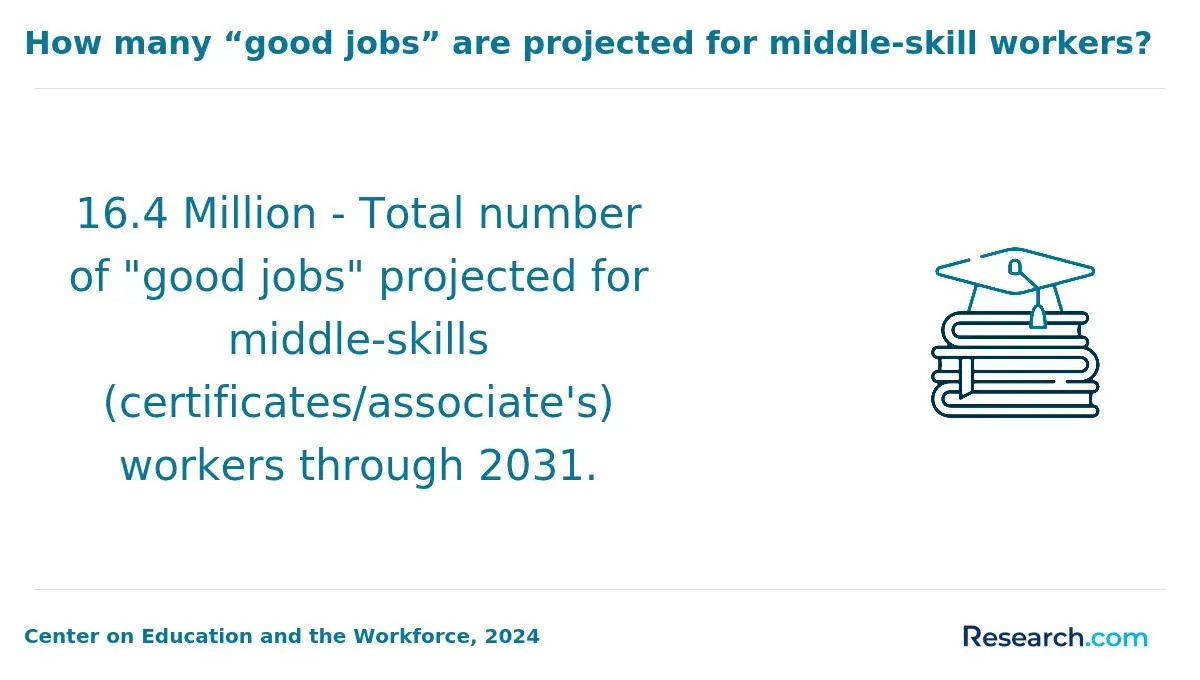
Programs lead to better job prospects when training maps to a recognizable entry-level role, a local employer need, or a required certification pathway. The strongest choices combine a clear occupational target with verifiable skills, not a broad promise of "career readiness." AI is changing this calculation: routine administrative and design tasks are increasingly automated, making software fluency, quality control, communication, and domain knowledge more valuable.
The table compares occupational outlook indicators from the U.S. Bureau of Labor Statistics' 2023-33 projections. These figures describe occupations, not outcomes for certificate completers.
| Career-training area | Example occupation | Projected 2023-33 change | Training decision |
| Healthcare support | Medical assistant | 15% | Check whether local employers require certification and whether clinical training is included |
| Skilled trades | HVAC mechanic and installer | 9% | Use online theory as a step toward hands-on training, apprenticeship, or employer entry |
| Technology | Web developer and digital designer | 8% | Prioritize a portfolio and current tools over a completion certificate alone |
| Legal support | Paralegal and legal assistant | -1% | Consider local openings, specialization, and a program's employer connections before enrolling |
A short program is usually a sensible investment when it fills a defined skill gap, meets an employer or exam requirement, and costs an amount you can reasonably recover through better job access or advancement. It is less suitable when the target role legally requires an associate degree, bachelor's degree, apprenticeship, state license, or substantial supervised practice.
What Careers Can You Start After Online Career Training?
Online career training can help launch support, technician, assistant, junior creative, or entry-level administrative roles. It is most effective when paired with evidence of competence: a portfolio, supervised practice, an exam result, completed projects, volunteer work, or prior related experience. A credential alone may not meet every employer's requirements.
These examples show the distinction between training completion and the additional steps often needed for employment.
| Training focus | Possible entry-level role | Common next step |
| Medical billing and coding | Billing specialist or coding assistant | Build coding experience and consider a recognized certification exam |
| HVAC fundamentals | Installer helper or maintenance trainee | Obtain hands-on experience and meet local licensing requirements |
| Paralegal studies | Legal assistant or paralegal trainee | Develop legal software, writing, and jurisdiction-specific experience |
| Graphic or web design | Junior designer or production artist | Strengthen a portfolio and demonstrate current software skills |
If your goal is a role with a higher academic threshold, a short program can still be a low-risk way to test your interest before pursuing a degree. Readers comparing long-term academic returns can also review what degree makes the most money, while remembering that major, occupation, location, and work experience all affect earnings.
How Do Tuition and Program Length Compare?
Tuition and completion time vary more by provider and hands-on requirements than by subject alone. Self-paced noncredit programs can be completed in weeks or months, while credit-bearing certificates often follow academic terms and may take one year or more. Practical placements can extend the calendar even when online coursework is flexible.
The following comparison highlights the cost factors that matter more than a headline tuition price. College Board's 2024 Trends in College Pricing reported average published tuition and fees of $4,050 for public two-year in-district students in 2024-25; that benchmark does not represent every online certificate or total student cost.
| Option | Typical timing | Main cost considerations | Best use |
| Short noncredit training | Weeks to several months | Tuition, exam fees, software, optional extensions | Focused skills or certification preparation |
| College certificate | Several months to about one year | Per-credit tuition, fees, books, labs, transportation | Academic credit or a possible degree pathway |
| Hybrid clinical or trade program | Several months to more than one year | Tuition plus uniforms, tools, background checks, travel, clinical requirements | Roles requiring supervised skills practice |
Compare total cost, not monthly payment. Ask whether certification exams, retakes, textbooks, supplies, proctoring, externship placement, and completion extensions cost extra. Federal aid may be available for eligible programs at eligible institutions, but many short noncredit programs do not qualify; employer tuition assistance and workforce grants may be alternatives.
What Admission Requirements Do These Programs Have?
Admission requirements depend on the provider and credential type. Many noncredit online career courses use open enrollment and require only identification, payment, basic technology, and sufficient English or math readiness. Credit-bearing college certificates may require an application, placement process, prerequisite coursework, or proof of high school completion. Healthcare programs can add immunizations, background checks, drug screening, or health documentation before a placement.
Do not assume "no live classes" means "no admissions process." The most useful questions are whether you can start immediately, whether prior coursework is required, and whether the provider accepts transfer credit or prior learning. Applicants seeking low-barrier college options can compare online colleges with open enrollment and no application fee, then confirm that the specific career program is offered online and meets their scheduling needs.
Do not pay an enrollment deposit before receiving the catalog, refund policy, technology requirements, expected completion window, and written disclosure of any in-person obligations.
Which Programs Require Licensure or Certification?
Licensure, certification, and a school completion certificate are different things. Licensure is legal permission from a government authority to practice a regulated profession. Certification is usually a voluntary or employer-preferred credential from an independent certifying organization. A certificate is evidence that a school or provider's training was completed.
Use this distinction to avoid one of the costliest enrollment mistakes: assuming a course title proves eligibility for an exam or license.
- Healthcare: Patient-facing roles may require state approval, supervised clinical hours, or a national exam; medical billing and coding roles often have employer-preferred certifications rather than state licensure.
- Trades: Electricians, HVAC technicians, and contractors may face state or local licensing rules, apprenticeship hours, examinations, or employer-supervised experience requirements.
- Legal services: A paralegal certificate does not license a person to practice law, and requirements vary by employer and jurisdiction.
- Design: Most graphic design work is not licensed, while interior design title or practice rules can vary by state.
Check the licensing board, certification organization, and at least several local job postings before enrolling. Schools should be able to explain exactly what their program prepares you to do and what additional eligibility conditions remain.
How Do You Compare Online and Campus Training Options?
Online and campus training can teach similar concepts, but they solve different problems. Asynchronous online study is strongest for theory, software practice, document-based work, and learners balancing jobs or caregiving. Campus or hybrid formats are often better for equipment-intensive skills, immediate instructor correction, clinical practice, and professional networking.
This comparison can help you decide whether flexibility outweighs the value of scheduled hands-on learning.
| Decision factor | Asynchronous online option | Campus or hybrid option |
| Scheduling | Usually lets learners choose study hours | Usually includes fixed class, lab, or clinic times |
| Hands-on skill practice | May use simulations or require local placements | Typically provides supervised equipment access |
| Feedback and accountability | Depends on instructor response and learner self-management | Often offers immediate interaction and a set routine |
| Networking | May be limited unless the provider offers career support | Can provide local peers, faculty, and employer contacts |
Choose online when you can reliably study independently and the target job does not require intensive lab learning. Choose hybrid or campus training when employers, licensing boards, or your own learning style make supervised practice essential. If you are considering a much longer credential after career training, explore one-year doctoral programs with caution: accelerated doctoral claims require close review of residency, dissertation, and accreditation requirements.
How Do You Choose a Reputable Career Training School?
A reputable career training school is transparent about its credential, instructional format, total cost, completion policies, and limitations. It does not imply that course completion is the same as professional certification, state licensure, guaranteed employment, or a college degree. For credit-bearing programs, verify institutional accreditation through the appropriate accreditor and confirm whether credits are likely to transfer before assuming they will.
Use this screening process before applying. It protects you from programs that market flexibility while hiding essential requirements.
- Start with a specific target job and review several current local job postings for required education, credentials, software, and experience.
- Confirm every live, in-person, clinical, lab, proctored-exam, and externship requirement in writing.
- Request the total cost, including tools, books, software, exam fees, retakes, travel, and extension charges.
- Verify accreditation, state authorization, program approval, and certification-exam eligibility directly with the relevant organization.
- Review refund, withdrawal, placement-assistance, and record-access policies before signing an enrollment agreement.
Red flags include vague claims of "national accreditation," pressure to enroll immediately, promises of a license without state-specific details, unverified salary claims, and no clear explanation of instructor support. A legitimate program welcomes questions and gives you documents to review before you commit.
Other Things You Should Know About
Often, yes, if the program is fully asynchronous. However, confirm whether it has scheduled exams, instructor appointments, clinical rotations, internships, labs, or skills assessments. These requirements may be mandatory even when lectures are recorded.
Some are offered by institutionally accredited colleges, while many noncredit providers issue completion certificates without academic accreditation. Accreditation is most important when you need academic credit, transfer options, federal aid eligibility, or a regulated professional pathway.
It can help demonstrate targeted knowledge and may prepare you for an entry-level role or certification exam. Results depend on the occupation, local demand, hands-on experience, portfolio quality, employer expectations, and any required license or certification.
A certificate is awarded by an education provider after completing training. A certification is awarded by a professional or industry organization after meeting its standards, which may include an examination, continuing education, or work experience.
References
- CourseCareers https://coursecareers.com/blog-posts/best-online-courses-to-start-new-career
- 9 Free Online Classes to Boost Your Career | Cancer and Careers https://www.cancerandcareers.org/blog/9-free-online-classes-to-boost
- Online Certificate Programs | Certifications Programs https://www.uscareerinstitute.edu/online-certificate-programs
- Online Career Training | Certificate Programs | CareerStep https://www.careerstep.com/
- Research showing that virtual learning is less effective than classroom teaching - right? | Tony Bates https://www.tonybates.ca/2021/08/26/research-showing-that-virtual-learning-is-less-effective-than-classroom-teaching-right/
- Are Online HR Certifications Legit? What You Should Know https://hrcertification.com/blog/are-online-hr-certifications-legit-biid1000050
- Course Completion Rate Benchmarks: Improve Yours (2026) | Ruzuku https://www.ruzuku.com/learn/articles/course-completion-rates
- Workforce Development Funding Options https://ctstate.edu/workforce-development/funding-options
- Getting Financial Assistance for Career Training https://ccitraining.edu/blog/getting-financial-assistance-for-career-training/
- 15 Best Online Learning Platforms for Professionals, and Lifelong Learners In 2025 https://buddyboss.com/blog/best-online-learning-platforms-for-professionals-and-learners/