2027 Best Online Stackable Credentials With Rolling Admissions

Co-Founder and Chief Data Scientist
Choosing a short online credential is difficult when one program leads to college credit and another is only a noncredit training badge. Stackable credentials can reduce that uncertainty by letting learners earn a smaller certificate first and apply eligible coursework toward a later certificate, diploma, or degree.
The U.S. Bureau of Labor Statistics reported that workers with postsecondary nondegree awards had median weekly earnings of $1,020 in 2024, though earnings vary substantially by occupation. This guide helps career changers, working adults, and recent graduates compare rolling-admission pathways, costs, recognition, and next steps.
Key Things You Should Know
- Choose a credit-bearing stack only when the school confirms in writing which courses apply to the next credential, the transfer deadline, and any grade minimum; "stackable" does not always mean credits transfer everywhere.
- Rolling admissions can mean monthly starts, multiple terms, or applications reviewed until seats fill. It improves timing flexibility but does not remove prerequisites, placement requirements, background checks, or cohort limits.
- Career value depends on the target role: BLS reported 2024 median annual pay of $61,890 for paralegals and legal assistants, while many regulated healthcare and skilled-trade roles require state-approved training, exams, or supervised clinical hours beyond an online certificate.
Top 10 Best Online Stackable Credentials With Rolling Admissions
Popular Trade School Programs
Online stackable trade options commonly begin with certificates in construction management, HVAC theory, electrical fundamentals, welding technology, logistics, or industrial maintenance. Credit-bearing certificates may build into an associate degree in applied science; noncredit programs may prepare learners for an industry exam instead. Fully online study works best for estimating, code theory, safety, project coordination, and supply-chain courses. Hands-on trades usually require local labs, employer training, apprenticeships, or supervised practice. Choose a hybrid pathway if the job requires equipment proficiency or state-regulated field hours.
Healthcare Programs
Healthcare stacks may progress from medical billing and coding, pharmacy technician preparation, health information technology, or medical assisting coursework into certificates or associate degrees. Billing, coding, and health-information courses can often be completed online, although employers may prefer candidates who also hold a separate certification. Clinical occupations need more scrutiny: nursing, dental assisting, sonography, and medical assisting programs commonly require in-person skills labs and clinical placements. Confirm that the program meets the rules of the state where you intend to work before enrolling.
Criminal Justice / Law Programs
Common online stacks include criminal justice certificates leading to an associate degree, or legal studies and paralegal certificates that build on general education coursework. These programs suit learners interested in corrections, court administration, legal support, compliance, or public safety administration. A certificate can develop research, writing, records-management, and procedural knowledge, but it does not make someone an attorney or automatically qualify them as a sworn officer. Police hiring standards, academy training, background checks, and state requirements are separate from academic study.
Arts & Design Programs
Graphic design, digital media, web design, user experience fundamentals, photography, and animation certificates can be stacked into associate degrees or applied bachelor's pathways at some colleges. These programs are often well suited to online delivery because students can submit digital portfolios and receive critiques remotely. For creative roles, completed projects may matter as much as the credential itself. Compare course sequencing, software access, portfolio reviews, and instructor feedback. A short noncredit course can build a skill quickly, while a credit-bearing sequence is better for learners planning to pursue a degree later.
What Are Stackable Credentials in Online Education?
In online education, a stackable credential is a deliberately connected sequence of smaller credentials. A learner may complete a short certificate, use those earned academic credits toward an advanced certificate, and later apply them toward an associate or bachelor's degree. The key distinction is documented progression, not simply taking several unrelated courses.
Stackability is most reliable when credentials are issued by the same accredited college or by institutions with a formal articulation agreement. A credit-bearing academic certificate usually appears on a transcript and may be eligible for transfer under stated rules. A noncredit microcredential, digital badge, or provider-issued professional certificate may demonstrate a skill but usually does not carry college credit automatically.
The comparison below helps clarify which option fits different goals.
| Credential type | Best use | Typical recognition | Main limitation |
| Credit-bearing college certificate | Building toward a degree or entry-level academic pathway | Transcripted institutional credential | Transfer is subject to school policies |
| Noncredit career certificate | Focused job skills and faster upskilling | Provider or college continuing-education record | Usually does not convert to degree credit |
| Industry certification | Proving competency to employers | Credential from a certifying body, often after an exam | May require renewal and work experience |
| Microcredential or badge | Documenting a narrow skill | Digital evidence of course completion | Employer and transfer recognition vary |
For a working adult who wants a low-risk start, an entry certificate that has a published pathway into a degree can be a sensible choice. Learners who need a specific employer-recognized qualification may be better served by an industry certification preparation program instead.
Which Accreditations Matter for Online Stackable Credentials?
Institutional accreditation matters most for credit-bearing credentials, federal student aid eligibility, transfer planning, and degree progression. Check that the college is institutionally accredited by an accreditor recognized by the U.S. Department of Education or the Council for Higher Education Accreditation. Accreditation does not guarantee every course will transfer, but unaccredited coursework is often harder to use elsewhere.
Programmatic approval matters when a field is regulated. Nursing, allied health, teacher preparation, and some technical programs may need specialized approval in addition to institutional accreditation. For career certifications, verify the credentialing body rather than assuming a school certificate is equivalent to professional certification.
Use these checks before paying an enrollment deposit.
- Confirm whether the credential is credit-bearing, noncredit, or certification-exam preparation.
- Ask for the written pathway showing the next credential, applicable credits, grade requirements, and expiration rules.
- Verify institutional accreditation and any field-specific approval through the appropriate accreditor or state board.
- Check whether the online format is authorized for students in your state, particularly for clinical or licensed programs.
Readers comparing recognized providers can also review best online schools before narrowing their list.
Which Careers Use Stackable Credentials Most?
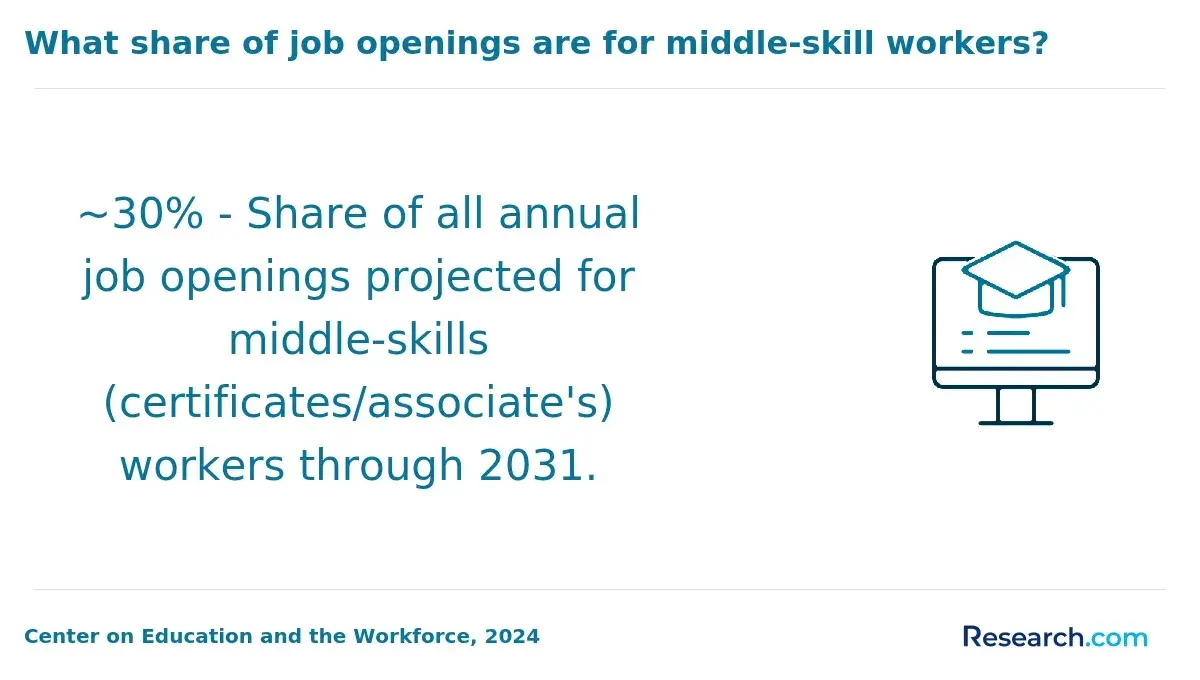
Stackable pathways are most useful in fields where employers value progressive technical skills and where colleges have established certificates-to-degree maps. Information technology, healthcare administration, business operations, logistics, manufacturing, education support, public safety administration, and design are common examples.
They are less useful when the intended job has a single mandatory route, such as a license requiring a specific approved degree, clinical placement, examination, or apprenticeship. In those cases, start by identifying the legal or employer requirement, then select the smallest credential that genuinely advances that requirement.
AI adoption is increasing the value of demonstrable skills in areas such as data analysis, cybersecurity, digital workflow management, and design tools. However, a short credential is not proof of broad professional readiness by itself. Pair coursework with projects, supervised experience, a portfolio, or an applicable industry certification where employers request one.
How Do Rolling Admissions Online Programs Work?
Rolling admissions means applications are reviewed on an ongoing basis rather than only after one fixed deadline. Online programs may offer monthly, every-eight-week, quarterly, or semester starts. Some admit qualified applicants until a cohort reaches capacity; others let students begin only after completing orientation, financial arrangements, and required documents.
This model benefits learners who cannot wait for a fall term, but it can create trade-offs. Frequent starts may use accelerated courses, limit elective availability, or delay access to clinical placements and capstone courses. Ask whether every course in the stack is offered often enough to preserve the advertised completion timeline.
Rolling admission is not the same as open admission. A program may still require a high school diploma or equivalent, prior college coursework, placement testing, prerequisite classes, identity verification, background screening, immunizations, or technology requirements. Submit documents early and obtain a written start-date estimate before resigning from work or arranging childcare.
What Courses Are in Stackable Credential Programs?
Coursework depends on the field and the level of the stack. Entry credentials generally teach foundational concepts and workplace tools; later credentials add advanced technical work, general education, practicum requirements, or management topics. A well-designed pathway clearly identifies which completed courses satisfy each next credential.
The following examples show how course sequences commonly progress. They are illustrative; course titles and required credits differ by institution.
| Pathway | Entry-level courses | Later stack components |
| Health information | Medical terminology, coding basics, health records | Advanced coding, reimbursement, compliance, data analytics |
| Information technology | Computer hardware, networking basics, operating systems | Cloud systems, cybersecurity, scripting, project work |
| Business operations | Business communication, spreadsheets, accounting fundamentals | Project management, analytics, supervision, operations |
| Legal studies | Legal research, writing, civil procedure basics | Litigation support, ethics, specialty law, internship |
Before enrolling, compare the catalog rather than relying only on marketing language. Look for required synchronous meetings, group projects, proctored exams, software fees, field experience, and whether courses must be taken in a fixed order. Learners seeking a degree should also verify how many stack courses satisfy general education versus major requirements.
How Long Do These Programs Take and Cost?
Completion time can range from a few weeks for a narrow noncredit microcredential to roughly one year for a college certificate; an associate-degree stack generally takes longer. Accelerated terms can shorten calendar time but increase weekly workload. The best pace is the one that lets you complete courses successfully while maintaining work and family commitments.
Total cost includes more than tuition. Credit-bearing programs may charge per credit, while noncredit programs often use a single course price. Budget for application fees, textbooks, online proctoring, software, certification examinations, required equipment, clinical screening, travel, and renewal fees where applicable.
For learners using aid, eligibility depends on the institution, program length, enrollment status, and federal rules. Explore FAFSA-approved online certificate programs only after confirming that the specific credential, not merely the college, is eligible for aid. Employer tuition assistance may also cover job-related coursework, but reimbursement policies often require advance approval and continued employment.
Compare cost per usable outcome: a lower-priced course is not necessarily economical if it cannot transfer, does not meet a licensing rule, or repeats training you already have.
What Jobs and Salaries Follow These Credentials?
Jobs after a stackable credential depend on the occupation, local hiring standards, prior experience, and whether the credential meets a required training standard. Certificates can support entry-level work or advancement, but they do not automatically confer a job title, salary, professional certification, or license.
These U.S. Bureau of Labor Statistics 2024 median annual wage figures describe occupations, not the earnings of certificate completers. They provide useful context when evaluating whether a pathway aligns with the work you want to pursue.
| Occupation | 2024 median annual pay | Credential consideration |
| Paralegals and legal assistants | $61,890 | Employers may prefer paralegal education; requirements vary |
| Medical records specialists | $50,250 | Certificate or associate coursework may help; certification can be preferred |
| Computer user support specialists | $60,340 | Employers may consider certificates, certifications, or experience |
| Graphic designers | $61,300 | Portfolio quality and software skills are important alongside education |
Use salary information as a market reference, not a return-on-investment promise. Compare local job postings for education requirements, required software, certifications, schedules, and experience. If your goal requires a bachelor's degree for advancement, compare the stack's transfer value with bachelor degrees that pay well before choosing a terminal certificate.
Do These Credentials Satisfy Licensure Requirements?
Sometimes, but only when the program is specifically approved for the license or certification pathway in your state. A school-issued certificate is an educational credential; it is not the same as a state license or an industry certification. Licensure boards determine qualifying education, clinical hours, examinations, background checks, and other conditions.
Fully online programs can be appropriate for nonclinical subjects, but many licensed occupations require in-person practical training. Nursing, dental hygiene, counseling, teaching, electrical work, cosmetology, and many allied health fields may have state-specific rules that cannot be satisfied through online coursework alone.
Before enrollment, obtain direct answers to these questions from the school and the relevant state board.
- Does this exact program meet educational requirements for initial licensure in my state?
- Are required labs, clinical placements, supervised hours, or apprenticeships included, and who arranges them?
- Does completion make me eligible to apply for the required examination, or are additional courses needed?
- Has the institution determined whether its online program is authorized for students living in my state?
Do not rely on a general statement that a program is "license-ready." Save written confirmation, because regulations and board interpretations can change.
How Do You Choose a Reputable Online Program?
A reputable online stack should make its credential level, cost, course sequence, student-support model, and outcome limitations easy to verify. Start with your target job rather than the school's marketing claim. Identify whether you need a college certificate, an associate degree, an industry certification, an apprenticeship, or state-approved training.
Then compare programs using evidence that affects the value of the stack.
- Match the curriculum to local job postings and any licensing or certification requirements.
- Request a written academic map showing exactly how completed courses stack into the next credential.
- Confirm institutional accreditation, programmatic approval where relevant, and authorization to enroll students in your state.
- Calculate full cost, including materials, exams, travel, clinical requirements, and fees not included in tuition.
- Ask how often each required course runs, whether instructors are accessible, and what career, tutoring, and technical support is available.
- Review withdrawal, refund, transfer-credit, and credential-expiration policies before paying.
Common red flags include vague transfer promises, pressure to enroll immediately, claims of guaranteed jobs or salaries, missing faculty information, and no clear explanation of hands-on requirements. A rolling-start program can be convenient, but convenience is not a substitute for a recognized pathway. If speed is the priority, compare workload and sequencing with accelerated online degree programs to determine whether a shorter credential or a faster degree route better fits your goal.
Other Things You Should Know About
Not always. Rolling admissions usually provides several start dates, but programs may still have application cutoffs, course capacity limits, orientation deadlines, and prerequisites. Confirm the next available start for every credential in the sequence.
It may, but transfer is never automatic. Credit-bearing courses are more likely to be considered than noncredit courses, especially when schools have an articulation agreement. Ask the receiving school to evaluate transferability before you enroll.
They can be worthwhile when they teach skills requested in target job postings and create a documented path to a higher credential. They are a weaker choice when the desired career requires a specific license, extensive hands-on training, or a bachelor's degree from the outset.
No. A certificate is generally awarded by an educational provider for completing coursework. A professional certification is typically awarded by a certifying organization after meeting standards that may include an exam, work experience, and continuing education.
References
- Tuition and Financial Aid https://www.relay.edu/tuition-and-financial-aid
- Online California Multiple Subject Teaching Credential https://www.pacificoaks.edu/academic-programs/online-learning/online-california-preliminary-multiple-subject-teaching-credential/
- USHE initiative helps students earn meaningful credentials on their way to a degree - Utah System of Higher Education https://ushe.edu/stackable-credentials-help-students-earn-credentials-on-their-way-to-a-degree/
- Teach Now Admission Requirements | Moreland University https://moreland.edu/teacher-certification-program-online/admission-requirements
- What are Stackable Credentials? https://assess.com/stackable-credentials/
- What Are Stackable Credentials and Why Do They Matter? https://www.pltw.org/blog/what-are-stackable-credentials
- 2025's Best Online Graduate Certificate Programs in the U.S. https://www.onlinemastersdegrees.org/graduate-certificate-programs/
- 10 Best Online Colleges with Rolling Admissions for 2026 - Rankings https://www.collegeconsensus.com/rankings/best-online-colleges-with-weekly-start-dates/
- Best Student Loans for Certificate Programs - Credible https://www.credible.com/student-loans/student-loans-for-certificate-programs
- How To Apply | Teach For America https://www.teachforamerica.org/apply/application-process