2027 Credit-Bearing vs. Noncredit Prerequisites for a Data Science Master's

Co-Founder and Chief Data Scientist
Choosing between credit-bearing and noncredit prerequisites can determine whether your preparation merely builds skills or also fulfills a data science master's admissions requirement. For applicants missing calculus, statistics, or programming, the distinction matters before paying for a course.
This guide explains what each option can demonstrate, where program policies differ, and how to choose the least costly route that your target schools will actually accept.
Key Things You Should Know
- Choose a graded, credit-bearing course when a program requires transcripted coursework or a minimum grade; a noncredit certificate is not automatically equivalent.
- Choose noncredit study when the program accepts other evidence of readiness or when you need skills practice rather than formal prerequisite fulfillment.
- Before enrolling, ask each target program to confirm the exact course, provider, grade standard, and deadline it will accept; these rules are not uniform across data science master's programs.
What are credit-bearing and noncredit prerequisites for a data science master's?
A credit-bearing prerequisite is an academic course that awards college credit and ordinarily appears with a grade on an official transcript. A noncredit prerequisite is preparation that does not award college credit, such as a continuing-education course, professional certificate, or self-paced course. Both can teach the same subject, but they provide different admissions evidence.
The distinction matters when a program specifies how applicants must document prior learning. This comparison describes what each format normally produces, not what any particular school promises to accept.
| Feature | Credit-bearing course | Noncredit course |
| Typical record | Official college transcript showing credit and grade | Certificate, completion record, or assessment result |
| Admissions use | Can document a formal course requirement if the program approves its content and level | Can demonstrate preparation; formal acceptance depends on program policy |
| Common trade-off | Often involves institutional tuition, enrollment procedures, and graded work | May offer more flexible practice but less standardized academic evidence |
A course marketed as a "prerequisite" is not necessarily approved by the master's program you plan to enter. Likewise, earning college credit does not mean the course will count toward the master's degree; fulfilling an admissions prerequisite and receiving graduate transfer credit are separate decisions.
Which prerequisites do data science master's programs typically require?
Programs commonly look for preparation in quantitative reasoning, statistics, and programming, but their stated requirements vary. One may name specific undergraduate courses; another may assess equivalent coursework or experience. Some admit students who still need foundation courses, while others expect those gaps to be closed before enrollment. A bachelor's degree in a particular major should not be treated as automatic proof of readiness - or as an automatic barrier.
Read the admissions page for the exact requirement, then read the curriculum to understand why it exists. An applicant comfortable with Python but unfamiliar with linear algebra has a different gap from someone who has taken mathematics courses but never written code. If your interests are closer to AI than general data science, AI master's program fit for non-CS applicants offers a related way to assess preparation without assuming the two types of program set identical requirements.
Do noncredit prerequisite courses satisfy data science master's admissions requirements?
Sometimes, but not automatically. Noncredit study may be persuasive when a program evaluates demonstrated competence rather than requiring a transcripted course. A completion certificate alone may be insufficient if admissions requires college credit, a letter grade, or coursework from an accredited institution. Projects and professional experience can strengthen an application, but they do not override a stated formal requirement unless the program grants an exception.
The most consequential mistake is interpreting "recommended background" as a required course - or interpreting "equivalent experience considered" as a promise that any certificate qualifies. Ask admissions whether the requirement is mandatory, whether noncredit evidence can satisfy it, and who makes the equivalency decision. Request written confirmation for the specific course or credential you intend to use.
How do accredited data science master's programs evaluate prerequisite coursework?
Institutional accreditation tells you about the institution's recognized status; it does not establish a universal prerequisite-acceptance rule. The receiving program decides whether earlier coursework meets its admissions standard. Its review may consider the issuing institution, course description, topics, academic level, grade, recency, and whether the course was completed before the required deadline.
For applicants comparing courses at different schools, these are the documents and questions worth gathering before registration:
- Provide the target program with the proposed course's catalog description and syllabus, including its mathematics or programming topics.
- Ask whether an official transcript and minimum grade are required, and whether the course must award a particular type or level of credit.
- Confirm whether approval means admissions prerequisite fulfillment only, rather than credit toward the graduate degree.
Keep the response from the admissions office. A course title such as "Statistics" may not reveal whether it covers the probability or inference expected for graduate work.
Which mathematics, statistics, and programming courses prepare students for admission?
Calculus, linear algebra, probability, statistics, and programming are useful areas to check against a program's stated expectations. They serve different purposes: calculus and linear algebra support many modeling methods; probability and statistics support inference and uncertainty; programming supports data preparation and analysis. The appropriate course depends on the gap you actually have and the content the program requires - not on collecting every possible credential.
A practical sequence is to compare your transcript and work against each target program's requirements, identify the missing subjects, and seek approval for courses that cover those subjects. If a program names a graded statistics course, prioritize an approved credit-bearing option. If it asks applicants to demonstrate Python competence without prescribing coursework, a noncredit course paired with substantial, explainable code may be more suitable.
Applicants aiming specifically for AI roles should check whether their intended curriculum demands more mathematical or computing depth. Aligning AI study with your intended career can help clarify that goal before you pay for preparation that does not address it.
Can applicants complete data science prerequisites online or at another college?
Often, applicants can prepare online or through another college, but delivery format and provider are separate approval questions. An online, credit-bearing course may provide the transcript a program requests. An online noncredit course may provide excellent instruction yet fail to meet a transcripted-course rule. Taking a course at a community college or another university likewise does not guarantee equivalency.
Before paying, send the receiving program the provider's name, course number, syllabus, credit status, grading method, and planned completion date. Ask whether the course will satisfy the named prerequisite if you earn the required grade. If you plan to use several courses, obtain an answer for each one; approval of introductory programming does not establish approval of statistics.
How do prerequisite requirements differ between online and campus-based programs?
Do not assume that an online master's has lighter prerequisites. Requirements arise from the program's curriculum and admissions policy, not simply where classes meet. Some programs offer preparatory courses or conditional routes, but applicants should verify both whether those options exist and when they must be completed.
Format can change the logistics of closing a gap. An online applicant may need a prerequisite available remotely before the start term; a campus applicant may have access to local undergraduate courses. Compare the full path from your current preparation to graduate enrollment, not just the advertised master's schedule. If you are also considering AI degrees, shorter pathways to an artificial intelligence master's are most useful to compare after accounting for any preparatory work you would need first.
How long and how much does prerequisite preparation for a data science master's take?
There is no reliable universal price or timeline: both depend on your existing preparation, the number of approved courses you need, the provider's charges, course availability, and whether subjects must be taken in sequence. Compare the total preparation cost - tuition or course price, mandatory fees, materials, and any additional time before graduate enrollment - rather than choosing the cheapest course listing.
Noncredit study may be the less expensive or more flexible choice when it satisfies your purpose. It can become an expensive detour if a program later requires you to retake the subject for credit. Conversely, paying for a credit-bearing course you do not need may add cost without improving your application. Applicants comparing fields as well as credentials can use affordable online study in artificial intelligence as a separate cost comparison, while checking prerequisite expenses for each program individually.
What career outcomes and salaries can data science master's graduates expect?
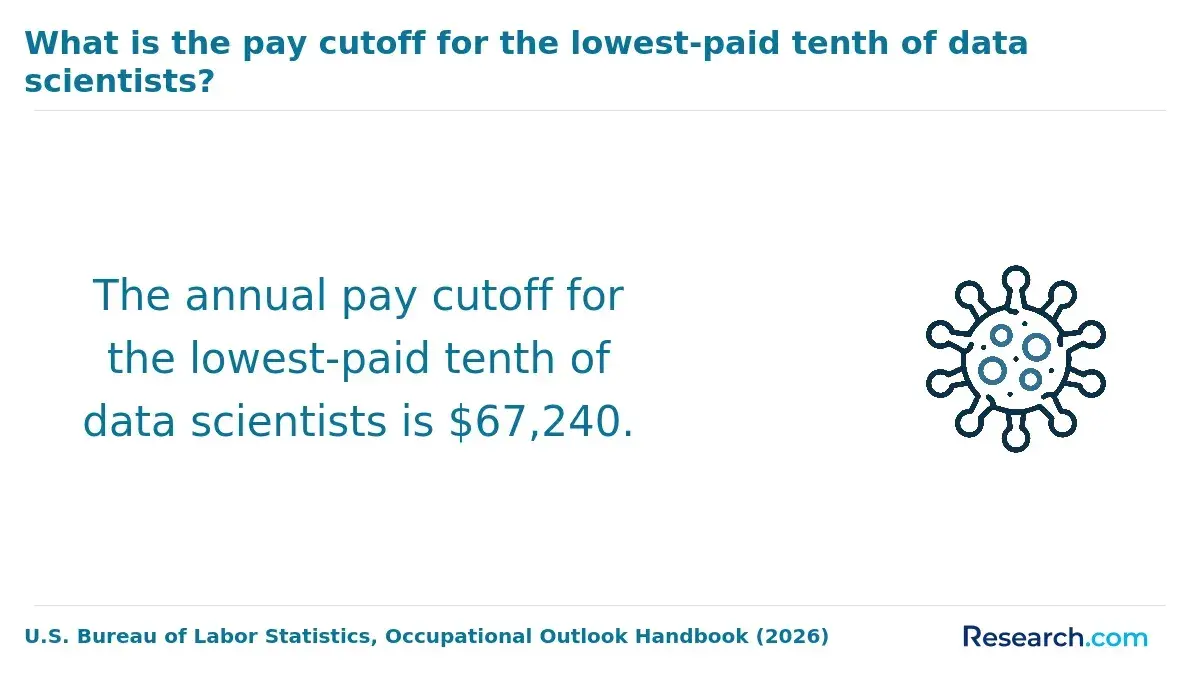
Prerequisites are an investment in reaching a program, not a guarantee of a job or salary. The U.S. Bureau of Labor Statistics reports a $120,230 median annual wage for data scientists in May 2025. That occupation-wide figure includes workers with different education and experience; it is not a starting salary or a measured outcome for graduates of any particular master's program.
Use your career goal to judge whether preparation and graduate study are worth the additional time and cost. A person moving toward statistical modeling may benefit from a different foundation than someone targeting data engineering. For a closer look at roles rather than a presumed return on tuition, see data career pathways supported by online data science study. Prior experience, location, employer, and the role you pursue will all affect your eventual outcome.
Do data science careers require professional licenses or certifications?
Data scientist is not generally a profession with one universal state license, and an optional certification is not a substitute for an admissions prerequisite unless a program explicitly accepts it. Employer expectations can still differ by role and industry. Applicants targeting regulated settings should check the requirements of the specific job rather than assume a data science degree or certificate grants permission to perform every associated task.
For the prerequisite decision, treat certifications as evidence of skills, not as college credit by default. If a program mentions them as acceptable evidence, ask what assessment, experience, or documentation it expects alongside the credential.
Other Things You Should Know About Data Science
That depends on the program's deadline and admissions policy. Ask whether it permits an in-progress course, when the final transcript is due, and whether any offer would be conditional.
Some programs consider how recently you used the material, while others publish no course-age limit. Ask for the program's policy and be ready to explain recent practice if your coursework is older.
Do not assume so. A course can support admission without counting toward degree requirements or the graduate GPA. Check the receiving school's academic-record policy.
It may, depending on your employer's rules and the course provider. Confirm eligibility and any approval deadline with your benefits administrator before enrolling.
References
- Testing and Placement | North Park University https://www.northpark.edu/admissions-aid/admitted-undergraduate-students/testing-and-placement/
- General Admission Requirements - Louisiana College https://catalog.lcuniversity.edu/content.php
- Frequently Asked Questions (FAQ) | CDS - Data Science https://codas.uchicago.edu/frequently-asked-questions/
- Prerequisites and Corequisites - Curriculum Management https://curriculummanagement.oregonstate.edu/pop/prerequisites-and-corequisites
- MSDS Course Requirements | ucsd.edu https://datascience.ucsd.edu/msds-course-requirements/
- How to Earn Credit for Non-Collegiate Learning | CUNY SPS https://sps.cuny.edu/academics/credit-prior-learning/credit-non-collegiate-learning
- COCI Policies and Procedures | ucdavis.edu https://academicsenate.ucdavis.edu/committees/courses-of-instruction/policies-procedures
- Prerequisite Key Topics - UVA School of Data Science https://datascience.virginia.edu/pages/prerequisite-key-topics
- Placement Tests Exemptions | Moraine Valley Community College https://www.morainevalley.edu/student-resources/testing-services/placement-tests-exemptions/
- | Medicine | Prerequisite Coursework Evaluation https://admissions.osu.edu/standards/standard.aspx