2027 Best Certificate Programs With Financial Aid Options

Co-Founder and Chief Data Scientist
Choosing a certificate is difficult when the lowest sticker price may not qualify for aid, transfer to a degree, or meet licensing rules. This guide compares credit-bearing career certificates, trade training, and professional programs that may have financial aid options.
In 2024-25, average published tuition and fees at public two-year colleges were $4,050, according to the College Board, making community-college certificates a useful starting point for cost-conscious learners. Learn how to verify aid eligibility, compare formats, assess outcomes, and select training aligned with a real job target.
Key Things You Should Know
- Federal aid generally requires enrollment in an eligible program at an approved institution; a short, noncredit certificate or third-party training course may not qualify even if it is career-focused.
- Public two-year colleges averaged $4,050 in published in-district tuition and fees for 2024-25, but books, tools, testing, clinical requirements, and lost work time can materially change a certificate's total cost.
- Choose the credential backward from the job: confirm employer expectations, state licensing rules, certification-exam eligibility, program accreditation, and whether credits can stack into an associate or bachelor's degree.
Top 10 Best Certificate Programs With Financial Aid Options
Popular Trade School Programs
Popular credit-bearing trade certificates include welding, HVAC/R, electrical technology, plumbing, automotive service, diesel technology, industrial maintenance, and construction management. Programs typically combine safety instruction with lab work and may take several months to two years.
Apprenticeships can be a better fit for learners who want paid work-based training, especially in electrical and plumbing trades. Before enrolling, verify whether the curriculum supports an apprenticeship, prepares you for an industry exam, or meets state licensing education rules. Tool purchases, protective equipment, and exam fees can add substantially to tuition.
Healthcare Programs
Healthcare certificates may prepare students for medical assisting, practical nursing, phlebotomy, pharmacy technician, dental assisting, billing and coding, or medical records work. Many include clinical placements, background checks, immunizations, CPR training, and drug screening.
A school certificate is not the same as a professional certification or state license: practical nursing requires licensure, while employers may prefer national certification for roles such as medical assistant or pharmacy technician. Confirm that clinical sites are available and that the program meets your state's rules before paying a deposit, particularly for online or hybrid programs.
Criminal Justice / Law Programs
Certificate and associate options in criminal justice, paralegal studies, legal assisting, homeland security, and corrections can build foundations in legal procedure, ethics, report writing, and evidence handling. A paralegal certificate may be appropriate for applicants who already hold a bachelor's degree or want focused legal training; an associate degree can provide a broader entry route.
Neither credential independently authorizes legal practice. Police, corrections, court, and security roles may require separate agency hiring standards, background checks, physical testing, academy training, or state-specific licensing.
Arts & Design Programs
Arts and design certificates commonly cover graphic design, UX/UI fundamentals, digital media, photography, web design, animation, interior design, and video production. They are best evaluated through portfolio development, software access, instructor feedback, and employer-relevant projects rather than course titles alone.
A short certificate can help an experienced creative update technical skills, while beginners may need a longer associate degree to build a competitive portfolio. Ask whether software licenses, equipment, portfolio reviews, internships, and intellectual-property guidance are included in the total cost.
What types of certificate programs qualify for federal and state financial aid?
Financial aid eligibility depends more on the institution and program structure than on the word "certificate." An academic or career certificate is an educational award for completing a defined curriculum. A professional certification is usually awarded by an industry body after an exam or other requirements; exam-prep courses do not automatically qualify for federal aid.
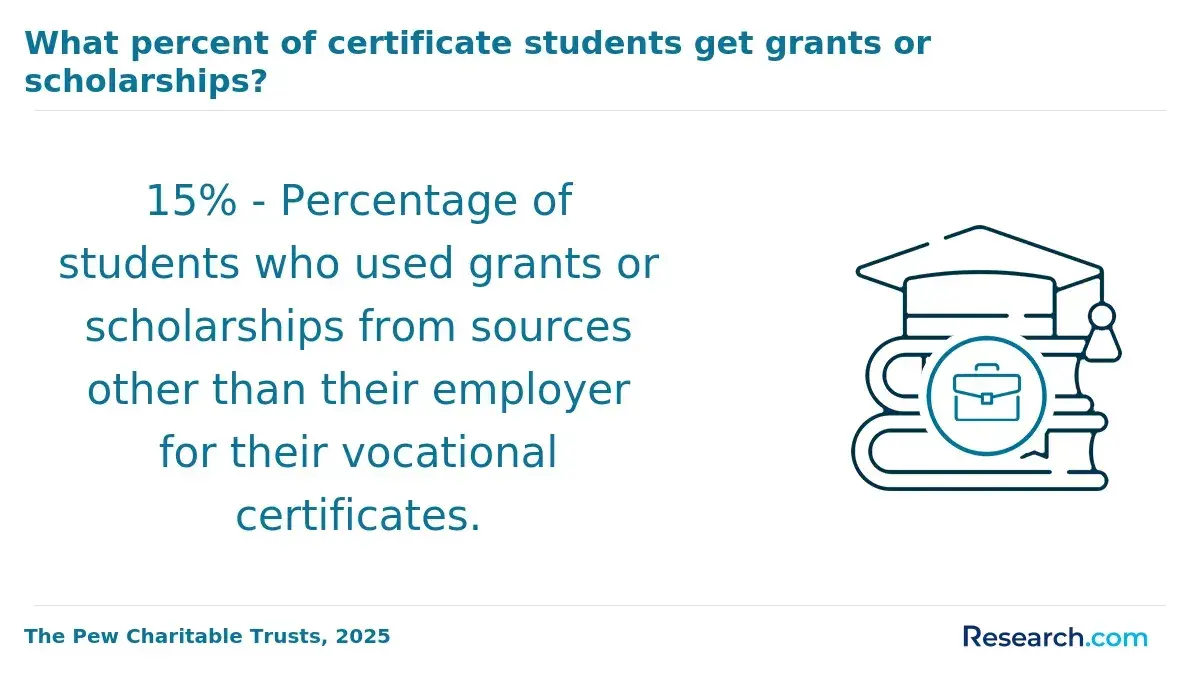
Federal student aid may be available when a student is enrolled in an eligible certificate program at a participating school and meets FAFSA eligibility rules. Eligible programs generally must lead to a degree or recognized credential and meet federal length and other requirements. Federal Pell Grant eligibility is need-based; the maximum Pell Grant for 2024-25 was $7,395, but awards depend on financial need, enrollment intensity, and other individual factors.
State grants, workforce-agency funding, veterans' education benefits, employer tuition assistance, and school scholarships can fill gaps, but rules differ by state and provider. The comparison below shows why the program's status matters before you apply.
| Program type | Typical provider | Potential aid pathway | Important limitation |
| Credit-bearing career certificate | Community college or accredited career school | May be eligible for federal, state, institutional, or workforce aid | Program and student must meet applicable eligibility rules |
| Noncredit workforce certificate | College continuing education unit or workforce provider | May use workforce grants, employer aid, or payment plans | Often does not qualify for federal student aid |
| Industry certification exam prep | Training company, association, or online platform | Employer reimbursement or private financing may be available | Training and the certification itself are separate credentials |
| Registered apprenticeship | Employer, union, or sponsor | Paid employment plus possible related-instruction support | Availability and entry requirements vary by sponsor |
Ask the financial-aid office for the program's federal school code, its aid-eligible status, required enrollment level, and a written estimate of grants, loans, and out-of-pocket costs. Do not assume FAFSA submission alone makes every course eligible.
How do online and campus certificate programs compare for flexibility, cost, and support?
Online certificates can reduce commuting and scheduling barriers, but they are not automatically cheaper or more flexible. Campus and hybrid formats are often stronger choices when learning requires labs, equipment, clinical rotations, shop supervision, or local employer connections. Learners seeking eligible distance options can compare online colleges while confirming that the specific certificate, not just the institution, participates in aid programs.
This comparison highlights the practical trade-offs to consider before choosing a delivery format.
| Factor | Online | Campus or hybrid |
| Schedule | Often asynchronous for lecture-based material; deadlines still apply | Fixed class, lab, or clinical times are common |
| Direct cost | May reduce commuting and housing costs | May include campus, lab, parking, or facility fees |
| Hands-on learning | Best for theory, software, business, and some administrative skills | Usually better for trades, clinical care, and equipment-intensive training |
| Support | Quality depends on remote tutoring, advising, and instructor access | Can offer in-person labs, peer networks, and on-site services |
| Licensure preparation | Must be checked carefully in the student's state | May simplify local placement and supervised-hour requirements |
Choose online study if you can reliably manage independent work and the role does not require extensive in-person practice. Choose campus or hybrid training when supervised skill demonstration, clinical placement, or employer networking is central to employability.
What accreditation and licensing requirements should certificate students look for?
Accreditation is institutional or programmatic quality review; it is not the same as a certificate, certification, or license. For federal aid, start by confirming that the school participates in federal student-aid programs. Institutional accreditation can also matter for credit transfer, while specialized accreditation may be essential in fields such as nursing, medical assisting, and some technical education programs.
Use directories of top online colleges as a starting point for researching institutional quality, then verify the program's own approval directly with the school and relevant accreditor. Do not rely only on an institution's marketing language.
Licensure is regulated by a state board or agency and is role-specific. Before enrolling in nursing, cosmetology, electrical work, counseling, or another regulated field, ask whether the curriculum meets the educational requirements in the state where you intend to work. Online programs may be unable to place students in required clinical or supervised experiences outside certain states.
Key red flags include vague claims of "accreditation" without naming the accreditor, no published licensing disclosures, promises of guaranteed certification, and a refusal to explain whether graduates are eligible for the required exam.
What admission prerequisites and application materials are required for most certificate programs?
Admissions requirements vary substantially by credential. Credit-bearing undergraduate certificates commonly require a high school diploma, GED, or equivalent and an application; some use placement measures for English or math.
Selective healthcare programs may add prerequisites, minimum grades, entrance testing, immunization documentation, background checks, and drug screening. Graduate certificates generally require a bachelor's degree, while noncredit training may have few formal admissions requirements.
Self-directed formats can suit experienced learners, but they require realistic time management. Compare best online self-paced colleges only after confirming whether pacing, proctored exams, labs, and aid disbursement rules work with your schedule.
Prepare a short application checklist before deadlines close.
- Request official transcripts early and ask whether prior college, military, apprenticeship, or industry training can be evaluated for credit.
- Confirm prerequisite courses and their required grades, especially for healthcare and technical programs with limited seats.
- Calculate time for placement testing, financial-aid verification, background checks, vaccinations, tools, and orientation.
- Ask whether admission to the college is separate from admission to the certificate cohort or clinical sequence.
A common mistake is treating open college admission as guaranteed entry to a selective program. Get the program-level requirements in writing and identify the next available cohort date.
How long do certificate programs typically take and what tuition and fees should you expect?
Certificate length ranges from a few months for focused training to about one year or longer for many credit-bearing career certificates. Time to completion depends on prerequisites, course sequencing, clinical or lab availability, and whether you attend full time. Accelerated programs can shorten calendar time, but they may leave little room for full-time work or repeating a difficult course.
Cost should be evaluated as a total budget, not only tuition. The 2024-25 national average published tuition and fees at public two-year colleges was $4,050 for in-district students, according to the College Board; your local certificate may cost more or less depending on credits, residency, and specialized fees.
| Cost category | Why it matters | What to verify |
| Tuition and mandatory fees | Usually the largest billed charge | Total credits or clock hours, residency rate, and repeat-course charges |
| Books, software, and supplies | Can be significant in design and technology programs | Whether digital access codes and licenses are included |
| Tools, uniforms, and equipment | Common in trades and clinical programs | Required brand, ownership rules, and replacement costs |
| Testing, licensing, and background checks | May be necessary to begin work after completion | Which fees are separate from tuition |
| Transportation and unpaid placement time | Can affect working students' real budget | Clinical, internship, lab, or externship scheduling |
If a certificate will not provide the advancement you need, compare it with online affordable master's programs only when you already hold the required undergraduate degree and the target occupation truly benefits from graduate education.
What core courses and skills are taught in high-demand career certificate programs?
High-demand certificates emphasize demonstrable workplace skills, not just course completion. The most useful curriculum maps each course to equipment, software, safety standards, documentation practices, client communication, and an employer-recognized assessment where relevant.
AI tools are changing administrative, design, and technology workflows, so programs should teach responsible use, verification, privacy, and human review rather than presenting automation as a substitute for foundational skills.
The table summarizes common skill patterns and the evidence a student should expect to produce.
| Career area | Core learning | Useful evidence of readiness |
| Skilled trades | Safety, blueprint reading, measurements, diagnostics, equipment operation | Lab competencies, work samples, apprenticeship readiness |
| Healthcare support | Patient communication, documentation, infection control, basic clinical or administrative procedures | Verified clinical hours or supervised competencies when required |
| Legal support | Legal research, writing, case-file organization, ethics, procedure | Drafting samples and supervised practical assignments |
| Design and digital media | Design principles, relevant software, accessibility, revision workflow | Portfolio demonstrating process and finished work |
| IT and business operations | Data handling, spreadsheets, customer support, cybersecurity basics, project workflow | Projects, simulations, and role-relevant industry certifications where appropriate |
Ask whether instructors assess hands-on competence and whether the program provides feedback on résumés, portfolios, interviews, or certification-exam preparation. A curriculum that lists only broad topics without measurable practice deserves closer scrutiny.
What jobs can you get with a certificate and how do career pathways work?
A certificate can support entry-level work, career change, skill updating, or progression into an associate degree, but the outcome depends on the occupation and local hiring market. It is most valuable when it is directly connected to a defined job family and employers recognize the training. In regulated occupations, completion may be only one step before an exam, license, supervised practice period, or employer training.
Career pathways commonly follow one of these patterns.
- Enter an entry-level support role, gain experience, and add an industry certification or specialized certificate.
- Use a credit-bearing certificate as a stackable first step toward an associate or bachelor's degree.
- Complete employer-sponsored or apprenticeship training while earning wages and progressing through documented competencies.
- Use an advanced certificate to update an existing degree or work background rather than to enter a field from scratch.
Before enrolling, review at least 10 local job postings for your target title. Note required education, certifications, software, licenses, shift expectations, and experience. If postings consistently request a degree or license beyond the certificate, treat the certificate as a stepping stone rather than a complete qualification.
What are typical salary ranges and earning potential for certificate program graduates?
Occupational wage data describes people working in an occupation, not the earnings of certificate graduates. Pay varies by location, experience, employer, union coverage, licensing status, and shift differentials. A certificate alone may not qualify a candidate for every role shown below.
These U.S. Bureau of Labor Statistics May 2024 median annual wage figures and 2023-33 employment projections provide context for several certificate-related pathways.
| Occupation | Median annual wage, May 2024 | Projected growth, 2023-33 | Credential caution |
| Electricians | $62,350 | 11% | Typically requires apprenticeship and state or local licensing |
| Medical assistants | $44,200 | 15% | Requirements and employer preferences vary; certification may be preferred |
| Medical records specialists | $48,780 | 7% | Certificate training can be relevant, but coding roles may seek added credentials |
| Paralegals and legal assistants | $61,010 | -1% | Employers may prefer degree-level education or prior legal experience |
| Graphic designers | $61,300 | 2% | Portfolio quality and experience are often decisive |
Use wage data to compare the field's broader earning potential against total training cost and time away from work. Also check local wages and job postings, because national medians do not predict an individual offer or regional demand.
How can you evaluate and choose a reputable certificate program with strong outcomes?
A reputable program makes its credential, costs, admissions rules, aid eligibility, learning format, and outcomes understandable before enrollment. "Best" should mean best fit for your target role, budget, schedule, and location - not the shortest advertised timeline or the most aggressive marketing.
Use this process to compare finalists consistently.
- Choose a specific target job and identify its required license, certification, degree level, and typical entry requirements from employers and state regulators.
- Verify the school's institutional status, the program's approval or specialized accreditation where relevant, and whether the curriculum meets requirements in your state.
- Request a written total-cost estimate that separates tuition, fees, books, tools, exams, uniforms, background checks, and transportation.
- Ask the financial-aid office whether the exact program is aid-eligible, what enrollment level is required, and how withdrawals or repeated courses affect aid.
- Compare completion, placement, licensure-exam, and debt information only when the school defines the measures and provides the reporting period.
- Speak with program staff about clinical sites, lab access, instructor availability, career services, and pathways to additional credentials.
Walk away from programs that guarantee jobs or salaries, pressure you to sign immediately, hide total costs, cannot explain licensing eligibility, or use "accredited" without identifying who recognized the school or program. A lower-cost, stackable public-college certificate can be a stronger investment than an expensive private option if both lead to the same recognized next step.
Other Things You Should Know About
Possibly. FAFSA can support eligible certificate programs at participating schools when both the student and program meet federal requirements. Noncredit training, very short courses, and many third-party certificate programs may not qualify. Confirm eligibility with the school's financial-aid office before enrolling.
A certificate is awarded by a school or training provider after completing a course of study. A certification is usually awarded by an industry or professional organization after meeting its standards, which may include an exam, work experience, or continuing education. A certificate may prepare you for a certification, but it does not automatically grant one.
Some are. Delivery format does not by itself determine eligibility. The institution must participate in aid programs, and the specific online certificate must meet applicable requirements. Also verify that online study satisfies any clinical, lab, exam, or state licensing requirements.
A certificate is usually better when you need focused, faster training for a clearly defined entry-level skill or when it stacks into a later degree. An associate degree may be better when employers expect broader general education, when you want more transfer options, or when the field requires deeper preparation.
References
- Best Student Loans for Certificate Programs - Credible https://www.credible.com/student-loans/student-loans-for-certificate-programs
- Types of Financial Aid https://www.hhloans.com/types-of-financial-aid/
- Are Certificate Programs Eligible for Financial Aid? | University of Phoenix https://www.phoenix.edu/blog/are-certificate-programs-eligible-for-financial-aid.html
- The Top 5 Certificate Programs for Jobs With Growth Potential | CourseStorm https://www.coursestorm.com/blog/top-certificate-programs-for-jobs
- Financial Aid For Online Colleges https://www.affordablecollegesonline.org/financial-aid/financial-aid-for-online-colleges/
- 2025's Best Online Graduate Certificate Programs in the U.S. https://www.onlinemastersdegrees.org/graduate-certificate-programs/
- Average Cost of College [2025]: Yearly Tuition + Expenses https://educationdata.org/average-cost-of-college
- Scholarships for Students Pursuing Career Education https://career.org/web/web/Multimedia/CER/Articles/Scholarships-for-Students-Pursuing-Career-Education.aspx
- 7 in-demand certifications in 2025 | edX https://www.edx.org/resources/in-demand-professional-certifications
- Student Loan Options for Certificate Programs https://collegefinance.com/student-loans/student-loan-options-for-certificate-programs