2027 Best Online Short Certificate Programs for Job Security

Co-Founder and Chief Data Scientist
Choosing a short online certificate is not simply about finishing quickly; it is about avoiding training that does not lead to a viable next step. U.S. Bureau of Labor Statistics projections for 2024-2034 show that employment across all occupations is expected to grow 3.1%, while demand varies sharply by field.
This guide helps career changers, working adults, and recent graduates compare certificate paths with durable demand, understand licensing limits, estimate costs and timelines, and choose training that fits a real job target.
Key Things You Should Know
- For job security, prioritize certificates connected to regulated services, essential infrastructure, or employer-recognized technical skills; healthcare support, HVAC, medical records, and certain IT roles generally have clearer demand signals than broad general-interest certificates.
- A short certificate is an educational program, while a professional certification is usually an industry credential earned through an exam or documented experience; many careers require one, the other, or both.
- BLS projects 12% growth for medical assistants and 8% growth for heating, air conditioning, and refrigeration mechanics and installers from 2024-2034, but state licensure, clinical training, and employer requirements can determine whether an online program is usable.
Top 10 Best Online Short Certificate Programs for Job Security
Popular Trade School Programs
Online trade certificates work best for the classroom portion of careers that still require hands-on labs, apprenticeships, or supervised field practice. Popular options include HVAC/R fundamentals, electrical theory, welding technology, construction estimating, industrial maintenance, and logistics.
HVAC is especially worth comparing: BLS projects 8% employment growth for HVAC mechanics and installers from 2024-2034. A fully online course alone does not qualify someone for field work where a state license, EPA Section 608 certification, apprenticeship hours, or in-person competency testing is required. Ask where practical training occurs before enrolling.
Healthcare Programs
Short healthcare certificates can lead toward medical assisting, phlebotomy, billing and coding, pharmacy technician work, or patient-care support. They suit learners comfortable with privacy rules, detailed documentation, and patient interaction. Medical assistant employment is projected to grow 12% from 2024-2034, according to BLS, but employers may prefer accredited programs and certification eligibility.
Clinical roles usually require externships that cannot be completed entirely online. Medical billing and coding may be more online-friendly, although a certificate does not automatically confer a coding certification. Verify clinical placement support, state rules, and exam eligibility.
Criminal Justice / Law Programs
Online certificates in paralegal studies, legal research, court reporting support, legal technology, and criminal justice administration can build useful office and research skills. They are best for administrative or support pathways rather than careers requiring a law degree, police academy training, or government hiring clearance.
Paralegals and legal assistants had a 2024 median annual wage of $61,010, according to BLS, although a certificate alone does not ensure entry into that occupation. Choose an American Bar Association-approved paralegal program when that distinction matters to target employers, and confirm whether local firms expect a degree.
Arts & Design Programs
Certificates in graphic design, UX design, digital marketing design, web design, animation, and photography can be useful when paired with a polished portfolio. These programs fit self-directed learners who can practice regularly and show project-based evidence of their skills.
Job security is less tied to the certificate name than to technical depth, portfolio quality, client communication, and comfort with evolving design tools. BLS projects 8% growth for web developers and digital designers from 2024-2034, while graphic designer employment is projected to grow 2%. Review software access and portfolio feedback before paying.
Which online certificates lead to the most stable jobs?
The most stable options usually support services people and organizations need regardless of economic cycles: patient care, health records, building maintenance, supply chains, bookkeeping, and information security. Stability does not mean a job is guaranteed. It means the certificate aligns with an occupation that has sustained demand, identifiable employers, and a clear entry route.
This comparison separates certificates that can build employable skills from those that require additional licensing, experience, or a degree. Use it to avoid assuming that an online completion credential alone unlocks a regulated occupation.
| Certificate area | Typical online fit | Job-security rationale | Important limitation |
| Medical billing and coding | Often fully online | Healthcare organizations need accurate reimbursement and records work | Employers may prefer a separate coding certification or experience |
| Medical assisting | Hybrid | Clinical offices continue to need support staff | Externship and state-specific requirements may apply |
| HVAC/R | Hybrid | Heating, cooling, repair, and replacement work is location-based and essential | Hands-on training and EPA certification are commonly needed |
| IT support or networking | Often fully online | Organizations maintain devices, networks, and user support | Vendor certifications and experience can matter more than a school certificate |
| Bookkeeping and payroll | Often fully online | Small businesses need recurring financial administration | Automation changes tasks; software fluency is essential |
| Supply chain and logistics | Often fully online | Warehousing, purchasing, and transportation operations require coordination | Entry roles may favor relevant work experience |
For the strongest return, start with the job advertisement rather than the course catalog. Read at least 15 local or remote postings for the role you want, identify repeated requirements, then choose a certificate that teaches those skills and leads to any required exam.
Technology-focused learners who eventually need a graduate credential should not use a short certificate as a substitute for a degree. Compare it with the easiest online masters degree only when the target occupation actually values graduate-level education.
How do accreditation and licensing affect certificate value?
Accreditation evaluates an institution or program against established standards; licensing is legal permission from a state or other authority to practice a regulated occupation. Neither term means the same thing as certification. A professional certification is typically granted by an industry body after an examination or other eligibility requirements.
Accreditation matters most when a certificate is credit-bearing, uses federal student aid, must transfer into a degree, or is intended to meet programmatic requirements for a healthcare or technical career. Institutional accreditation can help establish that a college meets recognized standards, while specialized programmatic accreditation may be critical for certain clinical pathways.
Before choosing an online healthcare, trade, or legal-support program, confirm the following directly with the school and relevant regulator:
- Whether the credential is a college certificate, a noncredit career-training certificate, or preparation for an external certification exam
- Whether online coursework is accepted for your state's licensing, registration, or certification pathway
- Where required clinicals, labs, skills assessments, or externships take place and who arranges them
- Whether the program holds any accreditation required for exam eligibility or employer recognition
- Whether credits transfer or stack into an associate or bachelor's degree, if continued education is part of your plan
A common mistake is seeing "accredited" in advertising and assuming it applies to your intended license. Ask for the exact accreditor, the program's approval status, and written confirmation of eligibility. If the school cannot clearly explain these items, treat that as a red flag.
Which short certificates have the strongest job outlook?
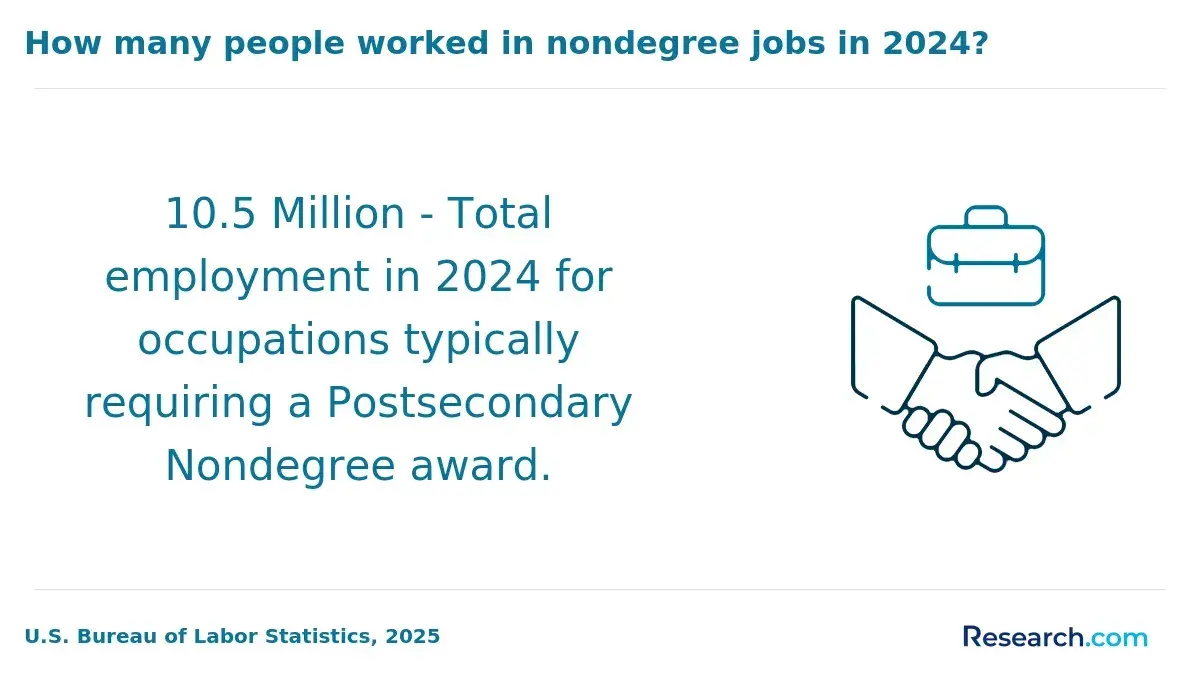
Among common short-program targets, healthcare support and skilled mechanical work show comparatively strong projected growth. BLS projects 12% growth for medical assistants, 7% for medical records specialists, 8% for HVAC mechanics and installers, and 6% for phlebotomists from 2024-2034. Projections describe nationwide occupational demand, not the likelihood that a particular graduate will be hired.
Healthcare support may be the stronger choice for learners who can complete clinical requirements and meet background, immunization, or health-screening rules. HVAC may be a better fit for learners who prefer physical troubleshooting, variable work sites, and apprenticeship-style learning. Medical records work can suit detail-oriented learners seeking an office-based path, but coding employers may expect knowledge beyond a basic certificate.
Do not choose solely by the highest projected growth rate. A smaller occupation can show rapid growth while still having fewer openings than a larger field. Compare local openings, schedule requirements, entry-level competition, required credentials, and whether the role can realistically be performed where you live.
If you decide a certificate is too narrow for your long-term goal, reviewing the cheapest easiest online degree options can help you compare a broader academic credential with short-term training.
Are online certificate programs better than campus options?
Online programs are better when coursework is primarily knowledge-based, you need flexible scheduling, and the provider offers meaningful instructor access, career support, and credible assessments.
They are not automatically better for clinical, trade, or lab-intensive work. In those fields, a hybrid program with scheduled local practice is often more practical and more likely to satisfy employer expectations.
This comparison highlights the trade-off between flexibility and hands-on preparation.
| Factor | Online certificate | Campus or hybrid certificate |
| Scheduling | Often asynchronous and easier to fit around work | May require fixed lab, clinical, or shop times |
| Hands-on learning | Limited unless local placements are included | Direct access to equipment, instructors, and supervised practice |
| Best fit | IT, bookkeeping, project tools, medical billing, legal research | Medical assisting, HVAC, welding, phlebotomy, electrical work |
| Networking | May require proactive virtual outreach | More organic contact with classmates, faculty, and local employers |
| Travel costs | Usually lower, though proctored exams or placements may require travel | Often higher because of commuting and campus attendance |
Check how the program delivers exams, labs, mentoring, and career placement before treating "online" as a convenience benefit. A self-paced program can be efficient, but it may provide less structure for learners who need live feedback or local professional connections.
For a wider comparison of institutions that offer remote study, explore the most popular online colleges after identifying whether you need a credit-bearing program or a shorter noncredit provider.
What careers can you get with a short certificate?
A short certificate can help prepare you for entry-level work, but career access depends on the employer, state rules, previous experience, and whether the role requires a separate license or certification. It is most useful when it teaches a defined skill set and gives you a portfolio, practicum, or exam-preparation pathway.
The roles below illustrate realistic directions rather than guaranteed outcomes. BLS median wage figures describe all workers in each occupation, not what certificate completers necessarily earn.
| Career direction | Potential certificate route | Typical additional requirement | 2024 BLS median annual wage |
| Medical assistant | Medical assisting certificate or diploma | Clinical practice; employer-preferred certification may apply | $44,200 |
| Medical records specialist | Health information or coding certificate | Coding certification may improve competitiveness | $50,250 |
| HVAC technician | HVAC/R certificate | Hands-on training and EPA Section 608 certification for refrigerants | $59,810 |
| Paralegal or legal assistant | Paralegal studies certificate | Employers may prefer a degree or ABA-approved education | $61,010 |
| Web developer or digital designer | Web or UX design certificate | Portfolio and demonstrated technical ability | $90,930 |
Consider a different route if your goal is registered nursing, cybersecurity analyst work, engineering, teaching, licensed counseling, or attorney practice. Those fields commonly require a degree, extensive supervised preparation, licensure, or experience beyond a short certificate.
How long do online certificate programs take to finish?
Online short certificate programs commonly take from a few weeks to about 12 months, but the advertised instructional period is not always the full time to job readiness. A noncredit, self-paced software certificate may take weeks.
A credit-bearing college certificate often takes one or two semesters part-time. Healthcare and trade programs can take longer because clinicals, labs, externships, or apprenticeships add fixed scheduling requirements.
Compare the total timeline, not just the time spent watching lessons. A practical timeline includes enrollment processing, prerequisite courses, background checks, equipment delivery, clinical placement, certification exam preparation, and job search time.
Accelerated study makes sense if you already have foundational knowledge and can consistently dedicate study hours each week. It is a poor fit when you need extensive instructor feedback, physical skills practice, or time to build a portfolio. Be skeptical of programs that promise immediate completion without explaining assessments and practical competency checks.
How much do online short certificate programs cost?
Costs range widely because "online certificate" can describe a short noncredit course, an industry training package, or a credit-bearing college program. Tuition is only one part of the decision. A low-cost program can be poor value if it does not meet licensing requirements, include exam preparation, or provide the hands-on component your intended employer expects.
Budget for the full cost of entering the field, especially in regulated and technical occupations.
- Tuition or subscription fees for the program, including any payment-plan charges
- Application, registration, technology, proctoring, and graduation fees when charged
- Books, software licenses, tools, uniforms, safety equipment, or home lab materials
- Certification examination, retake, background-check, immunization, drug-screen, or licensing fees where applicable
- Travel, parking, childcare, and unpaid time associated with clinicals, labs, or externships
Credit-bearing certificates at eligible colleges may have different aid options than noncredit programs, but eligibility varies by program and student circumstances. Employer tuition assistance, workforce grants, and community-college payment plans can reduce out-of-pocket cost.
If application fees are a barrier, consider colleges with free application fees while still checking program fit and accreditation.
Ask for a written total-cost estimate and refund policy before paying. Avoid comparing programs using monthly payment amounts alone; a low monthly figure can conceal a long payment term or a high total obligation.
What admission requirements do certificate programs usually have?
Requirements depend on whether the program is a college certificate, a workforce-training program, or preparation for an industry certification. Many entry-level noncredit online programs require only identity verification and payment.
Credit-bearing college certificates may require a high school diploma or equivalent, application materials, placement testing, or prerequisite coursework. Graduate certificates normally require a completed bachelor's degree.
Healthcare and public-safety-related programs can add requirements because students may enter clinical sites or work with sensitive information. These can include criminal background checks, drug screening, immunization records, CPR training, physical capability documentation, and proof of health insurance.
Do not assume a school's general admission standards are the same as admission to a selective certificate track. Request the program-specific checklist, deadlines, cohort start dates, and policies for prior learning or transfer credit.
For noncredit certificates, ask whether there is any academic credit at all; completion may be valuable for skills development but may not transfer into a degree.
How do you choose a reputable online certificate school?
A reputable program makes its credential, total costs, instructional format, outcomes support, and regulatory limits easy to verify. The best option is not necessarily the shortest or cheapest; it is the one that matches a specific entry role and gives you the evidence employers or licensing bodies require.
Use this process before submitting an application:
- Define one target job title and review local job postings to identify recurring skills, credentials, schedules, and experience expectations.
- Confirm whether the role requires a license, registration, clinical training, apprenticeship, or professional certification beyond the school certificate.
- Compare the credential type, curriculum, instructor qualifications, assessment method, and whether the program is credit-bearing or stackable.
- Request the complete price, refund policy, equipment list, clinical or lab plan, and the school's written explanation of exam or licensing eligibility.
- Verify institutional and programmatic accreditation when it matters, then ask how graduates receive career guidance, portfolio feedback, or employer introductions.
Watch for red flags: vague claims about "national recognition," pressure to enroll immediately, unclear refund rules, no explanation of required hands-on work, or salary promises without occupation-level context. A legitimate provider should answer direct questions about what the certificate does and does not qualify you to do.
Other Things You Should Know About the Best Online Short Certificate Programs
Possibly, especially in entry-level support roles, but the certificate is stronger when it includes a portfolio, practicum, simulated projects, externship, or preparation for a recognized certification. Target employers that explicitly list trainees, assistants, or junior roles.
They can be worthwhile when they fill a clearly identified skill gap for a realistic target job. They are less useful when chosen only because they are fast, inexpensive, or broadly labeled. Check job postings and licensing rules first.
Many do, particularly for knowledge-based skills, but employers generally care more about the provider's credibility, demonstrated competence, relevant certification, and practical experience than the delivery format alone. For clinical and trade work, hands-on training is especially important.
Some college certificates are credit-bearing and designed to stack into associate or bachelor's programs. Noncredit certificates usually do not transfer automatically. Ask the receiving college for its written transfer policy before relying on future credit.
References
- The Top 5 Certificate Programs for Jobs With Growth Potential | CourseStorm https://www.coursestorm.com/blog/top-certificate-programs-for-jobs
- Top 10 Jobs with High Job Security in 2026 https://www.onlineu.com/resources/college-planning/top-ten-jobs-with-high-job-security
- Online Certificate Programs | Certifications Programs https://www.uscareerinstitute.edu/online-certificate-programs
- What You Should Know About Short-Term Certification Programs https://www.learnhowtobecome.org/career-resource-center/short-term-certifications/
- Best online certificates for career growth | edX https://www.edx.org/certificates
- Short-term credentials and the labor market: Who stands to benefit? https://fedcommunities.org/short-term-credentials-labor-market-who-stands-benefit/
- Which Online Certification Programs Are Recognized by Employers in the U.S.? https://fellow.msicertified.com/blog/which-online-certification-programs-are-recognized-by-employers-in-the-u-s
- The Value of Certificates vs. Degrees: What's Right for You? https://www.calmu.edu/the-value-of-certificates-vs.-degrees-whats-right-for-you