2027 Best Professional Certificates

Co-Founder and Chief Data Scientist
Choosing a professional certificate can be difficult because programs vary widely in career value, cost, academic credit, and employer recognition. The U.S. Bureau of Labor Statistics projects about 6.7 million new jobs from 2023 to 2033, with demand concentrated in fields that often reward targeted technical and business skills.
This guide helps career changers, working adults, and recent graduates compare certificate paths, understand what each credential can - and cannot - do, and choose training that aligns with a specific job goal.
Key Things You Should Know
- The best professional certificate is one tied to a specific target role, recognized provider, and employer-requested skill - not simply the shortest or cheapest program.
- Professional certificates can take weeks to about a year; credit-bearing college certificates may take longer but can sometimes stack into an associate or bachelor's degree.
- BLS projects 6.7 million new U.S. jobs from 2023 to 2033, but occupational growth and median pay vary substantially; a certificate alone does not guarantee employment, licensure, or a stated salary.
Top 10 Best Professional Certificates
Popular Trade School Programs
Trade certificates and associate degrees prepare learners for hands-on work in construction, maintenance, transportation, and manufacturing. Common options include electrician, HVAC/R, welding, plumbing, automotive technology, diesel technology, machining, and commercial driving programs. Certificate programs commonly focus on job-ready skills and may lead to a separate licensing, apprenticeship, or industry-exam step.
An associate degree usually adds general education coursework and can help learners who want supervisory or longer-term degree options. Choose campus-based training when safe equipment practice, lab hours, or state rules require it.
Healthcare Programs
Healthcare certificates can support entry-level clinical or administrative work, but requirements differ sharply by role and state. Medical assisting, dental assisting, pharmacy technician, medical billing and coding, phlebotomy, sterile processing, and practical nursing are common program types. Some lead to eligibility for a national certification exam; others, especially nursing and certain technician roles, may require state approval or licensure.
An associate degree is more common for registered nursing and dental hygiene. Verify clinical-placement requirements, background checks, immunizations, and whether an online program includes approved local practicum sites before enrolling.
Criminal Justice / Law Programs
Criminal justice and legal studies certificates can introduce policing, corrections, security, legal research, court procedures, and ethics. Paralegal studies certificates are best for learners who already hold a degree or want focused legal-support training; employers may prefer programs approved by the American Bar Association, although approval is not universally required.
Associate degrees in criminal justice can offer broader general education and transfer potential. Neither credential independently qualifies someone to practice law, become a police officer, or bypass agency hiring standards, physical tests, background reviews, and state-specific requirements.
Arts & Design Programs
Arts and design certificates typically develop portfolio-based skills in graphic design, UX/UI design, digital marketing, web design, animation, photography, video production, or interior design. A short certificate can be useful when it teaches current software and produces work samples employers can review.
An associate degree usually offers more studio time, design theory, and broader portfolio development. Before choosing a program, review graduate portfolios, software access, instructor experience, and whether the curriculum covers AI-assisted workflows, accessibility, copyright, and client communication. In creative fields, demonstrable work often matters as much as the credential title.
What is a professional certificate and how does it differ from a degree?
A professional certificate is an educational credential awarded after completing a defined program of study. It may be offered by a college, university continuing-education division, professional association, technology company, or training provider. It is different from a professional certification, which is usually awarded by an independent certifying body after a candidate meets eligibility standards and often passes an exam.
The distinction matters because certificates show completed learning, while certifications typically validate that a person met externally set professional standards. The comparison below can help determine which path fits your objective.
| Credential | Typical provider | Best use | Key limitation |
| Professional certificate | College, university, company, or training provider | Building targeted knowledge and a portfolio or project record | Recognition depends on provider quality and employer relevance |
| Professional certification | Independent certifying organization or industry body | Meeting an employer, technical, or regulatory standard | May require an exam, experience, renewal, or continuing education |
| Academic certificate | Accredited college or university | Credit-bearing study that may stack toward a degree | Transferability is determined by the receiving institution |
| Associate degree | Accredited college | Broader education and preparation for roles requiring college coursework | Usually requires more time and tuition than a short certificate |
Choose a professional certificate when you need focused skills quickly. Choose a degree when a target occupation requires one, when you need extensive clinical or lab preparation, or when you want the widest advancement and transfer options.
How do I choose the right professional certificate for my career goals?
Start with the job, not the program name. Search recent postings from employers you would realistically consider and identify recurring requirements: software, credentials, portfolio expectations, clearance eligibility, clinical experience, or degree level. If your goal is still broad, exploring good majors in college may help you decide whether a certificate or a full degree is the better investment.
Use this sequence to compare professional certificates before applying.
- Name the target role and verify whether it requires a degree, license, apprenticeship, or third-party certification.
- Compare curriculum against employer-requested skills and confirm that projects, labs, or clinical training are included where needed.
- Check the provider's reputation, instructor qualifications, completion requirements, and whether the credential is credit-bearing or noncredit.
- Calculate total cost, including exams, tools, software, supplies, travel, and lost work time.
- Ask how graduates use the credential, but treat placement claims as information to verify rather than a guarantee.
A short, noncredit program is often sensible for an experienced worker adding one in-demand skill. A credit-bearing certificate can be stronger for someone who may later pursue an associate or bachelor's degree. Avoid programs that cannot clearly explain the role they prepare learners for.
Are professional certificate programs accredited and recognized by employers?
Professional certificates are not all "accredited" in the same way. Institutional accreditation applies to colleges and universities, not necessarily to every individual certificate. A certificate from an institution with recognized institutional accreditation can be a useful quality signal, particularly if academic credit, federal aid eligibility, or future transfer is important. It does not automatically mean a specific program meets licensing-board or employer requirements.
Industry certificates from technology companies and professional associations may carry strong employer recognition even when they are not academic credentials. Their value depends on whether employers in the target field request or respect that provider's training. Regulated fields require an additional check: confirm that the program meets state-board rules or prepares students for the applicable examination.
Red flags include vague claims of "national accreditation," a missing provider identity, promises of guaranteed employment, and no written explanation of exam eligibility. Ask for the exact accreditor, licensing-board approval status, credential issuer, and any required post-program exam before paying a deposit.
What are the admission requirements and prerequisites for professional certificates?
Admission requirements depend on the provider and level of study. Many noncredit professional certificates require only registration and payment. College-based undergraduate certificates may require a high school diploma or equivalent, placement testing, prerequisite courses, or formal admission. Graduate certificates commonly require a bachelor's degree and may require prior coursework or professional experience.
Programs involving patients, laboratories, transportation, government work, or field placements can add requirements that are separate from academic admission. Applicants with prior justice involvement should review program and occupational policies early; resources on best degrees for felons can help clarify education options while recognizing that licensing boards and employers set their own standards.
Before applying, request written answers about prerequisites, technical requirements, clinical or internship placement, background checks, drug screening, immunizations, and deadlines. Do not assume a school's admission decision means you will be eligible for every externship, certification exam, license, or employer screening process.
How long do professional certificate programs take and what do they cost?
Completion time ranges from a few weeks for a narrowly focused online certificate to roughly one academic year for many college or career-training certificates. A credit-bearing certificate may require multiple terms because it includes sequenced courses, labs, or supervised experience. Self-paced programs can be faster for learners with available time, but they require consistent independent study.
Total cost is more than tuition. Use the following cost categories to compare programs on an equal basis.
- For context, College Board reported average published tuition and fees of $4,150 at U.S. public two-year colleges for the 2025-26 academic year; an individual certificate may cost less or more depending on credits, residency, and program type.
- Include mandatory expenses such as application fees, books, software subscriptions, equipment, uniforms, lab fees, exam vouchers, background checks, and travel to clinical or testing sites.
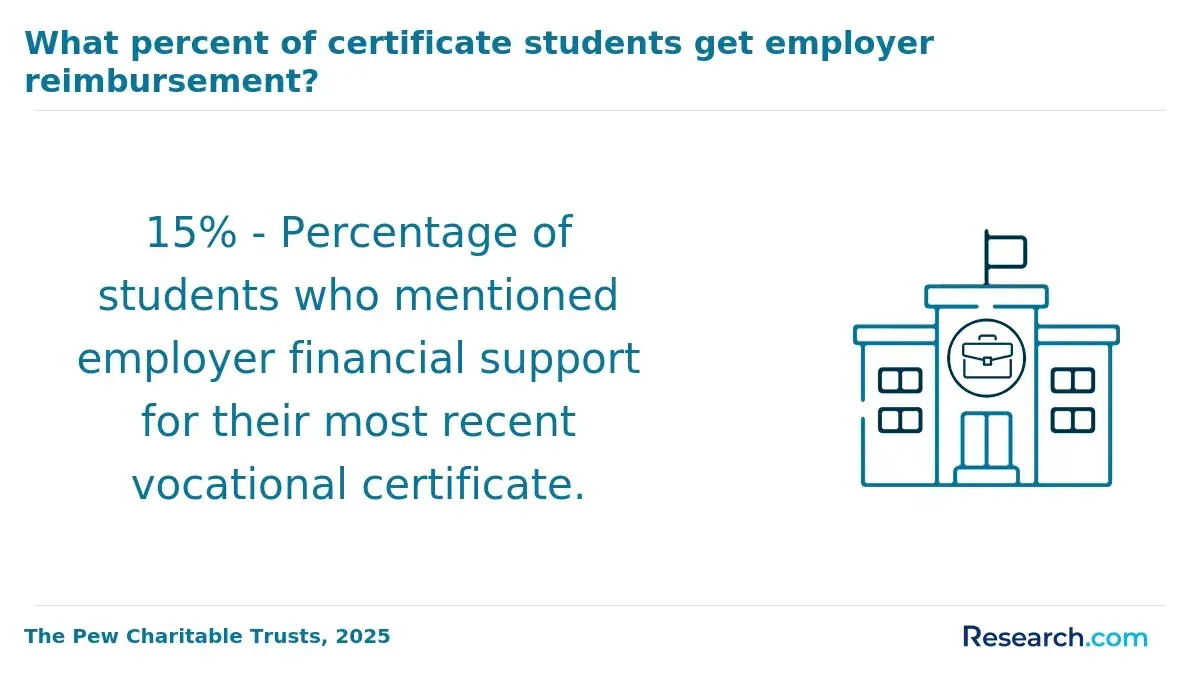
- Ask whether employer tuition assistance, workforce grants, payment plans, veterans' benefits, or federal aid apply; eligibility varies by program length, institutional status, and student circumstances.
Compare the certificate's full price against the alternative path. For a role that ultimately requires graduate education, reviewing affordable master degree programs can prevent spending on a credential that does not meet the role's minimum education requirement.
What is the difference between online and campus-based professional certificates?
Online professional certificates work well for software, business, data, project management, marketing, and other knowledge-based skills. Campus or hybrid programs are often better when learning depends on equipment, demonstrations, supervised practice, clinical skills, or employer networking. The best format is the one that delivers the required learning experiences - not automatically the most convenient one.
This comparison highlights the practical trade-offs to assess before choosing a delivery format.
| Factor | Online certificate | Campus or hybrid certificate |
| Scheduling | Often flexible and compatible with work schedules | Usually follows fixed meeting times or lab blocks |
| Hands-on learning | Best for digital, analytical, and business subjects | Better for equipment, clinical, studio, and technical practice |
| Networking | May require intentional virtual outreach | Can provide in-person instructor, peer, and employer contact |
| Location | Reduces commuting but may still require proctored exams or placements | Requires travel but provides access to facilities |
| Licensure preparation | Must be verified state by state when regulated training is involved | May simplify supervised-hour and facility requirements |
For working parents and caregivers, flexible formats can make training more feasible, but scheduled labs or clinicals still require childcare planning. Readers balancing family responsibilities may also compare degrees for moms when a broader academic credential better matches their long-term goal.
What courses and skills are typically covered in top professional certificate programs?
Top professional certificate programs focus on skills that can be applied and demonstrated, rather than only completed coursework. Strong programs explain what learners will create, perform, analyze, or manage by the end of training. The most useful curriculum depends on the field, but the categories below show what to look for.
| Program area | Typical skills covered | Evidence of learning to seek |
| Technology and data | Cloud tools, cybersecurity basics, data analysis, automation, AI-assisted workflows | Projects, labs, code repositories, or case studies |
| Business and project work | Budgeting, stakeholder communication, agile methods, reporting, process improvement | Project plans, dashboards, and scenario-based assignments |
| Healthcare support | Patient safety, documentation, terminology, procedures, privacy, clinical workflow | Skills checkoffs and approved supervised experience where required |
| Skilled trades | Safety, diagnostics, tools, blueprint reading, measurement, code awareness | Lab hours, instructor evaluation, and work-based learning |
| Design and media | Design software, visual communication, accessibility, copyright, client revisions | A polished portfolio with documented project goals |
AI is changing tasks in many professional fields, but it does not eliminate the need for judgment, communication, safety awareness, and domain knowledge. Favor programs that teach responsible use of current tools alongside fundamentals, rather than programs built around a single platform with no transferable concepts.
What jobs, industries, and advancement opportunities do professional certificates support?
Professional certificates can support entry into a new field, advancement within a current job, or a transition into a specialized function. They are most valuable when paired with related experience, a portfolio, an internship, an apprenticeship, or an employer-recognized certification. In some occupations, especially licensed healthcare and regulated trades, the certificate is one step in a larger eligibility process.
The following examples show realistic ways certificates may support career movement without implying that the credential alone qualifies every candidate.
| Certificate focus | Potential work settings | Common next step |
| IT support or cybersecurity | Business IT departments, managed service providers, help desks | Build experience and pursue role-relevant industry certification |
| Medical assisting or coding | Clinics, physician offices, hospitals, billing organizations | Meet employer preferences for certification or gain specialty experience |
| HVAC, electrical, or welding | Contractors, facilities teams, manufacturing sites | Apprenticeship, supervised hours, or state licensing as applicable |
| Paralegal studies | Law firms, corporate legal departments, government offices | Develop legal research and document-management experience |
| UX, graphic design, or digital marketing | Agencies, in-house creative teams, freelance projects | Expand a portfolio and demonstrate measurable project results |
Advancement often depends on more than classroom training. Document projects, seek supervised experience, and tailor your résumé to the exact skills requested in job postings.
What salary potential and job outlook can I expect with a professional certificate?
Salary potential depends on occupation, location, experience, union status, employer, schedule, and education beyond a certificate. The figures below are U.S. Bureau of Labor Statistics occupational medians for May 2024 and projections for 2023-33; they are not earnings promises for certificate completers. Use them to compare the labor market for a target occupation, then verify the education and licensing requirements in your state.
| Occupation often connected to certificate training | Median annual pay, May 2024 | Projected employment change, 2023-33 | Important qualification context |
| Electricians | $62,350 | 11% | Typically enter through apprenticeship and may need state licensure |
| Medical assistants | $44,200 | 15% | Employers may prefer certification; state rules vary for clinical duties |
| Paralegals and legal assistants | $61,010 | -1% | Certificate or degree requirements vary by employer and applicant education |
| Graphic designers | $61,300 | 2% | Portfolio quality and experience are central to hiring |
| Information security analysts | $124,910 | 33% | Many positions require a bachelor's degree and prior IT experience beyond a short certificate |
Fast growth can indicate opportunity, but it can also mean employers expect specialized skills. Compare local job postings, entry requirements, and the number of openings - not salary alone - before estimating a certificate's return on investment.
Other Things You Should Know About
They can be worthwhile when they teach skills directly tied to a target role and come from a provider employers recognize. They are less useful when the target job requires a license, degree, apprenticeship, or experience the program does not provide.
Yes, especially in skills-based fields such as IT support, project coordination, medical administration, digital marketing, and design. Career changers should also build work samples, complete practical projects, and seek entry-level experience.
It depends on the role. Employers may value a certificate for structured training and a certification for independently verified competence. Review job postings to see which provider names and credentials appear most often.
Possibly. Eligibility depends on whether the program is offered by an eligible institution, its length, whether it is credit-bearing, and your personal eligibility. Ask the school's financial-aid office and your employer about grants, payment plans, and tuition assistance.
References
- Certification Renewal Policy | CompTIA Certifications https://www.comptia.org/en-us/resources/test-policies/continuing-education-policies/certification-renewal-policy/
- Certification vs Degree: Which Holds More Weight in Tech? - ONLC https://www.onlc.com/blog/certification-vs-degree-in-tech/
- The certifications that boost your pay the most by trade https://skillit.com/the-certifications-that-boost-your-pay-the-most-by-trade
- What Employers Say a Certification Adds to Resumes https://www.nrep.org/blog/what-employers-say-about-certifications
- 10 Reasons to Renew Your Professional Certification https://blogs.ampp.org/protectperform/10-reasons-to-renew-your-professional-certification
- Highest Paying Certifications 2025-2026: IT, Cybersecurity, Medical & Career Growth Guide https://www.frontlinesourcegroup.com/blog-certifications-that-pay-the-most.html
- How Do Certifications Influence Salary Increases? https://certiprof.com/blogs/news/how-do-certifications-influence-salary-increases
- 25 Common Questions About Continuing Education | eCare Behavioral Health Institute https://www.ecarebehavioralinstitute.com/blog/questions-about-continuing-education/
- How to Manage Certification Renewals for Your Organization - Gauge https://gaugeonline.com/blog-certification-renewal/
- Certification Renewal Requirements - Alkademy Blog https://alkademy.com/blog/glossary/certification-renewal-requirements/