2027 Best Stackable Credentials

Co-Founder and Chief Data Scientist
Choosing between a short certificate, industry certification, and degree pathway can be costly if the credentials do not build toward the job you want. Stackable credentials let learners earn smaller, usable qualifications that may apply toward later certificates or degrees. This matters as the U.S. Bureau of Labor Statistics projects healthcare support occupations to grow faster than average from 2023 to 2033.
This guide helps career changers, recent graduates, and working adults compare pathways, verify recognition, estimate total costs, and choose credentials with a practical next step.
Key Things You Should Know
- Strong stackable pathways combine a short, job-relevant credential with clearly documented credit transfer or progression into a certificate, associate degree, bachelor's degree, license, or industry certification.
- Healthcare, skilled trades, IT, and business-support fields can offer practical entry points, but many regulated roles still require state approval, supervised clinical hours, an exam, or an employer-sponsored apprenticeship.
- Compare total cost, completion time, transfer terms, and local job requirements before enrolling; a low-tuition noncredit program may not qualify for federal aid or transfer into a degree.
Top 10 Best Stackable Credentials
Popular Trade School Programs
Trade pathways often begin with a certificate in welding, HVAC, electrical technology, automotive service, CNC machining, or construction. A short certificate can build foundational safety and technical skills, while a longer diploma or associate degree may add advanced troubleshooting, general education, and management preparation. Apprenticeship-based routes are especially valuable for electricians and plumbers because paid work experience is often central to licensing. Choose programs with equipment aligned to local employers and confirm whether coursework supports an apprenticeship, manufacturer credential, or state licensing requirement.
Healthcare Programs
Common stackable healthcare options include nursing assistant, medical assisting, phlebotomy, pharmacy technician, medical billing and coding, practical nursing, and registered nursing pathways. Some programs award academic certificates; separate certification exams may be available or required by employers. Nursing and many allied-health roles have state-specific approval, clinical placement, background-check, immunization, and exam requirements. A medical billing certificate may be fully online, while patient-care programs need in-person labs and clinical experience. Confirm that a program meets your state's eligibility rules before paying tuition.
Criminal Justice / Law Programs
Stackable options in this area include criminal justice certificates, corrections training, legal studies, paralegal studies, court reporting preparation, and cybersecurity-related public safety programs. A certificate can support entry-level administrative, records, compliance, or support work, but it does not by itself make someone a police officer, lawyer, or licensed private investigator. Paralegal employers may favor programs approved by the American Bar Association, although approval is not required everywhere. Check agency hiring standards, background requirements, and state rules before selecting a pathway.
Arts & Design Programs
Graphic design, UX design, digital media, web design, animation, photography, and interior design certificates can stack into associate or bachelor's study when they are credit-bearing. Portfolio quality usually matters as much as the credential for creative roles. Short noncredit programs can teach a software tool quickly, but they may not transfer or provide the critique, project depth, and portfolio development employers expect. For interior design and similar regulated fields, verify whether coursework supports the education requirements used by your state or professional credentialing pathway.
What are stackable credentials and how do they work in career pathways?
Stackable credentials are intentionally connected credentials earned in stages. Instead of enrolling immediately in one long program, a learner might complete an entry certificate, use it for employment, and later apply the completed courses toward an advanced certificate or degree. The "stack" can be vertical, moving from basic to advanced learning, or lateral, combining complementary skills such as healthcare administration and medical coding.
The key distinction is documented progression. A collection of unrelated badges is not necessarily stackable unless the provider identifies how each credential applies to a larger pathway.
| Credential stage | Typical purpose | What to verify |
| Short certificate | Build entry-level skills or prepare for a specific exam | Credit status, employer recognition, exam eligibility |
| Advanced certificate | Add specialization or supervisory skills | Prerequisites and whether earlier coursework applies |
| Associate degree | Broaden technical and general education | Written articulation of certificate-to-degree credit |
| Bachelor's completion | Support advancement or broader career mobility | Transfer limits, residency rules, and total remaining credits |
For working adults, this design reduces the risk of paying for a full degree before confirming career fit. It is less useful when the target occupation requires a bachelor's degree, a professional license, or a single prescribed educational sequence from the outset.
How do stackable credentials compare to traditional degrees for flexibility and cost?
Stackable credentials are usually more flexible than a traditional degree because learners can pause after a milestone and return later. They can also lower the upfront commitment, but they are not automatically cheaper overall: separate enrollment fees, repeated textbooks, exam fees, and lost transfer credit can raise the eventual total.
Use this comparison to decide whether an incremental route fits your goal. The most important question is whether each completed stage has standalone value and applies to the next stage in writing.
| Factor | Stackable pathway | Traditional degree route |
| Upfront commitment | Usually smaller, with exit points | Usually longer commitment |
| Schedule | Often modular, part-time, or online | May follow a fixed sequence |
| Cost planning | Pay by stage; total can be harder to forecast | Program-wide costs may be easier to estimate |
| Career use | Can support earlier job entry in some fields | May better match roles requiring a degree |
| Transfer risk | Higher if courses are noncredit or policies change | Lower within one institution, though transfer still varies |
Community colleges are often a practical choice for credit-bearing pathways, while industry providers may be stronger for a narrow certification objective. Learners seeking flexible degree progression can also compare bachelor degree programs for working adults when a certificate alone will not meet the role's education requirements.
Which industries offer the strongest job demand for stackable credentials?
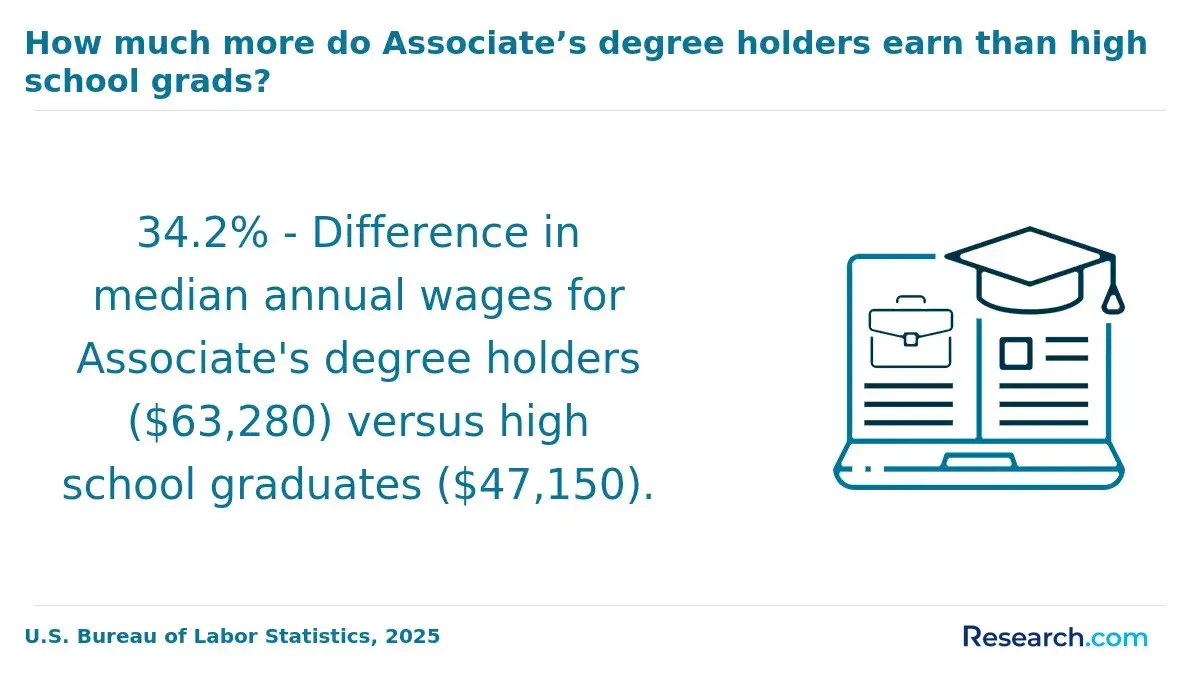
The strongest demand is generally in fields where employers need demonstrable technical skills, regulated patient-care staff, infrastructure workers, and technology support talent. Demand does not mean every short credential qualifies a learner for every role; local employers may require experience, a license, or a separate certification.
BLS projections for 2023-2033 identify healthcare support occupations as among the faster-growing occupational groups, reflecting an aging population and continuing need for direct-care services. That supports careful consideration of approved healthcare pathways, particularly where a credential leads to a required exam or supervised clinical experience.
| Industry area | Useful stackable starting point | Common next step |
| Healthcare | Nursing assistant, phlebotomy, medical assisting, coding | Advanced clinical training, licensure, or health administration degree |
| Skilled trades | HVAC, welding, electrical fundamentals | Apprenticeship, manufacturer training, or licensing pathway |
| Information technology | IT support, networking, cloud, cybersecurity coursework | Vendor-neutral or vendor certification and advanced specialization |
| Business operations | Accounting, project support, supply chain, data tools | Associate or bachelor's completion, plus role-specific certification |
Automation and AI are increasing the value of workers who can use digital tools, document processes, troubleshoot systems, and apply sound judgment. A stack should therefore include durable communication, data, and problem-solving skills rather than only one software platform.
What accreditation and licensing requirements apply to stackable credential programs?
Accreditation, approval, and licensing are different safeguards. Institutional accreditation concerns the college as a whole. Programmatic accreditation evaluates certain professional programs. State approval may determine whether graduates can sit for a licensure exam. Industry certification is awarded by a separate certifying body and commonly requires an exam or ongoing renewal.
Before enrolling in a regulated pathway, verify the requirement directly with the relevant state licensing board or employer. This is essential for nursing, practical nursing, dental assisting in some states, cosmetology, electrical work, and other occupations with jurisdiction-specific rules.
Ask the school for the exact credential awarded, the accreditor or approving authority, the current approval status, and whether distance learners in your state are eligible. Do not assume a nationally advertised online program meets every state's clinical-placement or licensing rules.
How do online stackable credential programs differ from campus-based options?
Online stackable programs can work well for theory-heavy subjects such as business software, IT, coding, project support, legal studies, and health information. Campus-based or hybrid formats are usually more appropriate when learners need labs, equipment practice, studio critique, clinical placements, or face-to-face skills assessment.
The format should match the skill, not just the schedule. This comparison highlights the trade-off.
| Format | Best fit | Primary limitation |
| Fully online | Flexible theory, digital tools, and self-directed learners | May not provide hands-on practice or local clinical placement |
| Hybrid | Working learners who need labs or periodic assessment | Requires travel and fixed in-person dates |
| Campus-based | Equipment-intensive, clinical, and studio programs | Less schedule flexibility |
Compare online courses for credit transfer, instructor access, proctoring, technical requirements, and local placement support. Students considering broader online degree options can review online colleges while keeping transfer and career relevance ahead of perceived ease.
What are typical admission requirements and program lengths for stackable credentials?
Admission requirements depend on the provider and credential level. A noncredit workforce course may require only age, identity, and payment information. Credit-bearing college certificates commonly require an application and placement information, while selective clinical programs may add prerequisite courses, health documentation, background checks, and entrance criteria.
Program length can range from a few weeks for a focused noncredit course to roughly one academic year for many certificate programs; associate degree pathways commonly take longer because they include broader coursework. Accelerated pacing reduces calendar time but not necessarily the required learning or clinical hours.
Use these questions before applying:
- Is the credential credit-bearing, and how many credits will apply to the next credential?
- Are there prerequisites, placement tests, background checks, or clinical eligibility requirements?
- What is the maximum time allowed to return and continue the stack?
- What fees are separate from tuition, including tools, uniforms, exams, and licensing applications?
For advanced progression, compare whether a certificate can lead efficiently into a degree or whether a graduate credential makes more sense after a bachelor's degree. Professionals with an existing undergraduate degree may instead consider the fastest masters degree online if their target role genuinely requires graduate-level education.
What courses and skills are usually included in high-quality stackable credential pathways?
High-quality pathways teach more than a narrow task. They combine job-specific practice with skills that remain useful when technology, employers, or job titles change. In credit-bearing programs, this may include general education; in noncredit programs, it may appear as applied projects and employability modules.
Look for curricula that deliberately build the following capabilities:
- Technical fundamentals that precede advanced coursework, such as safety, anatomy, electrical theory, coding logic, or design principles.
- Hands-on assessment through labs, simulations, supervised practice, portfolios, or work-based learning when the field requires it.
- Digital fluency, including documentation, spreadsheets, industry software, cybersecurity awareness, and responsible AI use.
- Communication, customer service, teamwork, and problem-solving skills that employers use to assess entry-level readiness.
- Career preparation such as résumé support, interview practice, licensing guidance, certification-exam preparation, or employer connections.
A course list that is almost entirely software tutorials or test drills may still be useful for a narrow objective, but it is a weaker foundation for a long-term stack unless it maps to recognized outcomes.
What salaries and career outcomes can stackable credentials realistically lead to?
Career outcomes depend on the role, location, experience, licensure, work schedule, and employer - not simply on earning a certificate. Use occupational wage data as context for a target job after confirming that your intended credential meets the employer's minimum requirements.
For example, BLS reported a 2023 median annual wage of $48,780 for medical assistants. That figure describes the occupation, not an expected salary for every medical-assisting certificate completer, and state rules and employer preferences can differ.
| Pathway outcome | What a stack may support | Important limitation |
| Entry-level employment | Proof of basic skills for technician, assistant, support, or trainee roles | Experience and employer screening still matter |
| Industry certification | Structured preparation for a separate exam | Program completion does not guarantee passing |
| Licensure progression | Required education component in approved fields | May also require exams, clinical hours, and state approval |
| Degree completion | Earlier coursework may reduce duplicated study | Transfer is limited by the receiving school's policy |
Calculate return on investment using your full cost, realistic time out of work, expected local entry opportunities, and the value of credits that will transfer. If a provider makes salary guarantees or will not share completion and placement definitions, treat that as a warning sign.
How can students choose reputable schools and avoid low-quality stackable programs?
Choose a program by working backward from the job, license, certification, or next degree you want. Start with local job postings and the requirements of the relevant licensing board or certifying organization, then compare only providers whose curriculum matches those requirements.
A careful review should cover these practical checks:
- Request a written map showing exactly how each completed course applies to the next certificate or degree.
- Confirm institutional accreditation for credit-bearing college study and program approval where a regulated occupation requires it.
- Ask for the total estimated cost, including supplies, software, exams, travel, clinical requirements, and retake fees.
- Clarify whether career-placement figures count temporary jobs, unrelated jobs, or only graduates who responded to surveys.
- Speak with employers or alumni about whether the credential is recognized locally and whether the program provides meaningful practice.
Common mistakes include assuming a certificate is the same as professional certification, enrolling in a noncredit program that will not transfer, and selecting online training without confirming hands-on requirements. If your immediate goal is an employer-recognized exam rather than academic credit, compare reputable certifications online and verify the issuing organization's eligibility rules.
Other Things You Should Know About
They can be worthwhile when each stage has job value and documented progression into the next credential. They are less compelling when credits will not transfer, the target job requires a degree immediately, or the provider cannot show employer recognition.
Yes, when a college formally applies certificate coursework toward an associate or bachelor's degree. Get the transfer or articulation policy in writing because acceptance can depend on grades, course age, residency requirements, and the receiving institution.
A certificate is usually awarded after completing an educational program. A certification is usually awarded by a professional organization after meeting standards that may include an examination, experience, and renewal requirements.
Many theory-based credentials are available online. Programs requiring labs, clinical practice, equipment training, or licensing eligibility may be hybrid or campus-based, and online students should confirm local placement and state-approval rules before enrolling.
References
- Building Stackable Credentials That Truly Deliver Value and Economic Mobility: 7 Steps for Success https://mcacs.talentfirst.net/building-stackable-credentials-that-truly-deliver-value/
- Stackable Certificates & Credentials - Complete College America https://completecollege.org/our-approach/structure/stackable-certificates-credentials/
- What Are Stackable Credentials and Why Do They Matter? https://www.pltw.org/blog/what-are-stackable-credentials
- Microcredentials vs Certificates: What Universities Need to Know https://moderncampus.com/blog/microcredentials-vs-certificates-what-universities-need-to-know
- Microcredentials: Empowering Modern Learners & Employers https://evolllution.com/microcredentials-empowering-modern-learners-employers
- USHE initiative helps students earn meaningful credentials on their way to a degree - Utah System of Higher Education https://ushe.edu/stackable-credentials-help-students-earn-credentials-on-their-way-to-a-degree/
- What are Stackable Credentials? https://assess.com/stackable-credentials/
- Stacked Credentials and Employment https://services.intead.com/blog/stacked-credentials-employment
- Stackable credentials can open doors to new career opportunities | Brookings https://www.brookings.edu/articles/stackable-credentials-can-open-doors-to-new-career-opportunities/
- Build a Bridge Between Education and Industry with Credentials https://www.nga.org/futureworkforce/pathways/build-a-bridge-between-education-and-industry-with-credentials/