2027 Best Certifications With No Campus Visits Required

Co-Founder and Chief Data Scientist
Choosing an online credential is harder when "100% online" can still hide internships, proctored exams, or clinical requirements. No-campus options are strongest in technology, business, legal support, and digital design; hands-on licensed careers are more limited. For context, the U.S. Bureau of Labor Statistics projects information security analyst employment to grow 29% from 2024 to 2034. This guide helps working adults compare certificates, professional certifications, and associate-level alternatives, verify delivery claims, estimate costs, and avoid credentials that do not fit their target job.
Key Things You Should Know
- Fully online, no-campus credentials are most realistic for desk-based fields such as IT support, cybersecurity, bookkeeping, medical billing and coding, project coordination, paralegal support, and digital design; clinical, laboratory, driving, welding, and electrical programs usually require supervised in-person training.
- A certificate is education completed through a college or training provider, while a certification is a professional credential issued by a certifying body, often after an exam; one may prepare for the other, but they are not interchangeable.
- Compare the total price, required exam fees, employer recognition, and whether the program is truly asynchronous before enrolling; information security analysts had a $124,910 median annual wage in May 2024, but a short certificate alone does not qualify a person for every cybersecurity role.
Top 10 Best Certifications With No Campus Visits Required
Popular Trade School Programs
Fully online trade-oriented certificates work best when the occupation does not require physical skill verification. Options include HVAC estimating, construction management support, OSHA-focused safety training, CAD drafting, supply chain logistics, and project coordination. A certificate may build job-ready knowledge, but it cannot replace an apprenticeship, shop hours, or state licensing pathway for electricians, plumbers, welders, or HVAC technicians. Choose an online option if you want administrative, estimating, design, or operations work; choose hybrid training if your goal requires equipment handling or supervised field competence.
Healthcare Programs
No-campus healthcare options commonly include medical billing and coding, medical office administration, health information support, healthcare management, and pharmacy technician exam preparation. These may be college certificates or noncredit career-training programs. They differ from nursing, dental hygiene, sonography, medical assisting, and laboratory programs, which typically require clinical practice and may have state-specific approval rules. Medical records specialists had a $50,250 median annual wage in May 2024, according to the BLS; this occupation-level figure is not a promised outcome for certificate completers. Confirm whether an employer expects a separate certification exam.
Criminal Justice / Law Programs
Fully online certificates can cover criminal justice foundations, legal studies, paralegal support, court administration, compliance, cybersecurity law, and victim advocacy. They suit learners seeking foundational knowledge or administrative support roles. They do not authorize legal practice, replace law school, or qualify someone as a police officer where academy training, background checks, fitness standards, and state requirements apply. For paralegal goals, examine employer expectations and whether the curriculum covers legal research, writing, ethics, litigation procedures, and technology. A credit-bearing certificate can be useful for later degree study, but transfer acceptance remains school-specific.
Arts & Design Programs
Online certificates in graphic design, UX design, web design, digital marketing content, animation fundamentals, and photography editing can be completed without campus attendance when software-based projects are accepted remotely. Portfolio quality usually matters more to hiring managers than the credential name alone. Look for structured critiques, accessible software requirements, copyright instruction, and portfolio assignments that match the work you want. These programs are appropriate for career changers and freelancers who can build samples consistently. They are less suitable for students who need studio equipment, intensive in-person mentoring, or a license-based professional pathway.
What are the most in-demand online certifications that never require campus visits?
The most in-demand no-campus credentials tend to support work performed with cloud software, business systems, records, or digital content. Demand does not mean every provider or credential has equal value, so prioritize credentials tied to a recognizable employer skill standard or a portfolio.
| Path | Typical credential type | No-campus fit | Important limitation |
| IT support and cloud fundamentals | Industry certification or professional certificate | Strong; coursework and many exams can be remote | Some certification exams may require approved remote proctoring or a test center |
| Cybersecurity | Industry certification preparation or college certificate | Strong for entry-level concepts and labs | Employers may still expect experience, projects, or a degree for advanced roles |
| Data analytics | Professional certificate or academic certificate | Strong; work is software and project based | Portfolio evidence matters alongside coursework |
| Medical billing and coding | Career-training or college certificate | Strong for theory and coding practice | Employer preferences and certification-exam eligibility vary |
| Bookkeeping and payroll | Professional certificate or software credential | Strong | It does not substitute for CPA licensure or accounting degree requirements |
Technology is the clearest no-campus choice because practice labs, simulations, and project repositories can be assessed online. Before choosing cybersecurity, compare entry-level job requirements against your current experience; BLS projects 29% growth for information security analysts from 2024 to 2034, but the occupation commonly requires related IT experience.
How do fully online certification programs compare to campus-based options in quality and outcomes?
A fully online program can be comparable to a campus option when it uses the same curriculum, qualified instructors, meaningful assessments, accessible student support, and transparent credential requirements. Delivery format alone does not establish quality. Online study is often better for adults who need asynchronous scheduling, while campus learning can be better for learners who need live accountability, equipment, networking, or clinical supervision.
Students considering accelerated enrollment should distinguish flexible access from reduced rigor. Schools with frequent enrollment cycles can help learners start sooner; review online colleges starting this month if timing is a major constraint, then confirm whether the specific certificate has the same start pattern.
| Decision factor | Fully online option | Campus-based option |
| Scheduling | Often asynchronous and suited to work schedules | Usually fixed meeting times and commute requirements |
| Hands-on learning | Effective for software, records, and digital projects | Better for equipment, labs, studios, and supervised practice |
| Networking | Requires deliberate use of virtual events and career services | May provide more spontaneous peer and local-employer contact |
| Assessment | Projects, simulations, remote proctoring, and discussion work | May include in-person demonstrations and exams |
What accreditation and licensing requirements should online certification programs meet in the U.S.?
Accreditation matters most for college-issued, credit-bearing certificates and for programs leading toward regulated professions. Institutional accreditation evaluates the college as a whole; programmatic accreditation evaluates certain professional programs. Neither is automatically required for every industry certification or noncredit professional certificate.
For a college certificate, verify the institution through the U.S. Department of Education's accreditation database and confirm that the accreditor is recognized. For an industry certification, verify the certifying organization, exam policies, renewal rules, and employer recognition in actual job postings. If your goal is licensure, contact the relevant state licensing board before enrolling because an online curriculum may not meet clinical, supervised-hour, background-check, or location requirements.
Major red flags include claims of "national accreditation" without naming a recognized accreditor, vague statements that a program "qualifies" learners for a license, pressure to enroll immediately, and no written refund or cancellation policy. Legitimate providers state what credential is awarded and what it does not authorize.
Which career fields offer reputable online certifications with strong salary and growth potential?
Career potential depends on the occupation, local hiring market, experience, and the employer's requirements - not merely on holding a certificate. The strongest fully online paths generally pair a recognized skill signal with demonstrable work samples, such as a portfolio, lab record, bookkeeping file, or coding practice project.
| Career field | Useful no-campus credential route | BLS May 2024 median wage or outlook context | Best fit |
| Information security | Entry-level IT certification plus security training | $124,910 median wage for information security analysts; 29% projected growth, 2024-2034 | People with IT foundations who can build technical experience |
| Web and digital interface design | Portfolio-based certificate or professional certificate | $95,380 median wage for web developers and digital designers | Creative, software-comfortable learners |
| Medical records | Billing, coding, or health-information certificate | $50,250 median wage for medical records specialists | Detail-oriented learners interested in healthcare administration |
| Bookkeeping | Accounting software and bookkeeping training | Wages vary substantially by employer and experience | People seeking small-business or entry-level finance support work |
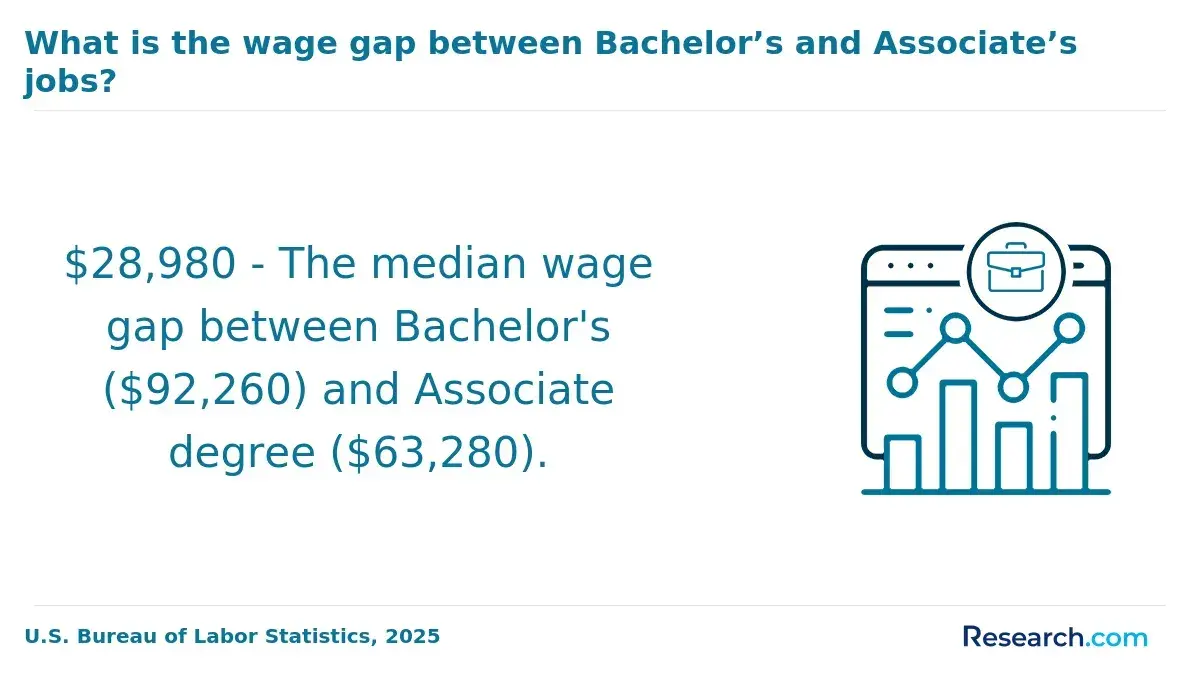
For a longer credential with broader general-education and career options, compare 2 year online degrees that pay well. An associate degree can be the better investment when job postings consistently request a degree, when you need transferable credits, or when you expect to progress into a bachelor's program.
How long do no-campus certification programs typically take, and what do they cost?
Completion time ranges from a few weeks for a vendor-led professional certificate to roughly one year for many college certificates. A fully online associate degree generally takes longer because it includes general education and more credits, although prior learning, transfer credit, and intensive terms can change the timeline. Explore online associate degrees carefully: unusually short completion claims often depend on transferred credits, credit for prior learning, or substantial weekly study time.
| Credential model | Typical timeline | Main cost factors | What to verify |
| Industry certification | Self-paced preparation plus an exam | Training, exam attempt, retake, renewal, and study tools | Exam delivery, prerequisites, renewal cycle, employer recognition |
| Noncredit professional certificate | Weeks to several months | Program fee, software, optional exam fees | Refund policy, instructor support, portfolio or assessment quality |
| College certificate | Often two semesters to one year | Per-credit tuition, fees, books, technology, and proctoring | Accreditation, credit transfer, financial-aid eligibility, stackability |
| Online associate degree | Usually longer than a certificate | Tuition, required credits, fees, and materials | Transfer-credit evaluation and total remaining credits |
Compare total cost rather than tuition alone. Required laptops, specialized software, certification exams, identity verification, retakes, and subscription renewals can materially change a low advertised price. Financial aid is most commonly relevant to eligible programs at institutions participating in federal student aid; it is not automatic for bootcamps, vendor courses, or standalone exams.
What admission requirements do online certification programs usually have for adult and nontraditional students?
Admissions depend on the provider. Noncredit professional certificates and industry-certification training may require only payment, basic computer access, and any stated prerequisite knowledge. College certificates may request a high school credential, placement information, prior coursework, or program-specific prerequisites. Standardized tests are often not relevant, especially for open-access community college certificates.
Adults returning to school should ask whether previous college credit, military training, professional experience, or placement testing can reduce prerequisites. Applicants concerned about academic history can review online colleges that accept 2.0 GPA, but admission to a college does not guarantee entry into every selective certificate or health-related sequence.
Before applying, gather transcripts only if the provider requests them, confirm whether courses are credit-bearing, and calculate whether you can meet the weekly workload. Avoid paying an application or enrollment fee before receiving the program's written attendance, withdrawal, technology, and no-campus requirements.
What coursework and skills are covered in leading fully online certification curricula?
Leading fully online curricula use applied assignments rather than video watching alone. The best course sequence depends on the field, but it should show how learners will practice a skill, receive feedback, and demonstrate competence to an employer.
For a practical comparison, review the curriculum against the work you expect to perform:
- IT and cybersecurity programs should include operating systems, networks, cloud concepts, incident response, security controls, documentation, and hands-on labs.
- Data and business programs should include spreadsheets, data cleaning, visualization, reporting, privacy, and communication of findings to nontechnical audiences.
- Medical billing and coding programs should cover terminology, coding systems, claims workflows, compliance, privacy, and realistic case practice.
- Legal-support programs should include legal research, citation, writing, document management, ethics, and civil procedure fundamentals.
- Design programs should include design principles, accessibility, software workflow, critique, client briefs, and portfolio development.
AI tools are increasingly part of workplace workflows, but a credible curriculum teaches verification, privacy, intellectual-property boundaries, and responsible use rather than treating generated output as proof of skill. Ask whether students must explain and revise their work; that is more valuable than an unreviewed completion badge.
How do online certificates stack with degrees and support long-term career advancement?
A certificate can be a focused first step, while a degree provides broader education and may meet employer screening requirements in some fields. A professional certification can validate a specific skill standard, but it may require ongoing renewal and does not usually carry academic credit. The best choice depends on the gap you need to close now and the career ceiling you expect later.
| Option | Usually best for | Long-term value | Key caution |
| Noncredit professional certificate | Quick skill building or career exploration | Can support a portfolio and targeted job search | May not transfer for college credit |
| Credit-bearing college certificate | Entry-level academic pathway or stackable study | May apply toward an associate or bachelor's degree if the receiving school accepts it | Transfer is never automatic |
| Industry certification | Validating job-specific knowledge | Can signal current capability to employers | May require exams, experience, and renewal fees |
| Associate or bachelor's degree | Broader career mobility and roles requiring degrees | More comprehensive foundation and transfer potential | Higher time and total-cost commitment |
Choose a stackable college certificate when you may continue into a degree and the school provides a written credit map. Choose a standalone certification when employers in your target role explicitly request it. Do not assume a badge from a training platform transfers to college or substitutes for an accredited degree.
How can students verify that an online certification program is legitimate and industry-recognized?
Verification should happen before you submit payment, not after you finish coursework. A legitimate program can explain exactly who awards the credential, what students must complete, whether exams are separate, and how employers or licensing boards recognize the outcome.
Use this screening sequence to avoid common enrollment mistakes:
- Match the credential to a specific target job by reading several current job descriptions and noting required education, certifications, software, and experience.
- Confirm the exact delivery format in writing, including internships, residencies, labs, orientation, proctored exams, and any state-based placement requirements.
- For college certificates, verify institutional accreditation and determine whether credits are academic, transferable, and eligible for aid at that institution.
- For certification preparation, confirm that the provider is not falsely presenting itself as the certifying organization and review the separate exam's eligibility rules.
- Request the complete cost estimate, refund policy, sample syllabus, completion requirements, and career-services details before enrolling.
Be cautious with claims of guaranteed jobs, guaranteed certification passage, unusually high salaries, or licensure "in all states." Employers, certifying bodies, and state boards - not marketing language - determine whether a credential is accepted. If a provider will not put its promises and requirements in writing, select another option.
Other Things You Should Know About
Yes, especially in technology, business, legal support, digital design, bookkeeping, and healthcare administration. Confirm the written program requirements because some programs marketed as online still require proctored exams, clinicals, internships, labs, or orientation.
They can be when the provider is credible, the skills match the job, and you can demonstrate competence through projects, an exam, or a portfolio. Employer recognition is usually stronger for established college certificates and well-known industry certifications than for generic completion badges.
Sometimes, but only when the program meets the relevant state board's education and supervised-practice rules. Many licenses require in-person clinical hours, field training, examinations, background checks, or a degree. Verify requirements directly with the state board before enrolling.
A short professional certificate or entry-level industry certification can be the fastest route for software-based roles, but speed should not be the only criterion. Choose a path with practical assignments, transparent costs, employer relevance, and a realistic match to your prior experience.
References
- How to Prepare for College Campus Tours | Army and Navy Academy https://www.armyandnavyacademy.org/blog/3-ways-to-prepare-for-your-campus-visit/
- Remote Work Certifications That Are Worth It: Credentials That Can Strengthen Your Career https://fatumasvoice.org/328874/
- About - ACCSC https://www.accsc.org/about/
- The Ultimate College Visit Checklist: What to Look For and Expect | Tiffin University https://www.tiffin.edu/news/the-ultimate-college-visit-checklist-what-to-look-for-and-expect/
- What is Accreditation? https://www.credentialingexcellence.org/Accreditation
- Recognized Institutions https://transcriptresearch.com/pages/recognized-institutions
- Online Certificate Programs | Certifications Programs https://www.uscareerinstitute.edu/online-certificate-programs
- Flexible online courses with certificates | edX 2025 https://www.edx.org/courses
- Online Certificates for Job-Ready Skills | Grow with Google https://grow.google/certificates
- Upskilling Certificates: An Affordable Way to Increase Income https://allcampus.com/newsroom/upskilling-certificates-an-affordable-way-to-increase-income/