2027 Best Online Certifications With High Acceptance Rates

Co-Founder and Chief Data Scientist
Choosing an online credential is difficult when "high acceptance" can mean open enrollment, flexible entry requirements, or simply eligibility to sit for an industry exam. This guide helps career changers, recent graduates, and working adults compare legitimate options. Demand makes careful selection important: the U.S. Bureau of Labor Statistics (BLS) projects medical assistant employment to grow 15% from 2023 to 2033. Learn which credentials are accessible, what they cost, and when a certificate is not enough for licensure or a targeted job.
Key Things You Should Know
- High acceptance does not equal high value: many noncredit online certificates use open enrollment, while credit-bearing college certificates may require transcripts, placement, prerequisites, or a minimum GPA.
- For regulated careers, verify state approval and exam eligibility before paying; an online certificate alone does not automatically qualify a learner for nursing, legal practice, skilled-trade licensing, or other licensed work.
- Use occupation data rather than salary promises: BLS projects 15% growth for medical assistants and 11% growth for electricians from 2023 to 2033, but pay and entry requirements vary by role, location, and experience.
Top 10 Best Online Certifications With High Acceptance Rates
Popular Trade School Programs
Accessible online trade options include HVAC theory certificates, construction estimating, welding fundamentals, electrical theory, and commercial-driver-license exam preparation. Many are noncredit and open enrollment, but hands-on competencies still require labs, employer training, an apprenticeship, or approved local instruction.
Choose a college certificate when you need academic credit or a pathway to an associate degree; choose industry training when an employer recognizes it. Do not assume an online electrical or welding course meets state licensing or practical-hour requirements.
Healthcare Programs
Online healthcare certificates commonly cover medical billing and coding, pharmacy technician preparation, medical assisting coursework, health information technology, and medical office administration. Billing and coding can be largely online, while medical assisting and pharmacy programs may require supervised externships.
A certificate is educational training; certifications such as CPC or CPhT are separate professional credentials with their own eligibility and exam rules. Confirm programmatic approval, clinical placement support, and state-specific requirements before enrolling.
Criminal Justice / Law Programs
Online options include criminal justice certificates, legal studies certificates, paralegal studies, court reporting foundations, and cybersecurity or digital-evidence training. Entry-level academic certificates often have broad admissions, but they do not authorize someone to practice law or guarantee paralegal employment.
A credit-bearing paralegal certificate may suit degree holders seeking structured legal training, while a criminal justice certificate can support public-safety administration or security-related roles. Check whether employers in your area prefer American Bar Association-approved paralegal education.
Arts & Design Programs
Graphic design, UX design, digital marketing design, photography, animation, and web design certificates are often accessible because portfolio development matters more than traditional admissions. Noncredit professional certificates can be faster and lower-cost, but credit-bearing college certificates may transfer into an associate or bachelor's program.
Review the curriculum for current software, instructor feedback, portfolio reviews, and project ownership. A credential helps signal training, but a strong, role-specific portfolio remains central to hiring.
What are the most accepted types of online certifications in the U.S.?
The most accepted online credential types generally have either open enrollment or minimal eligibility screening. They are accessible because providers can admit learners continuously, not because they have published a favorable college-style acceptance rate.
This comparison separates educational certificates from professional certifications so you can choose the credential employers or licensing bodies actually expect.
| Credential type | Typical provider | Entry model | Best use |
| Noncredit career certificate | College continuing education unit or training provider | Often open enrollment | Job skills and career exploration |
| Credit-bearing undergraduate certificate | Community college or university | Application, transcripts, and possible prerequisites | Academic credit, stackability, and career preparation |
| Professional certificate | University, platform, or industry partner | Usually open enrollment; advanced courses may expect prior knowledge | Focused, portfolio-based or technical upskilling |
| Professional certification | Independent certifying organization | Exam eligibility may require training or experience | Verification of competency in a specific field |
Open-enrollment courses are a practical fit for learners who need speed or want to test a field. A credit-bearing certificate is usually better when you may later pursue an associate or bachelor's degree, need federal-aid eligibility through an eligible institution, or need coursework recognized by a licensing board.
Readers considering a longer academic route can compare best college majors before selecting a short credential that may not meet their eventual goal.
How do online certification acceptance rates compare with campus-based programs?
Online and campus-based versions of the same college certificate may use the same admissions standards, credits, instructors, and transcript. Delivery mode alone does not make a program easier to enter. However, online programs can expand capacity and remove commuting barriers, while campus cohorts may have limited seats, labs, or clinical placements.
The distinction matters most in programs with required in-person training. Use this comparison to assess whether flexibility changes access without reducing required outcomes.
| Factor | Online format | Campus-based format |
| Admissions | May be similar to campus standards; open-enrollment options are common in noncredit training | May have cohort, lab, or room-capacity limits |
| Practical learning | Often requires local externships, labs, or proctored assessments | Usually scheduled on-site |
| Schedule | Often asynchronous, with fixed deadlines in many programs | Usually fixed meeting times |
| Networking | Requires deliberate use of virtual career services and local placements | More spontaneous access to faculty, peers, and facilities |
Do not choose online solely because you expect easier admission. Ask whether required clinical, practicum, or lab experiences are arranged by the school, available near you, and included in tuition. For learners who need a faster degree rather than a stand-alone certificate, accelerated degree programs may provide a clearer route to occupations requiring a bachelor's degree.
What accreditation and licensing requirements should online certification programs meet?
Accreditation applies primarily to institutions and, in some fields, to specific programs; it is not a universal feature of short online courses. For a credit-bearing college certificate, verify that the institution is accredited by an agency recognized by the U.S. Department of Education or the Council for Higher Education Accreditation.
For noncredit training, evaluate employer recognition, curriculum quality, and whether it meets the eligibility rules of the relevant certifying body.
Licensure is separate from accreditation. Nursing, teaching, counseling, electrical work, cosmetology, and many allied-health roles can have state-specific education, examination, background-check, supervised-practice, or residency requirements. Before enrolling, take these steps:
- Identify the exact job title and the state where you plan to work.
- Check the state licensing board's education and clinical-hour requirements directly.
- Ask the school in writing whether its online format meets those requirements in your state.
- Confirm whether external exam fees, background checks, equipment, travel, and placements are additional costs.
A school's general accreditation does not prove that a particular online program satisfies professional licensing requirements. Treat vague claims such as "license-ready anywhere" as a red flag.
What admission criteria influence acceptance rates for online certificate programs?
Acceptance rates are often unavailable for online certificates because many programs do not use selective admissions. Instead, admission depends on the credential type, available placements, and whether applicants satisfy entry requirements. Academic programs may review prior coursework; professional certifications may assess eligibility at registration rather than "admit" learners.
Common factors that influence access include:
- High school completion, GED, or college transcripts for credit-bearing certificates
- Prerequisite courses, placement results, or demonstrated English and math readiness
- Background checks, immunizations, drug screening, or physical-capacity standards for clinical and field placements
- Prior degree, work experience, or documented training for advanced certificates and professional-certification exams
- Seat availability for labs, internships, externships, and cohort-based instruction
Applicants with a lower GPA should distinguish between an institution's admission policy and a program's prerequisites.
Some online colleges provide flexible entry pathways; review universities that accept 2.0 GPA if a degree pathway is your objective. Still, meeting institutional admission requirements may not secure entry into a limited clinical or technical cohort.
How long do popular online certification programs take and what do they cost?
Completion time and total price vary more by provider, credit status, required equipment, and hands-on placement than by the word "online." Self-paced noncredit training can take weeks or months, while a credit-bearing certificate commonly takes one or more terms. A degree-seeking student should confirm whether certificate credits apply to a future program.
The ranges below are planning estimates, not published prices for a particular school. Request a written cost sheet before committing.
| Program path | Typical duration | Common cost drivers | Key trade-off |
| Self-paced professional certificate | Weeks to several months | Subscription or course fee, software, optional exam | Fast access, but limited academic transfer value |
| College credit certificate | About 6-18 months part time | Per-credit tuition, fees, textbooks, proctoring | More transferable structure, usually slower |
| Healthcare career certificate | Several months to about 1 year | Tuition, supplies, compliance checks, externship travel, certification exam | May require in-person participation despite online coursework |
| Trade-related training | Weeks to more than 1 year | Tools, protective equipment, lab sessions, licensing or exam fees | Online theory does not replace supervised practical training |
Compare total cost, not advertised tuition. Ask about refunds, payment plans, employer tuition assistance, books, software, mandatory exams, and unpaid clinical travel. Older adults returning to education may also find flexible degree options through college degrees for seniors, especially when a certificate would not meet their intended role's education threshold.
What careers and job roles do high-acceptance online certifications lead to?
High-access online credentials can support entry-level work, career advancement, or preparation for a separate certification exam. The strongest match occurs when the curriculum, local employer expectations, and your target role align. A credential is less likely to be sufficient when an occupation requires a degree, apprenticeship, state license, extensive experience, or a portfolio.
This role map clarifies the difference between training that supports a job search and training that independently qualifies someone for regulated work.
| Credential area | Potential roles | Important limitation |
| Medical billing and coding | Billing specialist, coding support, patient-account representative | Employers may prefer an external coding certification or experience |
| IT support | Help desk technician, desktop support assistant, technical support representative | Employers may test practical skills or request vendor certification |
| Digital design | Junior graphic designer, production artist, content designer | Portfolio quality is usually decisive |
| Construction and skilled trades | Estimator assistant, trade helper, maintenance trainee | Licensed roles generally require supervised field experience and state rules |
| Legal studies | Legal assistant, intake specialist, compliance support | A certificate does not permit legal practice |
Prioritize programs that show the actual tools, projects, placement expectations, and job titles they address. If a provider cannot explain what its credential prepares you to do - and what it does not - consider that a warning sign.
What salary ranges can graduates of top online certifications expect?
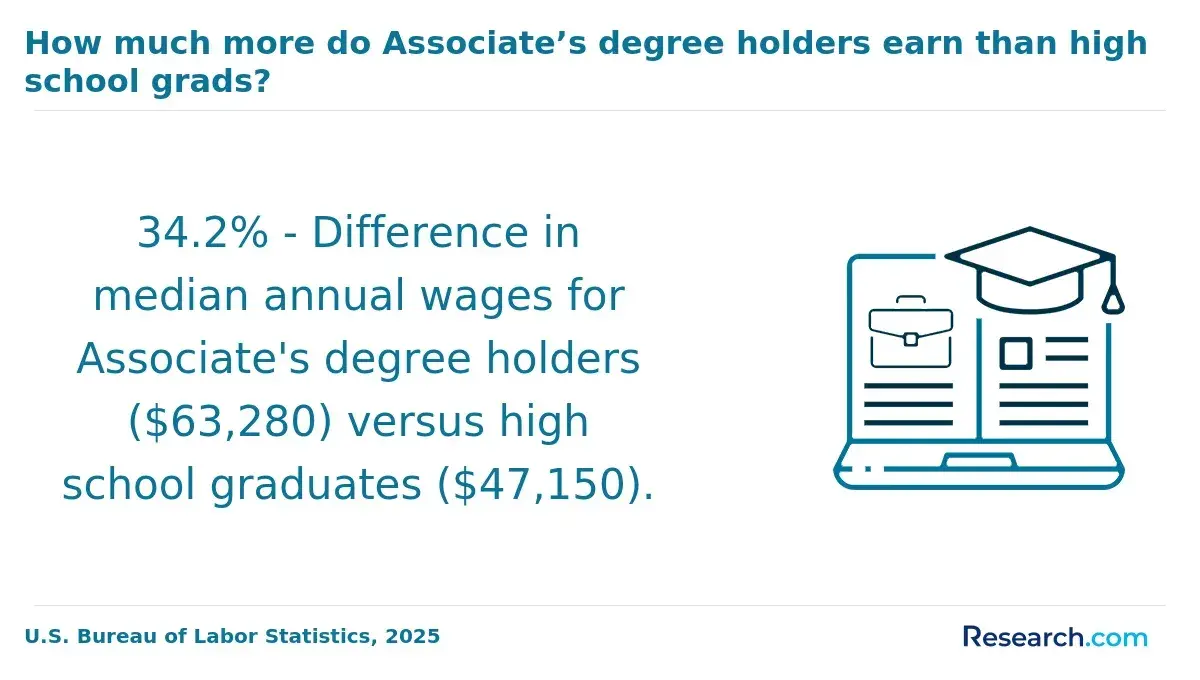
Salary information should be used as labor-market context, not as a promise attached to a certificate. The BLS reports occupation-wide median annual wages, which include workers with different education levels, locations, and experience. A short credential may help with entry, but it does not establish the wage an individual will receive.
These May 2024 BLS median annual wages illustrate the range among fields commonly associated with online training.
| Occupation | Median annual wage | Credential context |
| Medical assistants | $44,200 | Certificate training is common; employer and state expectations vary |
| Electricians | $62,350 | Typically requires apprenticeship and licensing progression, not online study alone |
| Paralegals and legal assistants | $61,010 | Employers may seek degree-level education or recognized paralegal preparation |
| Graphic designers | $61,300 | Portfolio, experience, and degree level affect opportunities |
| Web developers and digital designers | $95,380 | Skills and portfolio may matter substantially; requirements vary by employer |
Compare local job postings, not national medians alone. Look for recurring requirements such as a license, an associate or bachelor's degree, named software, an exam credential, or prior experience before deciding that a certificate has adequate return on investment.
How strong is the job outlook for fields tied to online certifications?
Job outlook is strongest when a credential connects to work that still needs people for direct service, installation, maintenance, compliance, or specialized technical problem-solving. AI and automation can streamline documentation, routine design production, and basic support tasks, increasing the value of hands-on ability, judgment, communication, and verified technical skills.
BLS 2023-2033 projections offer a useful national signal, although they do not predict openings in a specific city or prove that one credential leads to employment.
| Occupation | Projected employment change, 2023-2033 | What it suggests |
| Medical assistants | 15% | Healthcare support is a comparatively fast-growing pathway, subject to local hiring requirements |
| Electricians | 11% | Demand supports long-term trade pathways, but apprenticeship remains central |
| Heating, air conditioning, and refrigeration mechanics and installers | 9% | Technical training can be relevant, especially with practical experience |
| Web developers and digital designers | 8% | Digital skills remain relevant, but portfolio competition can be substantial |
| Paralegals and legal assistants | 1% | Training should be paired with local employer research and realistic expectations |
Use growth data as one filter, then review openings within commuting distance or realistic remote-work markets. Favor programs that build demonstrable skills and help learners translate those skills into résumés, portfolios, or supervised experience.
How can students evaluate and choose reputable online certification programs?
A reputable high-acceptance program is transparent about what students must do, what the credential represents, and what it cannot promise. The best option is not automatically the fastest or cheapest; it is the one that meets the entry requirement for your intended role without adding unnecessary debt or delay.
Before applying, use this practical screening process:
- Write down the target job, state, and the employer requirements found in several current job postings.
- Decide whether you need a college certificate, an industry certification, a degree, an apprenticeship, or a combination.
- Verify institutional accreditation for credit-bearing study and program approval when a regulator or licensing board requires it.
- Request the full price, expected weekly workload, refund policy, completion rules, and all required in-person components in writing.
- Confirm exam eligibility, credit transferability, and whether clinical or internship placement is guaranteed, assisted, or entirely self-arranged.
- Compare at least two providers on outcomes evidence, instructor access, curriculum currency, and employer relevance.
Common mistakes include treating a completion certificate as an industry certification, overlooking externship travel costs, assuming online delivery satisfies licensure rules, and trusting salary claims without checking occupational data.
Avoid providers that refuse to identify accreditation status, use pressure-based enrollment tactics, promise employment, or cannot explain their refund and placement policies.
Other Things You Should Know About
Many do not. Open-enrollment courses generally allow eligible learners to register without selective admissions. Colleges may publish institutional acceptance information, but it may not describe admission to a specific certificate cohort.
No. An online certificate usually documents completion of education or training. A professional certification is awarded by a certifying organization after meeting its standards, often including an exam and sometimes work-experience requirements.
Possibly, but only if the program meets your state board's specific education, clinical, examination, and other requirements. Confirm eligibility directly with the licensing authority before enrolling.
They can be worthwhile when they teach skills requested in local job postings, meet a recognized exam or employer requirement, and have transparent total costs. They are a weaker investment when a target occupation clearly requires a degree, license, apprenticeship, or extensive supervised experience.
References
- 20 Necessary IT Certifications + Salaries I Skillsoft - Skillsoft https://www.skillsoft.com/blog/top-paying-it-certifications
- The Rise of Online Certifications: Are They the Future of Professional Learning? | Adding Value Consulting https://www.addingvalue.nu/post/the-rise-of-online-certifications-are-they-the-future-of-professional-learning-018
- Top Online Courses for Certifications for Tech Jobs https://sciontechnical.com/top-online-courses-certifications-tech-jobs/
- Course Completion Rate Benchmarks: Improve Yours (2026) | Ruzuku https://www.ruzuku.com/learn/articles/course-completion-rates
- Examining Employers' Perceptions of Online Credentials - Ithaka S+R https://sr.ithaka.org/publications/examining-employers-perceptions-of-online-credentials/
- What Employers Actually Think About Online Degrees https://www.onlineu.com/magazine/what-employers-think-about-online-degrees
- 6 Considerations for Growing Online Programs | Carnegie https://www.carnegiehighered.com/growing-online-programs-in-higher-ed/
- 10 Quick Certifications That Lead To High-Paying Jobs | Become With Lantern https://www.learnhowtobecome.org/career-resource-center/quick-certifications-that-pay-well/
- Weighing the Value of Industry-Based Certifications against Their Costs https://www.nasbe.org/weighing-the-value-of-industry-based-certifications-against-their-costs/
- sfiscience https://santafe.edu/research/results/papers/569-do-online-certifications-improve-job-market-ou