2027 Careers You Can Start With an Associate Degree

Co-Founder and Chief Data Scientist
An associate degree can be a practical route into healthcare, technology, skilled trades, business, and public service without committing to four years of college upfront. According to BLS 2024 education data, workers with an associate degree had median weekly earnings of about $1,099, higher than the median for workers with only a high school diploma.
This guide is for students, career changers, and working adults comparing faster, lower-cost education paths. You will learn which careers fit an associate degree, what they pay, what licenses may be required, and how to choose a program wisely.
Key Things You Should Know
- Associate degrees are strongest for careers with clear employer requirements, hands-on training, or licensure pathways, especially in healthcare, engineering technology, IT support, public safety, and skilled technical fields.
- Costs vary widely, but public two-year colleges remain among the lowest-cost college options; NCES data for the 2024-25 academic year shows average published tuition and fees at public two-year institutions were far below public four-year in-state prices.
- The highest-paying associate-level options often require clinical training, certification, licensure, or high-responsibility technical work; BLS May 2024 data places several healthcare technology and transportation roles above the national median wage.
What types of careers can you start with an associate degree in the United States?
An associate degree is a two-year undergraduate credential that can prepare you either for immediate employment or transfer into a bachelor's program. Career-focused associate programs usually lead to an Associate of Applied Science, while transfer-oriented programs often lead to an Associate of Arts or Associate of Science.
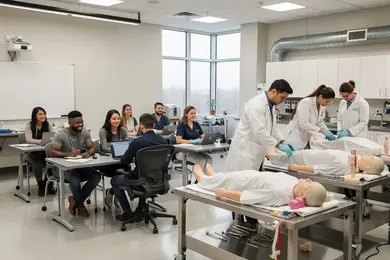
The best careers you can start with an associate degree are usually tied to a specific skill set, license, industry credential, or applied technical function. These roles often value lab practice, clinical hours, supervised fieldwork, equipment training, or software proficiency as much as general academic coursework.
The table below summarizes major associate-degree career categories and the kinds of entry-level roles they commonly support. Use it to compare whether you want a patient-facing, technical, office-based, field-based, or remote-friendly path.
| Career area | Common associate-level roles | Best fit for students who want | Important caveat |
| Healthcare | Registered nurse, radiologic technologist, dental hygienist, respiratory therapist, diagnostic medical sonographer | Stable demand, direct service work, structured licensure pathways | Programs often require selective admission, clinical placements, and state licensure |
| Information technology | Computer support specialist, network support technician, cybersecurity support technician, web developer | Technology work without necessarily starting with a bachelor's degree | Certifications, portfolios, and experience may matter as much as the degree |
| Skilled technical and engineering technology | Industrial engineering technician, electrical technician, manufacturing technician, HVAC technician | Hands-on work with equipment, systems, diagnostics, and maintenance | Some roles require apprenticeships, safety training, or employer-specific credentials |
| Business and legal support | Accounting clerk, paralegal, office manager, insurance claims support specialist | Administrative, analytical, or compliance-focused work | Advancement may depend on experience, software skills, or a later bachelor's degree |
| Public safety and transportation | Police officer, fire science technician, air traffic controller candidate, aviation maintenance technician | Mission-driven, regulated, or operational work | Age limits, background checks, physical standards, and federal or state requirements may apply |
Some associate pathways also align with hybrid or remote work, especially business administration, IT support, accounting technology, and web development. If flexibility is a major priority, compare program outcomes with broader guidance on the best degrees for work from home jobs before choosing a major.
A smart way to narrow your options is to start with the work environment rather than the degree name. If you want predictable licensing rules, healthcare may be a better fit; if you want faster skill stacking, IT or technical support may give you more room to combine a degree with certifications.
How does an associate degree compare to a bachelor's for starting a career?
An associate degree can be the better starting point when your target occupation accepts a two-year credential, when you need to enter the workforce quickly, or when you want to reduce upfront college costs. A bachelor's degree may be the stronger choice when your intended career requires broader theory, management preparation, graduate school eligibility, or long-term access to professional roles.
BLS 2024 education data shows median weekly earnings of about $1,099 for associate degree holders and about $1,543 for bachelor's degree holders. That gap matters, but it does not mean a bachelor's is automatically better for every student because program cost, time out of the workforce, licensure, location, and field choice all affect return on investment.
The comparison below shows where associate and bachelor's degrees tend to differ most for career starters. It is especially useful if you are deciding whether to enroll in a two-year program now or go directly into a four-year degree.
| Decision factor | Associate degree | Bachelor's degree | When the associate path may make more sense |
| Time to completion | Usually about two years full time | Usually about four years full time | You need faster entry into paid work |
| Upfront cost | Often lower, especially at public community colleges | Usually higher because of longer enrollment and university fees | You want to limit borrowing or test a field before transferring |
| Career access | Strong for licensed technical, healthcare, and support roles | Stronger for many professional, analytical, management, and graduate-school tracks | Your target role clearly lists an associate degree as acceptable preparation |
| Advancement | May require experience, certifications, or later degree completion | May open more supervisory and specialized roles earlier | Your employer offers tuition assistance or clear promotion steps |
| Flexibility | Good for stackable credentials and transfer pathways | Better for careers requiring broad academic preparation | You want to build credits gradually while working |
Students who expect to pursue graduate study later should plan the transfer path early. Some careers eventually require advanced credentials, and readers comparing long-term academic routes can explore how later options such as PhD programs differ from entry-level associate pathways.
The biggest mistake is assuming degree level alone determines career value. An associate degree in a licensed healthcare field can outperform a poorly matched bachelor's degree for a specific student, while a bachelor's may be essential for someone aiming at engineering, teaching, accounting licensure, or research-intensive roles.
Which associate-level careers offer the highest salaries and earning growth potential?
The highest-paying associate-level careers are typically in fields where workers operate complex equipment, make safety-critical decisions, complete regulated clinical duties, or support high-value technical systems. Salary also depends heavily on state, metro area, shift differentials, union coverage, employer type, and experience.
The table below uses BLS May 2024 median wage data where available to show career options often accessible with an associate degree, specialized training, or a related credential. Treat these figures as labor-market benchmarks, not promises of what any individual graduate will earn.
| Career | Typical associate-level preparation | Median annual wage, BLS May 2024 | Why earning potential can grow |
| Air traffic controller | FAA-approved education, training, testing, and federal hiring pathway | $144,580 | High responsibility, federal pay structures, and specialized training |
| Radiation therapist | Associate degree plus clinical training and state or employer credential requirements | $101,990 | Specialized oncology technology and clinical expertise |
| Nuclear medicine technologist | Associate degree in nuclear medicine technology or related approved pathway | $95,530 | Advanced imaging procedures and certification-based specialization |
| Dental hygienist | Accredited dental hygiene associate program and state licensure | $94,260 | Licensure, preventive care demand, and productivity-based settings |
| Registered nurse | Associate Degree in Nursing and NCLEX-RN licensure | $93,600 | Clinical specialization, shift differentials, BSN bridge options, and leadership pathways |
| Diagnostic medical sonographer | Associate degree or certificate after related education, plus credentialing often preferred | $89,340 | Specialized imaging skills and high-demand clinical settings |
Growth potential is not only about starting salary. In many associate-level fields, the most valuable advancement move is stacking credentials: an RN may complete a BSN, an IT support specialist may add cloud or cybersecurity certifications, and a manufacturing technician may move into automation or quality control.
Technology is also changing which skills command higher wages. AI-enabled imaging tools, electronic health records, remote monitoring, cybersecurity automation, and advanced manufacturing systems are not eliminating the need for trained workers, but they are raising expectations for digital fluency and judgment.
Before choosing a high-paying path, ask whether you can meet the nonacademic requirements. Some well-paid roles involve night shifts, physical stamina, liability exposure, competitive clinical admission, background checks, drug screening, or strict regulatory standards.
What admission requirements and prior education are needed for associate degree programs?
Most associate degree programs require a high school diploma, GED, or equivalent credential. Open-admission community colleges may admit many applicants broadly, but selective programs such as nursing, dental hygiene, sonography, radiography, and aviation maintenance often have additional prerequisites.
Admissions requirements matter because being admitted to the college is not always the same as being admitted to the career program. A student may start at the institution, complete prerequisite courses, and then apply separately to a competitive clinical or technical cohort.
Common requirements are easier to manage when you separate general college admission from program-specific screening. The list below highlights the items that most often affect your timeline:
- Proof of high school completion, GED, or recognized equivalent credential.
- College placement measures, which may include GPA, prior coursework, standardized tests, or placement assessments for math and English.
- Prerequisite courses such as anatomy and physiology, biology, algebra, statistics, chemistry, medical terminology, or computer fundamentals.
- Minimum GPA requirements for selective programs, often calculated separately for prerequisite courses.
- Background checks, immunizations, CPR certification, physical exams, drug screening, or liability insurance for clinical and public safety programs.
- Technical standards showing that students can meet physical, communication, safety, or professional requirements for the field.
- Entrance exams or program-specific applications for nursing, allied health, aviation, and other limited-seat programs.
Transfer students and adult learners should also ask how prior credits are evaluated. A school may accept general education credits but still require that science prerequisites be recent, completed with a minimum grade, or taken in person with a lab component.
A common mistake is applying only to the college and assuming the career program is guaranteed. Before you enroll, confirm the program's separate admission cycle, waitlist policy, clinical placement process, and minimum grade rules.
How long do associate degree programs take, and what do they typically cost?
Most associate degree programs are designed for about two years of full-time study, usually around 60 semester credits. Part-time students may take three or more years, while accelerated or year-round formats can shorten the calendar time if students can handle a heavier workload.
Cost depends on institution type, residency status, program fees, books, equipment, transportation, background checks, uniforms, testing fees, and lost work hours. NCES 2024-25 data shows public two-year colleges remain much less expensive on average than four-year institutions for published tuition and fees, which is why many students use them as a lower-risk starting point.
The table below breaks down the major cost categories to review before enrolling. This matters because the cheapest tuition price may not be the cheapest total path if a program has expensive supplies, long commutes, or nontransferable credits.
| Cost factor | What to check | Why it affects your decision |
| Tuition and fees | In-district, in-state, out-of-state, and online tuition rates | Residency rules can change the total cost substantially |
| Program-specific fees | Lab fees, clinical fees, simulation fees, testing fees, insurance, uniforms, tools, or kits | Career programs can cost more than general transfer programs |
| Books and materials | Textbooks, software, access codes, equipment, and certification exam prep | Some technical programs require tools or paid platforms |
| Transportation and scheduling | Commute distance, parking, clinical sites, evening labs, and unpaid fieldwork | Time and travel can reduce work availability |
| Financial aid | FAFSA eligibility, Pell Grants, state grants, scholarships, employer tuition aid, and payment plans | Net price is more useful than published tuition |
| Transfer value | Articulation agreements and bachelor's-completion options | Credits that transfer well can protect long-term ROI |
Students trying to move quickly should compare accelerated terms carefully. Short classes can help motivated students make progress, and some colleges use formats similar to 6 week courses online, but compressed courses require consistent weekly time and may not work well for lab-heavy or clinical subjects.
To control costs, complete the FAFSA early, ask about state workforce grants, compare net price instead of sticker price, and avoid borrowing for a program that does not clearly align with your target occupation. If you plan to transfer, get the receiving four-year college's transfer policy in writing whenever possible.
What are the most common online associate degree options, and how do they differ from campus programs?
Online associate degrees are common in business administration, accounting technology, criminal justice, computer information systems, cybersecurity, web development, early childhood education, liberal arts, and general studies. They are less common as fully online options in fields requiring labs, clinical hours, specialized equipment, or supervised patient care.
Online programs differ from campus programs mainly in delivery format, not necessarily in academic level. However, a fully online course schedule does not always mean the entire program can be completed from home, especially for healthcare, education, public safety, or technical trades.
The comparison below can help you decide whether an online, hybrid, or campus associate program fits your schedule and career target. Focus on required in-person components, not just the word "online" in the catalog.
| Format | Best for | Strengths | Limitations |
| Fully online | Business, IT, general studies, accounting, transfer degrees | Flexible scheduling, reduced commuting, easier access for working adults | May require strong self-management and fewer hands-on networking opportunities |
| Hybrid | Healthcare prerequisites, technical programs, education, labs | Combines flexibility with in-person practice | Campus visits or local placements may still be required |
| Campus-based | Nursing, dental hygiene, radiography, welding, aviation maintenance, advanced labs | Direct access to equipment, faculty, simulation labs, and clinical preparation | Less scheduling flexibility and possible commuting costs |
| Online transfer pathway | Students planning a bachelor's degree after community college | Can reduce cost while completing general education courses | Requires careful transfer planning to avoid lost credits |
Online students should be especially careful about accreditation, state authorization, proctored exams, local placement availability, and technology requirements. If your main goal is a manageable online path while balancing work or family, compare realistic workload expectations rather than relying only on lists of easy online degrees.
A good online associate program should provide advising, tutoring, library access, career services, disability accommodations, and transparent faculty contact. Red flags include unclear accreditation, vague licensure disclosures, pressure-based enrollment calls, and no clear explanation of how online students complete required hands-on training.
Which industries have the strongest job outlook for associate degree graduates?
The strongest outlook for associate degree graduates is in industries where employers need licensed practitioners, technical support workers, infrastructure technicians, and workers who can operate or maintain complex systems. Healthcare remains one of the most reliable areas because of population aging, chronic disease management, and ongoing demand for diagnostic and therapeutic services.
BLS 2024-34 projections show especially strong growth in several technical and healthcare-adjacent occupations, including rapid growth for wind turbine service technicians and solar photovoltaic installers. These examples show that two-year and technical training paths are not limited to traditional office or clinical roles; they also connect to energy infrastructure and field service work.
The table below summarizes industries where associate degree graduates may find stronger opportunity, along with the reason demand exists. Use it to compare labor-market stability with your preferred work setting.
| Industry | Associate-level roles to consider | Why outlook may be favorable | What to verify locally |
| Healthcare and allied health | RN, respiratory therapist, radiologic technologist, dental hygienist, sonographer | Aging population, diagnostic needs, outpatient care growth, replacement demand | Clinical seat availability, state licensure, local hospital hiring patterns |
| Information technology | Help desk technician, network support specialist, cybersecurity support technician | Business reliance on secure systems, cloud tools, and user support | Employer certification preferences and internship availability |
| Advanced manufacturing | Industrial technician, automation technician, quality technician, CNC-related roles | Automation, reshoring investments, and equipment maintenance needs | Local manufacturing base and employer partnerships |
| Renewable energy and utilities | Wind technician, solar technician, electrical technician, utility support roles | Energy infrastructure expansion and maintenance demand | Regional project activity, travel requirements, safety credentials |
| Transportation and aviation | Aviation maintenance technician, logistics coordinator, air traffic pathway roles | Complex operations and regulated technical work | Federal requirements, approved training providers, background checks |
Job outlook should guide your shortlist, but it should not replace local research. A high-growth occupation nationally may have limited openings in your area, while a slower-growth field may still offer strong local hiring because of retirements, hospitals, military bases, manufacturers, or regional infrastructure projects.
Before enrolling, review job postings within commuting distance, talk to program alumni, ask whether employers recruit on campus, and check whether the school publishes completion, licensure pass, and job placement information. These details are often more useful than a national ranking alone.
What licensing or certification is required for popular associate-level careers?
Licensing and certification are critical in many associate-level careers because the degree alone may not be enough to practice. Licensure is legal permission from a state or government authority, while certification is usually a credential from a professional organization or testing body that verifies competence.
Requirements vary by state, employer, and occupation. Always confirm rules with the relevant state board, licensing agency, or credentialing organization before enrolling, especially if you plan to study online or move after graduation.
The table below shows common credential expectations for popular associate-level careers. It is designed to help you see which paths require formal approval beyond graduation.
| Career | Typical degree or training | Common license or certification issue | What students should confirm |
| Registered nurse | Associate Degree in Nursing | NCLEX-RN exam and state board licensure | Program board approval, NCLEX pass rates, clinical placement quality |
| Dental hygienist | Accredited dental hygiene associate program | State licensure and national or regional exams | CODA accreditation and state-specific exam rules |
| Radiologic technologist | Accredited radiography program | ARRT certification often required or preferred; state licensure may apply | JRCERT accreditation status and state licensing requirements |
| Respiratory therapist | Accredited respiratory care program | State licensure and NBRC credentialing commonly required | CoARC accreditation and exam eligibility |
| Paralegal | Paralegal studies associate degree | Licensure usually not required, but certification can help | ABA approval, internship access, and local employer preferences |
| IT support or cybersecurity technician | IT, networking, or cybersecurity associate degree | Vendor certifications may be preferred, such as networking, cloud, or security credentials | Whether the curriculum prepares for recognized certification exams |
| HVAC technician | HVAC associate degree or technical training | EPA Section 608 certification required for refrigerant work | Hands-on lab access, apprenticeship links, and state or local licensing rules |
Common mistakes include enrolling in a program that is institutionally accredited but not approved for the specific license, assuming an online program meets every state's rules, or waiting until graduation to learn that a certification exam requires accredited coursework.
Use a simple verification process before you commit. First, identify your target job title; second, find the state licensing board or credentialing body; third, confirm the exact approved program type; fourth, ask the school for written evidence that graduates are eligible for the exam or license in your state.
What coursework and training should you expect in career-focused associate programs?
Career-focused associate programs combine general education with applied major courses. General education builds communication, math, science, and social science foundations, while major courses teach the specific technical or professional skills needed for the occupation.
Training style varies sharply by field. Healthcare programs emphasize labs, simulations, clinical rotations, patient safety, and documentation; IT programs emphasize systems, networks, scripting, troubleshooting, and security; technical trades emphasize diagnostics, equipment, codes, tools, and safety procedures.
Most programs include several of the following components, depending on the major. Review them because they affect your schedule, study time, and readiness for employment.
- General education courses such as English composition, communication, college algebra, psychology, sociology, statistics, or humanities.
- Foundational science or technical courses such as anatomy and physiology, microbiology, electronics, networking, programming logic, or mechanical systems.
- Hands-on labs, simulations, practicums, or shop courses where students practice with equipment, software, patients, or realistic scenarios.
- Field experiences such as clinical rotations, internships, cooperative education, externships, or supervised workplace training.
- Professional skills coursework covering ethics, documentation, safety, customer service, teamwork, communication, and workplace expectations.
- Certification or licensure preparation, including exam-style assessments, competency checkoffs, portfolio projects, or capstone experiences.
Expect career programs to be more structured than general studies programs. Missing a clinical, lab, or cohort course can delay graduation because some courses are offered only once per year or must be taken in sequence.
To prepare well, build a weekly schedule before classes begin, protect study blocks for lab-heavy courses, and ask early about tutoring or remediation. Students who work full time should be especially cautious with nursing, allied health, and accelerated technical programs because required hours may not be flexible.
How can you choose an accredited, reputable school for your associate degree?
Choosing the right school is one of the most important decisions in the associate degree process. A reputable program should be properly accredited, transparent about costs and outcomes, realistic about career preparation, and aligned with the licensing or transfer requirements for your goal.
Start by checking institutional accreditation through recognized accreditors and then verify programmatic accreditation when your field requires it. For example, nursing, dental hygiene, radiography, respiratory care, and many allied health programs often need specialized approval for graduates to qualify for exams or licensure.
Use the checklist below when comparing schools. These steps can help you avoid expensive mistakes before you submit an application or deposit.
- Confirm institutional accreditation using official accreditation databases and the school's current catalog.
- Check whether the specific program has required programmatic accreditation or state board approval for your occupation.
- Ask for total program cost, including fees, supplies, exams, background checks, uniforms, books, transportation, and technology.
- Review completion rates, licensure exam pass rates, transfer outcomes, and job placement information when available.
- Ask how credits transfer to partner bachelor's programs, especially if you may continue your education later.
- Verify whether online students can complete labs, clinicals, internships, or exams in their state or local area.
- Compare student support services, including advising, tutoring, career services, disability accommodations, and veteran or adult learner support.
- Watch for pressure tactics, unclear accreditation language, unrealistic salary claims, or refusal to provide written answers.
Application cost can also matter if you are applying to several schools. Students trying to keep upfront expenses low may want to compare online colleges with no application fee, while still prioritizing accreditation, licensure alignment, and transfer value over application savings alone.
The best school is not always the one with the lowest tuition, the fastest timeline, or the most advertising. It is the school that gets you eligible for the credential you need, at a cost you can manage, with credits and training that support your next step.
Other Things You Should Know About Career Planning
An associate degree can be worth it when it leads to a specific job, license, certification, or transfer pathway. It is usually strongest in healthcare, IT, technical trades, and applied business fields. It may be less valuable if the program has weak career outcomes, poor transfer options, or no clear connection to your target role.
Some IT support, business support, criminal justice, and technical roles may be accessible quickly, especially if you study full time or use accelerated terms. Licensed healthcare programs may take longer because of prerequisites, selective admission, clinical hours, and exam requirements.
Yes, some associate-level careers have strong median wages, especially roles such as registered nurse, dental hygienist, radiation therapist, diagnostic medical sonographer, and certain technical or transportation jobs. Pay varies by location, employer, experience, schedule, and credential status.
Choose a certificate if your target job requires a narrow skill set and you want the shortest training route. Choose an associate degree if you need broader education, transfer credits, licensure eligibility, or stronger long-term advancement options. In some fields, the best path is to earn a certificate first and apply those credits toward an associate degree later.
References
- Highest Paying Jobs in the World 2026 | Top Global Careers & Salaries https://ebsedu.org/blog/highest-paying-jobs-in-the-world/
- Affordable Associate Degrees Online https://www.accreditedschoolsonline.org/online-colleges/affordable-associate-degrees/
- Associate Degree vs Bachelor Degree: Comparing Options https://beal.edu/associate-degree-vs-bachelor-degree/
- Benefits of Career Focused Education for Students https://www.cdicollege.ca/news/benefits-of-career-focused-education-for-students/
- Guide to Online Associate Degrees https://www.onlineu.com/degrees/associate
- How Much Does an Associate Degree Cost? | SoFi https://www.sofi.com/learn/content/associates-degree-cost/