2027 Are Online MSW Programs Hard? Student Experience Breakdown

Co-Founder and Chief Data Scientist
Choosing an online MSW is not just a question of convenience. The real issue is whether you can manage graduate-level social work coursework, required field education, and professional or family responsibilities without losing the academic quality needed for licensure and career growth.
Online MSW programs can be demanding because they combine theory, writing-intensive assignments, live or asynchronous participation, and in-person practicum hours. The format may be flexible, but the expectations are usually similar to campus-based programs, especially when the degree is accredited and designed for professional practice.
This guide explains where online MSW programs tend to feel difficult, how they compare with on-campus options, what admission and curriculum requirements look like, how long they take, what they cost, and how they may support licensure, salary growth, and social work career paths.
Key Things You Should Know
- Online MSW programs in 2026 require strong time-management skills, with 65% of students reporting balancing coursework and fieldwork as the biggest challenge.
- Technological proficiency is essential; 78% of students state that adapting to virtual learning platforms impacts their academic success significantly.
- Despite challenges, 82% of students find online MSW programs flexible and accessible, allowing them to maintain employment while completing their degrees.
Are online MSW programs hard?
Yes, online MSW programs can be hard, but the difficulty usually comes from the MSW curriculum and fieldwork requirements rather than from studying online itself. Students are expected to read complex material, write graduate-level papers, apply social work theories to practice situations, complete group work, and participate in supervised field education.
The online format adds a different kind of challenge. Instead of attending scheduled classes on campus, students often need to manage asynchronous coursework, virtual discussions, digital submissions, and remote communication with instructors and classmates. This can be manageable for organized students, but it can become difficult for those who underestimate the weekly workload.
Most students find the hardest parts include:
- Time management: MSW assignments, readings, discussion posts, and practicum responsibilities can overlap with work and family obligations.
- Field placement coordination: Even in an online program, practicum hours are typically completed in person at an approved agency.
- Academic writing: MSW programs often require reflective papers, policy analysis, research-based assignments, and case assessments.
- Emotional intensity: Social work education involves trauma, inequality, ethics, crisis response, and vulnerable populations.
- Reduced informal interaction: Online students may need to be more intentional about building relationships with peers, faculty, and supervisors.
A strong online MSW program should not feel easier than a campus program. It should feel flexible, structured, and supported. Look for clear course expectations, responsive faculty, practicum support, academic advising, writing resources, and reliable technology. Students comparing the cost of advanced social work education may also find related affordability information in the Simmons University DSW cost guide.
What makes online MSW programs challenging?
The main challenges in online MSW programs are workload, field education, self-direction, and the emotional demands of social work training. Many online MSW students are not traditional full-time students with open schedules. They are often working adults who must fit graduate school around employment, caregiving, and community responsibilities.
Data from the CSWE indicates online MSW graduates are 54% more likely to have six or more years of work experience before enrollment. That experience can be an advantage in class discussions and fieldwork, but it also means many students are balancing school with established professional and personal commitments.
Common difficulty factors
| Challenge | Why it matters | How to manage it |
| Heavy reading and writing | MSW courses require analysis, reflection, research, and application rather than memorization alone. | Block weekly study time and start papers before deadlines are close. |
| Field placement logistics | Students must complete supervised practice in an approved setting, often while managing work schedules. | Ask early how placements are arranged and whether evening, weekend, or employment-based options are possible. |
| Limited face-to-face contact | Students may feel disconnected if courses are mostly asynchronous. | Use office hours, group chats, discussion boards, and cohort networks intentionally. |
| Technology demands | Learning platforms, video meetings, uploads, and online exams require reliable access and comfort with digital tools. | Test systems before classes begin and have a backup internet plan when possible. |
| Emotional workload | Course topics and practicum experiences can involve trauma, abuse, poverty, grief, and crisis intervention. | Use supervision, peer support, and school counseling or wellness resources when needed. |
Another challenge is that online learning requires students to notice problems early. In a campus class, a professor may see confusion or disengagement in real time. Online students often need to ask for clarification, request feedback, and communicate when practicum or personal circumstances create obstacles.
Cost can also affect difficulty. A student who chooses a program that is financially manageable may have more room to reduce work hours or avoid excessive debt pressure. Comparing affordable online MSW programs can help applicants weigh tuition against accreditation, field support, and program fit.
How do online MSW programs compare to campus-based?
Online and campus-based MSW programs can lead to similar academic and professional outcomes when they are properly accredited and meet field education standards. The biggest differences are how students interact, how much schedule flexibility they have, and how field placement support is delivered.
According to the CSWE Social Work Student Perceptions report, 61.1% of students experienced a decline in learning quality after moving fully online during the COVID-19 pandemic. That figure is important because it shows that online delivery can affect the learning experience when programs are not designed carefully for virtual engagement. A well-built online MSW should not simply move campus lectures onto a screen; it should use structured discussions, accessible faculty support, clear assignment design, and strong field coordination.
| Factor | Online MSW | Campus-based MSW |
| Schedule flexibility | Usually better for working adults, caregivers, and students outside commuting range. | More fixed class times and location requirements. |
| Class interaction | Depends heavily on discussion boards, video meetings, group projects, and faculty responsiveness. | Offers more spontaneous conversation before, during, and after class. |
| Field education | Often completed locally, with remote coordination from the school. | May benefit from established nearby agency relationships. |
| Networking | Requires more intentional effort through virtual events, cohort groups, and professional associations. | Often easier through campus events, local placements, and in-person faculty access. |
| Best fit | Self-directed students who need flexibility and can communicate proactively. | Students who prefer in-person structure, immediate discussion, and campus resources. |
Online programs are not automatically easier, and campus programs are not automatically better. The right choice depends on your learning style, schedule, location, need for structure, and licensure goals. Applicants should also think beyond graduation. Reviewing the social worker salary by state can help connect program choice with regional job markets and long-term earning expectations.
Admission requirements for online MSW programs usually include a bachelor's degree from an accredited institution, official transcripts, a personal statement, letters of recommendation, and a resume or CV. Many programs prefer or require a minimum GPA around 3.0, although standards vary by school and track.
Applicants are often asked to explain why they want to enter social work, which populations or practice areas interest them, and how their academic or professional background has prepared them for graduate study. Relevant paid or volunteer experience in human services can strengthen an application, especially for applicants without a bachelor’s degree in social work.
Typical application materials
- Bachelor’s degree: Usually required from an accredited institution.
- Official transcripts: Used to verify degree completion, GPA, and prerequisite coursework.
- Letters of recommendation: Most programs request two or three letters from academic, professional, or service-related references.
- Personal statement: Should show maturity, ethical awareness, commitment to social work values, and realistic career goals.
- Resume or CV: Highlights employment, volunteer work, internships, advocacy, leadership, and human services experience.
- Prerequisite coursework: Some programs look for preparation in areas such as psychology, sociology, or statistics.
- Interview: Some schools use interviews to assess communication skills, readiness, and fit.
- Background check: Often required because field placements involve clients, agencies, schools, healthcare settings, or vulnerable populations.
- English proficiency: International students may need TOEFL or IELTS scores and credential evaluation.
Standardized tests such as the GRE are becoming optional at many schools, but policies differ. Applicants should not assume a test is unnecessary until they review the specific program’s current admission requirements.
Enrollment format is also part of the admissions decision. Only 12-27% of online MSW students enroll full-time, compared to 37% attending in person, which reflects how common part-time study is among online students with work or family commitments. Applicants who want more accessible admission pathways can compare the easiest MSW programs to get into, while still checking accreditation, field placement quality, and licensure alignment.
Online MSW programs typically take between two and three years to complete, though the exact timeline depends on enrollment status, program structure, field placement scheduling, and whether the student qualifies for an accelerated or advanced standing pathway.
Full-time students often finish in about 24 months. Part-time students usually take three to four years, which can be a better fit for those who plan to keep working, care for family members, or spread tuition costs over a longer period.
| Enrollment pace | Common completion time | Best suited for |
| Full-time | About 24 months | Students who can prioritize school and fieldwork with limited outside commitments. |
| Part-time | Three to four years | Working adults, caregivers, and students who need a lighter course load. |
| Flexible online pacing | Between two and three years in many programs | Students who want structure but need some scheduling flexibility. |
Technology readiness can influence progress, but it is not always a major barrier. Roughly 79% of online students rate their experience as equal to or better than in-person programs, suggesting that many students can adapt successfully when the platform, support services, and course design are effective.
The most common timeline problems come from underestimating field hours, taking on too many credits while working, delaying placement paperwork, or failing to plan around agency schedules. Before enrolling, ask for a sample plan of study that shows course sequencing, practicum timing, expected weekly hours, and any required live sessions.
The online MSW curriculum prepares students for professional social work practice through courses in human behavior, social welfare policy, research, ethics, practice methods, diversity, assessment, intervention, and field education. The curriculum is designed to connect theory with supervised practice, not simply to deliver academic content online.
Core coursework usually covers how individuals, families, groups, organizations, and communities are affected by social systems, policy decisions, trauma, poverty, oppression, health conditions, and access to services. Students also learn how to evaluate evidence, apply ethical standards, document practice decisions, and understand the role of social workers in different settings.
Common curriculum areas
- Human behavior and the social environment: Examines development, relationships, identity, culture, systems, and social conditions.
- Social welfare policy: Explores laws, programs, institutions, and advocacy strategies that shape service delivery.
- Research methods: Teaches students to interpret evidence, evaluate programs, and use data responsibly.
- Practice with individuals, families, and groups: Builds assessment, interviewing, intervention, crisis response, and case planning skills.
- Community and organizational practice: Focuses on program development, leadership, advocacy, and systems change.
- Ethics and professional practice: Covers confidentiality, boundaries, mandated reporting, cultural humility, and professional judgment.
- Electives or concentrations: May include mental health, child welfare, substance abuse, healthcare, school social work, or other areas.
Field placement is a required part of MSW education, including online programs. Students typically must complete up to 1,500 in-person hours at agencies close to their residence, where they apply classroom learning under supervision. This is often the most important and most time-consuming part of the degree.
Students should ask how the program approves field sites, who contacts agencies, whether employment-based placements are allowed, how supervision is documented, and what happens if a placement does not work out. A flexible online course schedule is helpful, but it does not eliminate the need to be available for agency-based practicum hours.
Online MSW programs typically cost between $20,000 and $60,000 in total tuition. The final cost depends on the school, program length, credit requirements, public or private status, residency rules, transfer credit, and whether the student qualifies for advanced standing or other reduced-credit options.
Public universities often charge lower rates for in-state students, while private institutions tend to cost more. Some online programs charge the same tuition regardless of residency, while others bill online students differently from campus students. Many programs charge per credit hour, typically ranging from $500 to over $1,000, so applicants should calculate the full degree cost rather than comparing only the per-credit price.
Costs to review before enrolling
- Tuition: Confirm the total number of credits required and the cost per credit.
- Fees: Ask about technology fees, distance learning fees, field placement fees, graduation fees, and student service fees.
- Books and materials: Required readings, software, assessment tools, or online resources may add to the budget.
- Fieldwork costs: Practicum may require transportation, background checks, immunizations, insurance, or reduced work hours.
- Residency or campus requirements: Some online programs include required in-person sessions that may create travel costs.
- Lost income: Even online students may need to reduce work hours during intensive field placement terms.
Online study can be financially practical because many students continue working while enrolled. However, flexibility does not automatically mean lower cost. The better measure is net cost after scholarships, grants, employer tuition assistance, assistantships, loan options, and any income changes required for fieldwork.
Before committing, compare the total tuition, expected fees, financial aid availability, field placement support, and licensure alignment. A lower-cost program is valuable only if it still provides the academic quality, accreditation status, and supervised experience needed for your goals.
An online MSW can prepare graduates for many of the same social work careers as a campus-based MSW, provided the program is accredited and meets the requirements for the student’s intended state and practice area. Career options can include clinical practice, healthcare, schools, child welfare, community services, policy, nonprofit leadership, and advocacy.
The degree itself does not automatically authorize independent clinical practice. Many clinical roles require state licensure, supervised post-graduate experience, and successful completion of required exams. Nonclinical roles may place more emphasis on program management, casework, policy analysis, community organizing, or direct service experience.
| Career path | Typical focus | Licensure considerations |
| Clinical social work | Therapy, assessment, treatment planning, crisis intervention, and mental health support. | Usually requires additional supervised clinical experience and state licensure. |
| Healthcare social work | Care coordination, discharge planning, patient advocacy, family support, and resource connection. | Requirements vary by role and state. |
| School social work | Student support, behavioral concerns, family engagement, attendance, and crisis response. | May require state education credentials or school social work certification. |
| Child and family services | Case management, child welfare, foster care, family preservation, and permanency planning. | Agency and state requirements vary. |
| Nonprofit and community leadership | Program design, grant work, supervision, advocacy, outreach, and service coordination. | Licensure may be less central than leadership and program experience. |
| Policy and advocacy | Research, legislative analysis, community organizing, and systems-level change. | Licensure may not be required, depending on the position. |
| Forensic social work | Work with legal, correctional, court, victim services, or reentry systems. | Requirements depend on employer and scope of practice. |
Class sizes in online MSW programs typically range from 15 to 25 students, which can support discussion and faculty interaction when courses are well designed. Still, career readiness depends heavily on field placement quality. Students should verify whether the program has relationships with agencies in their area and whether those placements match their interests, such as clinical diagnosis, crisis intervention, healthcare navigation, school services, or community resource coordination.
Choosing an accredited online MSW can support a wide range of career paths, but students should match the program to their target role before enrolling. A student planning to become an LCSW, for example, should be much more careful about clinical coursework, practicum settings, supervision, and state licensure rules than a student focused on macro practice or nonprofit administration.
The salary outlook for MSW graduates varies by role, location, employer type, license level, experience, and specialization. Entry-level MSW holders generally earn between $50,000 and $60,000 annually, with median salaries rising to $65,000-$75,000 after several years in the field. Those in clinical or specialized roles, such as healthcare or school social work, often earn above $80,000, while government agency or large nonprofit positions tend to offer more stable but lower salaries.
Graduates from online MSW programs can have strong employment outcomes, especially when they already have work experience or remain connected to employers during school. The CSWE Workforce Data Brief notes that 52% of online graduates find satisfying jobs easily, compared to 43% of in-person graduates. For some students, an online MSW can support advancement with a current employer because they can keep working while earning the degree.
Several factors have a major effect on pay:
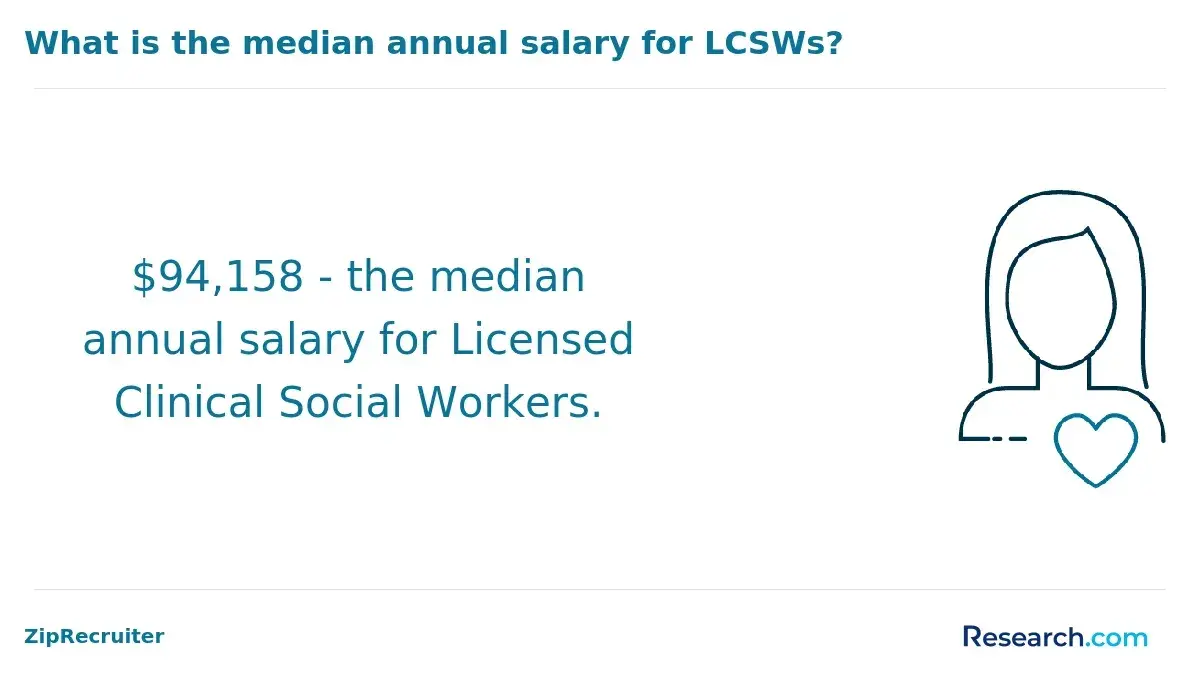
- Licensure: Long-term salary gains often depend on obtaining Licensed Clinical Social Worker (LCSW) status, which can boost pay by 20-30%.
- Practice setting: Healthcare, schools, government, private practice, and nonprofit organizations may have different compensation structures.
- Location: Salaries can vary widely by state, metro area, cost of living, and local demand.
- Specialization: Clinical mental health, medical social work, substance use, child welfare leadership, and administration may offer different earnings potential.
- Experience and supervision: Post-graduate supervised hours, leadership experience, and advanced credentials can improve competitiveness.
Applicants should be cautious about evaluating an MSW only by salary. Social work can offer meaningful career mobility, but the return on investment depends on tuition cost, debt level, licensure plans, and the kinds of jobs available where the graduate intends to practice.
Do online MSW programs lead to licensure?
Online MSW programs can lead to licensure when the program has the proper accreditation and meets the requirements of the state where the student plans to practice. The online format itself is usually not the barrier. The more important issues are accreditation, required coursework, field education, supervised clinical hours, exams, background checks, and state-specific rules.
Most reputable MSW programs are accredited by the Council on Social Work Education (CSWE), which is a key requirement for many social work licenses, including clinical pathways such as LCSW. Students should verify accreditation directly before enrolling and should not rely only on marketing language such as “licensure-track” or “clinical focus.”
State licensing requirements vary. Some states may require specific coursework, documentation of supervised experience, additional exams, jurisprudence requirements, or background checks. Online students should also confirm whether the program is authorized to enroll students in their state and whether field placements can be arranged locally in a way that satisfies licensing expectations.
Financial and career outcomes may differ by student population and career path. Financial outcomes for online MSW graduates show 61% earn $40,000 or more annually, compared to 74% of in-person graduates, indicating somewhat different career trajectories. Online graduates frequently work with specific populations like the elderly at higher rates (27% versus 14%), reflecting variation in professional focus.
Licensure checklist for online MSW applicants
- Confirm the program’s CSWE accreditation status.
- Check the social work licensing board requirements in the state where you plan to practice.
- Ask whether the curriculum satisfies clinical and nonclinical licensure pathways.
- Verify how field placements are approved, supervised, and documented.
- Clarify whether post-graduate supervised hours are required after the MSW.
- Keep copies of syllabi, field evaluations, supervision records, and official transcripts.
An online MSW can be a valid path to licensure, but students must verify requirements early. Completing the degree without confirming accreditation, state rules, and field documentation can create delays or limit eligibility after graduation.
Other Things You Should Know About Social Work
In 2027, online MSW students generally need to complete approximately 900-1,200 hours of supervised fieldwork. The intensity varies by program, but students spend significant time in diverse social work settings, integrating theoretical knowledge with practical skills.
Yes, many online MSW programs offer specializations such as clinical social work, school social work, or community practice. These concentrations allow students to tailor their education to career goals while fulfilling generalist coursework and fieldwork. Specialization availability differs between schools, so prospective students should review program details carefully.
Most online MSW programs require a reliable laptop, webcam, microphone, and stable internet. Students also need access to learning platforms like Canvas or Blackboard, plus video tools such as Zoom or Microsoft Teams. Some field placements require secure, HIPAA-compliant systems for client documentation and supervision notes.
To compensate for the lack of physical classrooms, online MSW programs use discussion boards, video conferences, group projects, and virtual study groups. These tools encourage collaboration, networking, and peer support throughout the program. However, the level of interaction may differ based on the school's platform and course design.
- Online MSW Programs No GRE Required - MasterofSocialWork.com https://www.masterofsocialwork.com/faqs/gre-requirements-online-msw-programs
- Online Master of Social Work https://socialwork.pacific.edu/programs/online-msw-programs
- Life as an Online MSW Student: Challenges and Triumphs https://www.mzuonline.in/blog/life-as-an-online-msw-student-challenges-and-triumphs.html
- Most Affordable Online MSW Programs: Review Low-Cost Options https://www.degreesforgood.org/online-degrees/social-work-programs/masters-msw/most-affordable/
- What Can I Do with an MSW Degree? MSW Career Paths https://socialworklicensemap.com/social-work-degrees/master-of-social-work-programs/what-can-you-with-a-msw-career/
- Socialworkdegrees - Cost Benefit Analysis https://www.socialworkdegrees.org/cost-benefit-analysis
- Full-time online MSW programs https://www.onlinemswprograms.com/online-social-work-degrees/full-time-online-msw-programs/
- Social Worker Salary and Jobs in Social Work https://teach.com/online-ed/social-work-degrees/online-masters-social-work/salary-and-career-outlook/
- Best Affordable Master's Degree In Social Work https://www.psychology.org/social-work/best-affordable-masters-programs/
- MSW Career Outlook https://www.kysu.edu/academics/college-as/school-of-social-work/careers/msw-career-outlook.php