2027 Fastest Advanced Standing Online MSW Programs in the U.S.

Co-Founder and Chief Data Scientist
Advanced standing online MSW programs are designed for students who already completed a Bachelor of Social Work and want the shortest accredited path to graduate-level social work practice. The key decision is not simply which program is fastest, but which program is fast, accredited, affordable, field-placement-ready, and aligned with your state’s licensure rules.
These programs can reduce duplicated foundation coursework, shorten the degree timeline, and help qualified students move toward clinical, community, policy, school, health care, or administrative roles sooner. However, they are not usually intended for students without a CSWE-accredited BSW. If your undergraduate degree is in another field, you may need a traditional MSW track rather than advanced standing.
This guide explains how accelerated advanced standing online MSW programs work, what accreditation and admissions standards matter, how long programs take, what they cost, what students study, and how to compare career outcomes before enrolling.
Key Things You Should Know
- Accelerated advanced standing MSW programs in 2026 offer completion timelines as short as 12 to 16 months, significantly reducing time compared to traditional 2-year tracks.
- These programs require a bachelor's degree in social work from a CSWE-accredited institution, ensuring foundational knowledge and eligibility for advanced coursework.
- Online delivery enhances accessibility nationwide, with over 60% of students reporting increased flexibility and compatibility with professional or personal responsibilities.
What are the fastest advanced standing online MSW programs?
The fastest advanced standing online MSW programs in the U.S. are typically built for students who already hold a Bachelor of Social Work from an accredited program and can handle a compressed graduate schedule. Many allow qualified students to complete the MSW in as little as 12 to 18 months by waiving foundation coursework already covered in the BSW.
Schools such as Simmons University, University of Southern California, and Rutgers University use intensive online formats, year-round calendars, and integrated fieldwork to help students move from undergraduate social work preparation into advanced practice more quickly.
Common features of accelerated advanced standing online master of social work programs in America include:
- Year-round coursework with fewer long breaks, which helps students finish credits faster.
- Credit waivers or advanced placement for prior BSW coursework, reducing repeated foundation content.
- Online delivery that may include asynchronous coursework for students balancing employment, caregiving, or relocation limits.
- Field placements scheduled alongside coursework so students continue building supervised practice experience while completing academic requirements.
Speed comes with trade-offs. A 12-month or 18-month MSW can be demanding, especially when coursework, practicum hours, employment, and family responsibilities overlap. Students should ask each program how many hours per week are expected for classes, assignments, and field education before choosing the shortest option.
Fast completion may support earlier licensure progress and career mobility, but salary outcomes depend on state licensure, specialization, employer type, geography, and experience. For instance, Simmons University graduates reported average LCSW salaries of $92,000, with top specialists earning over $120,000 annually. These figures show the potential value of timely degree completion, but they should not be treated as guaranteed earnings.
Before applying, confirm that your BSW meets program eligibility rules and that the MSW is appropriate for the license you plan to pursue in your state. Students who want advanced leadership, teaching, research, or policy credentials after the MSW may later compare social work doctorate programs.
How does advanced standing work in MSW programs?
Advanced standing in an MSW program means the school recognizes that a student has already completed the foundational social work curriculum in a CSWE-accredited BSW program. Instead of repeating introductory graduate content, eligible students move into advanced practice, policy, research, and specialization coursework sooner.
In the U.S., advanced standing eligibility requirements generally allow BSW graduates from a CSWE-accredited institution to complete the MSW in about one year rather than the usual two. This pathway can reduce tuition, shorten time away from full professional advancement, and help students qualify for post-graduate supervised practice sooner. For instance, University of Kentucky advanced standing MSW graduates started their careers 12 months earlier, earning approximately $25,000 more in early-career income compared to traditional students, based on the CSWE 2025 Workforce Study on MSW Program Outcomes.
Typical advanced standing requirements include:
- A BSW from a CSWE-accredited program.
- Completion of undergraduate social work courses that match MSW foundation competencies.
- A minimum GPA, often near 3.0, though exact thresholds vary by school.
- Professional or academic recommendations that speak to readiness for graduate-level social work.
- Evidence of field education or related practice experience completed during the BSW.
Advanced standing does not mean the program is easier. It means the curriculum is compressed because the student has already completed prerequisite social work preparation. Students enter closer to the specialization stage, where expectations for writing, ethics, assessment, research use, and field performance are higher.
Admissions rules vary. Some programs require interviews, supplemental foundation modules, or additional coursework if the applicant’s BSW curriculum does not align closely with the school’s MSW standards. Others offer advanced standing tracks in clinical social work, community practice, children and families, health care, mental health, or policy.
The safest first step is to verify both the MSW program’s accreditation and your BSW’s eligibility. Students comparing cost and speed can review affordable online MSW programs that include accelerated advanced standing MSW options.
What accreditation is required for online MSW programs?
The most important accreditation for an online MSW program in the U.S. is accreditation from the Council on Social Work Education, commonly known as CSWE. For students pursuing licensure, CSWE accreditation is not a minor quality signal; it is often a core requirement for state licensing boards, clinical supervision eligibility, and employer recognition.
Online MSW program accreditation in the U.S. requires the program to meet educational standards for curriculum, faculty, field education, assessment, and professional competencies. Regional accreditation standards for advanced standing MSW programs also matter because the institution itself must be recognized as a legitimate degree-granting college or university.
For online students, accreditation is especially important because the course format may differ from campus-based study, but the professional expectations should not. A CSWE-accredited online MSW must still include approved field education, ethical practice preparation, policy content, research training, and social work competency development.
For example, Fordham University's accredited online advanced standing MSW program reported that 78% of its graduates secured clinical roles within six months, outperforming the 62% placement rate of its standard MSW graduates (Council on Social Work Education, 2025 Annual Program Survey). This type of outcome can help students compare programs, but accreditation should be verified independently before enrollment.
Students should check CSWE's official directory and confirm that the specific MSW program, not just the university, is accredited. Also confirm whether the program is approved to enroll students from your state, since online authorization and field placement rules can vary.
Many state licensing boards require graduation from a CSWE-accredited MSW program for clinical licensure, including credentials such as Licensed Clinical Social Worker. Students considering fast online options can compare an accelerated masters in social work online while keeping accreditation and licensure requirements at the center of the decision.
Admission to an advanced standing MSW program is more selective than simply applying to a regular graduate program. Schools must determine whether the applicant has already completed the equivalent of MSW foundation coursework through a qualifying BSW and whether the student is ready for a faster, more advanced curriculum.
Most advanced standing MSW programs in the U.S. require a bachelor's degree in social work from a CSWE-accredited program. A minimum undergraduate GPA of 3.0 is typically required, although programs may consider the overall application, social work GPA, field evaluations, professional experience, and academic trend.
Common application materials include:
- Official transcripts from all colleges attended.
- Proof that the BSW program was CSWE-accredited.
- Two or three letters of recommendation from faculty, field instructors, supervisors, or professionals who can assess social work readiness.
- A personal statement explaining professional goals, ethical awareness, relevant experience, and reasons for choosing advanced standing.
- Documentation of practicum, internship, volunteer, or employment experience related to social work practice.
- A resume or curriculum vitae showing human services, advocacy, case management, research, or community engagement experience.
Some schools may request GRE scores, although this is less common for MSW admissions. Programs may also require background checks because students work with vulnerable populations during field placements. A prior conviction does not always mean automatic denial, but it can affect placement options and future licensure, so applicants should ask programs and licensing boards direct questions early.
Applicants should also review whether the program prefers or requires recent BSW completion. Some advanced standing tracks limit eligibility to students who earned the BSW within a certain period, while others allow older degrees if the applicant has relevant experience or completes refresher coursework.
Specialization can affect the value of the degree. Ohio State University MSW graduates specializing in mental health and substance misuse earned a 15% salary premium over social work generalists in 2025, averaging $98,500 (National Association of Social Workers, 2025 Compensation Report), highlighting how targeted preparation may influence outcomes.
Students who do not have a BSW should be careful when researching fast programs. Advanced standing generally requires a BSW, while non-BSW students usually need a traditional MSW track. Those comparing alternative entry routes can review 1 year MSW programs online no bsw to understand how admissions pathways differ.
Accelerated online MSW programs generally take 12 to 18 months for advanced standing students who already hold a Bachelor of Social Work from a program accredited by the Council on Social Work Education. These timelines usually assume full-time enrollment and continuous progress through coursework and field education.
Part-time options can extend completion up to 24 months depending on program structure, course availability, and field placement scheduling. Some institutions offer fast-track plans spanning three semesters, while others use a slightly longer calendar to make the workload more manageable for working professionals.
The biggest timeline factor is often field education. Coursework may be online, but supervised practice still requires real agency-based learning. Many accelerated MSW programs mandate a minimum of 900 hours of supervised practicum, which can affect graduation timing if a student cannot secure a placement quickly or cannot complete required hours within the planned schedule.
Students should compare timelines by asking practical questions:
- Is the 12-month plan available to all advanced standing students or only to full-time students?
- Are courses offered every term, including summer?
- Can field hours be completed near the student’s home?
- Does the school find placements, or is the student expected to identify agencies?
- How many weekly hours are typically needed for coursework and practicum combined?
- Can the program be slowed down without losing advanced standing status?
Financial incentives can also affect whether a shorter program is realistic. For example, San Jose State University provides military-affiliated MSW students with a 45% tuition discount, reducing costs on the advanced standing track to under $15,000, according to the U.S. Department of Veterans Affairs.
When choosing an accelerated online MSW program, balance speed against sustainability. A program that takes slightly longer but provides stronger field support, better scheduling, or lower financial risk may be the better choice than the absolute fastest option.
- Compare program pace with your work schedule, caregiving obligations, and capacity for intensive study.
- Review credit transfer and waiver policies for prior graduate or social work coursework.
- Confirm field placement requirements, supervision rules, and scheduling flexibility before enrolling.
Top online advanced standing MSW programs in the U.S. can cost from about $20,000 to over $50,000 in total tuition. The final cost depends on the institution, residency status, credit requirements, tuition model, required fees, and whether the student receives scholarships, military benefits, employer assistance, or other aid.
Advanced standing programs usually cost less than traditional MSW programs because they require fewer credits. Many advanced standing tracks require 30-36 credit hours instead of 60, as in traditional two-year MSW tracks. That reduction can significantly lower tuition and allow students to enter higher-level roles sooner, but the exact savings vary by school.
Public universities often offer lower tuition for in-state students, sometimes below $25,000. Private universities and out-of-state tuition rates often push costs above $40,000. Students should also budget for additional expenses such as technology fees, clinical placement fees, books, travel to field sites, background checks, liability insurance, and required software. Additional fees for technology or clinical placements, ranging from $1,000 to $3,000, may also apply.
For example, Florida State University's cohort-based online MSW program costs approximately $22,000 for in-state students and has demonstrated a 92% retention rate in 2025, which is 18% higher than non-cohort formats. This highlights the benefits of peer support in cohort models (CSWE 2025 Online Learning Effectiveness Report).
When comparing cost, do not stop at tuition. A cheaper program may become more expensive if it offers weak placement support, delays graduation, or requires travel that conflicts with work. A more expensive program may provide better value if it has strong retention, reliable field placement coordination, licensure preparation, and employment outcomes.
Before applying, calculate:
- Total tuition for the advanced standing track, not the full traditional MSW.
- Mandatory fees and field placement costs.
- Whether online students pay in-state, out-of-state, or flat-rate tuition.
- Scholarship availability and application deadlines.
- Federal loan eligibility and employer tuition assistance options.
- Expected lost income if the program requires reduced work hours.
Financial aid can reduce out-of-pocket costs, but students should review borrowing carefully. An accelerated program can be financially efficient, yet the best value comes from a program that is accredited, affordable, completion-friendly, and aligned with your intended license and career path.
Advanced standing MSW degrees build on prior BSW training rather than starting with introductory social work foundations. Students move quickly into advanced practice, assessment, intervention, policy analysis, research use, ethics, and specialization coursework.
A typical advanced standing curriculum may include:
- Advanced direct practice with individuals, families, groups, and communities.
- Clinical assessment, diagnosis, treatment planning, and intervention methods where permitted by program focus and state scope of practice.
- Social policy analysis and advocacy.
- Research methods, evidence-based practice, and program evaluation.
- Diversity, equity, inclusion, and culturally responsive practice.
- Trauma-informed care, mental health practice, substance abuse treatment, child welfare, aging, health care, or school social work, depending on concentration.
- Leadership, supervision, grant writing, organizational management, and administrative practice for students pursuing macro or management roles.
Field education remains central. Even in an online program, students complete supervised practice in approved agencies, clinics, schools, hospitals, nonprofits, government offices, or community organizations. Placements should connect to the student’s goals whenever possible, such as clinical practice, policy advocacy, case management, medical social work, or community program development.
Because the curriculum is compressed, students should expect substantial reading, writing, case analysis, role-play, research evaluation, and field documentation. The strongest programs connect classroom learning directly to practicum experiences so students can apply theory, ethics, and evidence-informed methods in real settings.
Some programs use fully online coursework, while others use hybrid formats. Flexible delivery can help working students, but it should not replace meaningful faculty access or field support. For instance, University of Houston Hybrid MSW graduates attained a 22% higher ROI within five years compared to fully on-campus peers (Georgetown University Center on Education and the Workforce, 2025 Social Work Degree ROI Analysis).
When reviewing curriculum, look beyond course titles. Ask whether the program prepares students for the population, license, and setting they want to enter. A student aiming for clinical mental health practice should evaluate clinical supervision, assessment training, and licensure preparation differently from a student aiming for policy, administration, or community organizing.
An online MSW degree can lead to clinical, administrative, school, health care, policy, nonprofit, and community practice roles. The degree format is less important than accreditation, field training, specialization, licensure eligibility, and the graduate’s supervised experience.
Licensed clinical social workers typically provide therapy, counseling, assessment, crisis intervention, and treatment planning for individuals, families, and groups. Clinical roles often involve mental health, substance abuse, trauma, grief, family conflict, or behavioral health support. Licensure requirements vary by state, and graduates usually need post-degree supervised hours before independent clinical practice.
MSW graduates may also work in medical social work, helping patients and families navigate discharge planning, chronic illness, hospice care, insurance barriers, community resources, and care transitions. In schools, social workers may support students facing attendance problems, behavioral challenges, family instability, disability-related needs, or mental health concerns.
Administrative and macro-practice roles can include program management, policy advocacy, grant writing, community organizing, nonprofit leadership, and evaluation of social service programs. These positions often combine social work ethics with data, budgets, supervision, coalition building, and systems-level problem solving.
Specialization in aging or health care is growing rapidly. The University of Texas at Arlington reports a 28% rise in job postings for MSW graduates with expertise in these areas. Careers in this realm include geriatric case management, hospice coordination, and chronic illness support.
Employment sites vary widely:
- Hospitals, clinics, behavioral health centers, and integrated care systems.
- Schools, colleges, and youth-serving organizations.
- Child welfare, family services, and foster care agencies.
- Substance abuse treatment programs and crisis response services.
- Veterans services, corrections, reentry programs, and courts.
- Nonprofits, advocacy organizations, and community development agencies.
- Government agencies at the local, state, and federal levels.
- Hospice, long-term care, aging services, and disability support organizations.
Students should choose field placements and electives with the target career in mind. The first post-MSW job is often shaped by practicum experience, supervisor references, licensure progress, and demonstrated skill with a specific population or practice setting.
The average salary for a Master of Social Work graduate in the United States varies between $60,000 and $75,000 annually, depending on region, employer, specialization, licensure, and experience. Clinical social workers tend to earn at the higher end, often between $70,000 and $90,000, while administrative, nonprofit, or community roles may be closer to the median.
Salary should be evaluated by role rather than degree alone. Health care, mental health, substance abuse, school social work, government, and leadership roles can have different pay structures. Licensure can also matter. Licensed clinical social workers with advanced certification and supervised post-graduate experience may qualify for roles with more autonomy, private practice options, supervisory responsibilities, or leadership duties.
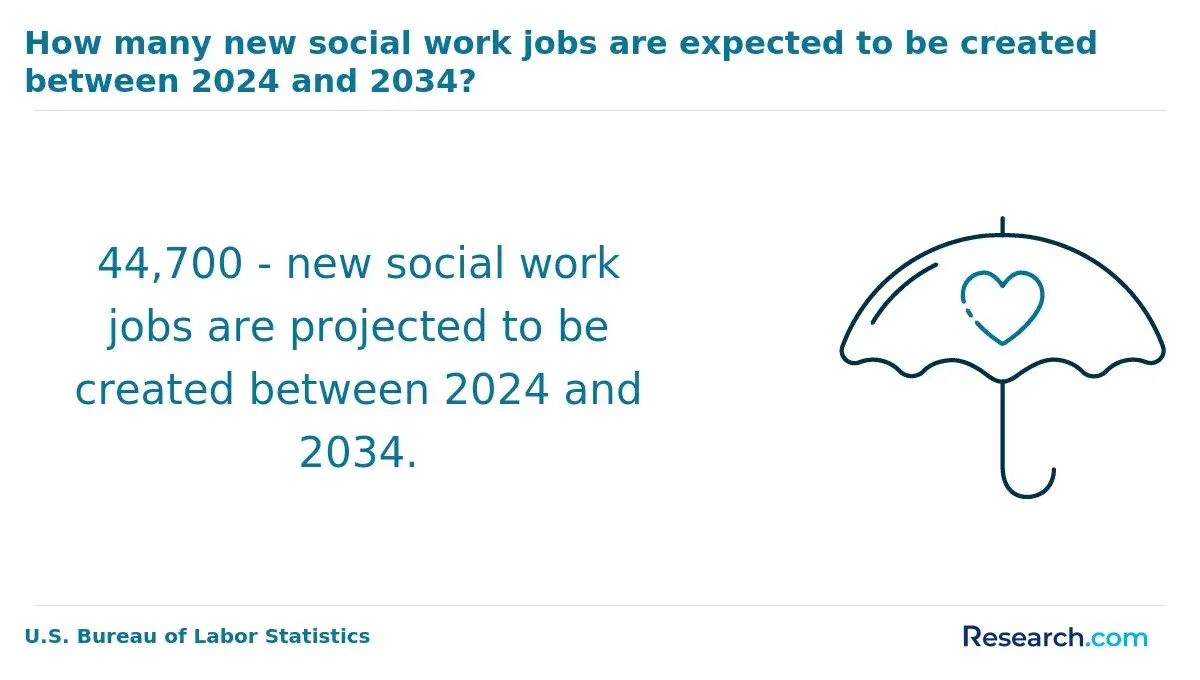
The job outlook for MSW graduates is strong. The U.S. Bureau of Labor Statistics projects a 12% growth in employment for social workers from 2024 to 2034-faster than average for all occupations. Demand is especially important in communities facing shortages in behavioral health, child welfare, rural care, tribal services, health care navigation, and substance abuse treatment.
For instance, New Mexico Highlands University rural clinical MSW graduates filled 65% of open tribal positions by 2025, greatly reducing a previous 40% vacancy rate (Health Resources and Services Administration, 2025 Rural Health Workforce Report). This example shows how location and specialization can affect opportunity, not just salary.
Graduates who are geographically flexible, willing to serve high-need populations, and prepared for licensure requirements may find stronger career options. Students should review state licensing rules, local workforce demand, and employer requirements before selecting a concentration or field placement.
How to choose the best advanced standing online MSW program?
The best advanced standing online MSW program is the one that is accredited, realistic for your schedule, affordable enough to justify the investment, strong in field placement support, and aligned with your intended license and career path. A fast program is only a good choice if it helps you graduate on time and meet professional requirements without avoidable delays.
Start with accreditation. Confirm the program is accredited by the Council on Social Work Education, and verify that the university is properly institutionally accredited. This is essential for licensure eligibility, employer recognition, and future education options.
Next, examine field placement support. Fully online coursework paired with local field internships can be effective when the school has strong placement systems. Metropolitan State University of Denver noted an 85% employer satisfaction for such graduates, outperforming hybrid options (NASW 2025 Field Education Outcomes Survey). Ask whether the program has agency partners near your location, whether it helps secure placements, and what happens if a placement falls through.
Use these criteria when comparing programs:
- Accreditation: Confirm CSWE accreditation before applying.
- Licensure alignment: Check whether the curriculum and fieldwork meet requirements in the state where you plan to practice.
- Program length: Compare 12-month, 18-month, and part-time plans based on workload, not just calendar speed.
- Field education: Review placement assistance, supervision standards, agency quality, and local availability.
- Specializations: Choose a program with coursework and placements tied to your target role, such as clinical practice, health care, child welfare, aging, policy, or substance abuse.
- Faculty expertise: Look for instructors with current or substantial practice, research, policy, or leadership experience in your area of interest.
- Student support: Evaluate advising, writing support, licensure guidance, career services, and access to faculty.
- Outcomes: Compare graduation rates, time-to-degree, licensure exam preparation, employment outcomes, and alumni feedback when available.
- Cost: Calculate total tuition, fees, books, placement-related expenses, and lost income, then compare financial aid and employer assistance.
- Format: Decide whether asynchronous, synchronous, hybrid, cohort-based, or self-paced learning best matches how you study.
Common mistakes include choosing the cheapest program without checking field placement support, choosing the fastest program without understanding weekly workload, or assuming any online MSW will meet licensure rules in every state. Students should contact both the program and the relevant state licensing board before enrolling.
A strong advanced standing online MSW should help you finish efficiently while building the supervised experience, ethical judgment, and specialized skills needed for long-term social work practice.
Other Things You Should Know About Social Work
Yes. Most advanced standing MSW programs require a Bachelor of Social Work from a Council on Social Work Education, or CSWE, accredited program. Many also require a minimum 3.0 GPA and recent graduation, often within the last five to seven years.
Yes, many online MSW programs, especially advanced standing formats, are designed to accommodate working professionals. These programs often offer flexible schedules, part-time options, and asynchronous coursework to support students who balance employment and study. However, field placements still require time commitment during typical agency hours.
Graduates of accredited online MSW programs, including advanced standing tracks, are eligible to pursue social work licensure in most states. It is important to verify that the program holds accreditation from the Council on Social Work Education (CSWE) to ensure licensure eligibility. Licensure requirements also include supervised experience and passing a state exam.
In 2027, advanced standing online MSW programs that expedite degree completion include those offered by major universities such as University of Southern California, University of Denver, and Boston University. These programs can be completed in less than a year, catering to students with a BSW degree.
- Online MSW - Advanced Track https://onlinedegrees.keuka.edu/programs/msw/advanced-standing
- Social Worker Salary and Jobs in Social Work https://teach.com/online-ed/social-work-degrees/online-masters-social-work/salary-and-career-outlook/
- MSW Program Options and Curriculum - MSU Denver https://www.msudenver.edu/social-work/master-social-work/program-options-and-curriculum/
- Social Worker (LCSW, MSW) Salary Guide By State https://socialworklicensemap.com/social-work-careers/social-work-salary/
- All CSWE Accredited Online MSW Programs (2025 Update) https://www.masterofsocialwork.com/online-msw-programs
- Best Online MSW Programs - CSWE-Accredited https://www.onlinemastersdegrees.org/best-programs/social-work-msw/cswe-accredited/
- One Year MSW Programs in California https://www.californiasocialworkedu.org/msw-programs-in-california/one-year-msw-programs/
- Admission requirements https://socialwork.wayne.edu/msw/requirements
- Social Work Salaries https://www.socialworkers.org/careers/career-center/kickstart-your-job-hunt/social-work-salaries
- Best Affordable Master's Degree In Social Work https://www.psychology.org/social-work/best-affordable-masters-programs/