
Most Affordable Electrical Technician Schools & Training in Missouri for 2027
Audited and Verified:
Our Editorial and Data Verification Process
Research.com uses government datasets, official education statistics and primary institutional information to support its career and degree guides. Our review process checks factual accuracy, occupational definitions, source dates and the requirements associated with the credentials discussed.
How This Article Was Fact-Checked
Our editorial team verifies salary estimates, employment projections, education requirements and program information against original data providers and official organizations. Salary figures are checked against the relevant occupational definitions and reporting periods. Information about licensure, accreditation and required in-person training is reviewed separately.
Fact-checked and verified on:

Co-Founder and Chief Data Scientist

Reviewed by Karolina Broda
Fact-Checker and Data Verification
Choosing an affordable electrician program means looking beyond tuition: you need practical training, a workable route into supervised employment, and a credential local employers recognize. The U.S. Bureau of Labor Statistics projects 9.2% national growth in electrician employment from 2025 to 2035. This guide compares Missouri training routes, costs, wages, and local licensing questions. It also accompanies the Most Affordable Electrician Trade Schools in Missouri for 2027 ranking, created by the Research.com team of data scientists to help students make an informed choice about programs worth considering.
Key findings about electrician degrees in Missouri
- Compare routes, not just tuition: a short school credential can provide foundational lab skills, while a paid registered apprenticeship combines classroom instruction with supervised work over several years (U.S. Bureau of Labor Statistics; U.S. Department of Labor).
- Plan for local rules: Missouri has no single statewide electrician license that a school credential automatically confers; check the jurisdiction where you intend to work before enrolling (Missouri Division of Professional Registration; relevant local licensing authority).
- Use wages as context, not a starting-pay promise: the national median for electricians was $63,190 in May 2025, and projected national employment growth is 9.2% for 2025-2035 (U.S. Bureau of Labor Statistics).
Table of Contents
- Most Affordable Electrical Technician Schools & Training in Missouri for 2027
- What can I expect from an electrician trade school program in Missouri?
- Where can I work with an electrician trade school training in Missouri?
What can I expect from an electrician trade school program in Missouri?
Expect instruction in electrical theory, code use, wiring methods, testing, and jobsite safety, followed by practice that goes beyond reading or watching demonstrations. A school program may prepare you to seek an apprentice or helper position; it is not the same as completing the supervised work needed for independent practice under applicable local rules.
These pathways differ most in when you earn wages and where you gain hands-on experience. Ask each provider exactly what its credential represents and whether employers or apprenticeship sponsors award credit for it.
| Pathway | Training and credential | Best fit and key limitation |
| School certificate or diploma | Classroom and lab instruction; school-awarded credential | Fits someone seeking structured preparation before applying for electrical work; field experience may still be needed. |
| Associate degree in an electrical field | Technical coursework and labs plus additional college requirements; academic degree | May suit broader technical goals, but extra coursework is not a substitute for supervised electrical experience. |
| Registered apprenticeship | Paid, supervised work and related instruction; apprenticeship completion credential | Fits someone ready to learn while employed; entry depends on openings and sponsor selection. |
| Employer-sponsored entry | Employer-directed training as a helper or trainee; credential varies | Can provide an immediate work route, but confirm whether experience is documented and counts toward local requirements. |
Examples of schools readers may investigate include State Fair Community College, Mineral Area College, Three Rivers College, Cape Girardeau Career and Technology Center, and State Technical College of Missouri. Program offerings and lab content can change; confirm the current electrician-specific curriculum directly rather than assuming similarly named credentials provide equivalent training.
Where can I work with an electrician trade school training in Missouri?
Potential settings include residential and commercial electrical contractors, industrial facilities, building-maintenance teams, and contractors installing power or control systems. Work involving an electrical contractor, a maintenance employee, or a supervised apprentice may fall under different local rules; the job title alone does not establish authorization to perform particular tasks (relevant local licensing authority).
Location affects access as well as employment. In the St. Louis and Kansas City areas, compare commuting distance to both training and worksites, then check the applicable city or county requirements. In a rural area, a lower-priced program may cost more overall if labs or employer sites require long trips. Ask prospective employers where trainees actually report each day.
Missouri pay depends on occupation, experience, employer, and work location. For a benchmark - not a Missouri wage estimate - the U.S. Bureau of Labor Statistics reports a $63,190 national median annual wage for electricians in May 2025. A new helper or apprentice should not budget as though they will immediately earn the median for the entire occupation.
Before accepting an offer, compare its starting hourly rate, scheduled hours, benefits, wage progression, and travel costs. Use Missouri-specific occupational wage estimates from the U.S. Bureau of Labor Statistics or Missouri's labor-market agency when comparing local opportunities; do not substitute a national median for a local pay quote.
A school certificate may take substantially less time than an apprenticeship, but its length alone does not indicate readiness for unsupervised work. Registered electrician apprenticeships commonly run about four to five years and combine related instruction with extensive supervised job training (U.S. Bureau of Labor Statistics). School schedules, required contact hours, and any credit an apprenticeship sponsor grants for prior coursework vary by program.
Ask for the published calendar, total lab hours, required attendance, and the date you could realistically start paid fieldwork. Do not treat a top 6 month associate degree comparison as evidence that an electrician credential - or the practical experience needed after it - can be completed on that timetable.
Online delivery can work for portions of electrical theory, mathematics, code reading, and safety instruction. It cannot replace hands-on practice with wiring, meters, troubleshooting, and safe work procedures. A hybrid program is useful only if its in-person labs and any required supervised work are accessible on your schedule.
Ask who provides equipment, where labs take place, and how practical skills are assessed. Institutional accreditation is a separate question from practical training or local licensing eligibility: a listing of accredited online colleges for adults with free application does not establish that an online electrical program meets the requirements where you plan to work.
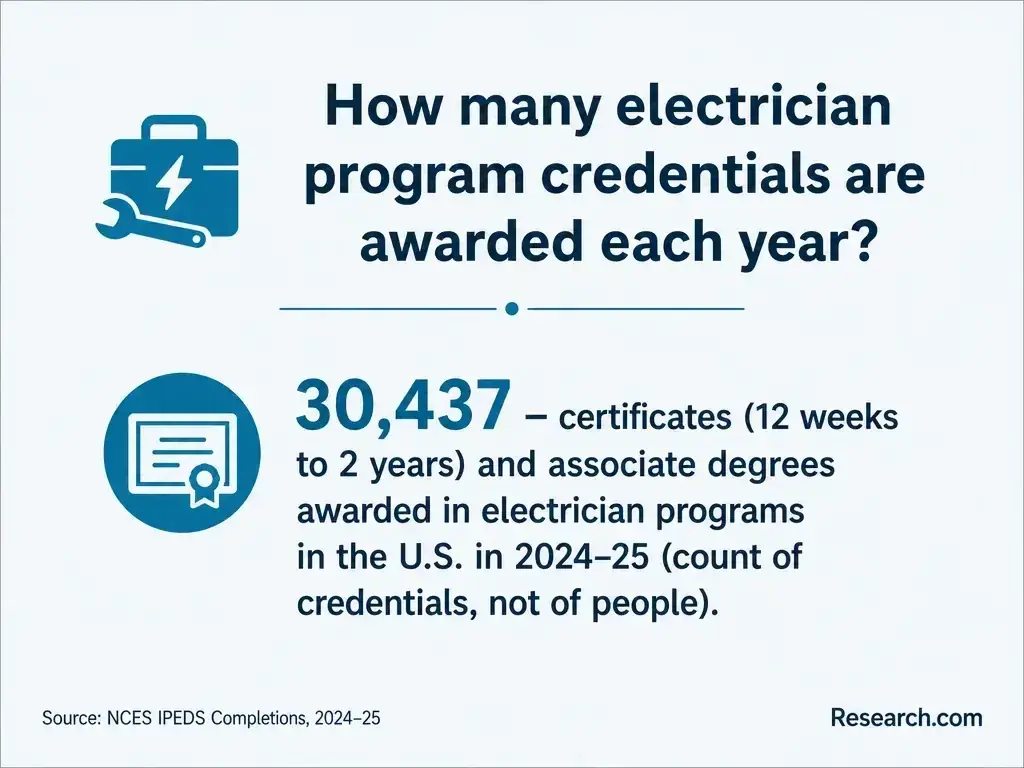
There is no single dependable statewide average that covers school programs, employer training, and paid apprenticeships on the same basis. Published tuition also omits costs that can determine which option is truly affordable. Request an itemized, current quote for each route you are considering.
This comparison shows which costs belong in a job-ready budget. Availability and who pays vary by provider, so verify each item rather than assuming it is included.
| Cost or offset | What to check |
| School charges | Tuition by residency status, mandatory fees, books, materials, and payment deadlines. |
| Work-ready supplies | Tools, meter, protective equipment, and any required clothing. |
| Career-entry expenses | Travel to labs and jobsites; applicable exam or local application fees. |
| Funding and earnings | Grants, eligible student aid, employer-paid training, and apprenticeship wages. |
| Time costs | Work hours forgone during classes and the time before paid fieldwork begins. |
Federal student aid depends on both student and program eligibility, not simply on a school's advertising (Federal Student Aid). Missouri's A+ Scholarship Program may help eligible students at participating institutions, subject to its requirements (Missouri Department of Higher Education and Workforce Development). Missouri Job Centers can also advise eligible workers about workforce-training assistance. Compare net cost after confirmed aid and likely debt, not tuition alone; an affordable bachelor's degree comparison measures a different educational investment and should not replace an electrician training budget.
Depending on the offering, a school may award a certificate, diploma, or associate degree. A registered apprenticeship awards its own completion credential; an employer training course may award only a company record of training (U.S. Department of Labor). None should be described simply as an "electrician license."
Before paying a deposit, get the exact credential name in writing. Ask whether the program documents lab hours, whether an apprenticeship sponsor accepts any coursework for advanced standing, and whether that sponsor makes the credit decision individually. Institutional accreditation, construction-training credentials, apprenticeship registration, and a local occupational license serve different purposes; one does not automatically provide another.
Requirements vary. A school may assess math or reading readiness and require an application or orientation; an apprenticeship sponsor may also require employment eligibility, testing, an interview, and the ability to reach changing worksites. Ask the specific provider for its current criteria and whether a driver's license or employer screening is required for placements.
Accessible college admission does not guarantee a seat in a particular electrical lab or an apprenticeship. Even if you are comparing open enrollment colleges, check program capacity, course prerequisites, start dates, and how students move into supervised work.
Core skills typically include interpreting diagrams, applying electrical calculations, installing and connecting components, using test instruments, locating faults, and following the electrical code and jobsite safety practices (U.S. Bureau of Labor Statistics; O*NET). Labs should give students opportunities to perform and correct work - not merely observe it.
Curriculum emphasis matters. Someone aiming for industrial maintenance should ask about motors and controls; someone aiming for construction should ask about branch circuits, conduit, and jobsite installation. Request the current syllabus and a description of assessed lab tasks before treating two programs with the same credential name as interchangeable.
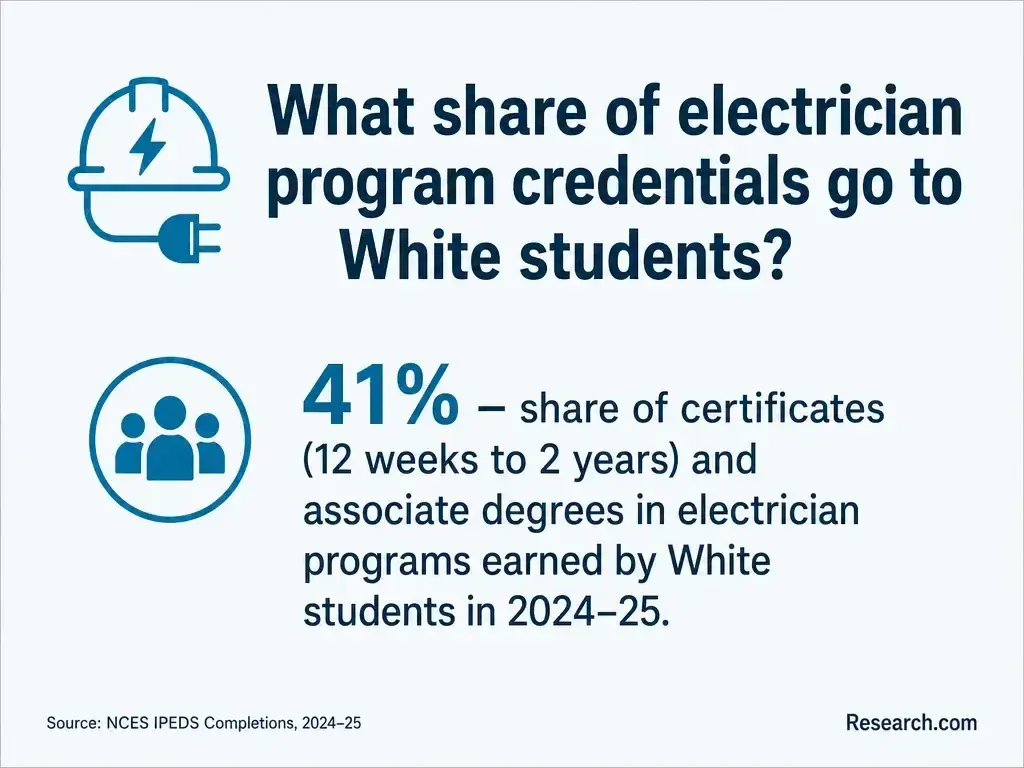
Check the locality and the work you intend to perform. Missouri does not have one statewide electrician license that every trade-school graduate receives. Local governments may regulate electrical work and contractors, with requirements that differ by jurisdiction (Missouri Division of Professional Registration; relevant local licensing authority). A school should not promise that completion alone permits independent work everywhere in the state.
Before enrolling, contact the licensing authority for your intended work location and ask which activities require a credential, how supervised experience is documented, whether an examination applies, and who must hold the contractor authorization. Ask an apprenticeship sponsor separately whether its program is registered with the U.S. Department of Labor. A voluntary training certification or an accredited school does not replace an applicable local license.
Start with the job you want and the jurisdiction where you expect to work. Then compare a school option with at least one apprenticeship or employer-training route. These checks expose common mistakes - particularly choosing the lowest advertised tuition without confirming practical training or a path into paid work.
- Ask the local licensing authority what experience, examinations, and authorizations apply to your intended work; do not rely solely on an admissions representative's summary.
- Request the credential name, syllabus, lab hours, equipment access, completion requirements, and any documented apprenticeship agreements.
- Confirm institutional accreditation and any relevant school authorization separately from apprenticeship registration or local occupational requirements.
- Calculate total net cost, likely debt, travel, and earnings forgone; compare those with paid-training opportunities and your ability to finish.
- Ask how many completers obtain relevant field positions and how the provider verifies that outcome; do not treat occupational median pay as graduate starting pay.
The right investment depends on completion probability, aid, debt, time away from work, expected wage progression, and how long you plan to work in the trade. A faster program is not automatically better: as with a quickest masters degree comparison, advertised speed says little about the hands-on competence an electrician needs. Choose a route only after its practical training and next employment step are clear.
An entry route may begin with supervised helper or apprentice work, progress to more independent installation and troubleshooting as experience grows, and later lead to industrial electrical work, supervision, or an electrical contracting business. Duties and permission to perform them depend on employer practice and applicable local rules, not merely years since graduation (U.S. Bureau of Labor Statistics; relevant local licensing authority).
If your goal is industrial controls, prioritize programs with substantial motor, controls, and troubleshooting practice. If you want to operate a contracting business, investigate the relevant locality's contractor requirements early. Optional specializations can improve a career fit, but they should not be confused with mandatory authorization to perform regulated work.
The U.S. Bureau of Labor Statistics projects 9.2% national employment growth for electricians from 2025 to 2035. That indicates broad demand, not a guaranteed Missouri opening or apprenticeship place. Construction activity, industrial hiring, and sponsor capacity can differ across the state.
For a local decision, check current Missouri labor-market projections and ask nearby contractors and apprenticeship sponsors about trainee openings. Compare where work is available with where you can afford to train and commute. A low-cost program is less compelling if its schedule or location prevents you from completing labs or reaching employers.
Most Affordable Electrical Technician Schools & Training in Missouri for 2027
Education is a consequential investment, so Research.com designed its Missouri affordability ranking to help readers compare electrician programs with other programs serving the same occupation and location. The team checks multiple education datasets for credible, consistent information. Only programs with completions reported to IPEDS are eligible; an apprenticeship or training provider absent from the ranking is not necessarily unavailable or inferior.
The most affordable ranking scores tuition, cost of attendance, median student debt, and federal loan default rate. An entropy-based method assigns more weight to indicators that differ more across eligible programs. Unlike Research.com's separate best-program rankings, this affordability score does not include accreditation, student support, completion, earnings, or industry recognition. Readers should therefore use the ranking to narrow their cost search, then verify training quality and career-entry requirements themselves.
The ranking draws on the following sources. Some, particularly the healthcare-focused organizations, support Research.com's broader trade-program research and are not electrician approvals.
- IPEDS database - reported completions and institutional data.
- National Center for Education Statistics - federal education data and definitions.
- College Scorecard database - available college cost, debt, and outcomes data.
- Peterson's database - supplemental institutional information.
- Commission on Accreditation of Allied Health Education Programs (CAAHEP) - occupation-specific reference for relevant allied-health rankings, not electrician approval.
- Accrediting Bureau of Health Education Schools (ABHES) - healthcare accreditation reference, not electrician approval.
- Commission on Dental Accreditation (CODA) - dental accreditation reference, not electrician approval.
- Dental Assisting National Board (DANB) - dental credential reference, not electrician approval.
- National Center for Construction Education and Research (NCCER) - construction-training and credential reference.
- Apprenticeship.gov Partner Finder - registered-apprenticeship pathway reference.
The ranking can identify lower-cost college-reported options, but it cannot establish the cheapest route to becoming job-ready: tools, commuting, paid apprenticeship wages, and local licensing rules may change that calculation. Research.com explains its broader ranking approach on its methodology page.
# 2 position
# 3 position
Mineral Area College - Electrician.
associate
# 4 position
Mineral Area College - Electrician.
certificate or diploma # 5 position
Three Rivers College - Electrician.
certificate or diploma# 6 position
Cape Girardeau Career and Technology Center - Electrician.
certificate or diploma
# 7 position

# 8 position
State Technical College of Missouri - Electrician.
certificate or diploma # 9 position
Southern Missouri Technical Institute
certificate or diplomaElectrical and Power Transmission Installation/Installer, General
Delivery mode: On Campus (May Include Online Courses)
60.24
/ 100
Final score
- School graduation rate
- 84%
- Students receiving Pell Grants
- 71%
- In-state tuition & fees (per year)
- $17,000
- Out-of-state tuition & fees (per year)
- $17,000
- School website
- zizzers.org
Accreditation
Institutional accreditation from Council on Occupational Education.
Southern Missouri Technical Institute earned a Research.com Affordability Score of 60.24/100.
Frequently asked questions about electrician programs in Missouri
Is trade school required to become an electrician in Missouri?
Not necessarily. A registered apprenticeship or employer-sponsored route may provide the instruction and supervised experience you need. Check the rules for the locality and type of work you intend to enter.
Will an electrician certificate make me licensed?
No. A school credential documents training; local authorities set any applicable licensing or contractor requirements. Verify those requirements directly before enrolling.
Can I complete electrician training entirely online?
Online coursework may cover theory, but wiring, testing, safe tool use, and supervised field skills require in-person practice. Ask where and how those competencies are assessed.
Is an apprenticeship cheaper than trade school?
It may be a better financial fit because apprentices earn wages while training, but pay, expenses, and entry opportunities vary. Compare net school costs with apprenticeship wages, tools, travel, and time to completion.
How can I tell whether a low-priced program is worth it?
Confirm its total cost, hands-on instruction, credential, completion requirements, and route into supervised employment. Then check applicable local rules and compare those findings with a paid-training alternative.
- U.S. Bureau of Labor Statistics - Electricians
Used to verify salary, employment outlook, and typical education requirements.
https://www.bls.gov/ooh/construction-and-extraction/electricians.htm - NCCER - Accredited Training
Used to verify programmatic accreditation or industry recognition of programs.
https://www.nccer.org/ - O*NET OnLine - Electricians
Used to verify common responsibilities, skills, work settings, and education expectations.
https://www.onetonline.org/link/summary/47-2111.00 - State Fair Community College - official website
Official school website (programs, tuition, admissions).
https://www.sfccmo.edu/ - Mineral Area College - official website
Official school website (programs, tuition, admissions).
https://mineralarea.edu/ - Three Rivers College - official website
Official school website (programs, tuition, admissions).
https://trcc.edu/ - Cape Girardeau Career and Technology Center - official website
Official school website (programs, tuition, admissions).
https://www.capectc.org/ - State Technical College of Missouri - official website
Official school website (programs, tuition, admissions).
https://www.statetechmo.edu/