# 1 position
Horry-Georgetown Technical College - Electrician.
certificate or diploma

Audited and Verified:
Our Editorial and Data Verification Process
Research.com uses government datasets, official education statistics and primary institutional information to support its career and degree guides. Our review process checks factual accuracy, occupational definitions, source dates and the requirements associated with the credentials discussed.
How This Article Was Fact-Checked
Our editorial team verifies salary estimates, employment projections, education requirements and program information against original data providers and official organizations. Salary figures are checked against the relevant occupational definitions and reporting periods. Information about licensure, accreditation and required in-person training is reviewed separately.
Fact-checked and verified on:

Co-Founder and Chief Data Scientist

Reviewed by Karolina Broda
Fact-Checker and Data Verification
Choosing an affordable electrician program means looking beyond tuition: you also need practical training, a way into paid work, and a clear understanding of South Carolina's licensing rules. The U.S. Bureau of Labor Statistics projects 9.2% national employment growth for electricians from 2025 to 2035. For prospective students and career changers, this guide compares training routes, costs, credentials, and career prospects. It also accompanies the Most Affordable Electrician Trade Schools in South Carolina for 2027 ranking, created by the Research.com team of data scientists to help students identify programs worth considering.
Expect a combination of electrical theory and supervised practice - not a credential that immediately qualifies you to work independently. A useful program teaches students to read plans, calculate loads, select wiring methods, follow electrical-code requirements, and use test equipment safely. Ask how many hours are spent wiring circuits and troubleshooting in a lab rather than watching demonstrations.
South Carolina students can compare electrical training at public technical colleges, private career schools, and apprenticeship sponsors. Horry-Georgetown Technical College, Orangeburg Calhoun Technical College, Midlands Technical College, Greenville Technical College, and Technical College of the Lowcountry are examples of colleges to investigate; confirm each location's current electrician-specific offerings rather than assuming every campus offers the same credential. An employer-sponsored or registered apprenticeship is another route: it combines paid work with related instruction, while a school program may provide a shorter introduction before employment.
The right choice depends on your next step. A short, hands-on credential may suit someone seeking entry-level employment quickly. A longer program may suit someone who wants broader technical preparation. If you can secure a suitable paid apprenticeship now, compare its wages and work experience against the cost and time of attending school first.
Electrical training can lead to work with residential and commercial contractors, industrial maintenance teams, utilities, and facilities operators. The U.S. Bureau of Labor Statistics identifies electrical contractors as major employers of electricians and notes that the job involves installing, maintaining, and repairing electrical power, communications, lighting, and control systems. The employer and tasks matter: residential wiring, industrial controls, and utility work call for different additional training.
Location affects access to that experience. In the Charleston, Columbia, Greenville-Spartanburg, and Myrtle Beach areas, compare nearby contractors and apprenticeship sponsors alongside school locations; elsewhere, the nearest suitable jobsite may require a longer commute. Ask providers where students complete field experience and whether employer partners offer the kind of work you intend to pursue.
South Carolina pay varies by experience, location, employer, and specialty, so a national median is a benchmark - not a local wage offer. The U.S. Bureau of Labor Statistics reports a $63,190 U.S. median annual wage for electricians in May 2025. That figure includes experienced workers and should not be used as an expected first-year salary for a new trainee.
For a useful South Carolina estimate, check the South Carolina Department of Employment and Workforce's current occupation and regional wage data, then compare actual apprentice or entry-level postings in the area where you can work. When judging whether training pays off, use likely starting wages and wage progression - not the occupation-wide median - and account for the income you could earn while training.
There is no single statewide trade-school duration. A focused certificate can be shorter than a diploma or associate degree, while scheduling, course availability, and part-time attendance change the calendar time. Request the exact program hours, lab hours, and course sequence for the year you plan to enter. An accelerated associate's degree may reduce time in school, but a faster schedule does not replace practical experience required for a particular job or license.
A registered electrician apprenticeship generally takes longer because it combines substantial paid on-the-job learning with related classroom instruction; the U.S. Bureau of Labor Statistics describes electrician apprenticeships as typically lasting four to five years. Compare time to a school credential with time to independent work. They are different milestones, and finishing either route does not automatically grant a state or local license.
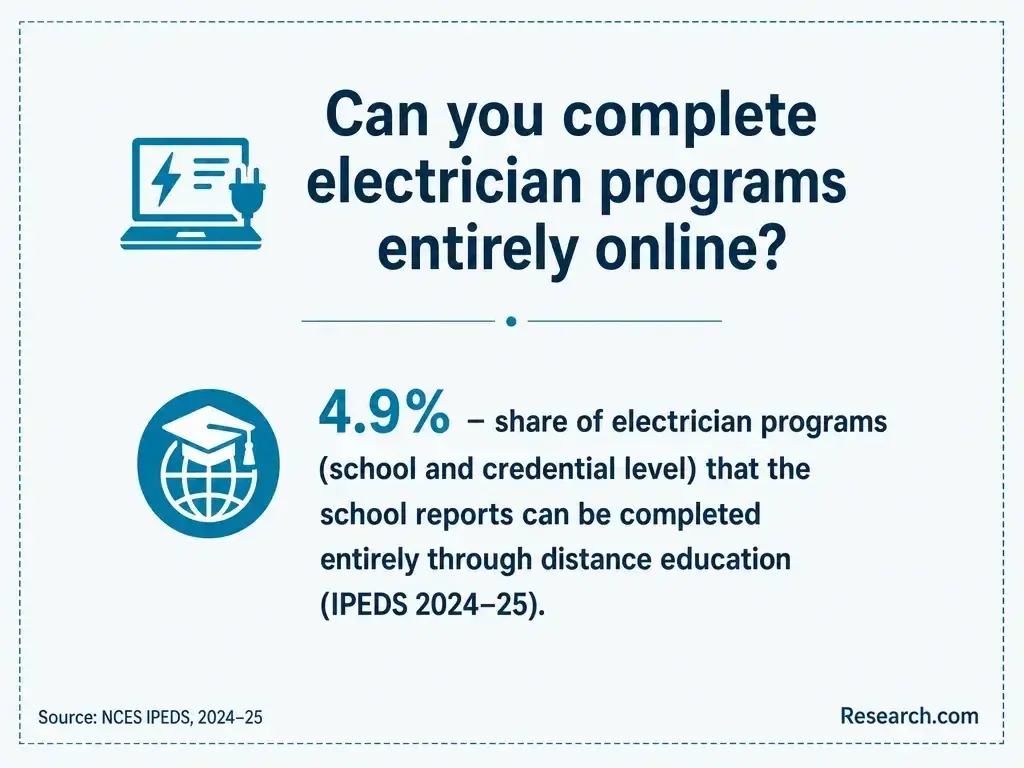
Online coursework can be useful for electrical theory, mathematics, plan reading, and some code study. Wiring, measurement, safe tool use, and fault-finding require supervised practice with equipment. A hybrid option is credible only if it specifies where and when those practical sessions occur and whether you can reach the site.
Do not confuse a fast online credential with a complete route into electrical work. Even if you are comparing associate online degrees in 6 months, ask an electrician provider to document its in-person lab requirements and employer-based training opportunities. Neither an online course nor its marketing language establishes licensing eligibility.
There is no single reliable average that covers every South Carolina electrician certificate, associate degree, private program, and paid apprenticeship. Published tuition often leaves out costs that determine what you actually need to spend. Compare a written, program-specific estimate for your residency status and attendance schedule; do not treat a college-wide price as the price of a particular electrical credential.
The largest cost categories to request from each provider are listed below. Use the same categories for every option so an apparently cheaper program does not win simply because it omits necessary supplies.
Ask the college whether its program qualifies for federal student aid and South Carolina assistance, including applicable technical-college aid or workforce funding; eligibility depends on the program and the student. Federal Student Aid notes that aid eligibility is program-specific, so accreditation alone is not proof that a short course qualifies. Lists of accredited online schools with waived application fees may help with a different education search, but an application-fee waiver says little about electrician training's full cost.
Depending on the provider, you may earn a certificate, diploma, or associate degree. A registered apprenticeship instead documents structured work-based training and related instruction, with a completion credential under its registered standards (U.S. Department of Labor). Some providers also prepare students for industry credentials, such as those associated with NCCER; ask whether an exam or credential is included or costs extra.
These credentials are not interchangeable with occupational licensure. Get the exact award name in writing, ask employers whether they recognize it, and ask whether prior coursework can count toward an apprenticeship or later college training. If you are exploring a certification that pay well, check what work experience and practical assessment it requires; an online certificate alone should not be mistaken for authorization to perform regulated electrical work.
Requirements differ by provider and pathway. A college or career school may assess reading and math readiness, request a high school credential or equivalent, and set prerequisites for particular courses. An apprenticeship sponsor may also require an application, an aptitude assessment, an interview, and the ability to travel to worksites. Check the current requirements directly rather than assuming admission to a school also means acceptance by an employer or apprenticeship sponsor.
Before applying, ask whether electrical courses have separate entry requirements, whether you need tools or safety gear on the first day, and whether your schedule allows for all labs. If a provider advertises apprenticeship placement, clarify whether it guarantees an interview, offers introductions, or requires a separate competitive application.
Core subjects typically include electrical safety, circuits, measurements, wiring methods, motors or controls, blueprint reading, and the use of applicable electrical codes. The U.S. Bureau of Labor Statistics describes electricians' work as interpreting diagrams, installing wiring and equipment, and testing systems. Effective training therefore needs more than memorizing terminology: students should build, inspect, measure, and troubleshoot circuits under supervision.
Ask for a lab outline showing the equipment students actually use and how performance is assessed. A program emphasizing residential installation may fit a different goal from one emphasizing industrial controls. If you already work in maintenance, ask whether documented prior learning can reduce duplicated coursework without removing essential safety or hands-on practice.
Do not assume one rule covers every electrical job. South Carolina's Department of Labor, Licensing and Regulation regulates contractor licensing, including categories relevant to electrical contracting; the license needed depends on the work and who contracts to perform it. Local governments may also impose requirements on individual tradespeople or permits. Working as a supervised employee is a different question from offering regulated contracting services independently.
Before paying for training, describe your intended work to the South Carolina Department of Labor, Licensing and Regulation and the local jurisdiction where you expect to work. Ask which license category, experience documentation, examination, and supervision rules apply. Then ask the school or apprenticeship sponsor exactly which of those requirements its training supports. Institutional accreditation, industry certification, apprenticeship registration, and occupational licensure each serve different purposes; none automatically substitutes for another.
Start with the job you want, then compare programs on their ability to get you there - not just their ranking position. A low-priced program can be a poor investment if its lab schedule prevents you from finishing or if it does not connect you to supervised work. Conversely, a longer route may be worthwhile if it offers useful experience while you earn wages.
Use these checks when speaking with admissions staff and apprenticeship coordinators:
A common mistake is treating a projected salary or low tuition as proof of return on investment. Instead, consider your current earnings, probability of completing, likely post-training pay, debt, and when benefits may arrive. Avoid any provider that cannot clearly explain its hands-on instruction or implies that graduation automatically makes you licensed.
Entry-level work may involve assisting an electrical contractor or entering an apprenticeship under supervision. With additional work experience, electricians may move into troubleshooting, industrial maintenance, controls, estimating, or supervision, depending on employer needs and applicable licensing rules. Independent contracting is a further step that requires checking South Carolina's contractor requirements - not merely earning a school credential.
Compare specialties by the work and training they require, not by a single salary headline. A list of best paying trade school jobs can provide career context, but electrician earnings vary with experience and specialty. Before choosing an advanced track, ask local employers which equipment, safety practices, and documented work experience they expect.
The U.S. Bureau of Labor Statistics projects 9.2% growth in electrician employment nationwide from 2025 to 2035. That supports considering the occupation, but a national projection cannot tell you how many apprentice openings are available near your home or when a particular contractor will hire.
For a local decision, review current South Carolina Department of Employment and Workforce projections and job postings in the region where you can commute. Look at the kinds of work advertised and the experience requested: demand for an experienced industrial electrician does not necessarily translate into an immediate opening for a first-term trainee. Ask apprenticeship sponsors and college career staff about recent entry-level placements rather than relying on growth projections alone.
Investing in training is an important decision, and an affordable program is useful only if it fits your career goal. Research.com's team uses multiple education and workforce sources to check the credibility and accuracy of its rankings. Programs are compared with others in the same occupation and location; only programs with completions reported to IPEDS are included. Consequently, the ranking is not an inventory of every apprenticeship, employer program, or electrician training provider in South Carolina.
The most affordable ranking measures costs and debt only: tuition, cost of attendance, median student debt, and federal loan default rate. Weights are assigned through an entropy-based method, which gives more weight to indicators that vary more among programs. Accreditation, practical-training quality, licensing fit, and other quality indicators do not enter this affordability score. Readers should check those separately before enrolling.
Research.com also produces best programs rankings using a different model. That model considers student outcomes, earnings and return on investment, costs and debt, and quality and recognition. Its current weights are 20% for occupation-relevant programmatic accreditation or industry recognition, 10% for institutional accreditation, 10% for student support, and 60% for outcomes, earnings, and costs, distributed among those indicators through an entropy-based method. These are not the weights for this affordability ranking.
The following databases and organizations were used in creating the ranking. Some cover occupations other than electrical work; their inclusion does not mean an electrician program needs healthcare or dental accreditation.
Use the ranking to narrow your cost comparison, then verify each finalist's current price, lab access, employer connections, and route toward the work you want. More detail on Research.com's approach appears on its methodology page.
# 1 position
# 2 position
# 3 position
# 4 position
# 5 position
# 6 position
Not necessarily. A suitable apprenticeship or employer training route may combine instruction with supervised paid work. Check the requirements for the specific electrical work and location you intend to pursue.
It depends on total cost and earnings during training. Compare the certificate's tuition, supplies, and travel with an apprenticeship's wages, required purchases, and longer time commitment.
Online courses can cover some theory, but practical wiring, testing, and safe tool use require in-person training. Verify a program's labs and fieldwork before enrolling.
No automatic licensing follows graduation. Confirm applicable state contractor and local requirements, including any experience or examination rules, with the relevant authorities.
No. It includes programs with completions reported to IPEDS. Compare registered apprenticeships and employer-sponsored routes separately.
Request the full cost, exact credential, lab schedule, practical-training hours, employer connections, refund policy, and a clear explanation of how the program supports your intended job.