# 1 position
Henderson Community College - Electrician.
certificate or diploma

Audited and Verified:
Our Editorial and Data Verification Process
Research.com uses government datasets, official education statistics and primary institutional information to support its career and degree guides. Our review process checks factual accuracy, occupational definitions, source dates and the requirements associated with the credentials discussed.
How This Article Was Fact-Checked
Our editorial team verifies salary estimates, employment projections, education requirements and program information against original data providers and official organizations. Salary figures are checked against the relevant occupational definitions and reporting periods. Information about licensure, accreditation and required in-person training is reviewed separately.
Fact-checked and verified on:

Co-Founder and Chief Data Scientist

Reviewed by Karolina Broda
Fact-Checker and Data Verification
Choosing the cheapest electrician program can become expensive if it leaves you short of the experience needed for a Kentucky license. The U.S. Bureau of Labor Statistics projects 9.2% national growth in electrician employment from 2025 to 2035, making the training decision timely. For prospective students and career changers, the Most Affordable Electrician Trade Schools in Kentucky for 2027 ranking, created by the Research.com team of data scientists, identifies programs worth considering. This guide helps you compare their full costs, hands-on training, credentials, and routes into paid work.
Expect a mix of electrical theory and supervised practice - not an immediate license. A useful program teaches students to interpret plans, select wiring methods, install devices, test circuits, troubleshoot faults, and work safely under the applicable electrical code. Ask for the actual lab schedule and equipment list: a program centered on demonstrations or online quizzes is not equivalent to one where students repeatedly wire and test installations.
The pathways below lead to different credentials and amounts of workplace experience. Their durations are typical structures, not Kentucky licensing promises; confirm each provider's current schedule and how graduates obtain supervised work.
| Pathway | What it provides | Best fit and main limitation |
| Short certificate or pre-apprenticeship | Foundational classes and labs; a school certificate or preparation for apprenticeship entry | Useful for testing the trade or strengthening an application; usually does not replace substantial work experience |
| Longer diploma or associate degree | Broader technical coursework and labs; a diploma or, where offered, an academic degree | Useful for structured study and potential education-based licensing provisions; usually involves more tuition and time away from earnings |
| Registered apprenticeship | Paid, supervised work plus related instruction and a recognized apprenticeship completion credential | Useful for earning while building experience; entry may depend on available sponsors and selection requirements |
| Employer-sponsored entry | Worksite training, sometimes alongside formal classes or a registered apprenticeship | Useful if an employer will document qualifying experience; training quality and portability need checking |
A public community or technical college, private career school, union training center, or employer may offer a viable route. Compare what you will do in labs and on jobsites, who supervises the work, and what written record of training you receive - not just the credential's name.
Electrical contractors install and service systems in homes and commercial buildings; industrial employers need electrical maintenance and troubleshooting in manufacturing facilities. Utilities and other infrastructure employers may have related roles, but their job titles, training, and hiring requirements can differ from those of a building electrician. The U.S. Bureau of Labor Statistics describes construction and maintenance as major settings for electricians.
Location changes the opportunity calculation. Someone near Louisville or Lexington may be able to compare more contractors and training schedules, while a rural student may need to travel farther to a lab or supervised jobsite. Before enrolling, look for apprenticeship sponsors and employers within a realistic commute, then ask whether a program makes introductions or offers documented work-based learning. A nearby classroom has limited value if the required next step is inaccessible.
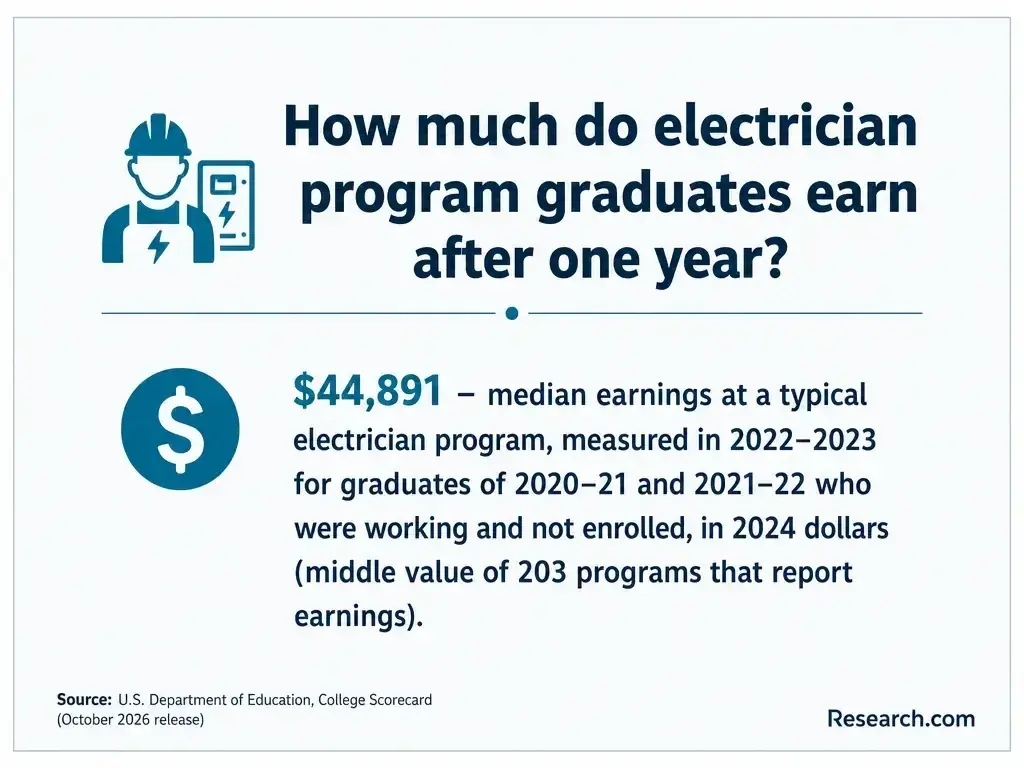
The U.S. Bureau of Labor Statistics reports a $63,190 national median annual wage for electricians in May 2025. That is the midpoint for employed electricians across experience levels, not Kentucky's median or an expected first-year apprentice salary. For a local comparison, check the latest Kentucky and metropolitan-area electrician estimates in the Bureau's Occupational Employment and Wage Statistics before accepting a school's earnings claim.
Pay depends on experience, employer, location, overtime, and the type of electrical work. A paid apprentice generally earns while progressing toward greater responsibility, whereas a full-time student may postpone wages. For a realistic return-on-investment estimate, compare your current earnings with likely entry-stage earnings, subtract total training costs and foregone pay, and consider completion probability, borrowing costs, and how long you expect to work in the trade. Do not use an occupation-wide median as a guaranteed graduate outcome.
A short certificate may take months; a longer diploma or associate degree generally takes longer. A registered apprenticeship combines instruction with paid work over multiple years. These are different timelines: finishing classes is not the same as accumulating the supervised electrical-work experience needed to seek a Kentucky journeyman license (Kentucky Department of Housing, Buildings and Construction; U.S. Department of Labor).
Kentucky's journeyman eligibility rules provide a route based on electrical-work experience and a route that combines experience with a qualifying, two-year electrical-trade education program. Before choosing an accelerated option, ask the licensing authority whether that specific curriculum meets the education provision and how experience must be documented. A short program can still be valuable for getting hired, but its speed should not be mistaken for a shorter path to independent licensed work.
Be wary of treating a top associate degree in 6 months online accredited search as a timetable for this trade. Electrical labs and qualifying work experience impose practical constraints that an accelerated online academic schedule cannot remove.
Online instruction can cover mathematics, electrical theory, code concepts, and some safety lessons. Campus labs and supervised jobsites let students handle conductors and tools, build circuits, measure faults, and demonstrate safe procedures. A hybrid program can reduce classroom trips, but it should identify where practical assessments occur and whether students must arrange their own work placement.
Choose an online-heavy option only after obtaining its in-person requirements in writing. Ask who supplies equipment, how instructors assess hands-on skills, and whether any employer or licensing authority accepts the resulting training. Fully remote coursework alone should not be treated as proof of practical competence or Kentucky licensing eligibility.
Catalogs of 1 year phd programs online no dissertation describe a fundamentally different kind of study; their advertised speed offers no useful benchmark for electrician training. For this occupation, judge flexibility by how it fits around required labs and paid work.
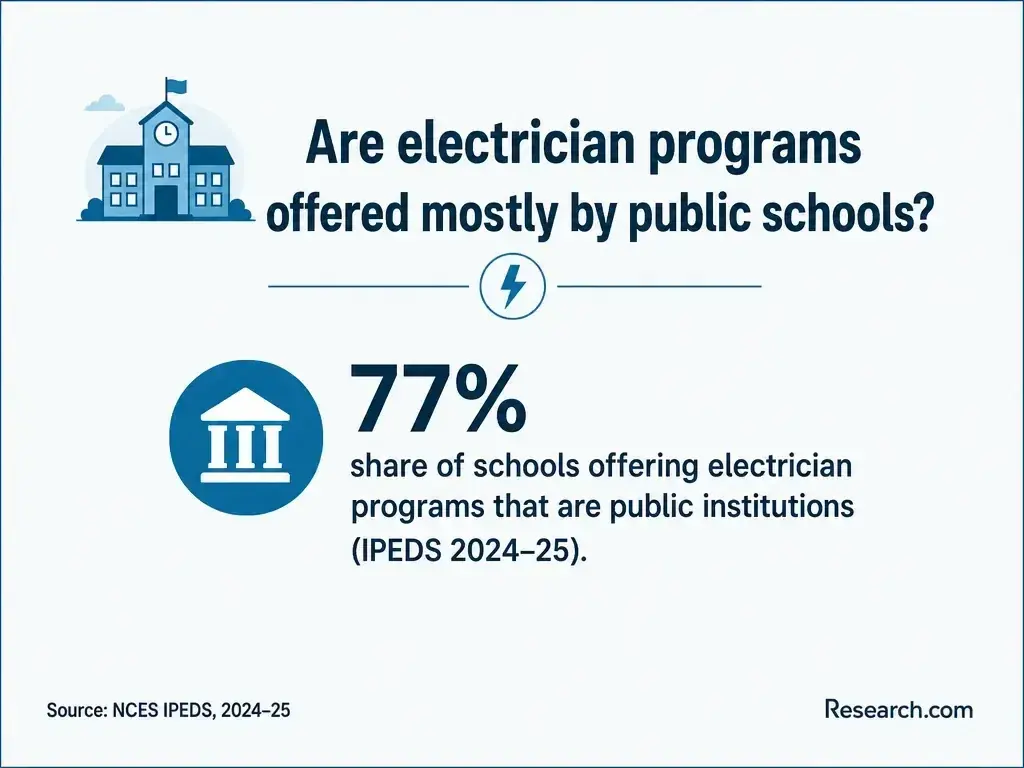
There is no single dependable statewide average for all electrician pathways. College-reported tuition does not capture every private program, union sponsor, or paid apprenticeship, and programs differ in length and included supplies (National Center for Education Statistics; U.S. Department of Labor). A more useful figure is the total cost to become job-ready for each route you can actually attend.
Request an itemized estimate from each provider. These costs - and any offsets - can change which option is most affordable for you.
Check the current published price and aid eligibility at any school you consider, including Henderson Community College, Madisonville Community College, Owensboro Community and Technical College, Jefferson Community and Technical College, or Bluegrass Community and Technical College where the relevant training is offered. Federal aid depends on the institution, program, and student - not on the words "trade school" (Federal Student Aid). Avoid borrowing against a projected electrician wage without accounting for time to licensure and the possibility of not completing.
Depending on the pathway, you may receive a school certificate, diploma, associate degree, industry training credential, or registered-apprenticeship completion credential. Each records something different. A certificate documents specified coursework; apprenticeship completion documents a structured combination of instruction and on-the-job training (U.S. Department of Labor). Neither is itself a Kentucky journeyman license.
Ask the provider for the exact credential title, transcript or training record, and any articulation or advanced-standing policy. A prior course or related work experience might shorten a particular training plan, but only the receiving provider or relevant authority can confirm what it accepts. If a school advertises NCCER credentials, verify which electrical modules and performance assessments are included directly with the provider and the National Center for Construction Education and Research.
Lists of a list of colleges that allow double majors address a different credential question. For electrician training, the consequential distinction is whether the credential comes with documented practical skills and supports the next licensing or employment step.
Entry rules vary by provider. Schools may require an application, placement testing or prerequisite preparation, and documents needed for enrollment; an apprenticeship sponsor may also screen for math readiness, ability to perform job duties safely, and availability for work and classes. Check the current school or sponsor notice rather than assuming that admission to one route qualifies you for another.
If you need a low-barrier start, distinguish admission from progression. An online open college enrollment policy may make coursework accessible, but it does not reserve an electrical lab seat, supply a supervising employer, or waive apprenticeship selection and Kentucky licensing requirements. Ask when the next practical cohort begins and whether help finding paid work is offered.
Core instruction typically covers electrical math, circuit theory, drawings, wiring methods, motors or controls, testing instruments, troubleshooting, and workplace safety. Training should also teach students to locate and apply the code requirements governing the work they perform. Employers need people who can communicate a fault clearly, follow a work order, protect coworkers, and stop when a task exceeds their training - not just pass a written test (U.S. Bureau of Labor Statistics; National Center for Construction Education and Research).
Curriculum depth matters. A construction-focused program may emphasize installation and plan reading; an industrial pathway may put more time into motors, controls, and equipment faults. Request a syllabus and ask students to demonstrate a completed, tested installation. Compare hours spent actually working at benches or jobsites rather than assuming similarly named courses teach the same competencies.
For work performed in a licensed electrician capacity, Kentucky has journeyman, master, and electrical-contractor licensing requirements administered by the Department of Housing, Buildings and Construction. A person entering the trade can pursue supervised work before qualifying for a journeyman license; completing a school program alone does not grant one. Journeyman eligibility involves qualifying electrical-work experience and passing an examination. Kentucky's published rules also provide an experience pathway that incorporates qualifying two-year electrical-trade education (Kentucky Department of Housing, Buildings and Construction).
Before enrolling, get written clarification from the licensing authority on whether the proposed program meets that education provision, what experience counts, how to document it, and which current examination rules apply. Master and contractor licenses are later steps with separate requirements. Institutional accreditation, school authorization, NCCER training credentials, apprenticeship registration, and occupational licensure serve different purposes; none should be advertised as a substitute for another.
Begin with your intended job and next required step: getting hired as a supervised beginner, entering a registered apprenticeship, or building toward journeyman eligibility. A lower-priced classroom program is a poor bargain if you cannot reach its labs or find qualifying work afterward. Use the affordability ranking as a shortlist, not as a verdict on instructional quality.
Before paying a deposit, ask each school or sponsor the following questions and request written answers where possible.
Verify institutional accreditation through the accreditor or U.S. Department of Education, school authorization with the applicable Kentucky regulator, and apprenticeship registration with the sponsor or Apprenticeship.gov. These checks answer different questions. If a provider will not specify its practical hours, additional charges, or licensing claims, compare another option before committing.
A common progression is supervised electrical work, journeyman licensure after meeting state requirements, and - after additional qualifying experience - consideration of master or contractor licensure. Some workers develop expertise in commercial installation, industrial maintenance, controls, or troubleshooting. Advancement depends on documented experience and, where applicable, separate examinations and licenses; a specialty course alone does not confer a new legal scope of work (Kentucky Department of Housing, Buildings and Construction).
Choose training for the work you want first. Someone targeting industrial equipment should inspect the motors-and-controls curriculum and nearby employers; someone targeting construction should prioritize installation labs and access to a contractor or apprenticeship sponsor. A highest paying masters programs comparison is not an electrician career ladder or a sound earnings benchmark. Evaluate this trade against the costs and wages of its own entry and licensing stages.
The U.S. Bureau of Labor Statistics projects 9.2% growth nationally for electricians from 2025 to 2035. That projection signals continued demand across the occupation, but it does not predict the number of openings in your Kentucky county or guarantee an apprenticeship place. Construction activity, maintenance needs, and the availability of local contractors will shape your actual search.
Use the national projection as context, then check Kentucky's current occupational projections and local job postings for your intended specialty (Kentucky Center for Statistics; U.S. Bureau of Labor Statistics). If openings cluster beyond commuting distance, compare relocation or travel costs with the savings offered by a cheaper program. Confirm that advertised roles accept your expected credential and experience level before using them to justify tuition or debt.
Education is a substantial investment, so Research.com designed its most-affordable ranking to help readers compare electrician programs with other programs in the same occupation and location. The team checks multiple sources for credibility and accuracy. Only programs reporting completions to the Integrated Postsecondary Education Data System (IPEDS) are eligible; a missing apprenticeship or training provider is not necessarily unapproved or low quality.
The most-affordable score uses tuition, cost of attendance, median student debt, and federal loan default rate, with weights assigned through an entropy-based method. Unlike Research.com's separate best-program rankings, it does not score accreditation, student support, or other quality indicators. Readers should therefore use the ranking to narrow a cost comparison, then verify practical training and licensing fit independently.
The following sources inform Research.com's trade-program ranking research. Some cover other occupations and should not be mistaken for electrician-specific approvals.
Because published datasets do not capture every union, employer, or apprenticeship pathway - and cost-based rankings do not establish licensing eligibility - compare each shortlisted option with its current program documents. More detail on the ranking approach is available in Research.com's methodology.
# 1 position
# 2 position

# 3 position
# 4 position

# 5 position
# 6 position

# 7 position

# 8 position
# 9 position

# 10 position
# 11 position
# 12 position
# 13 position

# 14 position

# 15 position
# 16 position

# 17 position
# 18 position

# 19 position

# 20 position

Not necessarily. Supervised employment and registered apprenticeship can provide routes into the trade. Compare each option against Kentucky's current journeyman experience, education, and examination rules before deciding that school is necessary or sufficient (Kentucky Department of Housing, Buildings and Construction).
Not by itself. Ask the licensing authority whether the specific education counts toward an eligibility provision and what qualifying work experience and examination you would still need.
It can reduce lost income because apprentices earn wages, but compare application or class charges, tools, travel, available aid, and the time required. A paid place is not guaranteed (U.S. Department of Labor).
You may study theory online, but practical electrical skills and supervised work require in-person participation. Verify the lab and worksite arrangements before enrolling.
Compare total required spending, hands-on hours, access to paid supervised work, and whether each program supports your intended Kentucky licensing route. Similar tuition can lead to very different costs and next steps.