# 1 position
Jackson College - Electrician.
associate

Audited and Verified:
Our Editorial and Data Verification Process
Research.com uses government datasets, official education statistics and primary institutional information to support its career and degree guides. Our review process checks factual accuracy, occupational definitions, source dates and the requirements associated with the credentials discussed.
How This Article Was Fact-Checked
Our editorial team verifies salary estimates, employment projections, education requirements and program information against original data providers and official organizations. Salary figures are checked against the relevant occupational definitions and reporting periods. Information about licensure, accreditation and required in-person training is reviewed separately.
Fact-checked and verified on:

Co-Founder and Chief Data Scientist

Reviewed by Karolina Broda
Fact-Checker and Data Verification
Choosing an electrician trade school means deciding what will get you into paid electrical work - not just which program awards a credential fastest. The U.S. Bureau of Labor Statistics (BLS) projects electrician employment to grow 9.2% from 2025 to 2035, making the quality of training worth examining. For new students and career changers, this guide compares costs, practical experience, apprenticeships, and licensing implications. It also accompanies the Best Electrician Trade Schools for 2027 ranking, created by the Research.com team of data scientists to help students make an informed choice about programs worth considering.
Expect a combination of electrical theory and supervised practice: reading plans, calculating loads, identifying components, installing wiring and raceways, testing circuits, and working safely around energized systems. The balance varies considerably. A program with substantial shop time and an employer connection may prepare you for an apprentice opening more directly than a similarly named program centered on self-paced coursework.
The main pathways serve different starting points. The comparison below separates the credential from the work experience it does - or does not - include.
| Pathway | What it typically provides | Best fit and key limitation |
| Pre-apprenticeship | Introductory safety and trade skills; sometimes placement support | Useful before applying to apprenticeships; completion is not itself journeyman qualification. |
| Certificate or diploma | Focused classroom and lab instruction | Useful for building entry-level skills; ask whether an employer or licensing authority credits the instruction. |
| Associate degree | Electrical training plus broader coursework | May suit students seeking a longer college-based route; additional coursework does not replace required job experience. |
| Registered apprenticeship | Paid, supervised work with related instruction under a registered program | Strong fit for learning while earning; entry depends on sponsor openings and selection requirements. |
| Employer-sponsored or direct-entry training | Worksite training that varies by employer | Can reduce upfront school costs; verify supervision, documented hours, and any required classroom instruction. |
Public technical colleges, community colleges, private career schools, vocational schools, union training centers, and employers can all offer viable routes. Neither a school's ownership nor its credential title establishes whether its graduates can enter the intended job. If remote study is a major constraint, compare the required in-person work before assuming an electrician program resembles other accredited online-college options.
Electricians work for electrical contractors on construction and renovation projects, as well as in building maintenance, manufacturing, and other settings with electrical equipment. The BLS Occupational Outlook Handbook notes that electricians install and maintain electrical power, communications, lighting, and control systems. A school credential may help you compete for an apprentice or supervised entry-level role; it does not independently authorize unsupervised electrical contracting.
Match training to the work you want. Residential construction emphasizes homes and service work; commercial and industrial jobs may demand different systems, equipment, schedules, and safety practices. Ask potential employers whether a program's labs and placements reflect their work. Because worksites and team coordination are central to the trade, readers considering careers for an introvert should weigh the actual work setting rather than assume electrical work is solitary.
The national median annual pay for electricians was $63,190 in May 2025, according to BLS. Half of workers in the occupation earned more and half earned less. It is a benchmark for the occupation as a whole, not a forecast for a new graduate or apprentice.
For a useful local comparison, ask apprenticeship sponsors for their current wage progression and examine electrician wages in the state or metro area where you expect to work. Local pay, hours available, and the time needed to qualify for higher-paid responsibilities can change whether an expensive accelerated program is worthwhile. Compare earnings after training with what you could earn while training - not simply with the national median.
A focused school program may take months, while an associate degree generally takes longer; schedules and required clock hours depend on the provider. Neither duration tells you how long it will take to qualify for independent work. Registered apprenticeships combine related instruction with paid, supervised work over multiple years, with length and requirements set by the program and applicable jurisdiction (U.S. Department of Labor, Apprenticeship.gov).
Ask for three separate timelines: time to finish school, time to secure a supervised position, and time to meet the experience and examination requirements for your target license. Part-time attendance can protect current income but lengthen the first timeline. When weighing a short electrician credential against an unrelated one-year education option, compare the time to the intended occupation, not just time until graduation.
Online instruction can cover topics such as electrical theory, calculations, code concepts, and plan reading. Wiring installations, tool use, testing, troubleshooting, and safe work practices require supervised hands-on assessment. Hybrid programs can be practical if their labs and worksite requirements are accessible; a fully remote course should not be treated as equivalent to an in-person electrical training pathway.
Before enrolling, request the scheduled lab hours, location, equipment access, and method used to assess practical skills. Also ask whether worksite hours are arranged or left to the student. Confirm any claimed licensing credit with the relevant authority: completing online coursework alone does not establish eligibility for an electrician license.
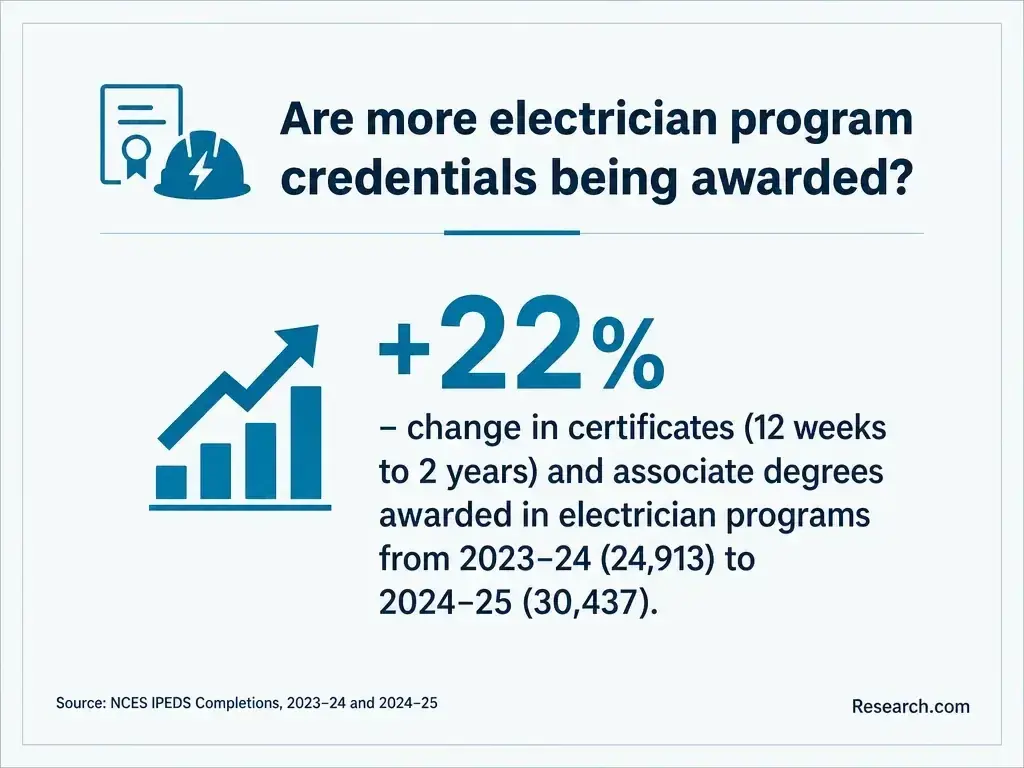
There is no single reliable national price that covers electrician certificates, college programs, private-school training, and paid apprenticeships on the same basis. Published tuition is only one part of the cost of becoming job-ready. Request a written, program-specific budget before comparing offers.
These expense categories show what to include in that comparison; not every provider charges each item.
| Cost or offset | Why it changes the decision |
| Tuition and mandatory fees | Charges differ by provider, program length, and sometimes residency. |
| Tools, PPE, books, and materials | Required purchases may not appear in advertised tuition. |
| Exams and license applications | Potential later costs depend on the credential and jurisdiction. |
| Travel and forgone earnings | Lab schedules and unpaid study time can outweigh a small tuition difference. |
| Aid and paid training | Eligible grants, workforce assistance, employer support, or apprenticeship wages may reduce net cost. |
Check federal-aid eligibility with the provider and Federal Student Aid; do not assume every short program qualifies. Ask a local workforce agency about training assistance and compare any apprentice wage offer with school attendance costs. A sound return-on-investment comparison includes completion probability, debt, foregone income, expected earnings relative to current pay, the time horizon, and the value of money over time. The same discipline applies when comparing electrician training with other education-and-earnings options: an occupational median alone cannot establish your return.
Depending on the pathway, you may earn a school certificate, diploma, associate degree, industry credential, or a registered-apprenticeship completion credential. These are not interchangeable. NCCER credentials, for example, document training or assessment under its system; they are not state electrician licenses (NCCER). A school can also prepare students for an apprenticeship without awarding credit for supervised work.
Institutional accreditation concerns the school, while state authorization concerns permission to operate. Occupation-relevant program recognition, apprenticeship registration, and occupational licensure answer different questions. Request the exact credential name and ask the licensing authority and prospective apprenticeship sponsor how, if at all, they recognize its instruction and hours. The U.S. Department of Education's accreditation information and the applicable state regulator can help verify separate institutional and operating claims.
Schools set their own admissions criteria, while apprenticeship sponsors set separate entry and selection rules. Depending on the provider, applicants may need evidence of prior education, math readiness, an application assessment, or the ability to attend scheduled labs. An employer or sponsor may also impose worksite-related conditions. Check the actual provider's current requirements rather than assuming admission to school secures an apprenticeship position.
If your goal is paid apprenticeship entry, contact sponsors before buying preparatory training. Ask whether they accept direct applicants, prefer particular preparation, provide related instruction, and recognize prior learning or school coursework. Credit or advanced standing is a sponsor or regulator decision - not an automatic benefit of completing a certificate (U.S. Department of Labor, Apprenticeship.gov).
Core instruction commonly covers electrical measurements and calculations, circuits, wiring methods, prints, tools, testing, and safety. Practical learning should require students to select materials, make connections, diagnose faults, and explain safe procedures - not merely watch demonstrations. BLS identifies troubleshooting, critical thinking, and physical work as important parts of the occupation.
Curriculum depth should follow your target work. Ask to see lab assignments and the equipment students actually use, then compare them with local apprentice job descriptions. Code instruction matters, but knowing code concepts in a classroom is not the same as demonstrating safe installation and troubleshooting under supervision.
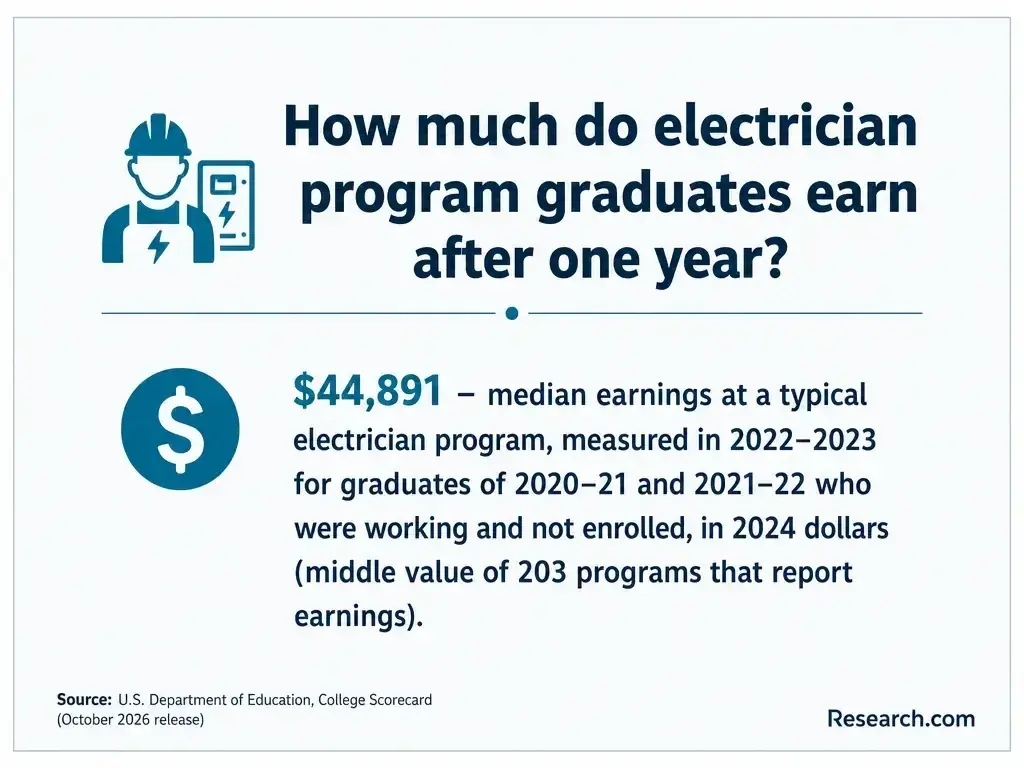
Requirements depend on where you work and the tasks you perform. States - and, in some places, local jurisdictions - set rules for electrical work, supervision, experience, examinations, and progression to journeyman or contractor status. There is no single school certificate or national occupational license that overrides those rules. Apprenticeship registration and optional industry credentials are separate from government permission to perform regulated work.
Before enrolling, find the licensing authority for your intended work location. Verify which work must be supervised, whether school instruction counts toward required hours, how experience must be documented, and which exams apply. If you may move, check the destination's rules rather than assuming a credential or license transfers automatically. An attractive program is a poor investment if its promised licensing credit cannot be confirmed with the authority that grants it.
Start with your intended job and jurisdiction, then compare programs on the full route to that job. A lower-cost school with strong lab access and a credible path into paid supervised work may be more useful than a faster program with weak employer connections. A direct apprenticeship may be the better choice if you can secure a position and its schedule works for you.
Use these checks with admissions staff, apprenticeship coordinators, and the relevant regulator before committing money:
Beware of claims that graduation automatically produces a license, that an online-only course substitutes for field training, or that experienced electricians' median pay represents likely starting earnings. Rankings are a shortlist tool, not a substitute for checking the program and jurisdiction yourself.
A common progression is supervised apprentice work, greater responsibility after documented experience and any required examination, and then specialization or supervision. Depending on the employer and jurisdiction, experienced electricians may focus on construction, maintenance, industrial systems, or controls; some pursue contractor licensing before operating a business. Additional credentials may support a specialty, but optional certificates do not replace a required occupational license.
Choose initial training with the next step in mind. Someone seeking the quickest paid entry should examine apprenticeship openings; someone needing foundational practice first may benefit from a school with substantial labs and verified placement support. If you are weighing electrician training against a very different education path, decide first which occupation you actually want: the credentials and work experience are not substitutes for one another.
BLS projects U.S. electrician employment to grow 9.2% from 2025 to 2035. That is an occupational projection, not a promise of a job for every graduate. Construction activity, maintenance needs, and local employer demand will influence opportunities where you intend to work.
Use the national projection as a reason to investigate local openings, not as a reason to ignore them. Ask nearby contractors, employers, and apprenticeship sponsors what entry-level roles they are filling and what preparation they recognize. This is particularly important if training requires a long commute or you cannot relocate: access to supervised work is part of the value of a program.
Investing in electrician training is a consequential decision. Research.com created its ranking to help readers compare programs with other electrician programs in the same city, state, region, or national market - not with unrelated trades. The team evaluates reported outcomes, costs, and relevant quality indicators; only programs with completions reported to IPEDS are eligible. That boundary matters: an unlisted apprenticeship or employer training program is not necessarily a poor option.
The best-programs ranking evaluates four areas. Student outcomes include completion and full-time and part-time retention. Earnings and return on investment include median earnings one year after completion and earnings relative to annual cost of attendance. Costs and debt include resident and nonresident tuition, attendance costs, median debt - including debt held by students who withdrew - and the federal loan default rate. Quality and recognition include institutional accreditation, occupation-relevant programmatic accreditation or industry recognition, and student support services.
Occupation-relevant programmatic accreditation or industry recognition receives 20% of the score, institutional accreditation 10%, and student support services 10%. The remaining 60% covers outcomes, earnings, and costs; an entropy-based method gives more weight to indicators that vary more across programs. The separate most-affordable-programs ranking scores only tuition, attendance cost, median debt, and federal loan default rate, using entropy-based weights. Accreditation and other quality indicators are not part of that affordability score.
The ranking draws on the following databases and organizations. Some cover other trades or health occupations and should not be mistaken for electrician-specific approval bodies:
Use the ranking to build a shortlist, then confirm each program's current price, electrical-lab access, apprenticeship connections, and recognition by the authority where you intend to work. Published school outcomes cannot by themselves establish an individual student's licensing eligibility. More detail on the ranking process is available in Research.com's methodology.
# 1 position
# 2 position
# 3 position

# 4 position
# 5 position
# 6 position

# 7 position
# 8 position

# 9 position
# 10 position

# 11 position
# 12 position
# 13 position

# 14 position

# 15 position
# 16 position

# 17 position

# 18 position

# 19 position
# 20 position
Not universally. A registered apprenticeship or employer-sponsored route may provide instruction and supervised work without a separate trade-school credential. Check the rules for the jurisdiction where you plan to work.
No. Licensing may require documented experience, examinations, and other conditions set by a state or local authority. Verify whether the school's instruction receives any credit before enrolling.
It depends on access and goals. Apprenticeships combine paid work and instruction, while a school program may help you build skills before applying. Compare sponsor openings, lab quality, cost, wages while training, and recognized hours.
You can study some theory online, but electrical installation, testing, troubleshooting, and supervised work require in-person practice. Confirm a program's lab and field arrangements before relying on it for career entry.
Request tuition and mandatory fees plus required tools, PPE, materials, travel, and possible exam or application charges. Subtract only aid or paid-training income for which you are actually eligible.