
# 1 position
Best Electrical Technician Training Programs & Trade Schools in Baton Rouge for 2027
Audited and Verified:
Our Editorial and Data Verification Process
Research.com uses government datasets, official education statistics and primary institutional information to support its career and degree guides. Our review process checks factual accuracy, occupational definitions, source dates and the requirements associated with the credentials discussed.
How This Article Was Fact-Checked
Our editorial team verifies salary estimates, employment projections, education requirements and program information against original data providers and official organizations. Salary figures are checked against the relevant occupational definitions and reporting periods. Information about licensure, accreditation and required in-person training is reviewed separately.
Fact-checked and verified on:

Co-Founder and Chief Data Scientist

Reviewed by Karolina Broda
Fact-Checker and Data Verification
Choosing electrician training in Baton Rouge means deciding not just where to study, but how to gain supervised experience while earning a living. The U.S. Bureau of Labor Statistics projects electrician employment to grow 9.2% nationally from 2025 to 2035, making the choice timely - but not guaranteeing a local job. This guide compares school-based training with apprenticeships, costs, credentials, and Louisiana rules. It also accompanies the Best Electrician Trade Schools in Baton Rouge for 2027 ranking, created by the Research.com team of data scientists to help students identify programs worth considering.
Key findings about electrician degrees in Baton Rouge
- Compare pathways, not just schools: A short certificate can teach electrical fundamentals, but a registered apprenticeship combines paid work with related instruction; the U.S. Department of Labor describes four years as a common electrician-apprenticeship duration.
- Interpret wages carefully: Electricians' national median annual pay was $63,190 in May 2025, according to the U.S. Bureau of Labor Statistics. That is neither a Baton Rouge wage nor a likely starting wage for a new trainee.
- Check the route to the job: Before paying for training, confirm its lab and worksite components, whether an apprenticeship sponsor recognizes it, and which Louisiana contractor or local permit rules apply to your intended work.
Table of Contents
- Best Electrical Technician Training Programs & Trade Schools in Baton Rouge for 2027
- What can I expect from an electrician trade school program in Baton Rouge?
- Where can I work with an electrician trade school training in Baton Rouge?
What can I expect from an electrician trade school program in Baton Rouge?
Expect to study circuits, wiring methods, electrical drawings, code use, testing instruments, and jobsite safety, then apply them in a lab or supervised work setting. A school-based certificate or diploma usually provides structured preparation for an entry-level helper or apprentice role; it does not replace the supervised experience needed to develop as an electrician. Ask how much time is spent actually installing, troubleshooting, and testing equipment rather than watching demonstrations.
The practical choice is between preparing for work before applying and learning primarily through paid work. This comparison distinguishes credentials that can otherwise sound similar:
| Pathway | What it provides | Best fit and principal trade-off |
| School certificate or diploma | Classroom and lab training; a school-awarded credential | Useful for someone who wants fundamentals before seeking a job; verify the price and whether employers or sponsors grant credit. |
| Associate degree in an electrical field | Technical training plus broader coursework; an academic degree | May suit a student seeking a broader technical foundation; takes longer and is not a substitute for required work experience. |
| Registered apprenticeship | Paid, supervised work and related instruction; a completion credential upon finishing | Suited to someone ready to apply for a work-based opening; entry depends on sponsor selection and available positions. |
| Employer-sponsored entry | Workplace training that varies by employer | Can provide an immediate route to work; confirm supervision, instruction, and whether experience is documented and transferable. |
Baton Rouge Community College and ITI Technical College are two institutions a local searcher may investigate, but do not assume a particular electrician credential is currently offered at either. Request the current catalog and ask whether the training targets building wiring, industrial electrical work, or a related occupation. If speed is your priority, compare the actual hands-on content of short options rather than choosing by duration alone; a list of 6 month certifications that pay well is not evidence that a short electrician course completes the path into the trade.
Where can I work with an electrician trade school training in Baton Rouge?
Possible workplaces include residential and commercial construction sites, maintenance departments, and industrial facilities in the greater Baton Rouge area. Work settings matter because their tasks differ: a building-wiring trainee may install branch circuits and fixtures, while an industrial trainee may work around motors, controls, and plant equipment. The U.S. Bureau of Labor Statistics identifies construction contractors and other employers as major sources of electrician work; a school credential alone does not establish readiness for every setting.
Ask a program where its students obtain supervised experience and whether its employer contacts match your goal. Someone seeking industrial maintenance should examine controls and troubleshooting labs, not assume a residential-wiring course provides the same preparation. Readers comparing other careers in trade school should likewise compare the actual occupation, credential, and work setting rather than treating all trade training as interchangeable.
There is no defensible single wage for every newly trained Baton Rouge electrician. The latest national U.S. Bureau of Labor Statistics Occupational Outlook Handbook figure supplied for this occupation is a $63,190 median annual wage in May 2025. A median covers experienced and newer workers across the United States; it should not be presented as local apprentice pay or a graduate's expected first salary.
For a local decision, compare current Baton Rouge-area electrician wage estimates from the U.S. Bureau of Labor Statistics or the Louisiana Workforce Commission with actual apprenticeship wage schedules and job postings. Check whether a quoted rate is for a helper, apprentice, experienced electrician, or supervisor, and whether overtime or travel is required. A paid apprenticeship may improve cash flow during training even if its initial wage is below the occupation-wide median.
There is no single required length for a Baton Rouge school-based program: a short introductory credential, a longer diploma, and an associate degree cover different amounts of material. Obtain the current catalog's total clock or credit hours, lab hours, schedule, and expected completion time before comparing offers. A compressed schedule can get you into the job market sooner but may leave less time to work for pay while studying.
A registered electrician apprenticeship commonly takes about four years, according to the U.S. Department of Labor, because it combines related instruction with substantial supervised on-the-job learning. Actual hours, duration, and any credit for prior training depend on the registered sponsor's standards. Ask whether completed coursework earns advanced standing in writing; a school certificate does not automatically shorten an apprenticeship.
Online instruction can be useful for electrical theory, calculations, plan reading, and some code-study assignments. It cannot, by itself, demonstrate safe installation, instrument use, or troubleshooting on a jobsite. An on-campus or hybrid option is stronger when it provides supervised labs and a credible route into worksite training; ask exactly where those activities occur and who evaluates them.
Do not equate a remotely delivered credential with apprenticeship completion, employer acceptance, or licensing eligibility. If flexibility is essential, request a calendar showing every required in-person session and its location before enrolling. Comparisons with affordable online masters programs are not useful for judging electrician readiness: this trade depends on practical competencies that must be assessed in person.
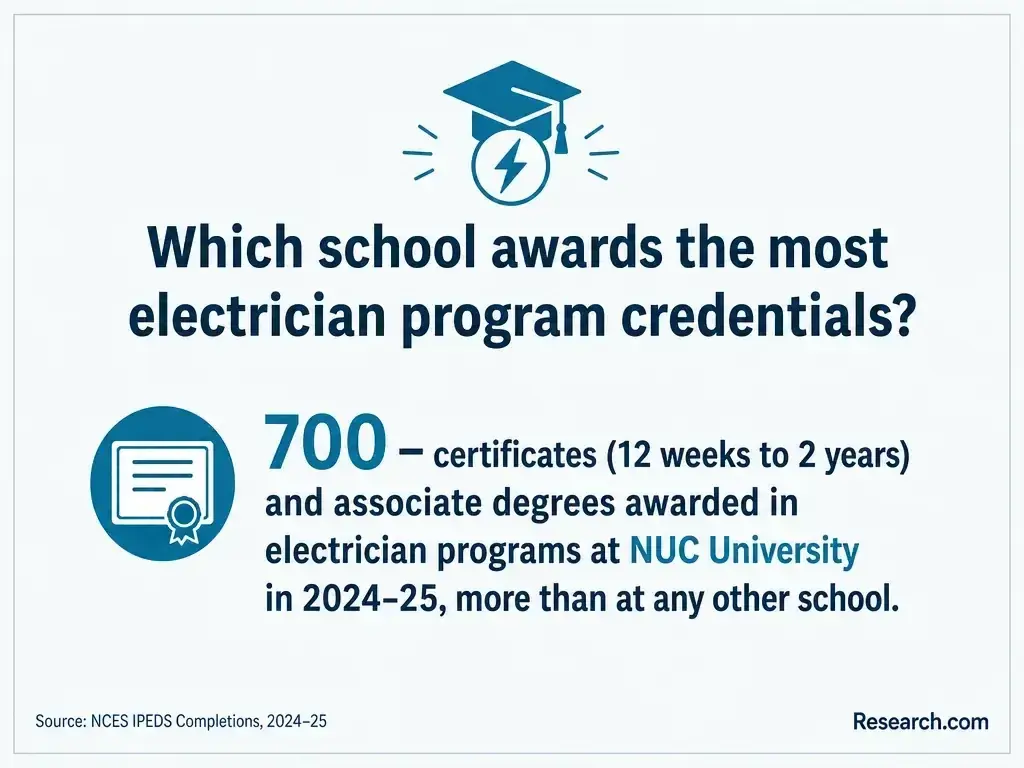
A reliable Baton Rouge-wide average cannot be stated without comparable, current prices for school programs and apprenticeships. Posted tuition also understates what it can cost to become job-ready. Request an itemized estimate covering mandatory fees, books or software, tools, safety gear, materials, transportation to labs or worksites, and any applicable examination or application fees. Include earnings forgone when comparing full-time study with paid training.
Compare net cost and cash flow, not sticker price alone: eligible federal or state aid, scholarships, workforce assistance, or employer-paid instruction can change the result. Ask each school whether its specific program is eligible for federal student aid; institutional accreditation alone does not establish that eligibility. Ask apprenticeship sponsors about wages, related-instruction charges, tool purchases, and how pay progresses. A sensible return-on-investment comparison also considers completion probability, debt, starting earnings, later earnings, the time horizon, and the value of money over time - not institution type or tuition alone.
The answer depends on the pathway: a school may award a certificate, diploma, or associate degree; a registered apprenticeship awards its own completion credential when its requirements are met. An industry training credential, where offered, is a separate form of recognition. Ask for the precise credential name and whether an employer or apprenticeship sponsor accepts the coursework for placement or advanced standing.
Keep four checks separate: institutional accreditation concerns the school; state authorization concerns permission to operate; industry recognition or program approval concerns a particular training standard; and occupational licensure concerns legal authority to perform regulated work. None automatically confers another. Lists of best non profit accredited universities cannot answer whether a specific electrician training program provides the required practical preparation or is recognized by a local apprenticeship sponsor.
Requirements vary by provider and pathway. A school may ask for an application, evidence of secondary-school completion, and placement information; an apprenticeship sponsor may also assess math readiness, availability for work, and employer-related entry conditions. Do not assume that being admitted to a school also secures an apprenticeship position or job. Obtain each provider's written requirements, deadlines, and any costs tied to testing or screening.
Before applying, check whether you can meet the schedule and travel demands. Electrical training often involves attendance at a lab and, later, changing jobsite locations. If you already have relevant work or coursework, ask whether the provider evaluates prior learning and whether any credit applies to both the school credential and a prospective apprenticeship; those decisions are made separately.
A useful curriculum connects electrical theory to safe work: interpreting drawings, calculating loads, selecting conductors and protective devices, using meters, installing raceways and wiring, and finding faults. Instruction should also teach students how to locate and apply the electrical code used on the job, rather than merely memorize answers. The U.S. Bureau of Labor Statistics describes installing, maintaining, and repairing electrical power, communications, lighting, and control systems as core electrician duties.
Match the shop to the intended work. For commercial construction, ask to see installation practice and plan-reading exercises; for industrial work, look for motors, controls, and troubleshooting equipment. Ask how instructors assess each task and whether students practice under supervision with tools they will encounter at work. Similar credential names do not imply equivalent lab time or equipment.
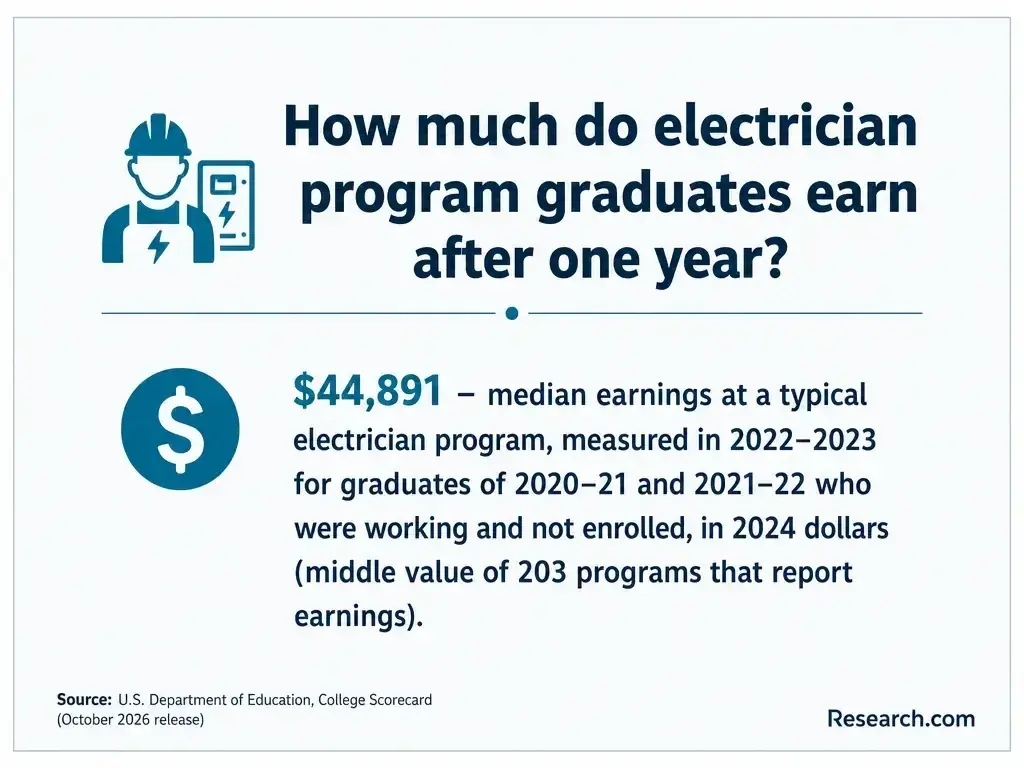
Do not assume a school credential is a license. Louisiana's State Licensing Board for Contractors regulates contractor licensing, while applicable local permitting and inspection rules can affect electrical work in the Baton Rouge area. The obligations for a business bidding on or contracting for regulated work are not necessarily the same as those for an employee learning under supervision. Confirm the rules for the role you actually intend to hold with the Louisiana State Licensing Board for Contractors and the relevant local permitting authority before paying for a program or planning to work independently.
A registered apprenticeship is a structured training route, not a contractor license. An optional industry certificate may show a particular skill, but it does not replace required contractor authority, permits, or supervision. If self-employment is your long-term goal, ask what documented experience, examinations, business requirements, and local approvals would apply at that later stage; verify current rules directly rather than relying on a school's general statement that its graduates are "licensed."
Start with the work you want - building construction, industrial electrical work, or maintenance - then compare programs against that target. The following checks turn a ranking into an enrollment decision:
- Request the current curriculum, total hours, supervised lab hours, credential awarded, schedule, and full itemized cost.
- Ask where students gain worksite experience and whether a registered apprenticeship sponsor grants documented credit for the training.
- Verify the school's accreditation and authorization separately from any industry recognition, apprenticeship registration, or licensing claims.
- Request occupation-specific completion and placement information, including what the provider counts as a placement; compare it with available local openings.
- Compare the school option with applying directly to paid apprenticeships, accounting for admission timing, wages during training, debt, and travel.
Be wary of a program that advertises an electrician job or license without specifying the supervised work and regulatory steps between enrollment and that outcome. A lower-priced program can be poor value if it lacks useful practical training; a faster one can be poor value if its schedule prevents you from earning while you train. Choose the route that gets you the right experience and credential at a manageable total cost.
Training may lead first to a helper or apprentice position, followed by more independent installation or maintenance work as skills and supervised experience grow. Later directions can include commercial construction, industrial troubleshooting, controls, estimating, supervision, or contracting. These are progression possibilities, not outcomes conferred by a certificate; contracting can bring separate licensing and business obligations under Louisiana rules.
Choose early coursework with that progression in mind. Someone drawn to plant controls should ask about motor and control-system practice and relevant worksite access; someone interested in contracting should prioritize broad field experience and learn the applicable regulatory path before taking on independent work. Searches for easiest phds to get address a different goal: advancement in this trade rests chiefly on demonstrated electrical competence, experience, and any required authority to perform the work.
The U.S. Bureau of Labor Statistics projects 9.2% national electrician employment growth from 2025 to 2035. That indicates demand across the occupation, not a forecast for Baton Rouge or a guarantee of placement. Local opportunity depends on hiring by contractors, facilities, and industrial employers, as well as the availability of supervised openings for people new to the trade.
Use the national projection as context, then check current Baton Rouge-area postings and Louisiana Workforce Commission labor-market information for the roles you could actually enter. Separate apprentice or helper vacancies from openings requiring substantial experience. If most openings in your target specialty require experience you do not yet have, prioritize a program or sponsor that offers a credible route to supervised work over one that offers classroom instruction alone.
Best Electrical Technician Training Programs & Trade Schools in Baton Rouge for 2027
Investing in electrician training is a consequential decision. Research.com developed its ranking to help readers compare programs with other programs in the same occupation and location, rather than with unrelated schools. The team evaluates reported outcomes, costs, recognition, and support, while checking multiple data sources for credibility and accuracy. Only programs with completions reported to IPEDS are eligible; an apprenticeship or training provider absent from the ranking is not necessarily unapproved or low quality.
Best-program rankings consider student completion and full-time and part-time retention; earnings one year after completion and earnings relative to annual attendance cost; tuition, attendance cost, debt - including debt among students who withdrew - and federal loan default rates; and accreditation, occupation-relevant recognition, and student support. Occupation-relevant programmatic accreditation or industry recognition receives 20% of the score, institutional accreditation 10%, and student support 10%. The remaining 60% covers outcomes, earnings, and costs, with weights distributed by an entropy-based method that gives more weight to indicators that differ more across programs. Most-affordable-program rankings score costs and debt only, using entropy-based weights; accreditation and other quality indicators are not part of that score.
The team used the following databases and organizations to build and check the ranking. Some recognition sources cover other trades or health occupations and should not be mistaken for electrician-specific approval:
- IPEDS database - program completions and institution-reported education data.
- National Center for Education Statistics - federal education data and definitions.
- College Scorecard database - available cost, debt, and earnings measures.
- Peterson's database - supplementary institution and program information.
- Commission on Accreditation of Allied Health Education Programs (CAAHEP) - occupation-specific recognition checks where relevant.
- Accrediting Bureau of Health Education Schools (ABHES) - occupation-specific recognition checks where relevant.
- Commission on Dental Accreditation (CODA) - occupation-specific recognition checks where relevant.
- Dental Assisting National Board (DANB) - occupation-specific credential checks where relevant.
- National Center for Construction Education and Research (NCCER) - construction-training and industry-recognition information.
- Apprenticeship.gov Partner Finder - apprenticeship-sponsor information.
Use the ranking as a shortlist, then verify each electrician program's current curriculum, practical training, total price, and connection to employment or apprenticeship. More detail on Research.com's approach appears on its methodology page.
# 2 position
Baton Rouge Community College - Electrician.
certificate or diplomaFrequently asked questions about electrician programs in Baton Rouge
Is trade school required to become an electrician?
Not necessarily. A registered apprenticeship or supervised employer route may provide training without a separate school credential. Check the employer's and sponsor's entry requirements, and verify applicable rules for the work you plan to do.
Is an apprenticeship better than a school certificate?
It depends on access and finances. An apprenticeship combines paid work with instruction, while a certificate may help you build fundamentals before applying. Ask whether a sponsor gives credit for the certificate before paying for it.
Can I complete electrician training entirely online?
Theory may be taught online, but safe installation, testing, and troubleshooting require in-person assessment and supervised practice. Confirm where a hybrid program provides those components.
Will a certificate let me work independently in Louisiana?
Do not assume so. A school certificate is not a contractor license. Check the Louisiana State Licensing Board for Contractors and applicable local permitting rules for the work and business role you intend to undertake.
What should I ask about cost before enrolling?
Request a written total for tuition, fees, tools, safety gear, materials, and travel. Ask about aid or employer support, and compare that net cost with earnings you could receive during a paid apprenticeship.
- U.S. Bureau of Labor Statistics - Electricians
Used to verify salary, employment outlook, and typical education requirements.
https://www.bls.gov/ooh/construction-and-extraction/electricians.htm - NCCER - Accredited Training
Used to verify programmatic accreditation or industry recognition of programs.
https://www.nccer.org/ - O*NET OnLine - Electricians
Used to verify common responsibilities, skills, work settings, and education expectations.
https://www.onetonline.org/link/summary/47-2111.00 - ITI Technical College - official website
Official school website (programs, tuition, admissions).
https://www.iticollege.edu/ - Baton Rouge Community College - official website
Official school website (programs, tuition, admissions).
https://www.mybrcc.edu/