# 1 position


Audited and Verified:
Our Editorial and Data Verification Process
Research.com uses government datasets, official education statistics and primary institutional information to support its career and degree guides. Our review process checks factual accuracy, occupational definitions, source dates and the requirements associated with the credentials discussed.
How This Article Was Fact-Checked
Our editorial team verifies salary estimates, employment projections, education requirements and program information against original data providers and official organizations. Salary figures are checked against the relevant occupational definitions and reporting periods. Information about licensure, accreditation and required in-person training is reviewed separately.
Fact-checked and verified on:

Co-Founder and Chief Data Scientist

Reviewed by Karolina Broda
Fact-Checker and Data Verification
Choosing electrician training in Montgomery means deciding whether to pay for school, pursue a paid apprenticeship, or combine the two - and whether the training will count toward an Alabama license. The U.S. Bureau of Labor Statistics projects 9.2% national growth in electrician employment from 2025 to 2035. For new entrants and career changers, this guide compares credentials, practical training, costs, and licensing. It also accompanies the Best Electrician Trade Schools in Montgomery for 2027 ranking, created by the Research.com team of data scientists to help students identify programs worth considering.
Expect instruction in electrical theory, reading plans, wiring methods, code, testing, and safe work practices, paired with supervised labs or shop work. A classroom credential can prepare you to seek an entry-level position, but installing and troubleshooting electrical systems on real jobsites requires further supervised experience. Ask how much of the advertised schedule involves hands-on work rather than demonstrations.
For a Montgomery applicant, H Councill Trenholm State Community College is one local college option to investigate. Compare its current electrical offerings with registered apprenticeships and employer-sponsored training: a college schedule may suit someone seeking structured preparation before employment, while an apprenticeship combines instruction with paid, progressively skilled work. Neither route should be assumed to confer an Alabama license at completion (Alabama Electrical Contractors Board; U.S. Department of Labor).
Electricians work for electrical contractors on residential and commercial construction, for industrial facilities maintaining equipment, and for organizations maintaining building systems (U.S. Bureau of Labor Statistics). In and around Montgomery, compare employers by the work they actually offer: construction can provide broad installation experience, while a maintenance job may concentrate on troubleshooting existing systems. The distinction matters if you need documented experience in particular tasks for advancement.
Ask an employer who supervises trainees, whether the position is part of a registered apprenticeship, and how work hours are recorded. A school's job-placement assistance may help you find an interview; it is not a substitute for a job offer or verified qualifying experience.
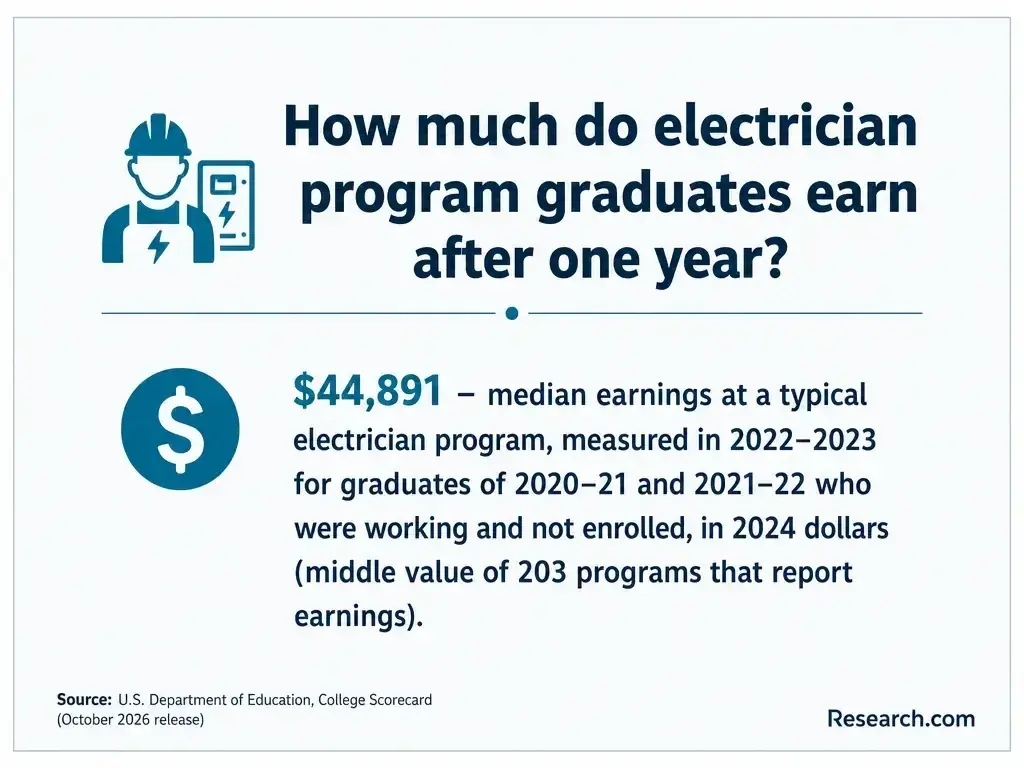
The U.S. Bureau of Labor Statistics reports a $63,190 median annual wage for electricians in May 2025. This is a national figure for workers across experience levels, not a Montgomery starting-pay estimate. Apprentices and newly trained workers should compare actual local offers, including wage progression, benefits, overtime expectations, and travel between jobsites.
To judge whether training is worth its cost, compare the pay you could earn while learning with what you would otherwise earn, then account for aid, debt, completion likelihood, and the time needed to reach a higher wage. A paid apprenticeship can change that calculation substantially even if its total training period is longer.
Duration depends on the credential and schedule. A short certificate or pre-apprenticeship provides initial instruction; a longer diploma or associate degree includes more coursework. A registered apprenticeship combines classroom instruction with years of paid, supervised work rather than ending when classes end (U.S. Department of Labor). Obtain the current program's calendar and clock or credit hours directly from the provider instead of treating all "electrician programs" as the same length.
In Alabama, finishing school and accumulating experience for a journeyman license are separate milestones. Ask the Alabama Electrical Contractors Board how a particular course of study may be credited, and ask the provider how it documents attendance, labs, and any work placement. An accelerated class may get you into the labor market sooner without shortening the experience required for licensure.
Electrical theory, code study, and some calculations can be taught remotely. Bending conduit, making terminations, using test instruments, and working safely around equipment require supervised, in-person practice. A hybrid option makes sense only if its lab location and schedule are workable for a Montgomery resident and its practical component matches the skills an employer expects.
Be cautious with a fully online certificate marketed as a direct route to electrician licensure. Ask where you will practice, who evaluates your work, and whether the Alabama Electrical Contractors Board will recognize any claimed educational credit. A short online credential can support exploration or theory study, but it should not be confused with the hands-on route into the occupation; that distinction also applies when browsing highest paying 6 month online certifications.
There is no single reliable Montgomery average covering college programs, private training, and paid apprenticeships. Published tuition alone also understates the cost of becoming job-ready. Request an itemized estimate for your intended start date before comparing options.
The following comparison shows which expenses and offsets can materially change your choice; amounts depend on the provider and training arrangement.
| Pathway | Costs and offsets to check |
| College certificate, diploma, or associate degree | Tuition, mandatory fees, books, lab materials, tools, safety gear, commuting, and possible aid |
| Registered apprenticeship | Possible instruction, tools, and travel costs, offset by wages during training; verify sponsor terms |
| Employer-sponsored training | Tool and transportation costs, pay while learning, and any repayment conditions |
Ask whether the specific program qualifies for federal student aid and what grants or workforce assistance you personally qualify for (Federal Student Aid; Alabama Department of Workforce). Include forgone earnings if classes reduce your work hours. Institutional accreditation and nonprofit status may be useful checks when comparing colleges, but neither alone establishes low cost or licensing eligibility; the same caution applies to lists of non profit accredited colleges.
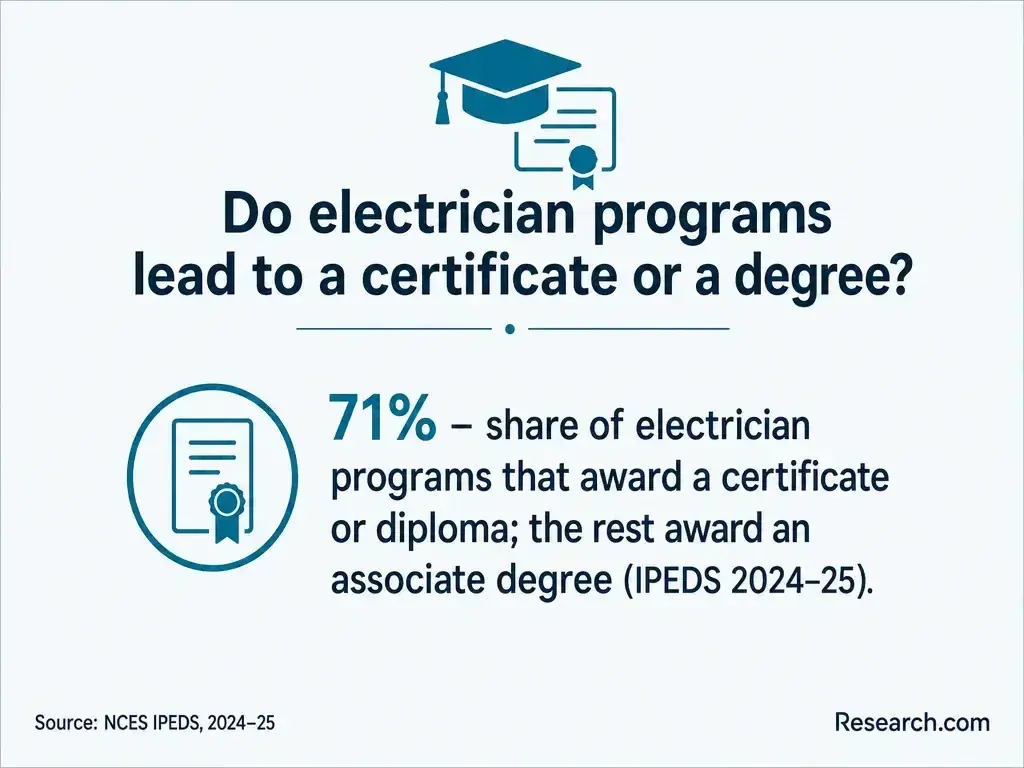
The award depends on the pathway: a college may offer a certificate, diploma, or associate degree; a registered apprenticeship has its own completion credential; and an employer course may issue only a training record. Confirm the exact award on the current program description. Credentials with similar names are not equivalent if one includes substantial supervised shop or jobsite training and another does not.
Keep the credential distinct from other forms of recognition. Institutional accreditation concerns the school, industry credentials may document particular skills, apprenticeship registration concerns the training arrangement, and an Alabama occupational license is granted through a separate state process (U.S. Department of Education; U.S. Department of Labor; Alabama Electrical Contractors Board). If you may later continue at a college, ask whether prior coursework or documented apprenticeship learning can receive credit; do not assume transfer or advanced standing.
Requirements vary by provider and pathway. Ask a college about its current application, placement, prerequisite, and program-entry rules. Ask an apprenticeship sponsor or employer about its application process, math expectations, work authorization, physical demands, driving requirements, and selection timetable. These are questions to verify, not universal conditions for every Montgomery program (U.S. Department of Labor; individual providers).
Before applying, check that you can attend the required labs and reach worksites reliably. A program with convenient classroom hours may still be impractical if field assignments conflict with your job or require transportation you do not have.
A useful curriculum connects electrical calculations and circuit theory to plan reading, code use, installation methods, measurement, troubleshooting, and workplace safety. Electricians must also communicate with supervisors and other trades and document work accurately (U.S. Bureau of Labor Statistics). Ask to see the lab equipment and sample tasks, particularly if your goal is industrial maintenance rather than residential installation.
Digital controls and changing equipment make troubleshooting more valuable, but no classroom can recreate every jobsite condition. Request the share of instruction spent practicing with tools and ask how instructors assess safe, independent performance. That evidence is more useful than a long course list when comparing similarly named programs.
Alabama regulates electrician licensing through the Alabama Electrical Contractors Board. Its journeyman pathway involves qualifying electrical experience and an examination; education may affect how experience is evaluated, but a school certificate does not itself grant a license. Electrical contracting has separate requirements. Verify the current rules and documentation directly with the board before relying on a school's claim about license eligibility (Alabama Electrical Contractors Board).
You can seek supervised entry-level training before becoming licensed, subject to the applicable work and supervision rules. Ask prospective employers who will supervise your work and maintain experience records. Optional industry training credentials may help demonstrate skills, but they do not replace state licensure where licensure is required.
Start with the job you want, then work backward from its practical skills and Alabama licensing path. A college program may be worthwhile if you need structured foundational instruction and can afford its total cost; a paid apprenticeship may fit better if you are ready to learn on a jobsite. Neither a ranking position nor a low advertised tuition answers that question alone.
Use this sequence when speaking with providers and apprenticeship coordinators:
Red flags include guaranteed salaries, vague promises of "license readiness," and a refusal to specify hands-on hours. The right investment is the option that gets you documented skills and a realistic route to the work you want, at a cost you can sustain. If you are comparing electrician training with broader academic routes, keep the occupational goal in view rather than selecting an easiest bachelor's degree solely for its apparent convenience.
Initial training can lead to supervised installation or maintenance work. With documented experience and the applicable examination, a worker may pursue Alabama journeyman licensure; later options include more specialized industrial work, supervision, or electrical contracting under the state's separate requirements (Alabama Electrical Contractors Board; U.S. Bureau of Labor Statistics). Ask whether a prospective employer's projects will expose you to the systems you hope to work on later.
An associate degree may offer broader technical coursework, but additional classroom credentials are not automatic substitutes for supervised experience. Likewise, universities with double majors address a different educational decision; electrician applicants should prioritize field competence, documented hours, and the relevant license path.
The U.S. Bureau of Labor Statistics projects 9.2% growth in electrician employment nationally from 2025 to 2035. That supports considering the trade, but it does not measure Montgomery openings or guarantee a position after training. Local hiring will depend on contractors' projects, facility maintenance needs, and whether applicants can travel to worksites.
Before committing to a schedule or loan, review current area postings and ask apprenticeship sponsors and employers what entry-level skills they seek. A classroom program is most useful when it helps you meet those requirements and obtain supervised work; paid training may offer a more direct route if you can secure a place. Longer academic options such as a doctorate without dissertation do not replace that occupational preparation.
Education is a consequential investment, so the Research.com team evaluates electrician programs against other programs in the same occupation and location - not against unrelated trades or schools elsewhere. The ranking is designed to help readers compare outcomes, costs, and recognition, but it should be used alongside direct checks of practical training and Alabama licensing eligibility.
Only programs reporting completions to the Integrated Postsecondary Education Data System (IPEDS) are eligible. The best-programs ranking assesses student completion and full-time and part-time retention; earnings one year after completion and earnings relative to annual attendance cost; tuition, attendance cost, debt - including debt held by students who withdrew - and federal loan default rates; and accreditation, relevant industry recognition, and student support. Relevant programmatic accreditation or industry recognition receives 20% of the score, institutional accreditation 10%, and student support 10%. Outcomes, earnings, and costs make up the remaining 60%, with weights distributed using an entropy-based method that gives more weight to indicators that vary more across programs.
Most-affordable-program rankings use only tuition, attendance cost, median student debt, and federal loan default rates, weighted by the entropy-based method; accreditation and other quality indicators are not part of that score. These distinctions matter: a low-cost ranking is not a finding that a program supplies the experience needed for licensure.
The team draws on the following data sources to check institutional information, outcomes, and occupation-relevant recognition where applicable. Some sources cover other trades and do not establish approval of an electrician program:
IPEDS and College Scorecard do not capture every apprenticeship, employer program, or other trade-training provider. Absence from this ranking therefore does not establish that an option is unavailable or poor quality. Readers can find further details on Research.com's ranking methodology.
# 1 position
# 2 position
No single trade-school credential is the only route. Supervised work and apprenticeships are important pathways; check the Alabama Electrical Contractors Board's current experience and examination rules for the license you intend to pursue.
Do not assume so. Online theory does not replace supervised practical work or satisfy licensing requirements by itself. Verify any claimed educational credit with the Alabama Electrical Contractors Board.
Choose based on access, cost, and the experience you need. College can provide structured preparation before employment; a registered apprenticeship combines instruction with paid supervised work. Compare actual offers and schedules.
No. A certificate documents completion of a particular program. Employment depends on hiring, and Alabama licensure has separate experience and examination requirements.
Request the total job-ready cost, exact credential, supervised lab hours, work-placement arrangements, and written explanation of how training may count toward Alabama licensing.