# 1 position

Audited and Verified:
Our Editorial and Data Verification Process
Research.com uses government datasets, official education statistics and primary institutional information to support its career and degree guides. Our review process checks factual accuracy, occupational definitions, source dates and the requirements associated with the credentials discussed.
How This Article Was Fact-Checked
Our editorial team verifies salary estimates, employment projections, education requirements and program information against original data providers and official organizations. Salary figures are checked against the relevant occupational definitions and reporting periods. Information about licensure, accreditation and required in-person training is reviewed separately.
Fact-checked and verified on:

Co-Founder and Chief Data Scientist

Reviewed by Karolina Broda
Fact-Checker and Data Verification
Choosing an electrician program in New Mexico means checking more than tuition: you need a route to supervised work, documented experience, and the right license. The U.S. Bureau of Labor Statistics projects 9.2% growth in electrician employment nationally from 2025 to 2035. For prospective students and career changers, this guide compares school and apprenticeship pathways, costs, training, and career prospects. It also introduces the Best Electrician Trade Schools in New Mexico for 2027 ranking, created by the Research.com team of data scientists to help students make an informed choice about programs worth considering.
Expect instruction in electrical theory, circuitry, blueprint reading, code use, testing, and safe installation, with practical work on wiring and equipment. The decisive difference between programs is what happens after the classroom: a school credential documents education, whereas an apprenticeship pairs instruction with supervised, paid work that can build the experience needed for licensure (U.S. Bureau of Labor Statistics; U.S. Department of Labor).
This comparison separates credentials that can sound similar but serve different purposes. Availability, schedules, and credit arrangements must be confirmed with the individual provider.
| Pathway | Typical outcome | Best fit and key limitation |
| Short certificate or pre-apprenticeship | School credential or preparation for apprenticeship entry | Fits someone testing the trade or strengthening an application; does not itself confer journeyman status. |
| College certificate or associate degree | Academic credential with classroom and lab training | Fits someone seeking structured instruction; ask whether credits or training receive recognition from a future apprenticeship sponsor. |
| Registered apprenticeship | Paid supervised work, related instruction, and an apprenticeship completion credential | Fits someone ready to work while training; entry, job placement, and schedules depend on the sponsor. |
| Employer-sponsored entry | On-the-job training, sometimes linked to a registered apprenticeship | Fits someone with a suitable opening; verify how experience is documented and whether instruction is provided. |
If your priority is earning while you learn, investigate apprenticeships before paying for a stand-alone program. If you need introductory lab practice or a more structured academic schedule, a college program may be useful - provided its cost and connection to supervised work make sense for your goal.
Electricians work for electrical contractors and in construction, maintenance, and industrial settings (U.S. Bureau of Labor Statistics). In New Mexico, that can mean residential or commercial projects, facilities maintenance, utility-related work, and specialized industrial sites. Training alone does not authorize independent electrical work: the tasks you may perform depend on supervision and the applicable state credential (New Mexico Construction Industries Division).
Location changes the practical choice. A program near Albuquerque may offer a different set of commuting and employer options than one serving a smaller community. Before enrolling, compare where its labs and work placements actually take place with where you can reliably travel; a nearby classroom is less useful if required fieldwork is out of reach.
The U.S. Bureau of Labor Statistics reports a $63,190 national median annual wage for electricians in May 2025. This is the midpoint across employed electricians, not an apprentice wage or a forecast of what a new program completer will earn. Pay can change substantially with experience, license classification, employer, location, and overtime.
For a New Mexico decision, request current pay scales from local apprenticeship sponsors and employers and compare them with the latest state occupational wage estimates from the New Mexico Department of Workforce Solutions. Use the wage for the job you could realistically enter first - not the experienced-electrician median - when estimating whether training costs are manageable.
A short preparatory program may take months; a college certificate generally takes longer, and an associate degree typically involves about two academic years of full-time study. Actual schedules depend on course sequencing and part-time availability. A registered electrician apprenticeship is a longer work-and-instruction commitment, commonly organized around multiple years of supervised experience (U.S. Department of Labor; U.S. Bureau of Labor Statistics).
Program length is not time to independent practice. New Mexico experience requirements depend on the journeyman classification sought. For the broad EE-98J classification, the New Mexico Construction Industries Division identifies four years, or 8,000 hours, of qualifying experience. Confirm the current classification rules and whether particular school or prior work experience can be credited before relying on an advertised graduation date.
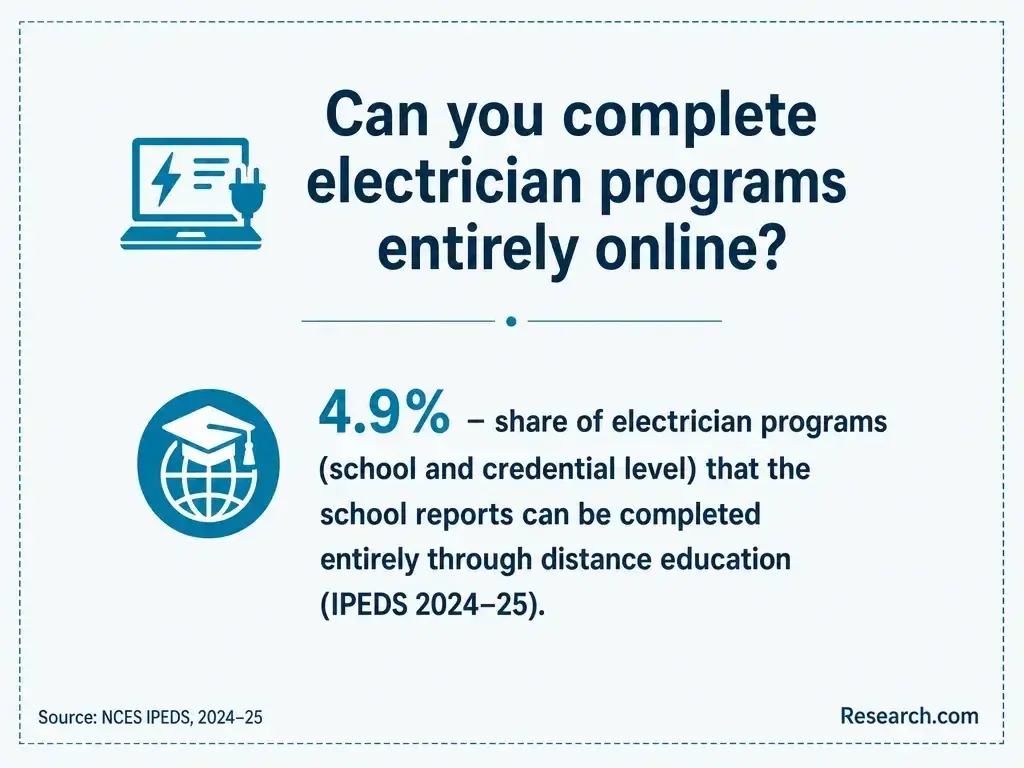
Online coursework can be practical for electrical theory, calculations, and some code study. It cannot replace physically installing circuits, using test instruments, practicing safe work procedures, or accumulating supervised jobsite experience. A hybrid program is useful only if its required labs and worksite arrangements are accessible to you.
Ask for the timetable and location of every in-person requirement before paying a deposit. An entirely online course may build knowledge, but do not assume it supplies practical competencies, apprenticeship credit, or New Mexico licensing experience without confirmation from the sponsor and the New Mexico Construction Industries Division. If schedule flexibility is your main concern, compare hybrid instruction with an apprenticeship that delivers related instruction outside regular work hours.
There is no single defensible statewide price for electrician training: a college certificate, an associate degree, and a paid apprenticeship have different tuition and earnings structures. Published tuition also omits expenses that determine whether a pathway is affordable. Compare each provider's current written cost estimate, including any resident and nonresident tuition difference that applies to you.
A job-ready budget needs more than the advertised course price. These are the costs to request in writing and the offsets to investigate:
Federal aid eligibility belongs to the specific institution and program, not to an online label; Federal Student Aid advises students to confirm school and program eligibility. The same check matters when comparing online colleges accepting fafsa with local hybrid training. Ask a New Mexico workforce office about current training assistance, and compare net cost with likely entry-level pay rather than assuming the cheapest tuition yields the best return.
Depending on the pathway, you may earn a certificate, an associate degree, or a registered apprenticeship completion credential. Some programs also prepare students for optional industry credentials. These outcomes are not interchangeable with a New Mexico journeyman license: occupational licensure is issued through the state's regulatory process, not by a school (New Mexico Construction Industries Division; U.S. Department of Labor).
Institutional accreditation concerns the school; state authorization concerns permission to operate; apprenticeship registration concerns an approved work-and-instruction arrangement; and industry recognition concerns a particular training standard or credential. None, by itself, establishes licensing eligibility. Ask the provider to identify its exact award, who recognizes it, and whether an apprenticeship sponsor grants credit or advanced standing for it - preferably in writing.
Requirements vary by provider and pathway. A college may ask for an application and placement information; an apprenticeship sponsor may assess math readiness, availability for work, and its own entry criteria. Employers may also impose jobsite or driving requirements. Check the current admissions notice rather than assuming that acceptance into a class secures an apprenticeship position.
If you have construction or military electrical experience, ask both the school and prospective apprenticeship sponsor how they assess prior learning. School credit, placement into a later course, and credit toward documented licensing experience are separate decisions made by different organizations. Before committing, request the program's prerequisites, lab schedule, placement process, and any conditions attached to a promised apprenticeship interview.
Useful training connects calculations and diagrams to safe physical work: reading plans, identifying conductors and components, making connections, testing circuits, troubleshooting faults, and applying the electrical code. The U.S. Bureau of Labor Statistics describes these as core aspects of electricians' work. Ask how students practice them in labs and how instructors assess safe performance - not merely whether a course lists them in its catalog.
For someone comparing 6 month certifications that pay well, an introductory electrician certificate can be appealing. Its short duration is a reason to inspect the lab hours and next-step employment or apprenticeship arrangements closely, not a reason to assume it leads quickly to independent electrical work.
New Mexico regulates electrical work through the Construction Industries Division. The license or certificate relevant to you depends on the work and journeyman classification; supervised entry-level work is different from qualifying to perform work as a journeyman. The broad EE-98J journeyman route requires documented qualifying experience and an examination under state rules (New Mexico Construction Industries Division). A school certificate or optional industry certification does not replace that process.
Before enrolling, tell the division which electrical work you intend to do and ask which classification applies, how experience must be documented, and what examination is required. Then ask a prospective school or sponsor how its instruction and supervised work connect to those requirements. This prevents a costly mistake: completing a course only to discover that its credential does not establish the experience needed for your intended license.
Start with the work you want to do, then compare routes to that work. The ranking is a shortlist tool, not a substitute for checking licensing fit, hands-on training, and total cost. A school program is more likely to be worth the investment when it supplies skills you need, a feasible route into supervised employment, and a net cost you can sustain; a paid apprenticeship may be a better first application if earning during training is essential.
Use these questions with each school and apprenticeship sponsor. Written answers make similarly named programs easier to compare:
Compare return on investment over a realistic time horizon: include program duration, lost or apprentice earnings, aid, debt, your probability of finishing, likely entry-level pay, later earnings, and the time value of money. Red flags include guaranteed-license claims, vague lab arrangements, or placement promises with no named employer or sponsor. A claim that a short course is "accredited" is not an answer to whether it provides qualifying supervised experience.
A common progression is supervised entry-level work, documented experience, a relevant journeyman examination and credential, then greater responsibility in installation, maintenance, troubleshooting, or supervision. Some electricians later pursue specialized work or contractor-related responsibilities; those steps can involve additional state requirements and business obligations (New Mexico Construction Industries Division; U.S. Bureau of Labor Statistics).
If you prefer focused technical problem-solving, consider whether service and maintenance work suits you when exploring best high paying careers for introverts. Electrical work still requires coordination with crews, customers, and safety supervisors. Choose a training provider whose labs and employer connections reflect the kind of work you want, rather than treating all electrician placements as the same.
The U.S. Bureau of Labor Statistics projects 9.2% national electrician employment growth from 2025 to 2035. That is a national occupational projection, not a New Mexico hiring guarantee. It supports investigating the trade, but it cannot tell you whether an apprenticeship opening exists near your home or whether a particular credential will help you get one.
For a local decision, check current New Mexico Department of Workforce Solutions projections and vacancies, then speak with contractors or sponsors in the areas where you can commute. Compare the type of work advertised - construction, maintenance, or specialized systems - with the practical skills taught by your proposed program. Demand only helps your investment if the pathway makes you eligible and prepared for the jobs available to you.
Investing in training is an important decision. The Research.com team created this ranking to help readers compare electrician programs with other programs serving the same occupation and location, rather than with unrelated schools. Only programs with completions reported to IPEDS are eligible; the ranking therefore does not cover every apprenticeship, employer program, or training provider.
For best-program rankings, Research.com evaluates student outcomes; earnings and return on investment; costs and debt; and quality and recognition. Occupation-relevant programmatic accreditation or industry recognition receives 20% of the score, institutional accreditation 10%, and student support services 10%. The remaining 60% covers completion and retention, earnings, tuition, attendance costs, debt, and loan default measures, with weights distributed through an entropy-based method. Most-affordable rankings use only cost and debt indicators, weighted through that method; they do not score accreditation or other quality indicators.
To check the quality, credibility, and accuracy of its comparisons, the team used the following sources. Some support rankings across multiple trades and should not be mistaken for electrician-specific approvals:
The ranking can narrow a shortlist, but a score cannot establish whether a particular course supplies the supervised experience needed for a New Mexico license. Readers can review Research.com's full methodology, then confirm program details directly with each provider and the state licensing authority.
# 1 position
# 2 position
# 3 position

# 4 position
# 5 position
# 6 position

# 7 position
# 8 position
# 9 position

# 10 position
# 11 position

No single trade-school credential replaces supervised experience and state licensing requirements. A registered apprenticeship or suitable employer-sponsored pathway may combine instruction with paid work; check the rules for your intended classification with the New Mexico Construction Industries Division.
No. A certificate records completion of a school program. Journeyman eligibility depends on the applicable New Mexico experience and examination requirements, and the state issues the occupational credential (New Mexico Construction Industries Division).
You may study some theory online, but practical wiring skills and supervised work require in-person participation. Verify labs and worksite arrangements before enrolling in an online or hybrid program.
Choose based on your goal and constraints. College may provide structured introductory training; a registered apprenticeship combines paid work with instruction. Compare net cost, entry requirements, practical experience, and any credit one pathway grants toward the other.
It may affect course placement or apprenticeship standing, but neither is automatic. Ask the school, sponsor, and New Mexico Construction Industries Division separately what records they require and which experience they recognize.