
# 1 position
Most Affordable Electrical Technician Schools & Training in Arizona for 2027
Audited and Verified:
Our Editorial and Data Verification Process
Research.com uses government datasets, official education statistics and primary institutional information to support its career and degree guides. Our review process checks factual accuracy, occupational definitions, source dates and the requirements associated with the credentials discussed.
How This Article Was Fact-Checked
Our editorial team verifies salary estimates, employment projections, education requirements and program information against original data providers and official organizations. Salary figures are checked against the relevant occupational definitions and reporting periods. Information about licensure, accreditation and required in-person training is reviewed separately.
Fact-checked and verified on:

Co-Founder and Chief Data Scientist

Reviewed by Karolina Broda
Fact-Checker and Data Verification
An inexpensive electrician program is only a good deal if it helps you gain the practical experience employers need. The U.S. Bureau of Labor Statistics reports a May 2025 national median wage of $63,190 for electricians, but that is not a starting-pay estimate. For students and career changers, this guide compares Arizona training routes, full costs, and the path from school to paid work. It also accompanies the Most Affordable Electrician Trade Schools in Arizona for 2027 ranking, created by the Research.com team of data scientists to help you identify programs worth considering.
Key findings about electrician degrees in Arizona
- Compare the route, not just the price: a short school certificate can introduce electrical work, while a registered apprenticeship combines paid job training with instruction and typically takes several years (U.S. Bureau of Labor Statistics; U.S. Department of Labor).
- Check the path to work: Arizona does not issue a statewide journeyman electrician license, but contracting for electrical work is regulated by the Arizona Registrar of Contractors. A school credential alone is not a contractor license.
- Look beyond today's bill: national electrician employment is projected to grow 9.2% from 2025 to 2035, but that projection does not guarantee an Arizona opening or make high tuition worthwhile (U.S. Bureau of Labor Statistics, Employment Projections).
Table of Contents
- Most Affordable Electrical Technician Schools & Training in Arizona for 2027
- What can I expect from an electrician trade school program in Arizona?
- Where can I work with an electrician trade school training in Arizona?
What can I expect from an electrician trade school program in Arizona?
Expect an introduction to electrical theory and supervised practice - not automatic qualification to work independently. Certificate and associate-degree programs may cover circuits, blueprint reading, the National Electrical Code, and installation in a lab. Ask how often you will actually use meters, bend conduit, assemble circuits, and troubleshoot faults; similarly named credentials can offer very different amounts of shop time.
The choice is principally between school-first instruction and learning while employed. The table separates those pathways because their credentials and work experience are not interchangeable (U.S. Bureau of Labor Statistics, Occupational Outlook Handbook; U.S. Department of Labor, Apprenticeship.gov).
| Pathway | What it usually provides | Best fit and main limitation |
| Community-college certificate or diploma | Structured classes and labs; credential and length depend on the program | Useful for exploring the trade or preparing to seek work; verify whether it connects to an employer or apprenticeship |
| Electrical associate degree | Electrical coursework plus additional academic requirements | May suit someone who values a broader college credential; compare its extra time and cost with the job you want |
| Registered apprenticeship | Paid, supervised work and related classroom instruction under a registered sponsor | Strong fit for someone ready to work and learn over several years; entry depends on sponsor openings and selection rules |
| Employer-sponsored entry route | Job-specific training under an employer's supervision | Can reduce upfront school costs; confirm the instruction, advancement path, and whether experience is documented |
For Arizona applicants, the decisive question is whether the program's practical training and employer connections suit the electrical work available within commuting distance. A classroom-only credential may still be useful, but it is not equivalent to documented jobsite experience.
Where can I work with an electrician trade school training in Arizona?
Potential workplaces include residential and commercial electrical contractors, industrial facilities, building-maintenance teams, and employers installing or servicing electrical systems. The work differs: a new-construction crew may emphasize conduit and wiring, while maintenance work places more weight on diagnosis and safe repairs (U.S. Bureau of Labor Statistics, Occupational Outlook Handbook).
Location changes the value of a program. Someone near the Phoenix area may be able to compare more employers and training schedules; a student farther from a major population center should check jobsite travel, lab attendance, and apprenticeship service areas before enrolling. Ask whether placements are local, whether travel between worksites is expected, and what transportation costs you would bear. Training in a classroom does not by itself authorize unsupervised contracting (Arizona Registrar of Contractors).
The U.S. Bureau of Labor Statistics reports a $63,190 national median annual wage for electricians in May 2025. That figure covers workers at different experience levels nationwide; it is neither an Arizona wage nor a reasonable promise to a new trainee. Compare Arizona electrician wages in the latest BLS Occupational Employment and Wage Statistics release with actual local apprentice or entry-level offers before estimating your return on training.
Pay also depends on the work offered, hours, overtime, experience, and whether a job involves construction, maintenance, or another setting (U.S. Bureau of Labor Statistics, Occupational Outlook Handbook). For an apprenticeship, compare wages earned during training with the tuition and lost earnings of a full-time school-first route, rather than comparing tuition alone with an experienced electrician's median wage.
Length depends on the credential and schedule. A focused certificate can take less time than an associate degree, but neither necessarily replaces the years of supervised practice needed to become an experienced electrician. Registered electrician apprenticeships commonly run about four to five years and combine paid on-the-job training with related instruction; the sponsor sets the applicable schedule and completion requirements (U.S. Bureau of Labor Statistics, Occupational Outlook Handbook; U.S. Department of Labor, Apprenticeship.gov).
Do not assume a school certificate reduces apprenticeship time. Before paying, ask the sponsor whether it grants credit or advanced standing for that exact program, which classes transfer, and how prior electrical work must be documented. For working adults, an evening program may preserve income but take longer in calendar time; an accelerated schedule can shorten attendance while increasing time away from paid work.
Online instruction can suit electrical theory, calculations, code study, and some blueprint exercises. It cannot replace demonstrating safe tool use, wiring, testing, and fault-finding in a lab or on a supervised jobsite. A hybrid program is credible only if it specifies where those practical assessments happen and who supervises them (U.S. Bureau of Labor Statistics, Occupational Outlook Handbook).
Readers exploring easy degrees to get online should use a different test for electrical training: convenience matters less than verifiable hands-on access. Likewise, a search for a cheapest online bachelors degree cannot establish whether an electrician program teaches jobsite competencies. An entirely remote course may help with theory, but ask for its lab location, required attendance, equipment, and employer or apprenticeship recognition before treating it as career-entry training.
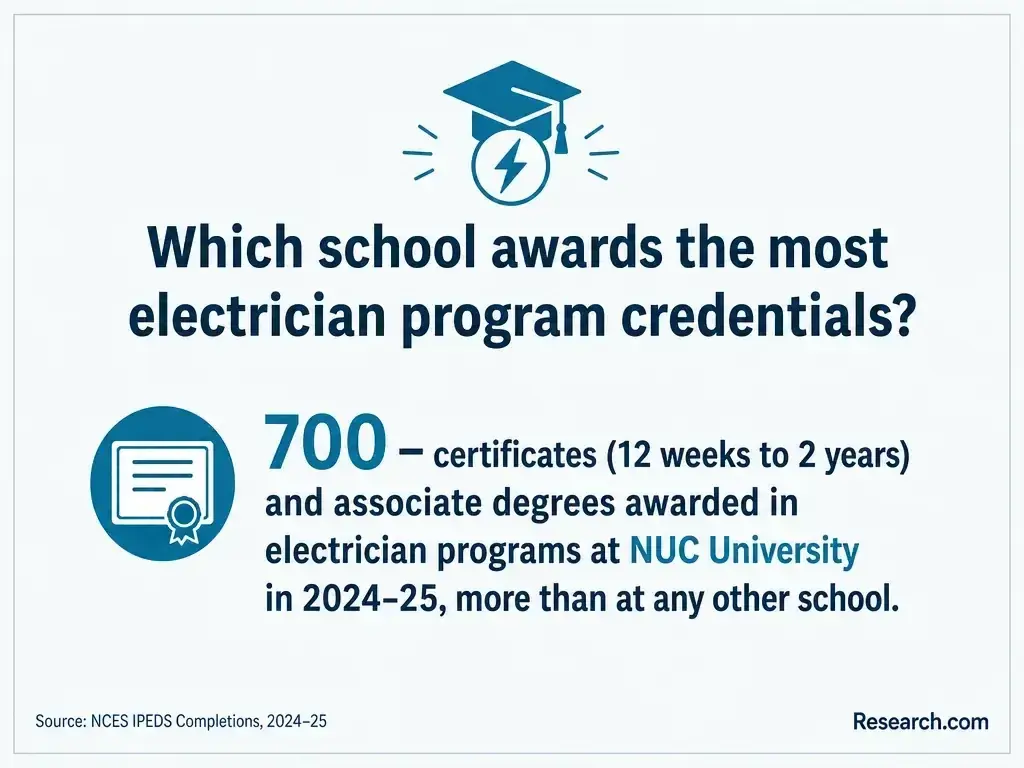
There is no defensible single Arizona-wide price for every electrician pathway: a college certificate, an associate degree, and a paid apprenticeship have different billing and wage arrangements. Public-college tuition can also depend on residency and course load. Use each provider's current program-specific estimate rather than treating an institution-wide cost-of-attendance figure as the price of its electrical training (National Center for Education Statistics, IPEDS; U.S. Department of Education, College Scorecard).
Build a job-ready budget before comparing offers. These costs matter because the lowest advertised tuition may not produce the lowest total outlay:
- School charges: tuition, mandatory fees, books, lab materials, and any repeated-course charges.
- Practical-training costs: tools, meter, work clothes, personal protective equipment, and transport to labs or jobsites.
- Career-entry costs: any applicable exam or application fees, plus earnings forgone while attending classes.
- Offsets: grants, scholarships, eligible aid, employer-paid instruction, and apprentice wages.
Federal aid eligibility depends on the institution and eligible program, not simply on a school appearing in a list of fafsa-approved schools (Federal Student Aid). Ask the financial-aid office for the specific electrical program's eligibility and check Arizona workforce-training assistance through the state workforce system. A sensible return-on-investment estimate also accounts for completion likelihood, debt, your current earnings, expected earnings after training, and how long you expect to work in the trade - not institution type alone.
Check the award named on the program page: it may be a certificate, diploma, or associate degree. A registered apprenticeship instead documents completion of a structured work-and-instruction program under its sponsor. An optional industry credential may demonstrate specific skills, but it is distinct from a college award, apprenticeship completion, and permission to operate an electrical contracting business (U.S. Department of Labor, Apprenticeship.gov; Arizona Registrar of Contractors).
If you are comparing low cost online associate degrees, confirm that the electrical program actually awards an associate degree and provides the practical instruction you need. Ask whether its courses can transfer into another electrical credential or earn apprenticeship advanced standing; neither benefit should be assumed from the credential's title.
Requirements vary by provider and route. A college may require an application and placement steps, while an apprenticeship sponsor may also assess math readiness, require eligibility to work, and use an interview or other selection process. Jobsite roles can have additional employer safety and transportation expectations. Obtain the current written requirements for the specific program or sponsor rather than assuming admission to a college means admission to an apprenticeship (U.S. Department of Labor, Apprenticeship.gov).
Before applying, ask whether a high school credential or equivalent is required, which math skills are tested, when cohorts start, and whether you must secure an employer yourself. If you already have relevant construction experience, ask how it is evaluated for placement or advanced standing. A short pre-apprenticeship can help a newcomer prepare, but confirm that its sponsor connections are real; it is not the same credential as completing a registered apprenticeship.
Core instruction commonly covers electrical theory, circuit calculations, drawings, materials, code use, testing, and safe installation or repair. In practical work, students should learn to select tools, assemble and test circuits, identify faults, and explain how to make equipment safe before working on it (U.S. Bureau of Labor Statistics, Occupational Outlook Handbook).
For an Arizona applicant, curriculum depth matters more than a long topic list. Ask to see the lab sequence and assessment method: does each student perform installations and troubleshooting, or mainly watch demonstrations? Also ask which code edition the program teaches and how instructors update lessons. Because electrical standards and workplace equipment change, the ability to read current requirements and diagnose unfamiliar systems is more useful than memorizing one installation exercise.
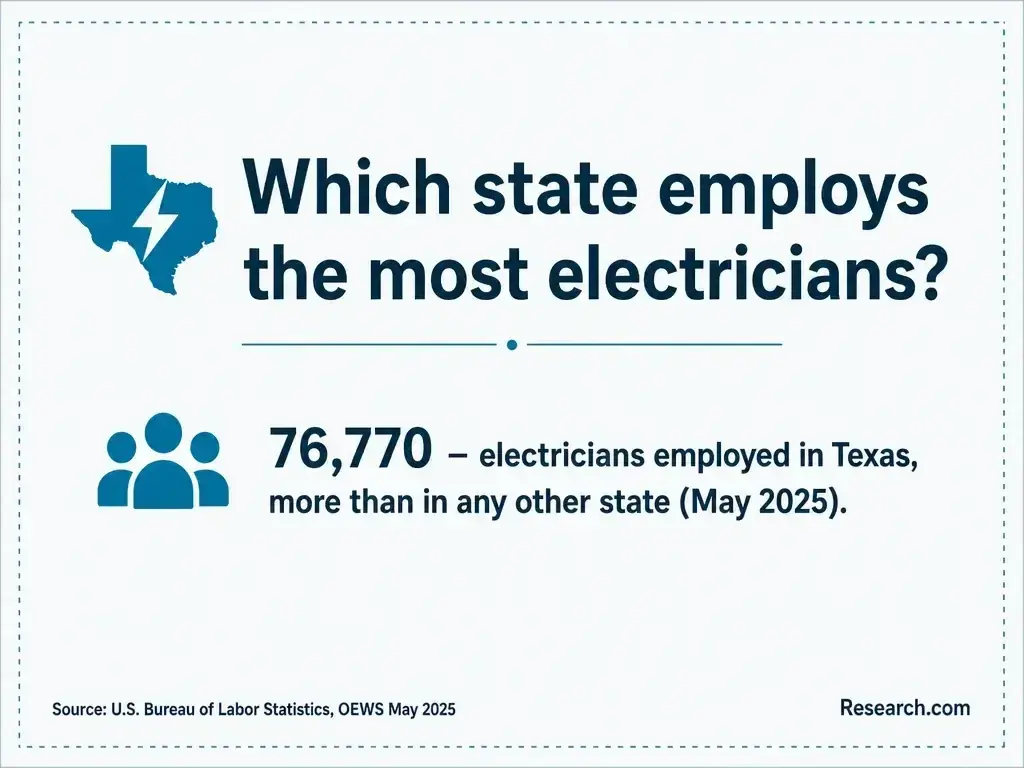
Arizona does not issue a statewide journeyman electrician license. That does not mean anyone may offer electrical contracting services independently. The Arizona Registrar of Contractors licenses electrical contracting businesses under applicable classifications and sets requirements for their qualifying parties. A school certificate, optional industry certification, or completed apprenticeship is not itself a contractor license (Arizona Registrar of Contractors).
Distinguish the stages before selecting training: supervised entry-level employment depends on employer expectations; apprenticeship registration identifies a structured training arrangement; and operating or qualifying an electrical contracting business involves the Registrar's separate requirements, which can include experience, examinations, and other application conditions. If self-employment is your goal, check the current classification and qualifying-party rules directly with the Arizona Registrar of Contractors. Ask prospective schools how they document practical experience; graduation alone should not be treated as proof of contractor-license eligibility.
Start with your intended first job. A college certificate may suit someone who needs structured preparation before applying to employers; a paid apprenticeship may better suit someone ready for a longer work-based commitment. An associate degree makes more sense if its additional coursework supports a goal you value enough to justify the extra time and expense. The cheapest option is not necessarily the best investment if it lacks practical access or a workable route into employment.
Use the following checks when speaking with admissions staff and apprenticeship coordinators. They test the parts of an offer that a price ranking cannot establish:
- Ask for the exact credential, full schedule, total required lab hours, and a written breakdown of fees, tools, and other required purchases.
- Find out who supervises practical work, where it occurs, and whether the program arranges employer introductions or leaves the job search entirely to you.
- Verify institutional accreditation separately from any industry recognition, apprenticeship registration, or state authorization that the provider claims; ask what each claim actually covers.
- Request evidence of completion and placement outcomes for the electrical program, including the cohort and reporting period, rather than relying on school-wide claims.
- Check any promised apprenticeship credit with the receiving sponsor and any contractor-licensing claim with the Arizona Registrar of Contractors.
Be wary of guarantees of licensure, vague claims that a wholly online course makes you job-ready, or a quoted price that excludes tools and travel. Compare your realistic chance of finishing and securing relevant work alongside cost; rankings are a starting point, not a substitute for those checks.
Common progression begins with supervised electrical work, followed by broader installation or troubleshooting responsibility as experience grows. Some workers move toward maintenance, industrial systems, crew supervision, or eventually contracting. Each step depends on actual work experience and employer needs; running a contracting business requires meeting the Arizona Registrar of Contractors' separate licensing rules (U.S. Bureau of Labor Statistics, Occupational Outlook Handbook; Arizona Registrar of Contractors).
Readers considering what are the best college majors for the future should assess electrician training on its own terms: it is a work-based route whose value depends heavily on supervised experience, local opportunities, and the cost of reaching independent competence. If your goal is rapid entry into paid work, ask about apprentice openings before committing to a longer school-first program. If you want a particular specialty, check whether local employers offer that work before paying for specialized classes.
National employment of electricians is projected to grow 9.2% from 2025 to 2035 (U.S. Bureau of Labor Statistics, Employment Projections). This signals broad demand, not a forecast for a particular Arizona city or a guarantee that a new trainee will be hired. For a local decision, consult Arizona's official occupational projections and compare current postings and apprenticeship openings within the area you can reasonably reach.
Pay particular attention to the type of demand: construction openings, maintenance jobs, and specialized work may ask for different experience. A program is more valuable when its labs and employer relationships match the jobs you intend to pursue. If you live far from training sites or worksites, commuting costs and the availability of nearby supervised work can matter as much as statewide growth.
Most Affordable Electrical Technician Schools & Training in Arizona for 2027
Education is a significant investment, so the Research.com team designed this ranking to make local cost comparisons more transparent. Electrician programs are compared with other programs in the same occupation and location. Only programs with completions reported to the Integrated Postsecondary Education Data System (IPEDS) are eligible; a paid apprenticeship or other training provider may be a sound option even if it does not appear.
The most affordable ranking scores costs and debt: tuition, cost of attendance, median student debt, and federal loan default rate. An entropy-based method gives more weight to indicators that differ more across eligible programs. Accreditation and other quality measures are not part of this affordability score. By contrast, Research.com's separate best-programs methodology considers outcomes, earnings, costs, debt, accreditation or relevant industry recognition, and student support. Readers can review further details on the Research.com methodology page.
The team draws on the following sources to check institutional, program, cost, and recognition information. Some sources cover the broader trade-school ranking framework rather than electrician-specific approval; their inclusion should not be read as an endorsement of an electrical program.
- IPEDS database - reported program completions and institutional information.
- National Center for Education Statistics - federal education data and definitions.
- College Scorecard database - available institutional cost, debt, and outcome measures.
- Peterson's database - supplementary institution and program information.
- Commission on Accreditation of Allied Health Education Programs (CAAHEP) - accreditation information relevant to other occupational fields in the broader framework.
- Accrediting Bureau of Health Education Schools (ABHES) - health-education accreditation information in that broader framework.
- Commission on Dental Accreditation (CODA) - dental-program accreditation information in that broader framework.
- Dental Assisting National Board (DANB) - dental-assisting credential information in that broader framework.
- National Center for Construction Education and Research (NCCER) - construction-training and credential information potentially relevant to electrical training.
- Apprenticeship.gov Partner Finder - information for identifying apprenticeship alternatives.
Use the ranking to narrow a shortlist, not to declare the first-listed program your best fit. Its reported costs may not capture your tools, commute, available aid, or the wages you could earn in an apprenticeship.
# 2 position
Pima Community College - Electrical and Power Transmission Installation/Installer, General.
certificate or diploma
# 3 position
Pima Community College - Electrician.
certificate or diploma # 4 position
Rio Salado College - Electrician.
certificate or diploma# 6 position
Mohave Community College - Electrician.
associate# 7 position
# 8 position
Mohave Community College - Electrician.
certificate or diploma# 9 position
Mesa Community College - Electrician.
certificate or diploma# 10 position
GateWay Community College - Electrician.
associate# 11 position
GateWay Community College - Electrician.
certificate or diploma# 12 position
South Mountain Community College - Electrician.
certificate or diploma# 13 position
Yavapai College - Electrician.
certificate or diploma
# 14 position
UEI College-Phoenix - Electrician.
certificate or diploma
# 15 position
Refrigeration School Inc - Electrician.
certificate or diploma
# 16 position
UEI College-Mesa - Electrician.
certificate or diploma
# 17 position
Carrington College-Phoenix North - Electrician.
certificate or diploma
Frequently asked questions about electrician programs in Arizona
Is trade school required to become an electrician in Arizona?
No single trade-school credential is required for every entry route. Registered apprenticeships and supervised employer training are alternatives. Compare each route's instruction, jobsite experience, and entry requirements (U.S. Department of Labor, Apprenticeship.gov).
Will a short electrician certificate make me a journeyman?
No. Arizona does not issue a statewide journeyman electrician license, and a short certificate is not equivalent to years of supervised work. Ask employers or apprenticeship sponsors how they recognize the training (Arizona Registrar of Contractors).
Can I complete electrician training entirely online?
You can study some theory online, but installation, testing, and safe tool use require supervised practical training. Confirm the location and attendance requirements for labs or jobsites before enrolling.
Is an apprenticeship cheaper than trade school?
It can reduce upfront tuition and provide wages while you train, but costs, availability, travel, and time commitment vary. Compare your full school budget with the sponsor's pay and training terms.
Does an electrician school certificate let me start a contracting business?
No. Electrical contracting is subject to separate Arizona Registrar of Contractors licensing requirements. Check the current classification and qualifying-party rules before planning for self-employment.
- U.S. Bureau of Labor Statistics - Electricians
Used to verify salary, employment outlook, and typical education requirements.
https://www.bls.gov/ooh/construction-and-extraction/electricians.htm - NCCER - Accredited Training
Used to verify programmatic accreditation or industry recognition of programs.
https://www.nccer.org/ - O*NET OnLine - Electricians
Used to verify common responsibilities, skills, work settings, and education expectations.
https://www.onetonline.org/link/summary/47-2111.00 - Central Arizona College - official website
Official school website (programs, tuition, admissions).
https://www.centralaz.edu/ - Pima Community College - official website
Official school website (programs, tuition, admissions).
https://www.pima.edu/ - Rio Salado College - official website
Official school website (programs, tuition, admissions).
https://www.riosalado.edu/ - Mohave Community College - official website
Official school website (programs, tuition, admissions).
https://www.mohave.edu/ - Mesa Community College - official website
Official school website (programs, tuition, admissions).
https://www.mesacc.edu/