# 1 position

Audited and Verified:
Our Editorial and Data Verification Process
Research.com uses government datasets, official education statistics and primary institutional information to support its career and degree guides. Our review process checks factual accuracy, occupational definitions, source dates and the requirements associated with the credentials discussed.
How This Article Was Fact-Checked
Our editorial team verifies salary estimates, employment projections, education requirements and program information against original data providers and official organizations. Salary figures are checked against the relevant occupational definitions and reporting periods. Information about licensure, accreditation and required in-person training is reviewed separately.
Fact-checked and verified on:

Co-Founder and Chief Data Scientist

Reviewed by Karolina Broda
Fact-Checker and Data Verification
Choosing electrician training in California means checking more than tuition: a program must fit the state's rules for supervised work, classroom instruction, and certification. The Research.com team of data scientists created the Best Electrician Trade Schools in California for 2027 ranking to help students identify programs worth considering. Electrician employment is projected to grow 9.2% nationally from 2025 to 2035, according to the U.S. Bureau of Labor Statistics. This guide helps you compare training routes, costs, credentials, and the steps from enrollment to paid work.
Expect classroom instruction in electrical theory and code alongside shop practice with circuits, conduit, wiring methods, testing equipment, and safe work procedures. The decisive difference between programs is what happens next: a classroom credential can prepare you to seek supervised work, while a registered apprenticeship combines instruction with paid, documented on-the-job training. Neither a certificate nor an associate degree is the same as California electrician certification.
The main routes serve different circumstances. A public college or private career-school program can suit someone who needs structured preparation before applying for trainee work; compare actual lab time and employer connections. A registered union or nonunion apprenticeship can suit someone ready to compete for a paid training position and commit to its longer work-and-class schedule. Employer-sponsored trainee work can suit someone who already has a qualifying job offer, provided the school and supervision arrangements meet state rules. California's Department of Industrial Relations (DIR) maintains the relevant trainee-school and apprenticeship information.
Do not assume a school is approved because it appears in a broad directory of best colleges offering open enrollment. Ask the electrical program which California trainee or apprenticeship pathway its instruction supports, and confirm the answer with DIR before paying a deposit.
Electrical contractors hire for residential and commercial construction, while industrial facilities, utilities, building operators, and maintenance employers offer other settings. Work may include installing power and lighting systems, troubleshooting controls, or maintaining existing equipment. The setting matters: a program emphasizing house wiring may not provide enough exposure to industrial controls for someone seeking plant maintenance work (U.S. Bureau of Labor Statistics, Occupational Outlook Handbook).
Compare training and job locations, not just the school's address. A nearby classroom is less valuable if required labs, apprenticeship assignments, or supervised worksites demand a commute you cannot sustain. Ask prospective sponsors where apprentices typically report and whether assignments change during training.
Pay depends on location, employer, experience, specialty, and whether a worker is a trainee, certified electrician, or contractor. The latest national benchmark supplied by the U.S. Bureau of Labor Statistics is a May 2025 median annual wage of $63,190 for electricians. Half of employed electricians earned more and half earned less; the figure includes experienced workers and should not be used as a promised California starting salary.
For a useful local comparison, ask employers or apprenticeship sponsors for their current trainee wage steps and journey-level rate in the area where you intend to work. Then compare likely earnings during training as well as afterward. A paid apprenticeship may offset a longer path to certification, while a short course may mean less time in school but no guaranteed job offer.
A school's advertised course length is not the time required to become a certified electrician. Certificates and pre-apprenticeship courses vary by provider; an associate degree generally takes longer because it includes additional coursework. Part-time schedules can extend either route. Request the program's calendar, total instructional hours, lab hours, and completion requirements rather than relying on a "finish fast" claim.
California's general electrician certification pathway requires 8,000 hours of qualifying work experience and satisfaction of the applicable classroom-instruction or registered-apprenticeship requirements, followed by the certification examination (California DIR). That work-based requirement is why even a useful short program is usually a starting point, not a shortcut to independent practice. Ask whether prior documented electrical work could count toward experience or advanced standing; get the decision from the appropriate authority or sponsor in writing.
Online instruction can cover concepts such as electrical theory, code study, calculations, and exam review. Wiring, conduit installation, instrument use, fault-finding, and supervised jobsite work require physical practice. A hybrid program can work well if its lab schedule is accessible and its instruction fits your California trainee or apprenticeship route; an entirely online course should not be assumed to satisfy state requirements.
The distinction is regulatory as well as practical. A school's general institutional accreditation - even if it appears among accredited online universities free to apply - does not establish DIR approval for electrical-trainee instruction. Before enrolling remotely, ask where hands-on sessions occur, who supervises them, how attendance is documented, and whether DIR recognizes the specific program.
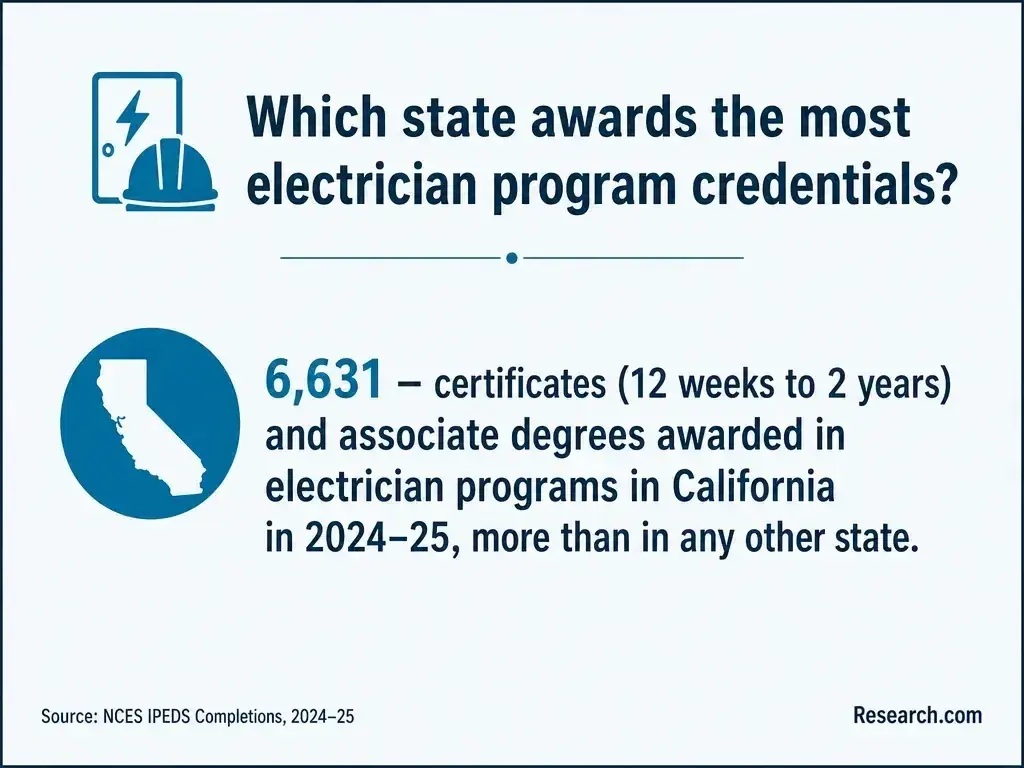
There is no single reliable statewide average that covers public colleges, private career schools, and paid apprenticeships on the same basis. Public-college charges may depend on residency and units; private providers set their own tuition; apprenticeships may pay wages while requiring purchases or fees. Compare the total cost to become job-ready, not an advertised tuition figure.
Use each provider's written estimate to compare these cost categories. They can change which route is affordable even when two programs teach similar material.
| Cost or offset | What to verify |
| Instruction | Tuition, mandatory fees, residency rules, and any charges for repeated courses |
| Work readiness | Tools, testing equipment, PPE, books, materials, and transportation to labs or jobsites |
| Career entry | Applicable trainee, examination, and certification fees |
| Offsets | Apprentice wages, employer-paid training, grants, and aid for which the specific program qualifies |
California residents should check eligibility for the California College Promise Grant at participating community colleges; federal aid depends on the school, program, and student meeting federal requirements (California Community Colleges Chancellor's Office; Federal Student Aid). Include foregone earnings, likely debt, completion probability, and the time until paid work in your comparison. Unlike accelerated bachelor degree programs, a short electrical course should be judged primarily by whether it leads to approved instruction and a realistic supervised-work opportunity - not speed alone.
The answer depends on the route: a school may award a certificate, diploma, or associate degree; a pre-apprenticeship may issue a completion credential; and a registered apprenticeship documents completion of its work-based training. These credentials describe training completed. California electrician certification is a separate state process involving eligibility and an examination (California DIR).
Ask a provider to name the exact credential on your transcript or completion record and explain whether its hours meet an approved trainee-school curriculum or form part of a registered apprenticeship. Institutional accreditation concerns the school; state authorization concerns permission to operate; DIR approval and apprenticeship registration concern specific training routes. None, by itself, substitutes for the electrician certification requirements.
School admission and permission to work as an electrical trainee are different steps. Providers set their own entry rules, which may include an application, basic math assessment, or evidence of prior schooling. Apprenticeship sponsors may use separate applications, assessments, interviews, and work-eligibility checks; confirm current requirements with the specific sponsor rather than assuming admission is automatic.
To work under California's electrical-trainee route, you generally must enroll in a DIR-approved school, register as a trainee, and work under the required supervision; registration has renewal and continuing-training obligations (California DIR). Ask the school how it verifies enrollment for registration and whether it helps students find qualifying supervised work. Lists of most affordable online doctoral programs address a different educational goal and cannot answer either question.
Core instruction typically connects electrical calculations and circuit theory to the National Electrical Code, California-applicable requirements, blueprint reading, wiring methods, motors or controls, testing, and jobsite safety. Shop work should let students build, inspect, troubleshoot, and correct installations - not merely watch demonstrations. Electricians also need to communicate with crews and customers and document work accurately (U.S. Bureau of Labor Statistics, Occupational Outlook Handbook).
For each program on your shortlist, request a course outline and a breakdown of supervised lab hours. If your goal is industrial maintenance, look for substantial controls and troubleshooting practice; if it is residential contracting, prioritize wiring methods, code application, and a pathway into relevant supervised work. Similarly named certificates need not provide equivalent hands-on preparation.
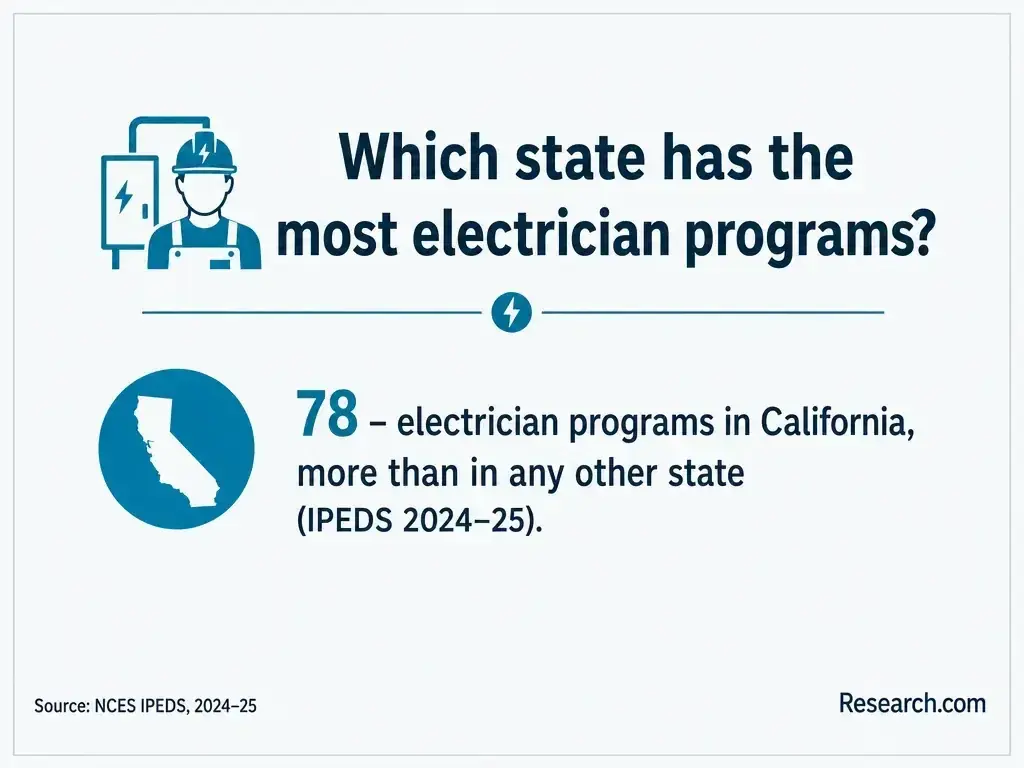
California distinguishes an electrical trainee, a registered apprentice, and a certified electrician. DIR administers electrician certification and identifies who may perform electrical work for C-10 electrical contractors under the trainee, apprentice, and certification rules. A trainee's supervised work is not independent practice, and graduation alone does not confer certification. Check DIR's current rules for the work category you intend to enter, because qualifying experience and instruction differ by certification category.
Running an electrical contracting business is another question: California's Contractors State License Board regulates the C-10 electrical contractor license. Employee electrician certification and a business contractor license serve different purposes; neither should be mistaken for a school-issued certificate (California DIR; Contractors State License Board).
Start with your intended job and the California route that permits you to train for it. A ranking can help identify candidates, but a lower-priced course is a poor investment if its instruction is not recognized for your route or its schedule prevents you from taking supervised work. Use these checks before signing an enrollment agreement:
A red flag is a promise that an online certificate alone makes you a licensed electrician. Another is a salary claim based on experienced workers rather than new entrants. Choose the program whose verified instruction, practical training, schedule, and total cost fit your path to qualifying work - not merely the one with the shortest advertised duration.
A common progression is trainee or apprentice, certified electrician after meeting the relevant requirements, then more specialized installation, maintenance, troubleshooting, or supervisory work. Experience can also support a move toward contracting, but operating a C-10 business has separate licensing requirements (California DIR; Contractors State License Board).
Specialization should follow the work you want to do. Controls, industrial equipment, and building systems can call for different experience from residential installations. Optional professional certifications that pay well may complement a specialty, but no optional credential replaces California's applicable electrician-certification rules. Before paying for an add-on course, ask local employers whether they recognize it and whether your intended role actually requires it.
The U.S. Bureau of Labor Statistics projects 9.2% national employment growth for electricians from 2025 to 2035. That signals demand for the occupation, not a guaranteed opening in a particular California city or an assured placement after school. Construction cycles, maintenance hiring, and apprenticeship availability can affect when and where an entrant finds supervised work.
Use the national projection as context, then test your local opportunity before enrolling: compare current trainee openings, apprenticeship recruitment schedules, and commuting distances in the market where you can work. If paid placements are scarce nearby, a program with strong instruction may still require a wider job search; factor that possibility into its cost and timing.
Investing in electrician training is an important decision, so the Research.com team designed the ranking to compare programs with other programs in the same occupation and location - not with unrelated schools nationwide. The team evaluates student outcomes; earnings and return on investment; costs and debt; and quality and recognition. Only programs with completions reported to IPEDS are eligible. That makes the ranking useful for comparing listed schools, but it does not cover every apprenticeship, employer program, or training provider.
For best-program rankings, programmatic accreditation or occupation-relevant industry recognition receives 20% of the score, institutional accreditation 10%, and student support services 10%. Completion and full-time and part-time retention; earnings one year after completion and relative to annual attendance cost; tuition, attendance cost, debt - including for students who withdrew - and federal loan default rates account for the remaining 60%. An entropy-based method gives more weight to indicators that vary more across programs. Most-affordable rankings use only cost and debt indicators, weighted by that method; accreditation and other quality indicators do not enter those scores.
The team uses the following sources to check program, institutional, outcome, and recognition data. Some cover occupations other than electrical work; their inclusion as ranking data sources does not imply that an electrician program holds a healthcare or dental credential.
Use the ranking to narrow a shortlist, then verify current prices, available places, hands-on hours, and California approval directly with each provider. More detail on the approach appears in Research.com's methodology.
# 1 position
# 2 position
# 3 position

# 4 position

# 5 position

# 6 position

# 7 position
Electrician
Delivery mode: On Campus (May Include Online Courses)
36.05
/ 100
Final score
Accreditation
Institutional accreditation from Accrediting Council for Continuing Education & Training.
UEI College-Reseda received a Research.com Trade Program Score of 36.05/100.
# 8 position
# 9 position
# 10 position
# 11 position
# 12 position

# 13 position
# 14 position
# 15 position

# 16 position
# 17 position
# 18 position

# 19 position
# 20 position
Yes. Public-college instruction, registered apprenticeships, and qualifying trainee routes may be alternatives. Verify the specific route and its instruction, supervision, and experience requirements with California DIR.
No. School completion and state electrician certification are separate. DIR determines eligibility based on the applicable training and work-experience route, and certification requires an examination.
Online coursework can support theory or code study, but practical wiring skills and qualifying supervised work require in-person participation. Confirm whether any proposed online instruction is recognized for your California route.
It may be if you can obtain a place and need paid, structured work experience. A school program may help you build foundational skills or qualify for trainee work first. Compare entry requirements, wages, lab access, total costs, and time to qualifying employment.
Confirm the program's DIR status where applicable, its exact credential and training hours, hands-on instruction, total charges, refund terms, and how students obtain supervised work. Get the answers in writing.