# 1 position
Umpqua Community College - Electrician.
associate

Audited and Verified:
Our Editorial and Data Verification Process
Research.com uses government datasets, official education statistics and primary institutional information to support its career and degree guides. Our review process checks factual accuracy, occupational definitions, source dates and the requirements associated with the credentials discussed.
How This Article Was Fact-Checked
Our editorial team verifies salary estimates, employment projections, education requirements and program information against original data providers and official organizations. Salary figures are checked against the relevant occupational definitions and reporting periods. Information about licensure, accreditation and required in-person training is reviewed separately.
Fact-checked and verified on:

Co-Founder and Chief Data Scientist

Reviewed by Karolina Broda
Fact-Checker and Data Verification
In Oregon, the cheapest electrician course is not necessarily the cheapest route to a license: classroom instruction alone cannot replace supervised electrical work. The U.S. Bureau of Labor Statistics projects 9.2% national electrician employment growth from 2025 to 2035, making the training choice timely. This guide explains costs, apprenticeships, credentials, and Oregon licensing so you can compare realistic paths. It also accompanies the Most Affordable Electrician Trade Schools in Oregon for 2027 ranking, created by the Research.com team of data scientists to help students make an informed choice about programs worth considering.
Expect a mix of electrical theory, code interpretation, safety, and supervised practice. The crucial distinction is what the program connects you to next: an introductory certificate can build skills, but Oregon licensure also depends on qualifying experience, training, and an examination under the rules for the license sought (Oregon Building Codes Division).
These pathways lead to different credentials and different amounts of paid work. Compare them before treating similarly named programs as interchangeable.
| Pathway | What you receive | Best fit and main limitation |
| Pre-apprenticeship or introductory course | Preparation for entry, sometimes a completion certificate | Useful for exploring the trade or strengthening an application; ask whether it earns recognized credit toward apprenticeship. |
| Community college or career-school certificate | A school credential plus classroom and laboratory instruction | Useful for structured skill-building; a credential alone does not establish license eligibility. |
| Registered apprenticeship | Paid, supervised work and related instruction, leading toward the applicable license examination | Strong fit for someone ready to work while training; admission, employer placement, and worksite travel can be hurdles. |
| Employer-sponsored training | Job-based instruction that may connect to a registered apprenticeship | Potentially lowers upfront cost; confirm that hours are documented and count toward the intended Oregon license. |
Oregon's Bureau of Labor and Industries oversees registered apprenticeships, while the Building Codes Division administers electrical licensing. Ask both a school and its proposed apprenticeship sponsor how classroom, lab, and work hours will be recorded. Institutional accreditation concerns the school; apprenticeship registration and occupational licensing are separate checks.
Electricians work for electrical contractors on residential and commercial construction, for industrial facilities maintaining equipment, and for employers managing building electrical systems (U.S. Bureau of Labor Statistics). Oregon's construction and maintenance opportunities can require different skills: a housing-focused placement may emphasize branch circuits and service work, while an industrial placement may emphasize motors and controls.
Location affects both access to training and the value of an offer. Compare the worksite locations attached to apprenticeships or school partnerships with your commuting range; related instruction may be offered in a different location from the jobsite. In a rural area, a program's low tuition may be outweighed by repeated travel to labs or supervised worksites. Ask where recent trainees were placed rather than assuming a nearby classroom means a nearby job.
Oregon pay varies by license, experience, employer, and location. For a consistent benchmark, the U.S. Bureau of Labor Statistics reports a May 2025 national median annual wage of $63,190 for electricians. That is the midpoint for employed electricians, not a starting wage or a prediction of what an Oregon graduate will earn.
Before accepting a training offer, compare its actual apprentice wage progression, benefits, travel costs, and expected hours. For a local benchmark, check the Oregon Employment Department's occupational wage information for the area where you expect to work; do not substitute the national median for a local offer. A paid apprenticeship may improve cash flow during training even when an alternative school route has lower posted tuition.
A short introductory course can end much sooner than the training needed to work independently. Oregon's standard general journeyman apprenticeship pathway commonly involves 8,000 hours of supervised work and 576 hours of related instruction (Oregon Building Codes Division; Oregon Bureau of Labor and Industries). Schedules and eligibility can differ for limited-license pathways, so check the license category before comparing program lengths.
For working adults, a flexible class schedule can reduce time away from a job, but it does not compress required supervised experience. Unlike fastest adult degree programs online, a faster electrician classroom schedule should not be interpreted as a faster route through required work hours. Ask when students can start accumulating qualifying hours, whether evening instruction is available, and what happens if an apprenticeship placement is delayed.
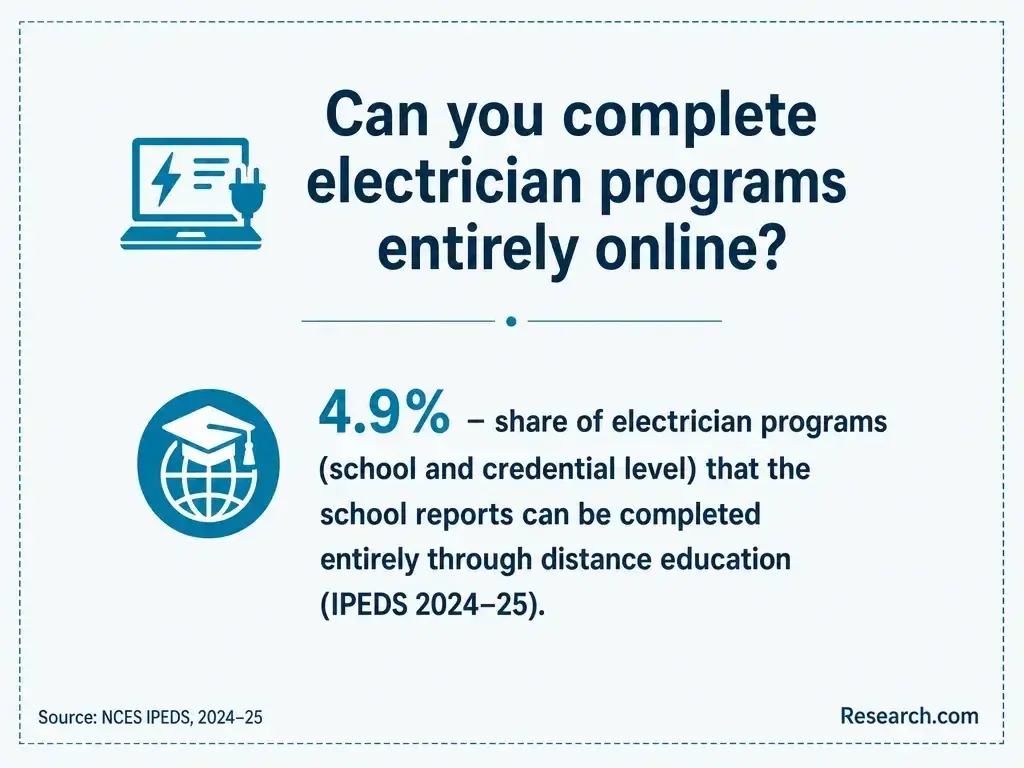
Online instruction can suit code reading, calculations, and some electrical theory. On-campus labs and supervised jobsites are where trainees practice tool use, wiring methods, testing, troubleshooting, and safety procedures. A hybrid option may reduce classroom travel, but it still needs a credible plan for in-person competencies and qualifying work experience.
Ask a hybrid provider to identify which activities occur remotely, where labs take place, who supervises fieldwork, and whether that work is documented for the intended Oregon license. A fully online certificate is not, by itself, evidence of practical competence or license eligibility (Oregon Building Codes Division). If travel to required labs is difficult, compare the full schedule - not just the online-course description - before paying a deposit.
There is no single useful Oregon-wide price for electrician training: a college course, a certificate, and a paid apprenticeship have different billing structures and cover different parts of the path to licensure. Posted tuition also changes by provider, enrollment status, and year. Request a current, itemized cost for your complete planned pathway rather than treating a course price as the total cost to become job-ready.
Include mandatory fees, books and code materials, tools, safety gear, lab supplies, examination and license-application charges, transportation to classes and worksites, and earnings forgone while studying. Then subtract grants, scholarships, and any wages or employer-paid instruction. Ask whether a college credential is eligible for federal aid; eligibility belongs to the institution and program, not to every course it offers (Federal Student Aid). For a broader comparison of aid-eligible remote study, see inexpensive online schools that accept financial aid, but verify electrician lab and work requirements separately.
Oregon residents can also ask a provider about state grant eligibility and contact WorkSource Oregon about possible workforce-training assistance; neither source of funding should be assumed available for every program or applicant. A sound return-on-investment comparison considers net cost, debt, time and wages while training, the likelihood of finishing and securing qualifying work, and earnings over the years afterward - not institution type or tuition alone.
It depends on the route. A school may award a completion certificate or an occupational certificate; a registered apprenticeship documents completion of structured work and related instruction. An Oregon electrical license is a separate state credential, not an automatic award at graduation (Oregon Building Codes Division; Oregon Bureau of Labor and Industries).
If you are comparing online certificates that pay well, do not assume an electrician certificate functions like a license. Ask exactly what appears on the school transcript, whether instruction or prior learning can receive credit from an apprenticeship sponsor, and what evidence of supervised hours you will need. Get any proposed advanced standing confirmed by the receiving sponsor before enrolling; a school's promise of transferable training is not the same as sponsor acceptance.
School and apprenticeship entry are separate processes. A course may use open admission or a placement assessment, while an apprenticeship sponsor may screen for math readiness, ability to perform job duties safely, an interview, and access to worksites. Requirements vary by provider; ask for the current application and selection criteria rather than assuming enrollment in a class reserves an apprenticeship position.
Online colleges open enrollment can be useful to understand as an admissions model, but open admission to coursework does not remove Oregon's electrical training or licensing requirements. Before applying, ask whether you need a sponsoring employer, what documentation is required to begin recorded work, when the next intake occurs, and whether the provider helps applicants find placements (Oregon Bureau of Labor and Industries; Oregon Building Codes Division).
Core instruction typically covers electrical calculations, circuit theory, plans and diagrams, wiring methods, grounding and bonding, code use, and safe testing and troubleshooting. Practical instruction should require students to select materials, assemble circuits, use test instruments, identify faults, and work safely around electrical hazards. Registered apprentices then apply these skills under supervision on real jobsites (U.S. Bureau of Labor Statistics; Oregon Bureau of Labor and Industries).
Look beyond a course title when comparing curricula. Ask to see the lab schedule and equipment list, how instructors assess hands-on work, and whether instruction addresses the code requirements relevant to Oregon work. If your goal is industrial maintenance rather than residential installation, seek meaningful motor-control and troubleshooting practice; a primarily residential lab may not match that goal.
Oregon regulates electrical work through license categories administered by the Building Codes Division. The requirements depend on the scope of work; a general journeyman license and a limited residential license are not interchangeable. Training, qualifying supervised experience, and an examination are relevant to journeyman eligibility, and a school certificate alone does not authorize independent electrical work (Oregon Building Codes Division).
Before paying for training, identify the license whose permitted work matches your goal and ask the Building Codes Division whether the proposed instruction and documented experience satisfy that pathway. Verify how you may legally work while training and how your hours must be recorded. Institutional accreditation, industry training certificates, registered-apprenticeship status, examination eligibility, and an issued Oregon license answer different questions; none should be used as a substitute for another.
Start with your intended work and license, then compare programs on the complete route to that goal. The affordability ranking can narrow a search, but its score does not measure hands-on training, placement access, or license eligibility. Unlike a comparison of most lucrative masters degrees, the decisive question here is whether training leads to documented electrical work and the appropriate state examination.
Use the same questions with every school and apprenticeship sponsor so a low price does not conceal a missing step.
A school-based route may suit someone who needs structured preparation before applying to apprenticeships. Direct entry to a registered apprenticeship may make more financial sense for someone ready for competitive selection and paid work. Avoid programs that imply a certificate alone grants a license, cannot explain where supervised hours come from, or will not provide a full cost breakdown.
Training can lead from supervised apprentice work toward a license appropriate to residential, general, or another regulated scope of electrical work. With experience, electricians may move into specialized installation, maintenance, troubleshooting, estimating, or supervisory responsibilities. Each move depends on employer needs, demonstrated skills, and any additional license requirements; completing an introductory course does not skip entry-level work (Oregon Building Codes Division; U.S. Bureau of Labor Statistics).
Choose early training with your likely work in mind, but do not overpay for a narrow specialization before securing the foundational hours you need. If you later want to operate an electrical contracting business, investigate Oregon's separate contractor requirements rather than assuming an individual electrician credential covers business operation (Oregon Construction Contractors Board; Oregon Building Codes Division).
The U.S. Bureau of Labor Statistics projects 9.2% growth for electricians nationally from 2025 to 2035. That outlook suggests continued demand for the occupation, but it is not an Oregon forecast or a promise of placement after training. Local construction schedules, maintenance hiring, and the availability of apprenticeship sponsors will matter more to an individual applicant.
Use Oregon Employment Department projections alongside current apprenticeship openings in the places you can realistically reach. Ask sponsors about intake timing and employer demand before choosing a school schedule. A program that helps you secure qualifying supervised work may be more valuable than one that finishes classroom instruction sooner but leaves you to find a placement alone.
Investing in training is an important decision, especially when a low advertised tuition price may leave out the experience needed for licensure. Research.com developed its ranking to help readers compare affordable options against other electrician programs in Oregon, using reported data and a consistent scoring process rather than promotional claims.
The most affordable ranking evaluates tuition, cost of attendance, median student debt, and federal loan default rate. An entropy-based method assigns more weight to measures that differ more across included programs. Unlike Research.com's separate best-program rankings, accreditation, student services, earnings, and completion are not part of this affordability score. Inclusion requires program completions reported to IPEDS; an apprenticeship or other provider missing from the ranking may still be a legitimate - and less expensive - option.
Research.com used the following data sources in developing its trade-program rankings. Some support broader quality or occupation checks rather than Oregon electrician affordability scores; allied-health and dental sources should not be mistaken for electrician-program approval.
Use the ranking to shortlist programs, then verify current prices, practical training, and the route to Oregon licensure directly with each provider and the relevant state agencies. For more detail on the ranking process, see Research.com's methodology.
# 1 position
# 2 position
# 4 position

# 5 position
# 6 position
# 8 position

# 10 position
# 12 position

# 13 position
# 14 position

# 15 position
# 16 position
# 17 position

# 18 position
# 19 position
A paid registered apprenticeship may reduce upfront costs because trainees earn wages while completing related instruction. Compare its fees, tools, travel, selection process, and wage progression with a school program's full cost; the cheapest option depends on admission and your circumstances.
No. A certificate alone does not confer an Oregon electrical license. Check the supervised-experience, instruction, and examination rules for the license you want with the Oregon Building Codes Division.
Some theory can be studied online, but practical skills and qualifying supervised electrical work require in-person participation. Confirm a provider's lab and worksite arrangements before enrolling.
Ask the receiving registered-apprenticeship sponsor whether it accepts the specific course for related instruction or advanced standing. Obtain its decision before paying; a school's course-completion certificate does not establish that credit.
Apply directly if you are ready for a sponsor's selection process and want paid, supervised training. Consider school first if you need foundational skills or application preparation - but verify its costs and apprenticeship connections before enrolling.