# 1 position
Florida State College at Jacksonville - Electrician.
certificate or diploma

Audited and Verified:
Our Editorial and Data Verification Process
Research.com uses government datasets, official education statistics and primary institutional information to support its career and degree guides. Our review process checks factual accuracy, occupational definitions, source dates and the requirements associated with the credentials discussed.
How This Article Was Fact-Checked
Our editorial team verifies salary estimates, employment projections, education requirements and program information against original data providers and official organizations. Salary figures are checked against the relevant occupational definitions and reporting periods. Information about licensure, accreditation and required in-person training is reviewed separately.
Fact-checked and verified on:

Co-Founder and Chief Data Scientist

Reviewed by Karolina Broda
Fact-Checker and Data Verification
Choosing an affordable electrician program means looking beyond tuition: a low-cost course may still leave you needing paid field experience, tools, and additional training. The U.S. Bureau of Labor Statistics (BLS) projects 9.2% growth in electrician employment nationally from 2025 to 2035, making the training decision timely. This guide compares Jacksonville pathways, costs, credentials, and licensing implications. It also accompanies the Most Affordable Electrician Trade Schools in Jacksonville for 2027 ranking, created by the Research.com team of data scientists to help students make an informed choice about programs worth considering.
Expect instruction in electrical theory, blueprint reading, the National Electrical Code, safety, and installation methods, followed by supervised practice with wiring, conduit, panels, and test instruments. A program's value depends partly on whether students actually practice these tasks in a shop or at a worksite; similar-sounding credentials can involve very different amounts of hands-on training.
Jacksonville students can compare current electrician-related offerings at Florida State College at Jacksonville and Tulsa Welding School-Jacksonville with registered apprenticeships and employer-sponsored entry routes. Ask each provider what credential it awards, how many hours take place in a lab, whether it arranges work experience, and whether an employer or apprenticeship sponsor accepts its training toward entry or advanced standing. Do not assume that completing a course makes you a journeyman or licenses you to contract independently.
The pathways below solve different problems. Choose based on how quickly you need earnings, the practical training you can access, and the credential an intended employer recognizes.
| Pathway | What it typically provides | Best fit and main limitation |
| School certificate or diploma | Structured classroom and shop instruction; credential depends on the provider | Useful for building entry-level skills; confirm whether field experience must be arranged separately. |
| Registered apprenticeship | Paid, supervised work plus related technical instruction and an apprenticeship completion credential | Useful for earning while training; entry depends on sponsor selection and available positions. |
| Employer-sponsored entry | Work-based learning under an employer's supervision | Can reduce upfront school costs; verify the training plan and whether experience is documented for future advancement. |
| Associate-degree pathway, if offered | Occupational training plus additional academic coursework | May suit broader technical goals; compare its added time and cost with the electrical skills and work experience you actually need. |
Electrical contractors are a principal route into residential, commercial, and industrial installation work. Other possible settings include building maintenance, manufacturing facilities, utilities, and contractors serving the port, logistics facilities, hospitals, and military-related construction. The setting matters: commercial conduit work, industrial motor controls, and residential service calls call for different practical experience. BLS describes electricians as working across construction and maintenance settings; a school credential alone does not qualify someone for every assignment.
If you want industrial maintenance rather than construction wiring, ask whether the curriculum includes motors, controls, and troubleshooting. If your goal is a utility position, check the actual job posting before enrolling: utility electrical work and power-line work are not interchangeable occupations, and employers may require distinct training.
The latest national BLS median annual wage for electricians was $63,190 in May 2025. That is the midpoint for employed electricians across experience levels and locations - not a Jacksonville starting wage or a predicted salary for a new graduate. Apprentices are generally paid while they train, but their rates depend on the sponsor and stage of training (BLS).
For a local pay decision, compare current Jacksonville-area job postings and apprenticeship wage schedules for the work you want. Separate apprentice, experienced electrician, and supervisory or contractor roles; combining them can make an entry-level opportunity look more lucrative than it is. Compare offered pay with commuting costs and the hours you can realistically work while completing instruction.
School-based training length varies by credential, schedule, and provider; request the current catalog's total clock hours, shop hours, and expected completion date rather than relying on a program label. Full-time study may get you into an entry-level job sooner, while part-time study may allow you to keep earning. Neither schedule removes the need to develop supervised field skills.
A registered electrician apprenticeship typically lasts four or five years and combines paid on-the-job learning with technical instruction (BLS). U.S. Department of Labor apprenticeship guidance commonly uses 2,000 hours of on-the-job learning and 144 hours of related instruction per year as benchmarks; confirm the actual schedule with the Florida-registered sponsor. If you first attend trade school, ask whether its coursework earns documented apprenticeship credit. It may improve your preparation without shortening the apprenticeship.
Electrical theory, calculations, code reading, and some safety coursework can be taught online. Terminating conductors, bending conduit, testing circuits, and diagnosing faults require supervised practice with equipment; apprenticeship fieldwork requires an actual worksite. A wholly online course should therefore be evaluated as knowledge training, not assumed equivalent to a shop-based program or registered apprenticeship.
Listings of the most popular online trade colleges can help you discover formats, but verify where an electrical program's practical work happens. A hybrid option may be convenient if you work shifts or commute across Jacksonville. Before paying, ask who supervises labs, whether equipment is included, and whether the schedule permits any required worksite training.
There is no single reliable Jacksonville average that covers school certificates, private career training, employer-sponsored routes, and paid apprenticeships on a comparable basis. Published tuition is a useful starting figure, not the total investment. Ask Florida State College at Jacksonville and Tulsa Welding School-Jacksonville for current, program-specific written estimates, including any resident-rate eligibility and charges that are not included in advertised tuition.
Build a like-for-like estimate of tuition, mandatory fees, books or software, tools, consumable materials, protective equipment, transportation, and any applicable examination or application fees. Add earnings you would forgo by reducing work hours. Then subtract grants, scholarships, eligible aid, or wages earned during training. Federal Student Aid notes that eligibility depends on both the student and the program; do not assume every short course qualifies for federal aid. Registered apprenticeships are paid employment, though sponsors may still specify expenses for tools or travel (U.S. Department of Labor).
For return on investment, compare that net cost with your realistic entry wage and advancement path - not with the national median for all electricians. Completion probability, debt payments, time in training, your current earnings, and how long you expect to work in the trade can change which option is more affordable. Lists of most profitable college majors cannot answer that electrician-specific payback question.
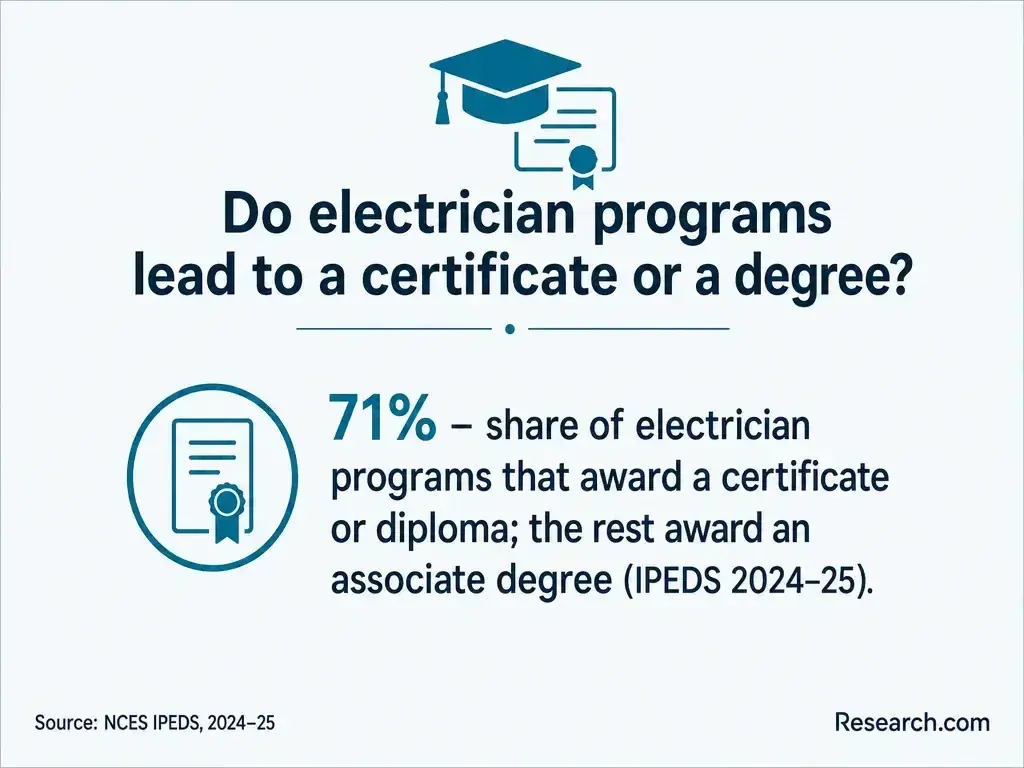
The credential depends on the pathway. A school may award a certificate, diploma, or, where offered, an associate degree. A registered apprenticeship culminates in a completion credential after the sponsor's required instruction and supervised work are satisfied (U.S. Department of Labor). An employer may offer documented in-house training without awarding a school credential.
Keep these distinctions clear: institutional accreditation concerns the institution; state school authorization concerns permission to operate; apprenticeship registration concerns a particular work-based training program; and occupational licensure concerns legal authority to perform regulated work or contract. An optional industry training credential, such as one aligned with NCCER, is not a Florida electrical contractor license. Ask a provider for the exact credential name and a written explanation of what, if anything, employers or apprenticeship sponsors recognize from it.
School requirements vary, so check each current catalog for its education prerequisite, age rule, application steps, and any placement or safety requirements. Apprenticeship sponsors set their own selection criteria and may assess math readiness, availability for paid work, and the ability to travel to jobsites. Admission to a school and selection by an apprenticeship sponsor are separate decisions.
A list of online colleges with open admission policies does not tell you whether an electrical training program has space, whether you meet an employer's requirements, or whether an apprenticeship is accepting applicants. Before applying, ask when instruction starts, what documentation is required, and whether a job placement or worksite assignment is part of the offer rather than an expectation you must arrange yourself.
A useful entry program links electrical calculations and code concepts to work you can demonstrate: reading a plan, selecting and installing materials, making connections, using meters safely, and identifying faults. Safety instruction should address shock and arc hazards, lockout/tagout, and the limits of a trainee's authority. BLS identifies technical instruction and supervised on-the-job learning as core parts of electrician apprenticeships.
Match the shop to your intended work. Residential installation, commercial conduit and distribution, and industrial controls are not the same skill set. Ask to see a course outline and lab schedule, then ask what students physically build or troubleshoot and how performance is assessed. New equipment and changing code editions make this more useful than judging a program solely by its credential title.
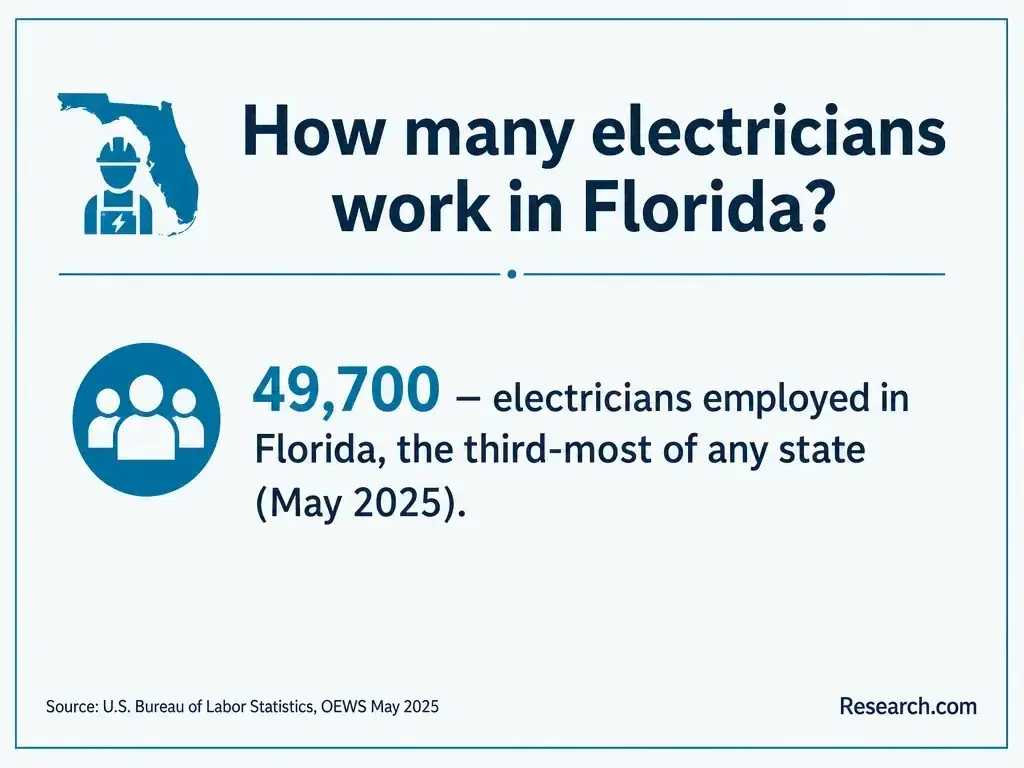
Do not confuse entry-level employment under supervision with operating as an electrical contractor. Florida's Department of Business and Professional Regulation (DBPR) and Electrical Contractors' Licensing Board regulate electrical contractor licensure. Florida distinguishes certified contractors, whose licenses can apply statewide, from registered contractors, whose authority is tied to the local jurisdiction of registration (Florida DBPR). Contractor qualification involves requirements beyond completing trade school, including documented experience and examinations; verify the current requirements with DBPR before choosing training on the assumption it will qualify you.
Journeyman recognition and work authorization may also involve local rules and employer requirements. Check with the City of Jacksonville's building or licensing authorities and your intended employer or apprenticeship sponsor rather than assuming a school certificate is a journeyman license. Institutional accreditation, a training certification, and apprenticeship registration serve different purposes; none automatically grants permission to contract independently.
Start with the job you want, then compare programs on practical preparation and net cost. A lower-priced classroom-only course may be a poor buy if you still need to find substantial supervised training; a paid apprenticeship may cost less out of pocket but take longer and require a competitive application. Neither route is automatically better for every schedule or career goal.
Use these checks before committing money. They expose the most consequential gaps between an advertised course and an employable training path.
Rankings - including lists of top schools to go to for college - cannot replace those program-level checks. Treat a claim that a short course alone will make you a licensed contractor, or that a national median wage is typical starting pay, as a reason to ask for evidence.
A practical progression is supervised helper or apprentice work, increasingly independent installation and troubleshooting, and then specialized or supervisory responsibilities as experience grows. Possible directions include residential service, commercial construction, industrial maintenance, controls, and estimating. Contracting or self-employment is a further step subject to Florida licensing requirements, not an automatic outcome of graduation (Florida DBPR).
Choose training that matches the first position you can realistically obtain, then ask what experience will support the next one. If you are comparing this hands-on route with fields discussed in top college majors for the future, focus on whether you want installation and troubleshooting work, a paid training route, and a career built through documented field experience.
BLS projects 9.2% national electrician employment growth from 2025 to 2035. That supports considering the trade, but a national projection cannot tell you how many Jacksonville apprenticeships are open when you apply. Local opportunities also depend on construction schedules, maintenance hiring, and whether employers need entry-level workers or experienced electricians.
For a current local read, compare Jacksonville-area postings with the intake dates of registered apprenticeship sponsors and ask prospective employers which skills they struggle to hire. Look at the work location as well as the job title: contractors may assign trainees to changing sites, making reliable transportation a meaningful part of the training decision.
Investing in training is an important decision, so the Research.com team built this ranking to help readers compare electrician programs with other reported programs in the same occupation and location. Only programs with completions reported to the Integrated Postsecondary Education Data System (IPEDS) are eligible. That limit matters: a registered apprenticeship or employer training program can be a strong local option without appearing in this college-oriented dataset.
The most-affordable ranking measures costs and debt, not overall program quality. Its inputs are tuition, cost of attendance, median student debt, and federal loan default rate. An entropy-based method assigns more weight to indicators that vary more across eligible programs. By contrast, Research.com's separate best-program rankings also consider outcomes, earnings, accreditation or industry recognition, and student support. Readers should use the affordability ranking to narrow a shortlist, then verify hands-on training, entry requirements, and the full cost of becoming job-ready.
Research.com uses the following sources in its trade-program ranking work. The health-profession organizations listed here apply to other occupations; their inclusion does not imply that they accredit electrician programs.
Learn more about the approach on the Research.com methodology page. Neither a low-cost score nor inclusion in IPEDS establishes that a program satisfies an employer's requirements or Florida's rules for electrical contracting.
# 1 position
# 2 position
Not necessarily. A registered apprenticeship or supervised employer route may provide training without a separate trade-school credential. Check the entry rules of the sponsor or employer you want to join.
It can reduce upfront tuition costs and provide wages while you learn, but compare tools, travel, available aid, time to completion, and any sponsor expenses. Entry also depends on available positions.
You can study some theory online, but electrical installation and troubleshooting require supervised hands-on practice. Confirm where a hybrid program provides that practice.
No. Florida contractor licensure has separate experience, examination, and application requirements administered through DBPR. Check the current rules for the license you intend to pursue.
Compare current itemized estimates from eligible school programs against paid apprenticeship options. The answer depends on your aid, required purchases, travel, lost earnings, and whether the training leads to the experience your target job requires.