# 1 position


Audited and Verified:
Our Editorial and Data Verification Process
Research.com uses government datasets, official education statistics and primary institutional information to support its career and degree guides. Our review process checks factual accuracy, occupational definitions, source dates and the requirements associated with the credentials discussed.
How This Article Was Fact-Checked
Our editorial team verifies salary estimates, employment projections, education requirements and program information against original data providers and official organizations. Salary figures are checked against the relevant occupational definitions and reporting periods. Information about licensure, accreditation and required in-person training is reviewed separately.
Fact-checked and verified on:

Co-Founder and Chief Data Scientist

Reviewed by Karolina Broda
Fact-Checker and Data Verification
Choosing electrician training near Winter Haven means comparing more than tuition: a short classroom program and a paid apprenticeship can lead to different costs, work experience, and credentials. The Research.com team of data scientists created the Most Affordable Electrician Trade Schools in Winter Haven for 2027 ranking to help students identify programs worth considering. With U.S. electrician employment projected to grow 9.2% from 2025 to 2035 (U.S. Bureau of Labor Statistics), this guide helps prospective students and career changers weigh training, licensing, cost, and local job prospects before enrolling.
Expect a mix of electrical theory and supervised practice: reading plans, calculating loads, installing raceways and wiring, using test instruments, and following electrical-code and safety procedures. Before comparing prices, ask how much time students spend doing these tasks in a shop rather than watching demonstrations. A classroom credential can help you seek an entry-level position, but it does not replace the work experience developed on a jobsite.
Near Winter Haven, compare public technical training, college-based occupational instruction, and registered apprenticeships accessible from your home and workplace. Polk State College and Ridge Technical College are local starting points for checking current offerings; confirm that the specific program and schedule you want are available before treating either as an option. A longer commute to a lab or employer worksite can change the real cost of a seemingly inexpensive program.
The routes differ most in when you begin earning wages and how practical experience is built. This comparison helps identify which questions to take to a provider or apprenticeship sponsor.
| Pathway | Typical credential and experience | Best fit |
| Technical-school certificate or diploma | School credential with supervised shop instruction; jobsite experience may still be needed | Someone seeking structured skills training before applying for electrical work |
| College-based occupational program | Program-specific credential; verify lab time and any work-based component | Someone who values a scheduled campus pathway and wants to compare aid eligibility |
| Registered apprenticeship | Paid, supervised work plus related instruction and an apprenticeship completion credential | Someone ready to work while training and able to secure a sponsor placement |
Electrical contractors are a likely starting point for residential and commercial installation or service work. Other possibilities include maintenance teams at industrial facilities and large buildings, where troubleshooting existing systems can matter as much as new construction (U.S. Bureau of Labor Statistics). In the Winter Haven area, ask whether a placement involves local service calls, travel across Polk County, or changing construction sites; travel time affects both take-home value and whether a training schedule is workable.
A school credential may help you qualify for an entry-level opening, but employers can still require jobsite readiness, a driver's license for travel, and continued supervised training. If you want industrial maintenance rather than residential installation, compare motor controls and troubleshooting practice in the curriculum instead of relying on the word "electrician" in a program title.
The U.S. median annual wage for electricians was $63,190 in May 2025 (U.S. Bureau of Labor Statistics). It describes the national occupation across experience levels, not Winter Haven pay or what a new graduate can expect. Apprentice wages, entry-level offers, overtime, benefits, and travel arrangements can make two local opportunities materially different.
For a useful local comparison, request current apprentice wage steps from sponsors and compare actual job postings for the kind of work you want. Ask whether quoted compensation includes overtime or benefits. Do not use the national median as the sole basis for deciding how much debt to take on.
Length depends on the credential and how much supervised work it includes. A school-based program may be shorter than an apprenticeship, but finishing school does not mean finishing occupational training. U.S. Department of Labor guidance describes electrician apprenticeships as commonly lasting four to five years while combining paid on-the-job training with related instruction; the registered sponsor's standards control the actual schedule (U.S. Department of Labor).
Ask each school for its published clock or contact hours, lab hours, attendance rules, and full-time and part-time completion schedules. Ask apprenticeship sponsors separately about required work hours and classroom instruction. A fast advertised completion date is valuable only if it leaves you with the practical skills and a feasible next step into supervised employment; an online associate degree in 6 months accredited is not a useful substitute for verifying those electrical training hours.
Online or hybrid instruction can be useful for electrical theory, calculations, and some code-study assignments. Wiring, testing, tool use, and safe work procedures require supervised, in-person practice; an apprenticeship also requires work at employer sites. Do not assume an entirely online certificate establishes practical competence or satisfies an employer's or licensing authority's requirements.
For a Winter Haven student, the decisive question is where and when practical training happens. Request a schedule showing required campus labs, assessment days, and worksites before choosing a flexible format. General guides to accredited online colleges non profit cannot establish whether a particular electrician program has adequate hands-on instruction.
There is no defensible single average for every Winter Haven electrician pathway: school charges vary, and a paid apprenticeship has a different cost structure from full-time campus study. Published tuition is only the starting point. Request a current, itemized program estimate and compare the amount you must pay through your first job, not just through enrollment.
The costs below belong in that comparison because they can change which option is actually affordable.
Federal aid depends on the student, institution, and eligible program, while workforce assistance and sponsor support have their own rules (Federal Student Aid; U.S. Department of Labor). Compare net cost, likely debt, completion probability, wages during training, and the time it may take for higher earnings to offset your investment. Searches for low cost phd programs offer no meaningful benchmark for these electrician-specific expenses.
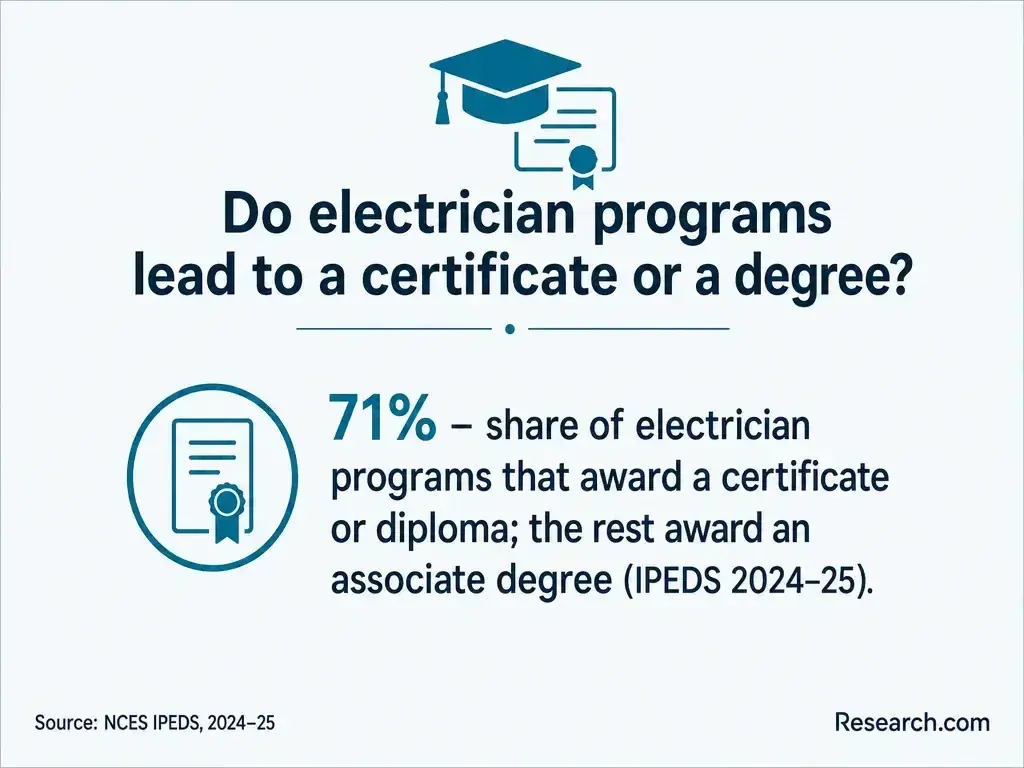
It depends on the route: a school may award an occupational certificate or diploma, while a registered apprenticeship awards its own completion credential after the sponsor's work and instruction requirements are met. An industry training credential may document particular competencies, but it is not the same thing as completing an apprenticeship or holding an occupational license (U.S. Department of Labor; NCCER).
Get the exact credential name in writing and ask employers or apprenticeship sponsors whether it earns hiring consideration, credit toward related instruction, or advanced standing. A similarly named credential from another provider may include very different lab and worksite experience. Questions about which universities offer double degrees concern a different credential decision and should not be confused with this trade-training comparison.
Requirements vary by provider. Ask about minimum age, prior schooling, math readiness, application dates, physical demands, and whether tools or safety equipment are needed on the first day. An apprenticeship sponsor may also assess applicants and require an available employer placement; admission to a school program alone does not secure one (U.S. Department of Labor).
If an accessible entry route is your priority, compare the specific electrician program's requirements rather than assuming an institution's general admissions policy applies. A guide to best open admission colleges will not tell you whether local labs have space or an apprenticeship sponsor is accepting applicants. Before paying a deposit, obtain the program's entry checklist and next confirmed start date.
Core instruction commonly covers electrical fundamentals, circuitry, blueprint reading, code use, installation methods, testing, and workplace safety (U.S. Bureau of Labor Statistics). What matters for choosing a program is whether you repeatedly perform the work: measuring, assembling, connecting, and diagnosing circuits under supervision, with feedback on errors.
Match electives and shop equipment to your intended first job. Residential installation calls for relevant wiring practice; commercial work adds different plans and systems; maintenance-focused work benefits from troubleshooting and controls. Request the course sequence and a description of practical assessments. If a provider cannot explain what you will build, test, and repair, its credential name alone is weak evidence of job readiness.
Do not treat "electrician license" as one credential. Florida regulates electrical contracting through the Department of Business and Professional Regulation; its certified and registered contractor credentials concern qualifying to contract for electrical work, not simply completing an entry-level school program (Florida Department of Business and Professional Regulation). Local journeyman or competency rules may also matter to the work and jurisdiction you choose. Confirm current requirements with the relevant authority and prospective employer before relying on a school's licensing claims.
For an entry-level job, focus first on what the employer accepts and what supervision the work requires. For an eventual contracting business, ask Florida's licensing authority about the applicable experience, examination, and other requirements. Institutional accreditation, school authorization, apprenticeship registration, industry certification, and occupational licensure are separate checks; none automatically grants the others.
Choose the route that gets you to your intended work at a manageable total cost. A campus program may suit someone who needs structured fundamentals before applying for jobs. A paid apprenticeship may suit someone ready to compete for a placement and learn primarily through supervised work. Neither wins solely because it appears first in an affordability ranking.
Use these checks to turn a shortlist into a decision; each addresses a common reason a low advertised price proves misleading.
A red flag is a promise that a short certificate alone makes you licensed, fully job-ready, or certain to earn an experienced electrician's wage. Request the claim and its supporting requirements in writing before enrolling.
A realistic progression begins with supervised installation or maintenance work, followed by broader troubleshooting responsibility as experience grows. Electricians may specialize in residential service, commercial construction, or facility maintenance; later options can include crew leadership or contracting, subject to the requirements of the work and Florida licensing rules (U.S. Bureau of Labor Statistics; Florida Department of Business and Professional Regulation).
Choose training for the first role you can credibly enter, not only the eventual title you want. If you hope to run an electrical contracting business, map the required experience and licensing steps separately. If you prefer steady maintenance work, prioritize diagnostic practice and ask whether employers value the program's shop training.
U.S. electrician employment is projected to grow 9.2% from 2025 to 2035 (U.S. Bureau of Labor Statistics, Employment Projections). That national outlook supports considering the occupation, but it does not measure openings in Winter Haven or guarantee an apprenticeship placement. Construction schedules, maintenance hiring, and willingness to travel across Polk County will shape a local job search.
Before choosing a program, compare current entry-level postings with its curriculum and ask sponsors whether they are recruiting. That check is more useful than projecting a national growth figure onto a single city - and may reveal whether you need a school-based starting point or can enter paid training directly.
Investing in electrician training is an important decision. To make the ranking credible and useful, the Research.com team compares programs with others in the same occupation and location, using documented education and cost data. Only programs with completions reported to IPEDS are eligible; a registered apprenticeship or other legitimate provider may therefore be absent.
For the most affordable ranking, scores use tuition, cost of attendance, median student debt, and federal loan default rates. Weights are assigned through an entropy-based method; accreditation and other quality measures do not contribute to this affordability score. Research.com's separate best programs methodology also considers student outcomes, earnings, support, and recognition, but readers should not mistake those criteria for this ranking's score. The sources consulted in creating the ranking are listed below. Some cover healthcare or dental programs rather than electrician training and should not be read as evidence of electrical-program approval.
The ranking can narrow a cost comparison, not establish that a program supplies enough supervised experience or meets a particular employer's requirements. See Research.com's methodology for more on how the ranking was created, then confirm current program details directly with each provider.
# 1 position
# 2 position
Not necessarily. A registered apprenticeship combines paid work and instruction and may be a direct route. A school program can provide structured preparation, but ask how it connects to supervised employment.
It can reduce lost earnings because apprentices are paid, but compare tools, travel, required instruction costs, and the availability of a placement. The lowest-cost option depends on your circumstances and sponsor terms.
Online coursework can cover some theory. Wiring, testing, safety practice, and apprenticeship work require in-person participation; verify where those activities occur before enrolling.
No certificate alone establishes that right. Florida regulates electrical contracting, and applicable experience, examinations, and local rules depend on the work you intend to do (Florida Department of Business and Professional Regulation).
Request the total cost, credential name, lab and clock hours, completion schedule, aid eligibility, and a written explanation of how the training connects to entry-level jobs or apprenticeship credit.