# 1 position
Ohio Business College-Dayton-Driving Academy - Electrician.
certificate or diploma

Audited and Verified:
Our Editorial and Data Verification Process
Research.com uses government datasets, official education statistics and primary institutional information to support its career and degree guides. Our review process checks factual accuracy, occupational definitions, source dates and the requirements associated with the credentials discussed.
How This Article Was Fact-Checked
Our editorial team verifies salary estimates, employment projections, education requirements and program information against original data providers and official organizations. Salary figures are checked against the relevant occupational definitions and reporting periods. Information about licensure, accreditation and required in-person training is reviewed separately.
Fact-checked and verified on:

Co-Founder and Chief Data Scientist

Reviewed by Karolina Broda
Fact-Checker and Data Verification
Choosing an electrician program means deciding how to get safe, supervised experience - not just where to take classes. The U.S. Bureau of Labor Statistics projects 9.2% growth in electrician employment nationally from 2025 to 2035, making the training pathway worth examining carefully. This guide is for Ohio residents comparing trade schools, apprenticeships, costs, credentials, and licensing rules. It accompanies the Best Electrician Trade Schools in Ohio for 2027 ranking, created by the Research.com team of data scientists to help students make an informed choice about which electrician training programs are worth considering.
Expect instruction in electrical theory, code use, circuit testing, wiring methods, and jobsite safety, followed by supervised practice. A classroom certificate or diploma may prepare you to seek an entry-level helper or apprentice position; it does not, by itself, establish the field competence employers expect of an experienced electrician. Ask to see the actual lab schedule and equipment list, not just a course catalog.
The main choice is between school first and earning while learning. A public career center, community college, or career school may suit someone who needs foundational skills before approaching employers. A registered apprenticeship combines paid work with related instruction and may suit someone ready to compete for a placement and commit to a longer training schedule. Union and nonunion sponsors, employers, and schools can all be part of that pathway; registration is what distinguishes a registered apprenticeship from a course marketed as "apprenticeship training" (U.S. Department of Labor, Apprenticeship.gov).
Ohio electricians work for electrical contractors on residential and commercial construction, in industrial facilities maintaining equipment and controls, and in building maintenance. The work differs: a construction apprentice may install conduit and panels across changing jobsites, while an industrial trainee may troubleshoot motors and controls at one facility. The U.S. Bureau of Labor Statistics describes both installation and maintenance as core electrician work.
Choose training around the worksite you want. If industrial maintenance interests you, look for motor-control, troubleshooting, and programmable-control exposure; if construction interests you, prioritize conduit, plan reading, code work, and a route to supervised field hours. Jobsites may be spread across a metro area or require substantial travel from a rural home, so ask sponsors where assignments actually occur before accepting a place.
Pay varies by experience, employer, specialization, and location; apprentice wages generally differ from experienced-electrician wages. The U.S. Bureau of Labor Statistics reports a May 2025 national median annual wage of $63,190 for electricians. That midpoint covers workers at different career stages and should not be used as a prediction of an Ohio graduate's first offer.
For a local comparison, check the latest Ohio and metro-area electrician estimates in the U.S. Bureau of Labor Statistics Occupational Employment and Wage Statistics tables, then ask apprenticeship sponsors for their current wage progression and employers about travel, overtime, and benefits. Compare offers on the same basis: an hourly rate alone can obscure differences in paid hours and commuting costs.
A school's completion date is not the same as the time needed to become an experienced electrician. A short pre-apprenticeship or certificate may get you ready to apply for entry-level work; a diploma or associate-degree program has a longer course sequence. Exact clock or credit hours depend on the provider, so request its published schedule and the number of supervised lab hours.
Registered apprenticeships commonly take several years because work experience and related instruction run together. Federal apprenticeship standards generally use at least 2,000 hours of on-the-job learning and 144 hours of related instruction per year as a benchmark, although the approved occupation-specific program sets its requirements (U.S. Department of Labor). Before paying for a short program, ask whether a sponsor will credit any coursework or prior experience toward apprenticeship requirements; never assume it will. A search for a best online associate degree in 6 months accredited is not a substitute for checking an electrician program's practical hours and field-training route.
Electrical theory, mathematics, code reading, and some safety coursework can be taught remotely. Wiring circuits, using test instruments, troubleshooting faults, and demonstrating safe work practices require supervised hands-on instruction or fieldwork. A fully online course may be useful preparation, but it should not be presented as equivalent to a program with electrical labs or an apprenticeship.
Hybrid study can reduce trips for theory classes, but ask exactly when and where labs meet and how missed sessions are made up. Ohio students comparing online universities with national accreditation should note that institutional accreditation alone says nothing about an electrician course's lab access, apprenticeship credit, or occupational eligibility. Verify each of those separately with the provider and intended apprenticeship sponsor.
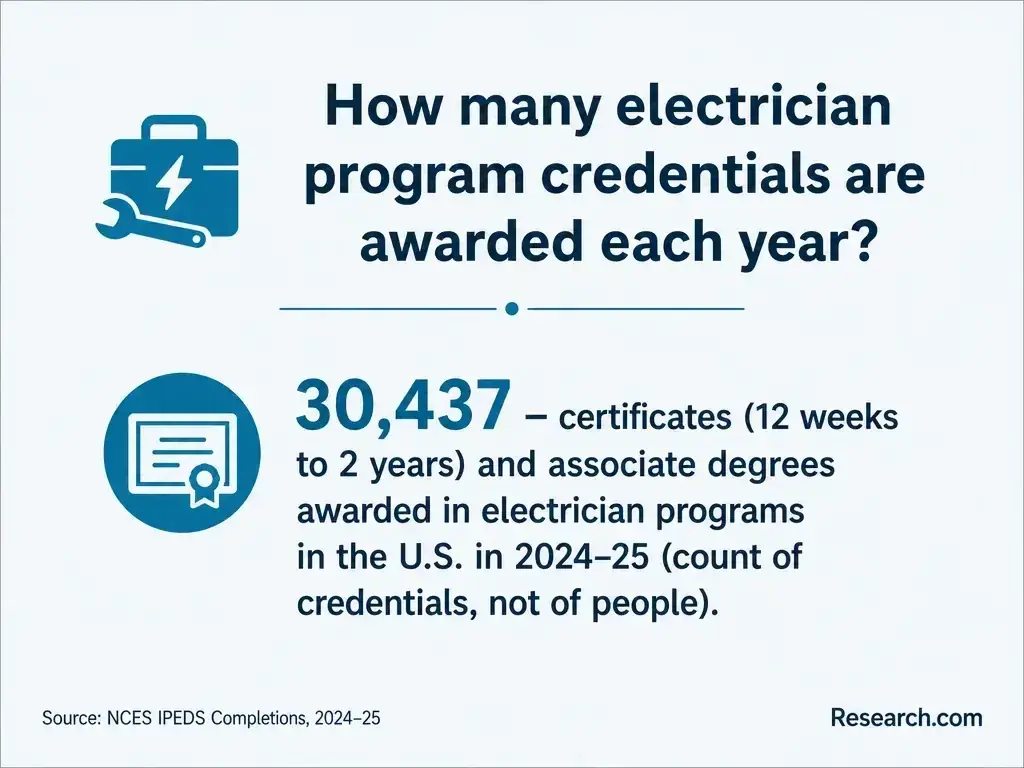
There is no single dependable statewide price for electrician training: a short school course, a public-college program, and a paid apprenticeship have different billing and earnings structures. Compare the total cost to become job-ready, not an advertised tuition figure. Request an itemized estimate covering fees, books, tools, boots and other protective equipment, materials, transport to labs or jobsites, and any applicable exam or application charges.
Paid apprenticeship wages can offset training expenses, while full-time school may mean earnings forgone during class hours. Aid also varies: federal student aid depends on school and program eligibility, and workforce funding depends on individual eligibility and approved training options (Federal Student Aid; OhioMeansJobs). An affordable college online may offer inexpensive theory coursework, but price alone cannot establish access to electrical labs or supervised employment. Compare written net-cost estimates and ask when payments are due.
The credential depends on the pathway: a pre-apprenticeship may award a completion certificate; a school may award a certificate, diploma, or associate degree; and a registered apprenticeship awards its own completion credential after its requirements are met (U.S. Department of Labor, Apprenticeship.gov). These are not interchangeable. Ask whether any school coursework earns recognized industry credentials or documented credit with a specific apprenticeship sponsor.
A school credential is also distinct from institutional accreditation, state school authorization, industry recognition, and an occupational license. Verify each claim with the organization that issues it. The useful question is not whether a credential sounds advanced, but whether the employers or sponsor you intend to approach recognize its particular coursework and practical training.
Requirements differ by provider. Schools may assess reading and math readiness and set their own age, application, or placement requirements. Apprenticeship sponsors may require an application, aptitude assessment, interview, ability to reach assigned jobsites, and employer-required screening; verify the current rules with each sponsor rather than treating one application checklist as statewide policy.
Before applying, ask whether algebra preparation is expected, whether prior electrical coursework is recognized, and whether you need a driver's license for field assignments. If you need paid work immediately, compare apprenticeship openings with school schedules before committing to daytime classes. Admission to a school does not guarantee an apprenticeship placement afterward.
Useful foundational instruction covers electrical calculations, circuit diagrams, installation methods, grounding and bonding, testing, and safe work practices. Stronger programs let students apply those topics in supervised labs: for example, building a circuit, finding a fault with a meter, and explaining a safe correction. The U.S. Bureau of Labor Statistics identifies reading technical diagrams, installing systems, and testing equipment as core electrician tasks.
Code instruction matters, but a course advertised as "code-based" needs scrutiny: ask which edition and local requirements it teaches and how updates are handled. Also ask how many hours involve actual equipment rather than demonstrations. For industrial goals, check for motor controls and troubleshooting; for construction, check conduit work, plan reading, and jobsite safety.
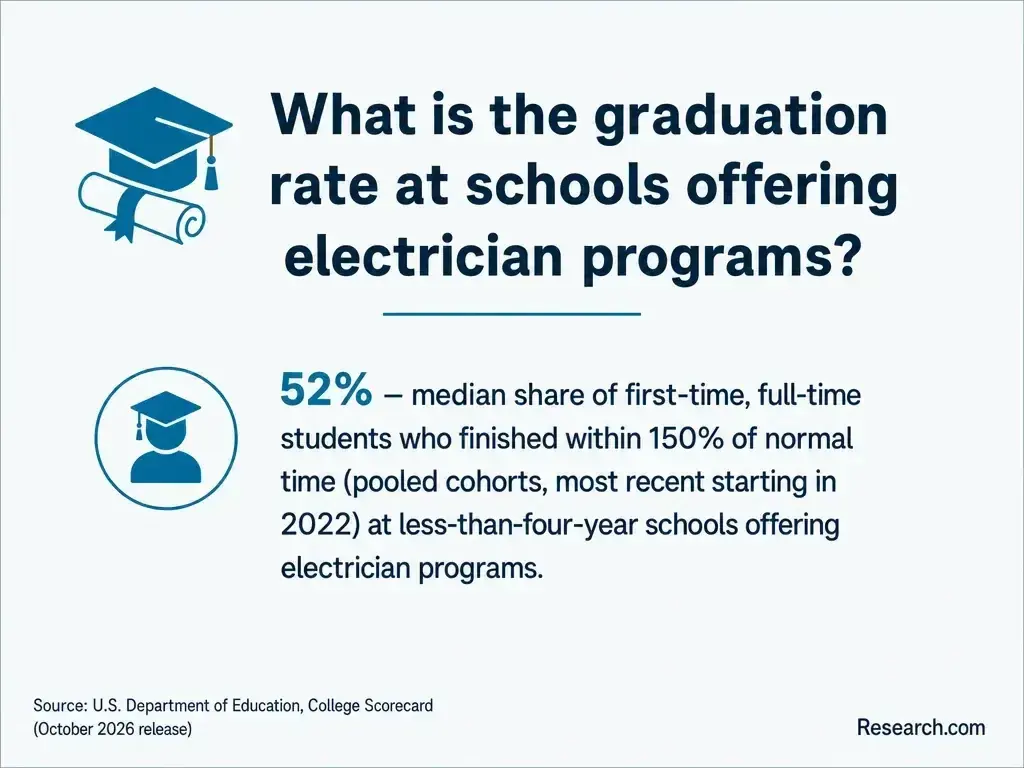
Ohio does not issue a general statewide journeyman electrician license. Its Ohio Construction Industry Licensing Board licenses qualifying electrical contractors, a different role from an employee learning or working under an employer. Municipal registration or licensing requirements can also affect where electrical work may be performed. Check the applicable local building department and the board before planning to work independently (Ohio Construction Industry Licensing Board).
A school certificate or optional industry credential is not a contractor license. The board's contractor process involves experience and other application requirements, including an examination; completing a trade-school course does not automatically satisfy them (Ohio Construction Industry Licensing Board). If self-employment is your long-term goal, ask the board how it evaluates experience and keep records of supervised work from the beginning.
Start with your intended job: construction apprentice, industrial trainee, or maintenance worker. Then compare programs against that target rather than relying on a ranking or credential title alone. A school can be a worthwhile investment if its labs build skills you lack and its cost and schedule leave you a realistic route into supervised work. A paid apprenticeship may be the better first application if you already meet its entry requirements.
Before enrolling, get answers to these questions in writing:
Check the answers with the relevant Ohio school regulator, accreditor, credential issuer, or sponsor - not only an admissions representative. Be wary of guaranteed jobs, claims that an online certificate makes you independently licensed, or a low tuition quote that omits tools and field travel. To assess return on investment, consider completion probability, debt, lost earnings during study, likely starting pay, later earnings, and how long you expect to work in the trade; institution type alone cannot settle that calculation.
Initial training can lead to helper or apprentice roles, followed by more independent installation or maintenance work as skills and supervised experience grow. Electricians may later specialize in industrial controls, commercial construction, or troubleshooting, or move toward crew supervision. Running an electrical contracting business raises separate Ohio contractor-licensing questions; experience, an examination, and board requirements matter more than the name of an entry-level school credential (Ohio Construction Industry Licensing Board).
Match the first credential to the next job, not to a distant earnings claim. Searches for a highest paying masters degree address a different educational route and cannot tell you whether an electrician certificate will secure supervised work. Likewise, easy masters programs are not a benchmark for the safety and practical competence this trade requires.
The national outlook is favorable but is not an Ohio hiring guarantee: the U.S. Bureau of Labor Statistics projects 9.2% growth for electricians from 2025 to 2035. Construction activity, facility maintenance, and replacement of workers all affect openings, while demand for a particular Ohio trainee depends on local employers and apprenticeship intake.
Use that projection to justify investigating the trade, not borrowing against an assumed job offer. Before choosing a program, review current Ohio and regional openings through the state labor-market system, speak with sponsors about their next intake, and compare the locations of actual jobsites with your commute. A program's employer connections matter most when they connect to work you can reach and are qualified to enter.
Education is a consequential investment, so Research.com compares electrician programs with other programs in the same occupation and location rather than with unrelated schools. The ranking includes only programs with completions reported to the Integrated Postsecondary Education Data System (IPEDS). That makes it useful for comparing covered schools, but it does not capture every registered apprenticeship, union training center, or employer-sponsored route.
For best-program rankings, student outcomes include completion and full- and part-time retention; earnings and return on investment include median earnings one year after completion relative to annual attendance cost; and cost measures include tuition, attendance cost, median debt - including for students who withdrew - and federal loan default rates. Quality measures include institutional accreditation, occupation-relevant programmatic accreditation or industry recognition, and student support. Occupation-relevant recognition receives 20% of the score, institutional accreditation 10%, and student support 10%. An entropy-based method distributes the remaining 60% across outcomes, earnings, and costs, giving more weight to indicators that vary more among programs. Most-affordable rankings instead score only costs and debt, using entropy-based weights; accreditation and other quality indicators are not part of that score.
The team draws on the following sources and checks their relevance to the occupation. Allied-health and dental sources are part of the broader trade-ranking research framework; they should not be mistaken for electrician approvals or licensing authorities.
Use the ranking to narrow your shortlist, then verify current program details, hands-on access, and apprenticeship connections directly. More detail about the approach is available on Research.com's methodology page.
# 1 position
# 2 position

# 3 position

# 4 position
# 5 position

# 6 position

# 8 position

# 9 position

# 10 position

# 11 position

# 12 position

# 13 position
# 14 position

# 15 position

# 16 position
No single trade-school credential is a statewide prerequisite for all electrician employment. A registered apprenticeship or employer-supported training may provide another route. Confirm each employer's entry requirements and any local rules.
Online study can cover theory, but it cannot replace supervised wiring, testing, safety practice, and jobsite experience. Ask where and when practical training occurs.
Possibly, but credit is not automatic. Ask the specific registered apprenticeship sponsor whether it grants advanced standing for that provider's coursework, and obtain the answer before enrolling.
Ohio has no general statewide journeyman electrician license. Local requirements may apply, and state electrical contractor licensing is a separate process (Ohio Construction Industry Licensing Board).
It may reduce the need to forgo wages, but compare tools, travel, fees, pay progression, and the time required. An apprenticeship also requires an available placement; a school course does not guarantee one.