
# 1 position
Best Electrical Technician Training Programs & Trade Schools in Louisiana for 2027
Audited and Verified:
Our Editorial and Data Verification Process
Research.com uses government datasets, official education statistics and primary institutional information to support its career and degree guides. Our review process checks factual accuracy, occupational definitions, source dates and the requirements associated with the credentials discussed.
How This Article Was Fact-Checked
Our editorial team verifies salary estimates, employment projections, education requirements and program information against original data providers and official organizations. Salary figures are checked against the relevant occupational definitions and reporting periods. Information about licensure, accreditation and required in-person training is reviewed separately.
Fact-checked and verified on:

Co-Founder and Chief Data Scientist

Reviewed by Karolina Broda
Fact-Checker and Data Verification
Choosing electrician training in Louisiana means deciding whether to pay for a school program, pursue a paid apprenticeship, or combine the two. The distinction matters: the U.S. Bureau of Labor Statistics projects 9.2% national growth in electrician employment from 2025 to 2035, but a school credential alone does not replace supervised experience. This guide explains costs, training, credentials, and licensing so you can assess your options. It also features a Best Electrician Trade Schools in Louisiana for 2027 ranking, created by the Research.com team of data scientists to help students make an informed choice.
Key findings about electrician degrees in Louisiana
- A Louisiana electrician school credential is a starting point, not a substitute for supervised work: registered apprenticeships commonly combine about 2,000 hours of paid on-the-job training with 144 hours of related instruction per year, according to Apprenticeship.gov.
- The national median annual wage for electricians was $63,190 in May 2025, and employment is projected to grow 9.2% from 2025 to 2035, according to the U.S. Bureau of Labor Statistics. Neither figure is a Louisiana starting-pay estimate.
- Compare a program's full cost and hands-on training with paid apprenticeship routes, then check the Louisiana State Licensing Board for Contractors and the jurisdiction where you plan to work; school graduation alone does not confer a contractor or local trade license.
Table of Contents
- Best Electrical Technician Training Programs & Trade Schools in Louisiana for 2027
- What can I expect from an electrician trade school program in Louisiana?
- Where can I work with an electrician trade school training in Louisiana?
What can I expect from an electrician trade school program in Louisiana?
Expect instruction in electrical theory, circuit calculations, the National Electrical Code, blueprint reading, installation, testing, and safe work practices. A worthwhile entry-level program also gives students supervised time handling tools, wiring devices and panels, bending conduit, and diagnosing faults. Ask how many hours are spent in a lab or at a worksite; two programs with similarly named certificates may offer very different practical preparation.
The main pathways differ in what they deliver immediately and what remains after training. This comparison helps you decide whether you need classroom preparation first or a paid route into the occupation:
| Pathway | Typical credential or outcome | Best fit and principal trade-off |
| Public technical or community-college program | Certificate, technical diploma, or, where offered, associate degree | Fits students who want structured labs before applying for work; tuition and fees may be due before earnings begin. |
| Private career-school program | School certificate or diploma | May fit a preferred schedule or location; compare total price and documented employer connections. |
| Registered apprenticeship | Paid supervised training, related instruction, and a completion credential | Fits applicants ready to work while learning; entry depends on openings and sponsor selection. |
| Employer-sponsored entry route | Work experience and any training the employer provides | Can provide faster access to a job; confirm the instruction, supervision, and documented hours offered. |
An introductory school program may help someone qualify for a helper or apprentice opening, but it is not an accelerated substitute for learning the trade on the job. Readers comparing fast careers that pay well should account for the additional supervised experience electricians need before taking on more independent work.
Where can I work with an electrician trade school training in Louisiana?
Potential workplaces include electrical contractors, residential and commercial construction sites, industrial plants, building-maintenance departments, and facilities that service power and control systems. Louisiana's industrial and petrochemical work can make instrumentation, motors, and industrial safety valuable subjects; residential work places more emphasis on building wiring, service equipment, and local inspection practices. Choose labs and work placements that resemble the setting you want to enter.
Location also affects access to supervised work. A student near a major employment center may have more sponsors within commuting range, while a rural student should ask where labs, job sites, and required classes actually meet. A program's campus location does not establish that an apprenticeship or job will be available nearby. The U.S. Bureau of Labor Statistics' occupational descriptions and Apprenticeship.gov's sponsor listings are useful starting points for checking the kind of work available.
Louisiana pay depends on the job market, employer, specialty, experience, and whether work is covered by a collective-bargaining agreement. For a benchmark - not a Louisiana wage quote - the national median annual wage for electricians was $63,190 in May 2025, according to the U.S. Bureau of Labor Statistics (BLS). A median describes workers across experience levels; it should not be used as a new graduate's expected offer.
Before borrowing for training, compare current apprentice or helper offers in the area where you can work with the BLS Occupational Employment and Wage Statistics estimate for Louisiana electricians. Ask prospective sponsors how pay progresses with documented experience, and compare benefits, travel time, and available hours alongside the hourly rate. Industrial and construction jobs can also differ in schedule and worksite travel, so a higher quoted rate may not mean higher or steadier annual earnings.
A school certificate may take months, while a longer technical diploma or associate-degree program takes more coursework; the actual calendar depends on credits or clock hours, course availability, and whether you attend part time. Request the program's required hours and a term-by-term schedule rather than relying on an advertised completion time. In particular, check whether an evening schedule still permits access to every required lab.
A registered electrical apprenticeship generally takes several years because it combines related instruction with substantial paid, supervised work. Apprenticeship.gov describes a common model of approximately 2,000 hours of on-the-job training and 144 hours of related instruction per year; each sponsor's registered standards govern its requirements. Thus, a short school credential can shorten the time to an entry-level application without necessarily shortening the full path to independent work. Claims about a top associate's degree in 6 months should not be mistaken for an electrician apprenticeship timeline.
Electrical theory, calculations, code study, and some assignments can be taught online. Safe installation, tool use, testing, troubleshooting, and supervised work require physical equipment and in-person assessment. A hybrid program can reduce classroom trips, but it does not eliminate lab or jobsite travel. An entirely online course may be useful preparation; do not assume it provides the practical experience an employer or apprenticeship sponsor expects.
Ask where and when in-person sessions occur, who supervises them, what equipment students use, and whether work experience is arranged or left to the student. If commuting is difficult, compare a nearby campus with a hybrid program's actual lab locations - not just its online timetable. Lists of easiest degrees cannot answer whether an electrical program provides sufficient hands-on training.
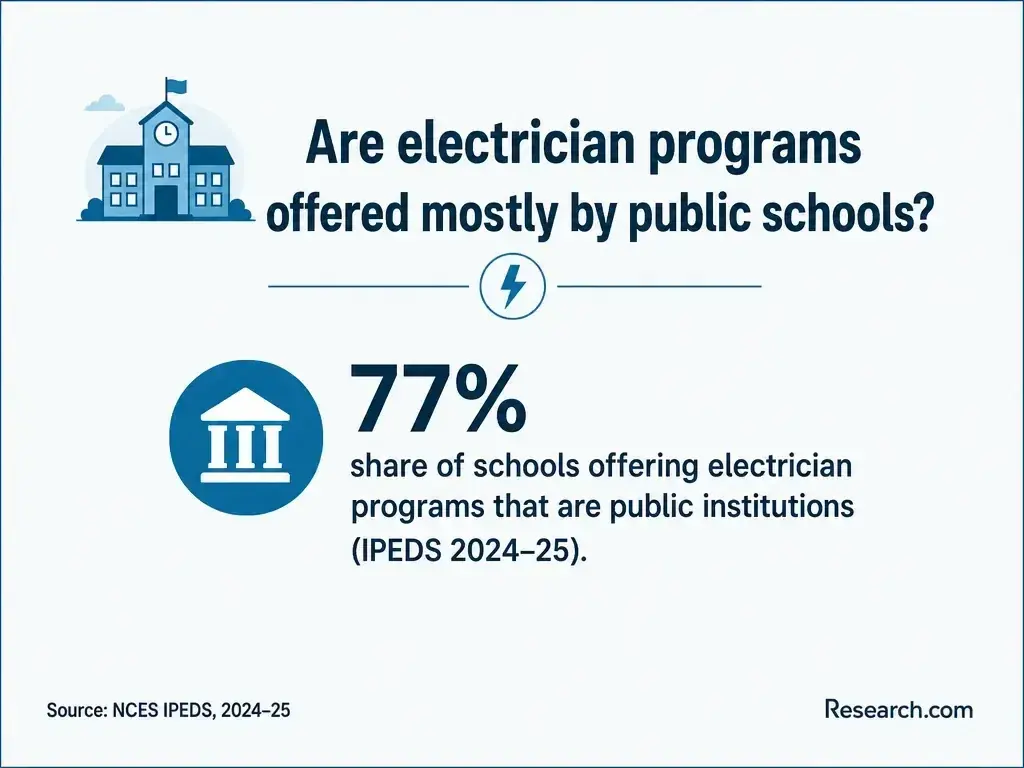
There is no single meaningful statewide average for all electrician training: public-college credentials, private-school programs, and paid apprenticeships have different prices and funding structures, and not every provider appears in college cost datasets. Ask each school for a current, program-specific estimate covering tuition, mandatory fees, books or code materials, tools, personal protective equipment, and any consumable supplies. Add travel to labs or worksites and earnings you would give up while attending.
A paid apprenticeship may offset training expenses through wages, but ask about dues, required tools, transportation, and when paid work begins. For school programs, check federal aid eligibility with the institution and Federal Student Aid; eligibility belongs to the student and the particular institution and program. Also ask Louisiana's workforce system about applicable training assistance and check Louisiana Office of Student Financial Assistance rules for any state aid you hope to use. Do not budget around an award until eligibility and available funding are confirmed.
To judge return on investment, compare total out-of-pocket cost and debt with a realistic local entry wage, your chance of finishing, the time before you can work, and later earnings over a sensible time horizon. Account for foregone wages and the timing of both costs and benefits. Even comparisons with lucrative masters degrees cannot establish whether a particular electrician program pays off for your circumstances.
That depends on the provider and the exact program: possible awards include a certificate, technical diploma, or associate degree. A registered apprenticeship instead awards a completion credential after the sponsor's required instruction and on-the-job training. NCCER credentials may document particular construction skills when a provider uses that curriculum, but they are distinct from a school award and from an occupational license (NCCER; Apprenticeship.gov).
Before enrolling, ask for the exact award name, a course list, and a written explanation of whether the coursework can count toward another program or an apprenticeship. Credit or advanced standing is not automatic: the receiving school or sponsor decides what prior learning it accepts. Institutional accreditation, authorization to operate, industry recognition, apprenticeship registration, and occupational licensure answer different questions; none should be presented as a substitute for the others.
Requirements vary by school and sponsor. A school may request an application, proof of prior schooling or equivalent preparation, placement assessment, and residency documentation for tuition purposes. Apprenticeship sponsors set their own selection criteria, which may include age eligibility, math readiness, an interview, and the ability to reach assigned jobsites. Check each provider's published rules rather than assuming school admission also secures an apprenticeship opening (institution or sponsor admissions requirements; Apprenticeship.gov).
Ask whether you must buy tools before classes begin and whether a job placement requires a driver's license, screening, or other employer-specific conditions. If you already have electrical experience, submit records of courses and supervised work for an individual review of possible credit or advanced standing. Keep copies of transcripts and hours; an informal promise that previous experience "should count" is not a transfer decision.
Core learning generally covers electrical quantities and calculations, circuit behavior, wiring methods, reading plans, code application, grounding and bonding, equipment installation, and fault-finding. Effective labs let students practice measuring circuits, making connections, installing conduit and devices, and identifying unsafe conditions under supervision. The U.S. Bureau of Labor Statistics identifies testing equipment, technical drawings, and safety practices as central to electricians' work.
Compare the curriculum against the work you want. Someone targeting industrial facilities should ask about motors, controls, and related troubleshooting; someone interested in construction should ask how often students interpret plans and complete code-based installation tasks. Seek evidence of assessed practical work - not just a list of topics - and ask whether instructors can explain the current code edition used in class and how instruction connects to local inspection practices.
Do not assume one statewide electrician license applies to every job. Louisiana's state contractor-licensing system addresses qualifying contracting work, while local jurisdictions may set trade-license or permit requirements for people performing or supervising electrical work. The requirements relevant to an employee, apprentice, journeyman-level worker, or business owner can therefore differ. Verify your intended role with the Louisiana State Licensing Board for Contractors and the permitting authority where the work will take place (Louisiana State Licensing Board for Contractors).
A school certificate is not a contractor license, and apprenticeship registration is not a local trade license. Before paying for a program, tell its coordinator the parish or municipality and role you are targeting. Ask which education, documented supervised experience, examinations, or applications that authority requires, and whether the program helps students meet any of them. Optional industry credentials may strengthen an application, but they should not be advertised as replacing a required license.
Start with the job you want, then compare programs on practical preparation and total cost - not rank alone. A public technical program may suit someone seeking a lower upfront price and a structured schedule; a private career school may suit a specific timetable if its cost and outcomes withstand scrutiny. If you can secure a suitable paid apprenticeship now, paying for a separate preliminary program may add less value. If you need basic electrical skills to compete for openings, school may be a useful first step.
Use these checks when speaking with admissions staff and apprenticeship coordinators; request answers for the specific electrician program, not the institution as a whole:
- Confirm the exact credential, required hours, lab access, and how practical skills are assessed.
- Request an itemized cost through completion, including fees, tools, safety gear, travel, and likely time away from paid work.
- Verify institutional accreditation and state authorization separately; ask which, if any, industry credentials or registered-apprenticeship arrangements apply.
- Ask for program-specific completion and placement information, how it was measured, and whether employers or sponsors accept its training for credit.
- Check local work and licensing requirements yourself before accepting a claim that graduation makes you "licensed."
Red flags include a promised salary, an undisclosed lab location, unclear fees, or a claim that online lessons alone qualify graduates for independent electrical work. The best investment is the option you can finish and afford that provides credible practical training and a workable route into supervised employment.
A common progression is helper or apprentice, then more experienced field electrician, with possible movement into industrial maintenance, controls, estimating, supervision, or contracting. These are not automatic promotions from a certificate: employers look for demonstrated work, and contracting or locally regulated duties can require separate authorization. Industrial specialization may call for additional equipment training, while supervisory work calls for planning, documentation, and oversight of safe practices (U.S. Bureau of Labor Statistics; Louisiana State Licensing Board for Contractors).
Choose an initial program for the first job it can realistically help you obtain, not solely for the highest-paid eventual title. A comparison of what trade school job pays the most can provide career context, but it cannot replace checking local entry wages, available apprenticeships, and the experience required for advancement.
The U.S. Bureau of Labor Statistics projects 9.2% growth in electrician employment nationally from 2025 to 2035. That supports considering the trade, but it is not a forecast of openings in your Louisiana parish or a promise of placement after school. Construction schedules, industrial projects, retirements, and the availability of apprenticeship positions can make local opportunities differ from the national trend.
Before choosing a campus or sponsor, review Louisiana Workforce Commission occupational projections and current openings for your intended commuting area. Compare the work advertised - residential installation, commercial construction, maintenance, or industrial electrical work - with the program's labs and placement relationships. A broadly favorable outlook is most useful when you can identify nearby employers willing to hire and train someone at your current skill level.
Best Electrical Technician Training Programs & Trade Schools in Louisiana for 2027
Investing in training is a consequential decision, so the Research.com team designed its ranking to compare electrician programs with other programs in the same occupation and location. It evaluates reported outcomes, costs, and quality indicators rather than treating a school's name or a single tuition figure as proof of value. Only programs with completions reported to the Integrated Postsecondary Education Data System (IPEDS) are included; a registered apprenticeship or employer program absent from IPEDS should not be assumed to be unavailable or inferior.
Best-program scores cover student completion and full- and part-time retention; earnings one year after completion and earnings relative to annual attendance cost; tuition, attendance cost, debt - including debt held by students who withdrew - and federal loan default rates; and accreditation, relevant industry recognition, and student support. Relevant programmatic accreditation or industry recognition accounts for 20% of the score, institutional accreditation for 10%, and student support for 10%. The remaining 60% covers outcomes, earnings, and costs, with entropy-based weights that give more weight to indicators that differ more across programs. Most-affordable rankings instead score only tuition, attendance cost, debt, and default rates using entropy-based weights; accreditation and other quality indicators are not part of that score.
The team uses the following data sources to check the quality, credibility, and accuracy of its comparisons. Several professional-health sources are part of the broader ranking process, not electrician-specific endorsements:
- IPEDS database - reported completions and institutional data.
- National Center for Education Statistics - education data and definitions.
- College Scorecard database - available cost, debt, and earnings measures.
- Peterson's database - supplementary school information.
- Commission on Accreditation of Allied Health Education Programs (CAAHEP) - relevant to other occupations in the broader ranking process, not electrician approval.
- Accrediting Bureau of Health Education Schools (ABHES) - relevant to health programs, not electrician approval.
- Commission on Dental Accreditation (CODA) - relevant to dental programs, not electrician approval.
- Dental Assisting National Board (DANB) - relevant to dental assisting, not electrician certification.
- National Center for Construction Education and Research (NCCER) - construction-training credentials and industry recognition.
- Apprenticeship.gov Partner Finder - registered-apprenticeship options to compare with schools.
Use the ranking to narrow your search, then verify the specific program's current price, lab access, apprenticeship connections, and fit with local work requirements. More detail on the ranking approach is available in Research.com's methodology.
# 2 position
Northshore Technical Community College - Electrician.
certificate or diploma# 3 position
Central Louisiana Technical Community College - Electrician.
certificate or diploma
# 4 position
# 5 position
# 6 position
SOWELA Technical Community College - Electrician.
certificate or diploma# 7 position
Fletcher Technical Community College - Electrician.
certificate or diploma
# 8 position
ITI Technical College - Electrician.
certificate or diploma# 9 position
South Louisiana Community College - Electrician.
certificate or diploma
# 10 position
Northwest Louisiana Technical Community College - Electrician.
certificate or diploma
# 11 position
Delgado Community College - Electrician.
certificate or diploma
# 12 position
Nunez Community College - Electrician.
associate
# 13 position
Nunez Community College - Electrician.
certificate or diploma # 14 position
Louisiana Delta Community College - Electrician.
certificate or diploma
# 15 position
Baton Rouge Community College - Electrician.
certificate or diploma# 16 position
Bossier Parish Community College - Electrician.
certificate or diploma
Frequently asked questions about electrician programs in Louisiana
Is electrician trade school required before an apprenticeship?
No universal trade-school prerequisite applies. Registered-apprenticeship sponsors set their own entry requirements and provide related instruction alongside supervised work. School may improve your preparation, but ask a sponsor whether it accepts prior coursework or offers advanced standing (Apprenticeship.gov).
Can I become an electrician entirely online?
Online coursework can teach theory and code concepts, but it cannot replace hands-on installation, testing, or supervised jobsite experience. Verify the in-person requirements and the expectations of employers and local authorities before enrolling.
How long does it take to become qualified for independent work?
That depends on the role and local rules. A short school program may prepare you to seek entry-level work; a registered apprenticeship typically combines several years of work and instruction. Ask the relevant sponsor and local permitting authority what experience and examinations your target role requires (Apprenticeship.gov; Louisiana State Licensing Board for Contractors).
Will financial aid pay for electrician training?
Possibly, but eligibility varies by student, institution, and program. Confirm federal aid eligibility with the school and Federal Student Aid, and ask about applicable state or workforce assistance. A paid apprenticeship may offer wages instead of the same school-based funding arrangement.
Does graduating from an electrician program give me a Louisiana license?
No. A school credential, contractor license, and any applicable local trade license are separate. Check requirements for the exact work and jurisdiction you intend to enter with the Louisiana State Licensing Board for Contractors and the local permitting authority.
- U.S. Bureau of Labor Statistics - Electricians
Used to verify salary, employment outlook, and typical education requirements.
https://www.bls.gov/ooh/construction-and-extraction/electricians.htm - NCCER - Accredited Training
Used to verify programmatic accreditation or industry recognition of programs.
https://www.nccer.org/ - O*NET OnLine - Electricians
Used to verify common responsibilities, skills, work settings, and education expectations.
https://www.onetonline.org/link/summary/47-2111.00 - Northshore Technical Community College - official website
Official school website (programs, tuition, admissions).
https://northshorecollege.edu/ - Central Louisiana Technical Community College - official website
Official school website (programs, tuition, admissions).
https://www.cltcc.edu/ - SOWELA Technical Community College - official website
Official school website (programs, tuition, admissions).
https://www.sowela.edu/ - Fletcher Technical Community College - official website
Official school website (programs, tuition, admissions).
https://www.fletcher.edu/ - ITI Technical College - official website
Official school website (programs, tuition, admissions).
https://www.iticollege.edu/