
# 1 position
Best Electrical Technician Training Programs & Trade Schools in Georgia for 2027
Audited and Verified:
Our Editorial and Data Verification Process
Research.com uses government datasets, official education statistics and primary institutional information to support its career and degree guides. Our review process checks factual accuracy, occupational definitions, source dates and the requirements associated with the credentials discussed.
How This Article Was Fact-Checked
Our editorial team verifies salary estimates, employment projections, education requirements and program information against original data providers and official organizations. Salary figures are checked against the relevant occupational definitions and reporting periods. Information about licensure, accreditation and required in-person training is reviewed separately.
Fact-checked and verified on:

Co-Founder and Chief Data Scientist

Reviewed by Karolina Broda
Fact-Checker and Data Verification
Choosing electrician training in Georgia means comparing more than tuition: a short classroom program and a paid apprenticeship can lead to very different experience and costs. The U.S. Bureau of Labor Statistics projects 9.2% national growth in electrician employment from 2025 to 2035, making the choice timely. This guide explains Georgia training routes, costs, work requirements, and licensing. It also features a Best Electrician Trade Schools in Georgia for 2027 ranking created by the Research.com team of data scientists to help students identify programs worth considering.
Key findings about electrician degrees in Georgia
- A Georgia electrician certificate or diploma can teach wiring fundamentals, but it does not itself provide the supervised work experience or electrical contractor license needed to operate independently.
- A registered apprenticeship combines paid work with classroom instruction; compare its wages and duration against a school program's full cost and access to employer placements.
- The U.S. Bureau of Labor Statistics reports a $63,190 national median annual wage for electricians in May 2025, not a starting wage or a Georgia-specific pay estimate.
Table of Contents
- Best Electrical Technician Training Programs & Trade Schools in Georgia for 2027
- What can I expect from an electrician trade school program in Georgia?
- Where can I work with an electrician trade school training in Georgia?
What can I expect from an electrician trade school program in Georgia?
Expect a mix of electrical theory, safety instruction, and supervised practice - not independent electrical work immediately after graduation. A useful program lets students read plans, select materials, install and test circuits, and diagnose faults in a lab or shop. Ask how often you will personally use tools and test equipment, rather than only watch demonstrations.
Georgia's public technical-college and private career-school routes may offer different schedules, facilities, and employer connections. North Georgia Technical College, Augusta Technical College, Georgia Northwestern Technical College, Oconee Fall Line Technical College, and Lincoln College of Technology-Marietta are among the providers a student might investigate; verify each location's current electrical offerings before applying. Short fast certificate programs that pay well may appeal to career changers, but speed alone cannot replace wiring practice or supervised job experience.
Trade school makes sense if you need structured fundamentals before seeking an electrical helper position, or if a program has a credible route to an employer. If you already have an offer from a registered apprenticeship with classroom training, compare that paid route before committing to separate tuition.
Where can I work with an electrician trade school training in Georgia?
Training can support applications for electrical helper, apprentice, or other supervised entry-level roles with electrical contractors, industrial facilities, and building-maintenance employers. Residential construction, commercial projects, and industrial maintenance use overlapping skills but different equipment and work routines. Ask a provider which local employers recruit its students and whether placements involve new construction, service calls, or plant work.
Location changes the practical choice. A student near a large metro area may be able to compare more contractors and worksites; someone farther away should calculate travel time to both the training lab and prospective job sites. A nearby program with reliable hands-on access may be more useful than a distant option with a stronger-looking credential name.
Pay depends on experience, specialty, employer, overtime, and location. The U.S. Bureau of Labor Statistics reports a $63,190 U.S. median annual wage for electricians in May 2025. That national midpoint is a benchmark for the occupation, not an estimate of what a newly trained Georgia helper will earn. Compare current Georgia and local-area electrician wage figures from BLS or Georgia labor-market data with actual apprenticeship and employer offers before budgeting around future income.
When judging an offer, separate base pay from overtime and benefits, and account for commuting and tool costs. Paid apprenticeship wages can improve cash flow during training even when experienced electricians earn more later.
A focused certificate may take months; a broader diploma generally takes longer. Actual time depends on the published clock or credit hours, course sequence, start dates, and whether you attend full- or part-time. Request the current program outline rather than relying on a general claim that training is "accelerated."
A registered apprenticeship is a longer work-and-classroom pathway, with supervised experience accumulated while earning wages. Its completion requirements depend on the registered sponsor's standards, not the length of a school certificate. Ask whether prior coursework can earn advanced standing or reduce related classroom instruction; do not assume it reduces required on-the-job experience.
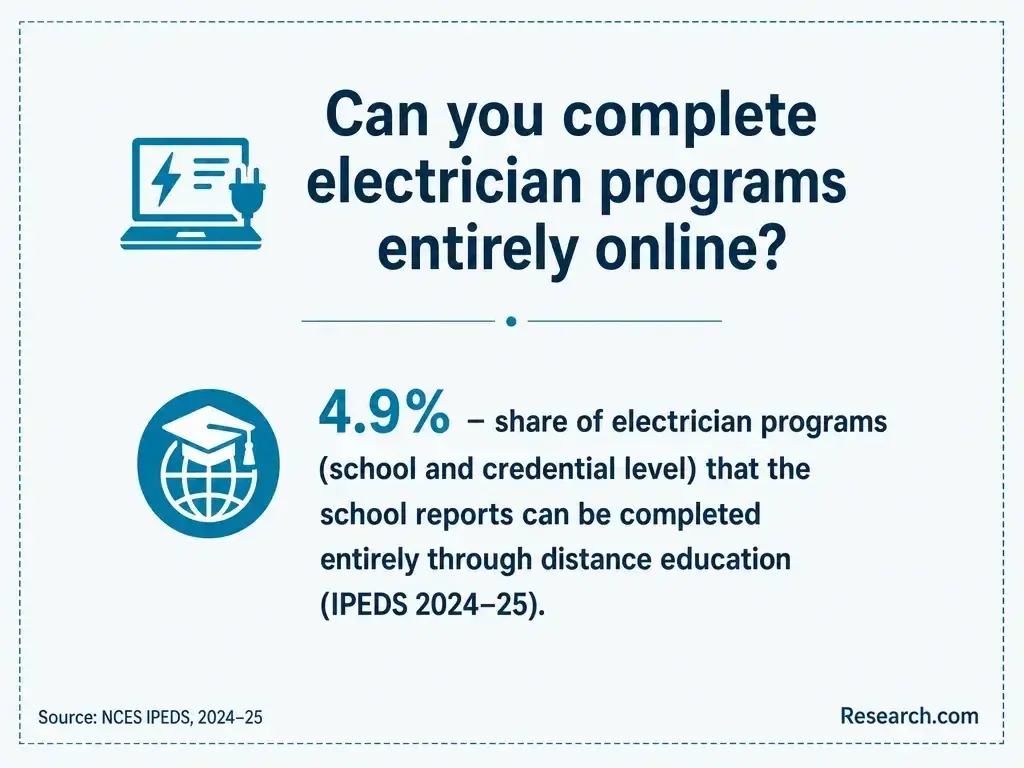
Electrical theory, code concepts, and some calculations can be taught remotely. Safe installation, troubleshooting, measurement, and tool use require supervised practice with physical equipment. An entirely online course should therefore be evaluated as preparation, not assumed to be equivalent to a lab-based program or apprenticeship.
This comparison identifies what each format can - and cannot - reasonably provide.
| Format | Useful for | Check before enrolling |
| On-campus | Scheduled shop practice and direct instructor feedback | Individual lab time, equipment, and travel requirements |
| Hybrid | Flexible theory lessons plus in-person labs | Required campus dates and whether practical hours are sufficient |
| Online coursework | Foundational knowledge or continuing study | How hands-on competencies and employer experience will be obtained |
Listings of top vocational colleges online can help identify flexible coursework, but confirm the electrician program's physical training arrangements separately. If regular travel to a Georgia lab is not feasible, ask whether a local registered apprenticeship offers a more workable schedule.
There is no single dependable statewide price for electrician training: a short public-college credential, a private career-school program, and a paid apprenticeship have different charges and earnings during training. Obtain a written, program-specific estimate instead of using a schoolwide tuition figure as your total cost.
The items below make competing quotes comparable and reveal expenses that tuition advertisements can omit.
- Tuition, mandatory fees, books, software, and consumable lab materials.
- Tools, testing equipment, required clothing, and personal protective equipment.
- Transportation to campus and worksites, plus earnings forgone if classes limit paid work.
- Any applicable examination or later contractor-license application costs, offset by grants, employer support, or apprenticeship wages.
Eligible students can ask about federal aid and Georgia's HOPE Grant; confirm the specific program's eligibility and current rules with the school and Georgia Student Finance Commission. A search for the cheapest online college will not capture required electrician lab travel or tools. For a meaningful return-on-investment comparison, consider completion likelihood, debt, pay while training, likely earnings before and after training, and how long you expect to work in the trade - not tuition alone.
Depending on the offering, you may earn a technical certificate or diploma. A registered apprenticeship instead provides a completion credential under its sponsor's registered standards, alongside documented work-based training. An employer may also offer training that does not award a school credential. These outcomes are not interchangeable simply because all teach electrical skills.
Before enrolling, get the exact credential name, transcript or training-record details, and a written explanation of any credit or advanced standing available toward further training. Institutional accreditation concerns the school; industry credentials concern particular skills; apprenticeship registration concerns the work-and-instruction program. None is a Georgia electrical contractor license.
Requirements vary by provider and pathway. Schools may ask for an application, evidence of secondary-school completion, and a placement assessment or documented readiness in math and reading. Apprenticeship sponsors set their own entry and selection rules and may assess math, interview candidates, and require the ability to reach changing worksites. Ask about any background, drug-screening, or physical requirements that apply to a particular placement rather than assuming every program uses the same standard.
Check when classes start and whether an employer connection is part of admission or something you must arrange afterward. Applicants returning to school should also ask whether prior learning or work experience changes placement or course requirements; obtain any credit decision in writing.
A sound entry-level curriculum connects electrical math and circuit theory to job tasks: interpreting drawings, measuring voltage and current, installing raceways and conductors, understanding grounding and overcurrent protection, and troubleshooting. Safety instruction should cover shock prevention, protective equipment, and safe testing practices. Code instruction should identify the edition and local requirements being taught rather than suggest that memorizing a codebook replaces supervised judgment.
Compare programs by the tasks students actually perform. Wiring a training board, making terminations, and finding a fault provide different practice from watching a recorded demonstration. Ask whether instructors assess each student's work and whether the curriculum covers the residential, commercial, or industrial setting you intend to enter.
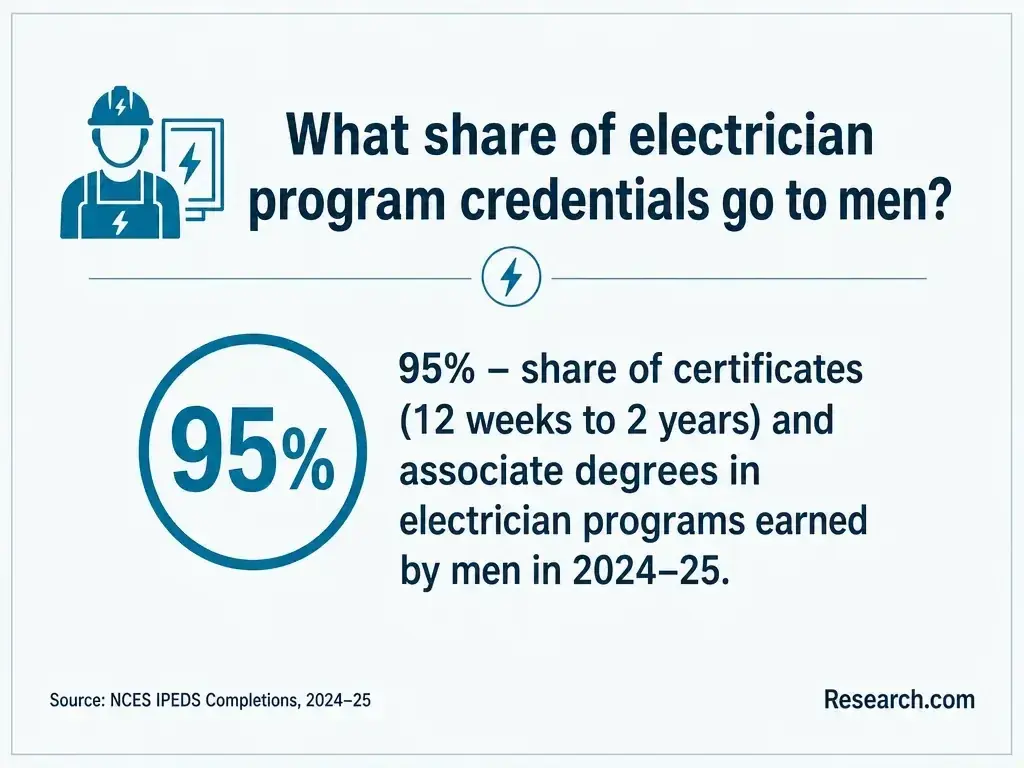
Georgia regulates electrical contractors through the State Construction Industry Licensing Board's Division of Electrical Contractors. It offers restricted Class I and unrestricted Class II electrical contractor licenses, with application, experience, and examination requirements set by the board. Georgia does not issue a general statewide journeyman electrician license. A trainee or employee working under appropriate supervision is not the same as someone authorized to contract independently. Confirm current rules and any local permitting requirements with the board and the jurisdiction where you plan to work.
A school certificate does not waive contractor-license requirements. Likewise, an optional industry credential can demonstrate training without granting permission to operate a contracting business. If self-employment is your goal, ask a prospective employer and the board what experience can be documented toward a future application before choosing a training route.
Start with the job you want: residential installation, commercial work, or industrial maintenance. Then compare the program's practical training and employer access with a registered apprenticeship, rather than treating a ranking position as the final answer. Unlike one year masters programs online, electrician training must be judged on in-person wiring competence and supervised work opportunities.
Use these checks when speaking with admissions staff and apprenticeship coordinators:
- Confirm the exact credential, total scheduled hours, lab tasks, and how individual practical skills are assessed.
- Verify institutional accreditation or state authorization as applicable, and ask which claims are about industry recognition rather than Georgia licensure.
- Request a written total-cost estimate, aid eligibility, completion information, and evidence of employer or apprenticeship connections.
- Ask whether coursework earns documented advanced standing and who verifies any supervised work experience.
A red flag is a promise that a brief or wholly online credential automatically makes you a licensed electrician. Another is an earnings claim presented as typical starting pay without identifying the occupation, location, experience level, and measurement period.
A common progression is supervised helper or apprentice work, greater responsibility installing and troubleshooting systems, and eventually specialized or supervisory work. Experienced electricians may focus on commercial projects, industrial controls, maintenance, or service. Contracting independently is a separate decision that requires meeting Georgia's applicable licensing rules; optional certifications or additional training may help with particular equipment or employers but do not replace a license.
If your priority is the quickest paid entry, seek apprenticeships and helper openings alongside school options. If you need structured lab preparation before applying, a certificate may fit better. Comparisons of what college majors make the most money answer a different question: for this trade, compare realistic entry pay, paid-training access, advancement requirements, and total training cost.
The U.S. Bureau of Labor Statistics projects 9.2% growth in electrician employment nationally from 2025 to 2035. That indicates demand across the occupation, not a guarantee of openings near a particular Georgia campus. Construction activity, maintenance needs, and employer hiring vary by locality and specialty.
For a local decision, check current Georgia labor-market projections and openings, then ask prospective employers which entry-level skills they require. A program with strong practical training and access to worksites you can reach may be a better investment than one selected on national growth figures alone.
Best Electrical Technician Training Programs & Trade Schools in Georgia for 2027
Education is a substantial investment, so the Research.com team designed this ranking to compare electrician programs with other options in the same occupation and location. The team reviews outcomes, costs, recognition, and student support using multiple data sources. Only programs with completions reported to IPEDS can enter the ranking; an unlisted apprenticeship or training provider is not necessarily a poor option.
Best-program scores consider completion and full- and part-time retention; median earnings one year after completion and earnings relative to annual attendance cost; tuition, attendance cost, debt - including debt held by students who withdrew - and federal loan default rates; and relevant recognition and support services. Occupation-relevant programmatic accreditation or industry recognition receives 20%, institutional accreditation 10%, and student support 10%. Outcomes, earnings, and costs share the remaining 60% through an entropy-based method that gives more weight to indicators that differ more across programs. Most-affordable rankings score costs and debt only, using entropy-based weights; they do not include accreditation or other quality indicators in the score.
The ranking methodology draws on the following sources across the occupations it covers. Health-specific organizations listed here are not substitutes for electrician training evidence or Georgia licensing requirements.
- IPEDS database - reported program completions and institutional data.
- National Center for Education Statistics - federal education data and definitions.
- College Scorecard database - available cost, debt, and earnings measures.
- Peterson's database - supplementary institutional information.
- Commission on Accreditation of Allied Health Education Programs (CAAHEP) - recognition information for applicable health occupations.
- Accrediting Bureau of Health Education Schools (ABHES) - recognition information for applicable health occupations.
- Commission on Dental Accreditation (CODA) - recognition information for applicable dental occupations.
- Dental Assisting National Board (DANB) - credential information for applicable dental occupations.
- National Center for Construction Education and Research (NCCER) - construction-trade training and credential information where relevant.
- Apprenticeship.gov Partner Finder - registered-apprenticeship provider information.
Use the ranking to narrow your search, then confirm current program details and work-based training directly with each provider. Research.com explains its scoring approach further on its methodology page.
# 2 position

# 3 position
Lincoln College of Technology-Marietta - Electrician.
certificate or diploma # 4 position
Augusta Technical College - Electrician.
associate
# 5 position
Augusta Technical College - Electrician.
certificate or diploma # 6 position
Georgia Northwestern Technical College - Electrician.
certificate or diploma
# 7 position
Oconee Fall Line Technical College - Electrician.
certificate or diploma
# 8 position
Central Georgia Technical College - Electrician.
certificate or diploma# 9 position
Southeastern Technical College - Electrician.
certificate or diploma
# 10 position
# 11 position
Wiregrass Georgia Technical College - Electrician.
certificate or diploma# 12 position
United Education Institute-Morrow - Electrician.
certificate or diploma
# 13 position
Atlanta Technical College - Electrician.
certificate or diploma
# 14 position
Ogeechee Technical College - Electrician.
certificate or diploma
# 15 position
United Education Institute-Stone Mountain - Electrician.
certificate or diploma
# 16 position

# 17 position
# 18 position
Lanier Technical College - Electrician.
certificate or diploma # 19 position
Coastal Pines Technical College - Electrician.
certificate or diploma# 20 position
Lincoln College of Technology-East Point
associateElectrician
Delivery mode: On Campus (May Include Online Courses)
22.84
/ 100
Final score
- Students receiving Pell Grants
- 84%
- Median earnings 1 year after completion
- $47,467
- In-state tuition & fees (per year)
- $37,766
- Out-of-state tuition & fees (per year)
- $37,766
- School website
- lincolntech.edu
Accreditation
Institutional accreditation from Accrediting Commission of Career Schools and Colleges.
Lincoln College of Technology-East Point received a Research.com Trade Program Score of 22.84/100.
Frequently asked questions about electrician programs in Georgia
Can I become an electrician in Georgia without trade school?
Yes. A registered apprenticeship or supervised employer training can provide an entry route. Compare its instruction, work experience, wages, and selection requirements with school-based options.
Does a Georgia electrician certificate make me a licensed contractor?
No. The Georgia State Construction Industry Licensing Board sets separate experience, application, and examination requirements for electrical contractor licensing.
Is an online electrician program enough to get hired?
Online study can build theory knowledge, but employers also need evidence of safe, hands-on skills. Ask how the program provides supervised lab or worksite practice.
Should I choose a certificate or an apprenticeship?
Choose based on your starting skills and available offers. A certificate can provide structured preparation; an apprenticeship integrates paid supervised work with instruction but may take longer and have its own selection process.
What should I ask about cost before enrolling?
Request a written estimate covering tuition, fees, tools, safety gear, materials, and travel. Ask about aid eligibility, paid placements, and what you would owe if you leave early.
- U.S. Bureau of Labor Statistics - Electricians
Used to verify salary, employment outlook, and typical education requirements.
https://www.bls.gov/ooh/construction-and-extraction/electricians.htm - NCCER - Accredited Training
Used to verify programmatic accreditation or industry recognition of programs.
https://www.nccer.org/ - O*NET OnLine - Electricians
Used to verify common responsibilities, skills, work settings, and education expectations.
https://www.onetonline.org/link/summary/47-2111.00 - North Georgia Technical College - official website
Official school website (programs, tuition, admissions).
https://northgatech.edu/ - Lincoln College of Technology-Marietta - official website
Official school website (programs, tuition, admissions).
https://www.lincolntech.edu/campus/marietta-ga - Augusta Technical College - official website
Official school website (programs, tuition, admissions).
https://www.augustatech.edu/ - Georgia Northwestern Technical College - official website
Official school website (programs, tuition, admissions).
https://www.gntc.edu/ - Oconee Fall Line Technical College - official website
Official school website (programs, tuition, admissions).
https://www.oftc.edu/