
Best Electrical Technician Training Programs & Trade Schools in The Woodlands for 2027
Audited and Verified:
Our Editorial and Data Verification Process
Research.com uses government datasets, official education statistics and primary institutional information to support its career and degree guides. Our review process checks factual accuracy, occupational definitions, source dates and the requirements associated with the credentials discussed.
How This Article Was Fact-Checked
Our editorial team verifies salary estimates, employment projections, education requirements and program information against original data providers and official organizations. Salary figures are checked against the relevant occupational definitions and reporting periods. Information about licensure, accreditation and required in-person training is reviewed separately.
Fact-checked and verified on:

Co-Founder and Chief Data Scientist

Reviewed by Karolina Broda
Fact-Checker and Data Verification
Choosing electrician training near The Woodlands means deciding whether to pay for school, enter a paid apprenticeship, or combine the two. The decision matters: the U.S. Bureau of Labor Statistics reports a May 2025 national median electrician wage of $63,190, but training alone does not confer a Texas license. This guide explains local options, costs, hands-on requirements, and the route to licensed work. It also accompanies the Best Electrician Trade Schools in The Woodlands for 2027 ranking, created by the Research.com team of data scientists to help students identify programs worth considering.
Key findings about electrician degrees in The Woodlands
- Texas journeyman applicants generally need 8,000 hours of on-the-job training under a master electrician and must pass an examination; a school certificate by itself does not replace that experience (Texas Department of Licensing and Regulation).
- The U.S. Bureau of Labor Statistics projects 9.2% national electrician employment growth from 2025 to 2035. That supports exploring the trade, but it is not a forecast of openings or starting pay in The Woodlands.
- Compare a reachable Lone Star College System training option with paid apprenticeships and employer entry routes. The best value depends on supervised work access, total out-of-pocket cost, schedule, and whether school training can count toward a sponsor's program.
Table of Contents
- Best Electrical Technician Training Programs & Trade Schools in The Woodlands for 2027
- What can I expect from an electrician trade school program in The Woodlands?
- Where can I work with an electrician trade school training in The Woodlands?
What can I expect from an electrician trade school program in The Woodlands?
An electrician trade program should build two things: safe practical competence and a workable route into supervised employment. Instruction may cover circuits, wiring methods, blueprint reading, testing, and the National Electrical Code. Labs let students practice installation and troubleshooting, while an apprenticeship adds sustained work on actual jobsites. Texas licensing is based on documented supervised experience and, for higher license levels, an exam - not simply possession of a school credential (Texas Department of Licensing and Regulation).
The pathways differ most in when you start earning, how you get field experience, and what you receive on completion. Ask each provider which hours are classroom instruction, which are lab work, and which are documented paid work under a Texas master electrician.
| Pathway | Typical result | Best fit and main limitation |
| College or career-school certificate | School-awarded occupational credential and supervised labs | Fits beginners seeking structured preparation; confirm how graduates obtain paid field work afterward. |
| Associate-level electrical program | Academic associate credential plus technical instruction, if offered | Fits students who want broader technical study; added time and cost do not replace Texas licensing hours. |
| Registered apprenticeship | Paid on-the-job training, related instruction, and an apprenticeship completion credential | Fits applicants ready to work while training; entry, work assignments, and schedules depend on the sponsor. |
| Direct employer entry | Paid supervised experience, sometimes paired with employer-sponsored classes | Fits applicants who can secure an appropriate supervisor; verify how experience will be documented and instruction provided. |
For a Woodlands resident, commuting matters: a nearby classroom is less useful if required labs or work placements are far away. Lone Star College System is a local public-college option to investigate, but confirm the current electrical program, campus, schedule, and credential directly. Union, nonunion, and employer-sponsored apprenticeships may also serve the wider Houston area; compare their actual jobsite reach rather than assuming every opening is close to home.
Where can I work with an electrician trade school training in The Woodlands?
Electricians work for electrical contractors, construction firms, building-maintenance operations, and facilities that maintain electrical systems. Around The Woodlands, that can mean residential construction and service work as well as commercial buildings and other facilities across the Houston-The Woodlands-Sugar Land metro area. The wider commuting area expands potential employers, but jobsite travel can add substantial time and expense.
Training should match the work you want. Residential wiring practice helps with homes; commercial or industrial work may require more experience with conduit, motors, controls, and larger electrical systems. Ask a program or apprenticeship sponsor which settings its students actually train in. Do not mistake a possible placement sector for a promised job.
The U.S. Bureau of Labor Statistics reports a $63,190 national median annual wage for electricians in May 2025. The median covers employed electricians at different experience levels; it is neither a Woodlands-specific figure nor a likely starting wage for a newly licensed apprentice. Compare current Houston-area job postings and apprenticeship wage schedules for the roles you could enter, including any progression in pay as you gain experience.
When weighing school against paid training, compare earnings over time rather than a graduate salary claim. Include the wages you might forgo during full-time classes, likely apprentice pay, commuting costs, debt payments, and the time needed to qualify for a higher license. A shorter course is not necessarily a better financial choice if it leaves you without a route to supervised work.
A school certificate may take substantially less time than the supervised work needed for independent career progression. Program calendars vary by provider and attendance schedule, so request the exact instructional and lab hours rather than relying on labels such as "accelerated." An associate program generally involves a longer course of study; a registered apprenticeship combines instruction with multiple years of paid work (U.S. Department of Labor, Apprenticeship.gov).
Texas requires 8,000 hours of on-the-job training under a master electrician for a journeyman electrician license; the residential wireman route requires 4,000 hours in residential electrical work under a master electrician. Both routes also have examinations (Texas Department of Licensing and Regulation). A classroom hour is not automatically an on-the-job hour. Before enrolling, ask how the provider helps students obtain and document qualifying supervised experience.
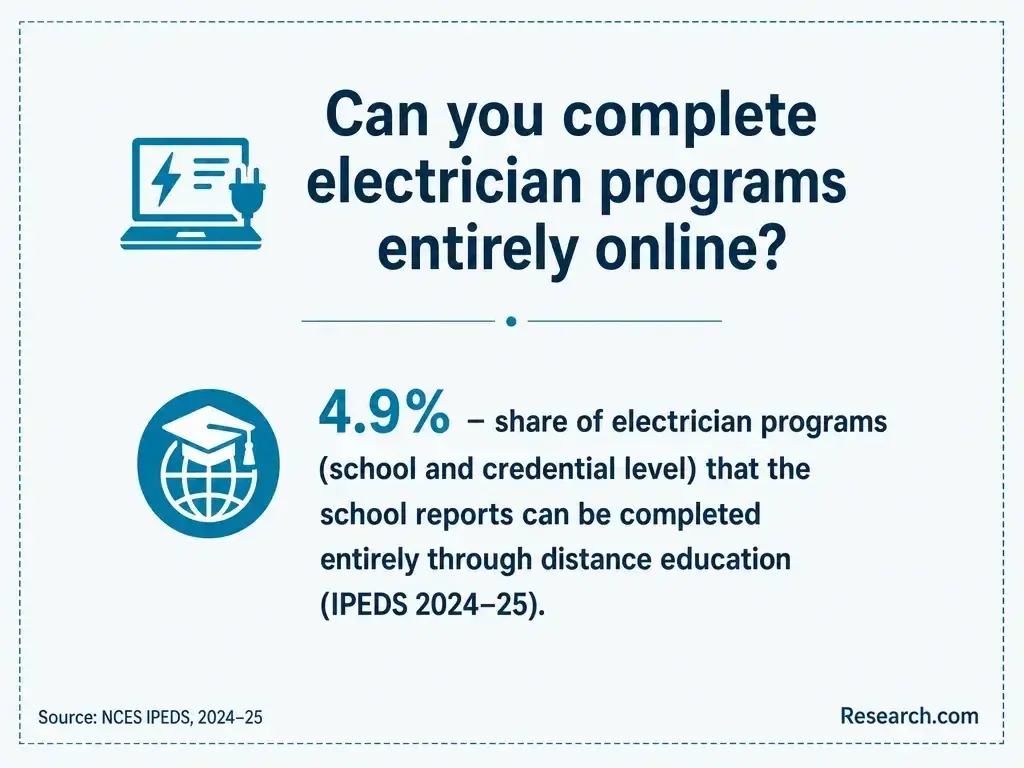
Online study can be useful for electrical theory, code concepts, calculations, and some scheduling flexibility. It cannot by itself demonstrate safe use of tools, installation methods, testing, or performance on a live jobsite. Hybrid training can work well if its labs and work placements are reachable from The Woodlands; an entirely remote course should be treated as theory preparation unless the provider can show how required practical experience is arranged.
Format is therefore a practical-access decision, not just a learning preference. Ask where and how often labs meet, whether field work is paid, who supervises it, and how absences are made up. When browsing best affordable online colleges for working students, check those same in-person requirements before assuming an online listing describes a complete electrician-entry pathway.
There is no responsible single "average cost" for electrician training in The Woodlands: a public-college program, career-school course, and paid apprenticeship have different charges and earnings arrangements. Request a current, program-specific total from Lone Star College System or any other provider you are considering. Check residency-based tuition where applicable and confirm whether the quoted price covers every required course and lab.
Build a job-ready budget from these price categories, even when an advertised tuition figure looks low:
- Tuition and mandatory enrollment, lab, and materials fees.
- Tools, test equipment, books or code materials, and required PPE.
- Licensing application and examination charges when you become eligible.
- Travel to classes and changing jobsites, plus income forgone while attending school.
Subtract only aid or wages you can reasonably expect to receive. Federal aid depends on both student and program eligibility; Texas workforce-training assistance may depend on local eligibility and approved training (Federal Student Aid; Texas Workforce Commission). A paid apprenticeship can reduce foregone earnings, although tools and transportation may still cost money. An online school that accepts financial aid is not necessarily offering an aid-eligible electrician program - or the practical training needed for Texas work.
Your credential depends on the route: a school may award a certificate or associate credential, while a registered apprenticeship awards a completion credential after its work and instruction requirements are met. These document training; neither is the same thing as a Texas occupational license. An industry training credential, where offered, is also distinct from state licensure (Texas Department of Licensing and Regulation; U.S. Department of Labor, Apprenticeship.gov).
Check the exact credential printed on completion documents and whether employers or apprenticeship sponsors recognize it. Ask whether prior training can earn credit or advanced standing with a sponsor, and get any agreement in writing. Institutional accreditation concerns the school, state authorization concerns permission to operate, and apprenticeship registration concerns the work-based program. None alone establishes that your hours qualify for a Texas electrician license.
School admission and entry to paid electrical work are separate steps. A provider may assess basic math, reading, and readiness for lab safety; an apprenticeship sponsor or employer may set its own entry and employment requirements. Request the current criteria directly rather than assuming that acceptance into a classroom also secures an apprenticeship or job.
Texas requires an apprentice electrician license for people performing electrical work as apprentices; applicants should confirm current eligibility and supervision rules with the Texas Department of Licensing and Regulation before beginning work. Ask prospective sponsors who will supervise you, when you can start, and how they record your hours. If you need evening classes or must keep a current job, verify the real lab and jobsite schedule before paying an enrollment deposit.
Useful training connects theory to work you can perform safely: reading plans, understanding circuits and grounding, selecting wiring methods, bending and installing conduit, using meters, finding faults, and applying the National Electrical Code. Electrical safety and communication matter too; a crew must be able to identify hazards and coordinate work with other trades (U.S. Bureau of Labor Statistics, Occupational Outlook Handbook; O*NET).
Curricula with similar titles can provide very different practice. Ask to see the lab setup and a course-by-course breakdown of hands-on hours. If your goal is commercial work, determine whether training extends beyond basic residential exercises; if your goal is maintenance, look for meaningful troubleshooting and equipment practice. Field experience under appropriate supervision is the test of whether classroom skills transfer to a jobsite.
Yes, Texas licenses electrical work. An apprentice electrician license supports entry into supervised work. Advancement to a journeyman license generally requires 8,000 hours of documented on-the-job training under a master electrician and passing the state examination. Texas also has a residential wireman route requiring 4,000 hours of qualifying residential experience and an exam. Master electrician licensure has further experience, journeyman-license tenure, and examination requirements (Texas Department of Licensing and Regulation).
Texas Department of Licensing and Regulation rules - not a school's marketing language - determine whether experience and examination applications qualify. School completion does not automatically produce a license, and an optional industry certificate is not a substitute. If you might work outside Texas, check the destination state's rules before choosing training; do not assume your Texas credential or hours transfer automatically.
The best program is the one that gets you from your current skills to qualifying supervised work at a manageable total cost. A structured school program can be worth paying for if its labs, schedule, and employer connections solve a problem you cannot solve through direct entry. If you already have a credible paid apprenticeship offer with instruction included, paying separately for introductory training may provide less value.
Use this sequence when comparing a Lone Star College System option, another training provider, and apprenticeship sponsors:
- Confirm the intended job and Texas license pathway; ask exactly which supervised work hours the route helps you obtain.
- Verify the school's accreditation and authorization, or the apprenticeship's registration, separately from any claims about licensing eligibility.
- Inspect the curriculum, lab hours, equipment, worksite arrangements, and travel demands - not just the credential name.
- Request a written total-cost estimate and compare aid, paid-training wages, likely debt, and time away from work.
- Ask for relevant completion and placement evidence, define what each measure includes, and speak with the employer or sponsor about hiring requirements.
Warning signs include promises of automatic licensure, an "online-only" route to practical qualification, unclear fees, and refusal to explain how supervised hours are documented. For return on investment, consider completion probability, your current earnings, expected earnings after training, borrowing, program length, and how long benefits might last. A ranking can narrow your search; it cannot answer those personal questions for you.
A common progression is licensed apprentice work, qualifying supervised experience, and then examination and licensure as a residential wireman or journeyman electrician. With further experience, some electricians pursue master licensure, supervision, specialized installation or maintenance work, or business ownership. Running an electrical contracting business involves additional Texas licensing and business requirements; it is not an automatic benefit of journeyman status (Texas Department of Licensing and Regulation).
Choose training around the next step, not the most advanced job title in an advertisement. Beginners need safe fundamentals and a real supervisor. Experienced workers may benefit more from targeted code, controls, or troubleshooting instruction than from repeating an entry-level program. Optional industry credentials can signal particular skills, but check whether the employers you want actually value them.
The U.S. Bureau of Labor Statistics projects 9.2% growth in electrician employment nationwide from 2025 to 2035. This indicates demand across the occupation, not a guaranteed job or a Woodlands-specific growth rate. Construction cycles, maintenance needs, and the location of contractors' jobsites will shape the openings available to an individual applicant.
For a local decision, search the full Houston-The Woodlands-Sugar Land commuting area and compare apprentice openings with experienced-electrician postings. A market with many jobs for journeymen does not necessarily have the same number of entry positions. Ask sponsors and employers when they recruit apprentices and whether their projects require travel across the metro area.
Best Electrical Technician Training Programs & Trade Schools in The Woodlands for 2027
Research.com created the ranking because investing in training is a consequential decision. Its team evaluates reported outcomes, costs, and quality indicators so readers can compare eligible electrician programs against options in the same occupation and location - not against unrelated fields. Only programs with completions reported to IPEDS are included; a registered apprenticeship or employer program may be a strong option even if it does not appear in the ranking.
Best-program rankings assess student outcomes, earnings and return on investment, costs and debt, and quality and recognition. Programmatic accreditation or relevant industry recognition receives 20% of the score, institutional accreditation 10%, and student support services 10%. The remaining 60% covers completion and retention, earnings one year after completion, earnings relative to annual attendance cost, tuition, attendance cost, debt - including debt held by students who withdrew - and federal loan default rates. An entropy-based method gives more weight to indicators that vary more across programs. Most-affordable-program rankings instead score only tuition, attendance cost, median debt, and loan default rate using entropy-based weights; accreditation is not part of that affordability score.
The team uses the following data sources to check coverage, costs, outcomes, recognition, and training context. Some recognition sources apply to other trades or health occupations; their inclusion in the broader methodology does not mean they accredit electrician programs.
- IPEDS database: program completions and institution-reported education data.
- National Center for Education Statistics: federal education data and institutional context.
- College Scorecard database: available cost, debt, and earnings measures.
- Peterson's database: supplemental institution and program information.
- Commission on Accreditation of Allied Health Education Programs (CAAHEP): occupation-specific recognition where applicable, not electrician accreditation.
- Accrediting Bureau of Health Education Schools (ABHES): health-school recognition where applicable, not electrician accreditation.
- Commission on Dental Accreditation (CODA): dental-program recognition where applicable, not electrician accreditation.
- Dental Assisting National Board (DANB): dental-assisting credential context where applicable, not electrician certification.
- National Center for Construction Education and Research (NCCER): construction-training recognition relevant to some electrician pathways.
- Apprenticeship.gov Partner Finder: registered-apprenticeship context and potential training partners.
These checks make the ranking a useful shortlist, not a substitute for confirming a program's current schedule, total price, practical training, and Texas licensing fit. More detail on Research.com's approach appears on its methodology page.
# 2 position

Frequently asked questions about electrician programs in The Woodlands
Do I have to attend trade school before becoming an electrician in Texas?
Not necessarily. A licensed apprentice can gain supervised experience through an employer or apprenticeship sponsor. School may help you build skills and find a route into work, but it does not replace Texas licensing requirements.
Can I become an electrician through an online program?
You can study theory online, but electrical installation and qualifying supervised work require in-person practice. Confirm where a hybrid program's labs and work placements take place.
How do I find training near The Woodlands?
Check current electrical offerings and campus schedules with Lone Star College System, then compare registered apprenticeships and employers recruiting across the Houston-area commute zone. Verify each option's entry criteria and supervised-work arrangements.
Will a certificate count toward my Texas journeyman hours?
Do not assume it will. Texas requires documented qualifying on-the-job experience under a master electrician. Ask the Texas Department of Licensing and Regulation about licensing rules and the apprenticeship sponsor about any credit for prior training.
Is a paid apprenticeship better than a school program?
It may be if you can secure a suitable placement and need to earn while training. School can be useful when you need structured labs or preparation before applying. Compare total costs, instruction, work access, and completion prospects.
Does the national median wage describe starting pay locally?
No. The Bureau of Labor Statistics median covers electricians across experience levels nationwide. Use current local apprentice wage schedules and job offers for an entry-pay estimate.
- U.S. Bureau of Labor Statistics - Electricians
Used to verify salary, employment outlook, and typical education requirements.
https://www.bls.gov/ooh/construction-and-extraction/electricians.htm - NCCER - Accredited Training
Used to verify programmatic accreditation or industry recognition of programs.
https://www.nccer.org/ - O*NET OnLine - Electricians
Used to verify common responsibilities, skills, work settings, and education expectations.
https://www.onetonline.org/link/summary/47-2111.00 - Lone Star College System - official website
Official school website (programs, tuition, admissions).
https://www.lonestar.edu/