
# 1 position
Most Affordable Electrical Technician Schools & Training for 2027
Audited and Verified:
Our Editorial and Data Verification Process
Research.com uses government datasets, official education statistics and primary institutional information to support its career and degree guides. Our review process checks factual accuracy, occupational definitions, source dates and the requirements associated with the credentials discussed.
How This Article Was Fact-Checked
Our editorial team verifies salary estimates, employment projections, education requirements and program information against original data providers and official organizations. Salary figures are checked against the relevant occupational definitions and reporting periods. Information about licensure, accreditation and required in-person training is reviewed separately.
Fact-checked and verified on:

Co-Founder and Chief Data Scientist

Reviewed by Karolina Broda
Fact-Checker and Data Verification
Choosing an affordable electrician program means looking beyond tuition: you also need a route to supervised work and, eventually, any license your state requires. The U.S. Bureau of Labor Statistics projects 9.2% growth in electrician employment from 2025 to 2035, making training choices especially consequential. For career starters and working adults, the Research.com team of data scientists created the Most Affordable Electrician Trade Schools for 2027 ranking to help identify programs worth considering. This guide explains how to compare their costs, practical training, credentials, and career-entry value.
Key findings about electrician degrees in the USA
- Lowest tuition is not the lowest entry cost: compare fees, tools, travel, and lost earnings with wages available through a paid apprenticeship; the affordability ranking does not score training quality or licensing eligibility.
- A school credential is not a journeyman license: states set different experience, training, and examination rules. For example, Texas requires 8,000 hours of supervised experience for a journeyman electrician license (Texas Department of Licensing and Regulation).
- The occupation has a substantial long-term market: U.S. electricians had a $63,190 median annual wage in May 2025, and employment is projected to grow 9.2% from 2025 to 2035. Neither figure predicts a new trainee's pay (U.S. Bureau of Labor Statistics).
Table of Contents
- Most Affordable Electrical Technician Schools & Training for 2027
- What can I expect from an electrician trade school program in the USA?
- Where can I work with an electrician trade school training in the USA?
What can I expect from an electrician trade school program in the USA?
Expect instruction in electrical theory and codes alongside supervised practice with circuits, wiring methods, test instruments, and safe work procedures. The central question is not simply what certificate you receive: it is whether the program helps you enter an apprenticeship or qualifying job and whether its instruction counts toward requirements in your intended state.
These routes serve different needs. Program length and credit for classroom or work hours depend on the provider, sponsor, and state; similarly named certificates can therefore have very different practical value.
| Pathway | What it typically provides | Best fit and principal limitation |
| Pre-apprenticeship or short certificate | Introductory safety, tools, and electrical fundamentals; often a school or sponsor credential | Useful for testing the trade or strengthening an apprenticeship application; may provide little qualifying work experience |
| Technical-college certificate or diploma | Structured classroom and lab instruction, sometimes with employer connections | Useful when local employers value school preparation; verify whether hours transfer into an apprenticeship |
| Associate degree in electrical technology | Electrical coursework and broader technical or general-education study | May suit someone seeking a broader credential; usually takes longer and is not a substitute for required supervised work |
| Registered apprenticeship | Paid, supervised job training plus related instruction and a completion credential | Strong fit for learning while earning; entry can depend on sponsor openings and selection requirements |
| Employer-sponsored entry | Workplace training under an employer's arrangements | Can reduce upfront school costs; verify supervision, state registration, and how experience is documented |
Union training centers, nonunion sponsors, public colleges, and private career schools can all play a role. Some students benefit from school before applying for work; others can start directly in a paid apprenticeship. Unlike an online accelerated bachelors pathway, electrician training must account for physical skills and supervised work, not just course completion.
Where can I work with an electrician trade school training in the USA?
Electricians work for electrical contractors and in construction, building maintenance, manufacturing, and infrastructure settings. Installation work may follow building projects; maintenance work is more likely to involve diagnosing and repairing existing systems. The U.S. Bureau of Labor Statistics identifies both construction and maintenance among the occupation's work settings. A certificate may help you apply for an entry-level position, but the tasks you may perform independently depend on your experience and local rules.
Location changes the value of a program. If you live far from training sites or jobsites, commuting can materially increase your cost; if you plan to move, ask whether your recorded work hours and credentials will be recognized by the destination state. Compare programs with employers and apprenticeship sponsors in the area where you expect to train, rather than assuming a nationally advertised course provides a local placement.
The national median annual wage for electricians was $63,190 in May 2025 (U.S. Bureau of Labor Statistics). This is the midpoint for employed electricians across experience levels and locations, not a likely first-year wage or a promise of what a program graduate will earn.
For a useful pay comparison, ask local apprenticeship sponsors for their current starting wage, scheduled increases, benefits, and any costs you must cover. Then compare those figures with entry-level job postings near the school. A program with higher tuition may still make financial sense if it shortens the path to suitable paid work - but only if its training is recognized and you can complete it.
School-based introductory programs may take months, while more extensive certificates, diplomas, and associate programs take longer according to their course loads. That completion date is not necessarily the date you can work independently. A registered apprenticeship combines ongoing paid work with related instruction and typically spans several years; the U.S. Department of Labor describes roughly 2,000 hours of on-the-job learning and 144 hours of related instruction per apprenticeship year as a common model, not a universal rule.
Before enrolling, request the program's actual clock or credit hours, lab hours, schedule, and completion requirements. Ask a prospective apprenticeship sponsor or licensing authority whether any school hours earn advanced standing and what documentation it accepts. Part-time attendance can preserve income but may delay access to the supervised experience needed for advancement.
Online coursework can cover calculations, theory, blueprint reading, and some code concepts. In-person instruction is better suited to using tools and meters, making terminations, testing circuits, and demonstrating safe procedures under supervision. Hybrid programs combine the two; an entirely online course should not be assumed to supply practical training or qualifying experience.
Check the address, frequency, and cost of required labs before choosing a remote program. Also ask who evaluates hands-on skills and whether an apprenticeship sponsor or state authority accepts the instruction. A comparison with cheap online bachelor degrees will not answer those electrician-specific questions: the limiting requirement is often supervised practice, not access to lectures.
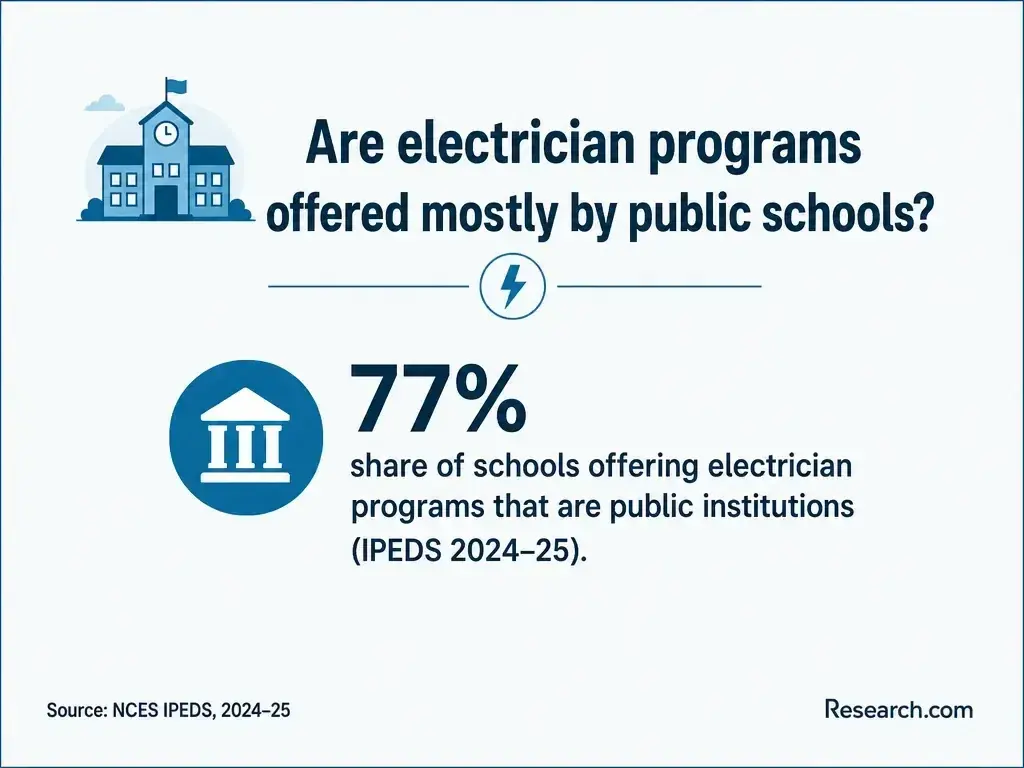
There is no single responsible national price for "electrician trade school": a short certificate, a community-college program, and a paid apprenticeship have different cost structures. Published school tuition also excludes expenses that can change the cheapest choice. Compare a written cost to become job-ready, not a tuition figure alone.
Ask each provider for an itemized estimate covering tuition and mandatory fees; books and software; tools, meters, consumables, and personal protective equipment; any examination or licensing fees; and travel to labs or worksites. Add income you would forgo while studying. Then subtract grants, scholarships, employer-paid items, and wages you realistically expect during paid training. Federal Student Aid explains that aid eligibility depends on both the student and the eligible school and program; do not assume every trade provider participates.
Resources about cheap online schools that accept fafsa can help explain why aid eligibility matters, but they cannot establish whether a particular electrician program qualifies. Confirm participation with that program's financial-aid office, and ask a local workforce agency whether training assistance is available. If borrowing, compare debt and likely completion as well as price.
A school may award a certificate, diploma, or associate degree. A registered apprenticeship awards a completion credential through its registered sponsor; some programs also offer industry credentials, such as NCCER credentials, where applicable. These credentials document training, but they are not interchangeable with an occupational license (U.S. Department of Labor; NCCER).
Read the exact award name and transcript or training record before paying. Ask whether employers recognize it, whether completed coursework can be applied to a later program, and whether an apprenticeship sponsor grants advanced standing. Academic comparisons such as easy phd programs do not help establish electrician licensing eligibility; documented electrical instruction and supervised experience are the relevant records.
Requirements vary by provider. A school may require a high school diploma or equivalent, a placement assessment, or evidence that you can safely participate in labs. An apprenticeship sponsor may additionally assess math preparation, interview applicants, and require applicants to meet its employment and worksite conditions. Check the school or sponsor's published requirements rather than assuming one application process applies nationwide.
If you need income immediately, compare the timing of a school start date with apprenticeship openings. If you need math preparation first, ask whether an adult education or pre-apprenticeship option offers a lower-cost route into the sponsor's selection process. Confirm any age, driver's-license, physical, or background-screening conditions with the specific provider or employer; do not pay a deposit based only on a general advertisement.
Typical instruction includes electrical quantities and calculations, circuit diagrams, wiring and raceway methods, equipment installation, troubleshooting, code use, and jobsite safety. Labs should turn that knowledge into observable skills: selecting materials, using test equipment, identifying faults, and checking work safely. The U.S. Bureau of Labor Statistics describes reading technical diagrams, installing and maintaining wiring, and inspecting electrical components as core electrician tasks.
Ask to see the lab syllabus and equipment, not just a course-title list. A program aimed at residential wiring may be a poor match if your goal is industrial maintenance; one emphasizing theory without substantial practice may leave more skills to learn on the job. Code editions and equipment change, so ask when instruction and lab materials were last updated.
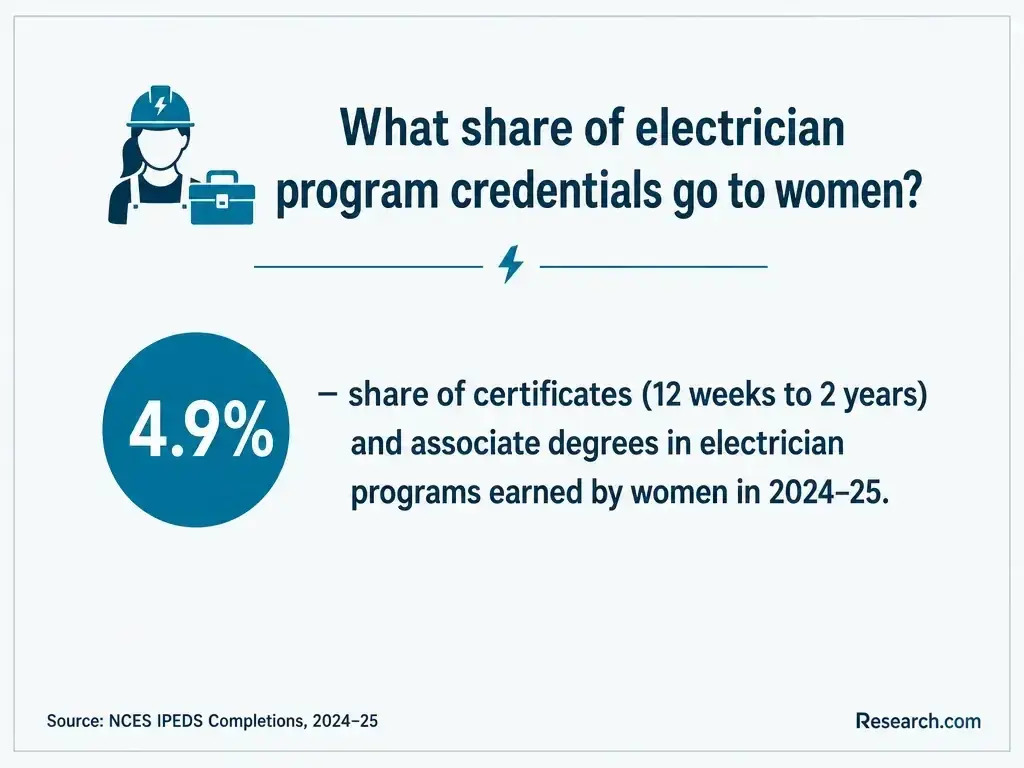
Often, yes - but the required authorization depends on the state, locality, work performed, and stage of training. An apprentice or trainee may work under supervision before qualifying for an independent credential. Journeyman or master electrician progression can involve documented experience and examinations. There is no single national electrician license; verify requirements with the authority where you intend to work (U.S. Bureau of Labor Statistics; relevant state licensing board).
The differences can affect which school is worth buying. Texas requires 8,000 hours of supervised experience and an examination for its journeyman electrician license (Texas Department of Licensing and Regulation). California uses an electrician certification system and has rules governing electrician trainees and qualifying instruction (California Department of Industrial Relations). A program suitable for one state should not be assumed to satisfy another state's requirements or reciprocity rules.
Keep the categories separate: institutional accreditation concerns the school; state school authorization concerns permission to operate; industry credentials recognize particular training; apprenticeship registration concerns the sponsor and training arrangement; and occupational licensure or certification governs work under the relevant law. None automatically substitutes for another. Obtain written clarification on how a program's coursework and supervised hours apply before enrolling.
Start with the job and state you want, then work backward to the required experience. The least expensive ranked school is worth considering only if its schedule, practical instruction, and employer connections help you reach that goal at a manageable total cost. Institutional accreditation may matter for aid or credit transfer, but it does not itself establish licensing eligibility.
Use the following checks with each finalist and at least one local apprenticeship sponsor. Written answers make it easier to spot differences hidden by similar program names.
- Ask the state licensing authority which trainee registration, classroom instruction, supervised experience, and examinations apply to your intended work.
- Request the program's award, total hours, in-person lab requirements, completion requirements, and written explanation of any apprenticeship credit or advanced standing.
- Get an itemized cost and aid estimate, including tools, protective gear, transportation, and the effect of your study schedule on earnings.
- Ask for recent completion and placement definitions, the employers or sponsors involved, and whether a paid direct-entry route is available instead.
Red flags include promises of automatic licensure, an "online-only" practical qualification with no verified skills assessment, or a tuition quote that omits mandatory equipment. A ranking cannot resolve those issues for you. If your goal is immediate paid electrical experience, a suitable apprenticeship may be a better investment than a separate school program; if you need foundational instruction or a more accessible entry point, a local technical program may be worth its added cost.
A common progression is supervised trainee or apprentice work, followed by qualification for broader electrician duties under applicable state rules. With experience, electricians may move toward troubleshooting-intensive maintenance, industrial systems, supervisory work, or contracting. Additional licenses and examinations may be required for some roles; safety and manufacturer training may improve specific skills without replacing those legal requirements (U.S. Bureau of Labor Statistics; relevant state licensing board).
Choose training that matches your next step, not a distant title. Someone interested in industrial work should look for motor controls, diagnostics, and relevant employer exposure; someone aiming for residential service should prioritize wiring practice, customer-facing troubleshooting, and the local licensing route. Searches about what masters degree makes the most money address a different investment decision and should not be used to estimate returns from electrician training.
U.S. electrician employment is projected to grow 9.2% from 2025 to 2035 (U.S. Bureau of Labor Statistics, Employment Projections). The projection points to national demand, not guaranteed openings near a particular school or immediate employment for every graduate.
Test that outlook against your intended labor market. Ask sponsors whether they are accepting apprentices, review local entry-level postings for experience and licensing requirements, and consider how far you can travel for jobsites. Strong national demand does not erase a local shortage of training positions; conversely, willingness to commute or relocate may widen your options.
Most Affordable Electrical Technician Schools & Training for 2027
Investing in electrician training is an important decision, and a low advertised price does not necessarily mean a low cost to become job-ready. Research.com created this ranking to help readers compare affordable programs against other electrician programs in the same geographic market. The team checks multiple education and occupational sources for credible, comparable information; readers should still confirm current prices and licensing details directly before enrolling.
The most affordable ranking evaluates tuition, cost of attendance, median student debt, and federal loan default rate. Indicator weights are assigned through an entropy-based method, which gives more weight to measures that vary more across programs. Accreditation, training quality, and employment outcomes are not included in the affordability score. Only programs reporting completions to IPEDS are eligible, so the ranking does not represent every trade school, union training center, employer program, or registered apprenticeship.
Research.com also publishes best programs rankings, which use a different model: 20% for occupation-relevant programmatic accreditation or industry recognition, 10% for institutional accreditation, 10% for student support, and 60% for student outcomes, earnings, and costs, with that final share distributed using the entropy-based method. That model considers completion and retention, earnings after completion, earnings relative to annual attendance cost, tuition, debt - including debt among students who withdrew - and loan default rates. Do not interpret an affordability position as a quality or licensing endorsement.
The ranking draws on the following data sources. Some cover occupations other than electrical work; their inclusion among Research.com's sources does not imply that a health-related accreditor approves electrician programs.
- IPEDS database - program completions and institution-reported education data.
- National Center for Education Statistics - federal education data and definitions.
- College Scorecard database - available institution-level costs, debt, and outcomes.
- Peterson's database - supplementary institution and program information.
- Commission on Accreditation of Allied Health Education Programs (CAAHEP) - accreditation information relevant to allied health, not electrician licensure.
- Accrediting Bureau of Health Education Schools (ABHES) - accreditation information relevant to health education.
- Commission on Dental Accreditation (CODA) - dental-program accreditation information.
- Dental Assisting National Board (DANB) - dental-assisting credential information.
- National Center for Construction Education and Research (NCCER) - construction-training and credential information potentially relevant to electrical training.
- Apprenticeship.gov Partner Finder - a way to identify apprenticeship partners beyond college-based programs.
Use the ranking to narrow your search, then compare each finalist's full job-ready cost, hands-on instruction, apprenticeship connections, and eligibility under the rules where you intend to work. More information about Research.com's approach appears on its methodology page.
# 2 position
Wiregrass Georgia Technical College - Electrician.
certificate or diploma# 3 position
Brazosport College - Electrician.
associate
# 4 position
Brazosport College - Electrician.
certificate or diploma # 5 position
Laredo College - Electrical and Power Transmission Installation/Installer, General.
certificate or diploma
# 6 position
Laredo College - Electrician.
certificate or diploma # 7 position

# 8 position

# 9 position
# 10 position
Metropolitan Community College Area - Electrician.
certificate or diploma # 12 position

# 13 position
Central Arizona College - Electrician.
certificate or diploma# 14 position
Southeast Community College Area
associateElectrician
Delivery mode: On Campus (May Include Online Courses)
91.07
/ 100
Final score
- School graduation rate
- 39%
- Students receiving Pell Grants
- 24%
- In-state tuition & fees (per year)
- $3,000
- Out-of-state tuition & fees (per year)
- $3,504
- School website
- southeast.edu
Accreditation
Institutional accreditation from Higher Learning Commission.
Southeast Community College Area earned a Research.com Affordability Score of 91.07/100, supported by $3,000 annual in-state tuition and $5,500 median student debt.
# 15 position
Southeast Community College Area - Electrician.
certificate or diploma
# 16 position
Oakland Community College - Electrician.
associate# 17 position
Oakland Community College - Electrician.
certificate or diploma# 18 position
Pima Community College - Electrical and Power Transmission Installation/Installer, General.
certificate or diploma
# 19 position
Pima Community College - Electrician.
certificate or diploma # 20 position
Macomb Community College - Electrician.
certificate or diploma
Frequently asked questions about electrician programs in the USA
Is electrician trade school necessary to become an electrician?
Not always. A registered apprenticeship or employer-sponsored route may provide paid entry and required instruction without a separate school credential. Check your state's rules and local sponsor openings before choosing.
Will a trade school certificate qualify me for a journeyman license?
Usually not by itself. A state may also require documented supervised experience, registration, and an examination. Ask its licensing authority whether the specific program's instruction counts.
Are electrician apprenticeships free?
They are paid work-based training, but costs vary. Ask about instruction charges, tools, dues where applicable, transportation, and wages before comparing an apprenticeship with school.
Can I complete electrician training entirely online?
Theory may be available online, but practical electrical skills and supervised work require in-person participation. Verify a program's lab and worksite arrangements before enrolling.
What is the cheapest useful route into the trade?
Compare the full cost of a local school program with paid apprenticeship or employer-sponsored entry. The cheapest useful route is one you can access and complete that provides recognized training and a viable path to your state's requirements.
- U.S. Bureau of Labor Statistics - Electricians
Used to verify salary, employment outlook, and typical education requirements.
https://www.bls.gov/ooh/construction-and-extraction/electricians.htm - Apprenticeship.gov - Partner Finder
Used to verify programmatic accreditation or industry recognition of programs.
https://www.apprenticeship.gov/partner-finder - O*NET OnLine - Electricians
Used to verify common responsibilities, skills, work settings, and education expectations.
https://www.onetonline.org/link/summary/47-2111.00 - Wiregrass Georgia Technical College - official website
Official school website (programs, tuition, admissions).
https://www.wiregrass.edu/ - Brazosport College - official website
Official school website (programs, tuition, admissions).
https://www.brazosport.edu/ - Laredo College - official website
Official school website (programs, tuition, admissions).
https://www.laredo.edu/index.html - Hutchinson Community College - official website
Official school website (programs, tuition, admissions).
https://www.hutchcc.edu/ - Metropolitan Community College Area - official website
Official school website (programs, tuition, admissions).
https://www.mccneb.edu/