# 1 position


Audited and Verified:
Our Editorial and Data Verification Process
Research.com uses government datasets, official education statistics and primary institutional information to support its career and degree guides. Our review process checks factual accuracy, occupational definitions, source dates and the requirements associated with the credentials discussed.
How This Article Was Fact-Checked
Our editorial team verifies salary estimates, employment projections, education requirements and program information against original data providers and official organizations. Salary figures are checked against the relevant occupational definitions and reporting periods. Information about licensure, accreditation and required in-person training is reviewed separately.
Fact-checked and verified on:

Co-Founder and Chief Data Scientist

Reviewed by Karolina Broda
Fact-Checker and Data Verification
An inexpensive electrician program is only a good deal if it teaches the practical skills you need and fits your path into paid electrical work. The U.S. Bureau of Labor Statistics projects electrician employment to grow 9.2% nationally from 2025 to 2035, making training choices especially consequential. This guide compares Kansas certificates, associate degrees, and apprenticeships, including costs, hands-on experience, and local licensing. It also accompanies the Most Affordable Electrician Trade Schools in Kansas for 2027 ranking, created by the Research.com team of data scientists to help students identify programs worth considering.
Expect instruction in electrical theory alongside supervised practice: reading plans, selecting wire and conduit, installing devices, testing circuits, and following electrical and job-site safety procedures. A short certificate may prepare you to seek an entry-level helper or apprentice position. An associate degree generally adds broader technical coursework. Neither should be mistaken for the extensive work experience involved in an apprenticeship.
The central question is what happens after completion. Ask whether the provider arranges interviews, has an apprenticeship connection, or can document lab and classroom hours for a prospective sponsor or local licensing authority. A lower-priced program with little hands-on work may cost more in time if you must repeat training elsewhere.
Compare pathways by the result you need, not by credential name alone:
| Pathway | Typical outcome | Best fit and main limitation |
| College or career-school certificate | Foundational training credential | Useful for exploring the trade or preparing to apply for entry-level work; supervised employment may still be needed. |
| Associate degree | Academic degree with electrical training | Useful if its added technical coursework serves your goals; check whether the extra time and cost improve your intended entry route. |
| Registered apprenticeship | Paid, structured on-the-job training and related instruction | Strong fit for applicants ready to work while learning; openings, entry requirements, and work locations depend on the sponsor. |
Electrical contractors employ people on residential, commercial, and industrial projects; other possibilities include facility maintenance, manufacturing, and utility-related work. The U.S. Bureau of Labor Statistics describes electricians as installing, maintaining, and repairing electrical power, communications, lighting, and control systems. The exact work you may perform independently depends on your experience and the rules where the job is located.
Location affects access to training as well as jobs. Someone near the Kansas City area may be able to compare more nearby contractors and training sites, while a rural student may need to travel farther for labs or supervised worksites. Before enrolling, compare the campus location with the location of any required apprenticeship or employer placement - not just the nearest classroom.
For a national benchmark, the median annual wage for electricians was $63,190 in May 2025 (U.S. Bureau of Labor Statistics, Occupational Outlook Handbook). That figure covers electricians across experience levels and should not be used as an expected first-year paycheck in Kansas. Pay for a new helper or apprentice, an experienced electrician, and a person running a contracting business can differ substantially.
For a Kansas-specific decision, check the latest state occupational wage estimates and current local apprentice or employer pay scales for the area where you intend to work. Compare those figures with your likely starting pay, not solely the occupation-wide median. Overtime, travel, benefits, and the amount of paid work available during training can materially change the value of an offer.
A certificate can take substantially less time than an associate degree, but calendars and required contact hours vary by program. Registered electrician apprenticeships commonly take several years because they combine related instruction with extensive paid, supervised work; the U.S. Bureau of Labor Statistics describes the typical apprenticeship as lasting four to five years. Finishing a shorter school program does not shorten a sponsor's work requirements automatically.
Ask for the published calendar, total classroom and lab hours, and the number of hours spent actually installing, troubleshooting, or testing equipment. If faster entry is your priority, compare the date you could start paid electrical work, not just graduation dates. A search for an accelerated bachelors degree addresses a different educational goal; acceleration alone cannot substitute for supervised electrical experience.
Online instruction can suit electrical theory, calculations, code study, and some safety coursework. Wiring, conduit bending, instrument use, troubleshooting, and worksite safety require physical practice and assessment. A hybrid program can be practical if its in-person labs and employer placements are accessible from where you live; an entirely remote curriculum should not be treated as equivalent to supervised hands-on training.
When considering the best accredited trade schools online, verify the electrician program's lab schedule, required travel, and how it connects students with supervised work in Kansas. Institutional accreditation concerns the school; it does not by itself establish that a local licensing jurisdiction or apprenticeship sponsor will accept its coursework.
There is no single reliable statewide price that covers college certificates, associate degrees, private training, and paid apprenticeships on the same basis. Published tuition also may not be the amount you spend to become job-ready. Request a written, program-specific estimate for your residency status and intended schedule before comparing offers.
The estimate should separate school charges from expenses you may incur elsewhere:
Federal aid depends on both student and program eligibility (Federal Student Aid). Ask the financial-aid office whether the specific electrical credential qualifies, and check Kansas Promise Scholarship eligibility and obligations with the institution and Kansas Board of Regents rather than assuming every program is covered. For a realistic return-on-investment comparison, consider completion likelihood, expected starting wages, debt, time spent training, and how long you expect to work after training; a low tuition figure alone cannot answer whether the investment is worthwhile.
Depending on the provider, completion may lead to a certificate, diploma, or associate degree. A registered apprenticeship has a different structure: its sponsor records related instruction and supervised work toward an apprenticeship completion credential (U.S. Department of Labor, Apprenticeship.gov). An optional industry training credential, such as one associated with NCCER, is distinct from both a school award and permission to work independently.
Get the exact credential name in writing. Then ask a prospective employer or apprenticeship sponsor whether it recognizes the training and grants any advanced standing. Recognition and credit are not automatic. Even if you are also asking what is the easiest online degree to get, the more useful electrical-trade question is whether the credential includes verifiable practical training and advances your intended work pathway.
Entry rules depend on the school or apprenticeship sponsor. Programs may assess reading and math readiness; applicants may also need to meet a minimum age, provide prior education records, or satisfy a prospective employer's work and safety requirements. Do not assume admission to a school also secures an apprenticeship position or a job.
Before paying a deposit, request the current admissions checklist and ask whether placement testing affects when you can begin electrical labs. For an apprenticeship, ask separately about application windows, selection steps, required transportation, and where work assignments take place. Those details can matter more to a working applicant than the school's application deadline alone.
Core topics generally include electrical math, circuit theory, blueprint reading, wiring methods, overcurrent protection, testing, and safe use of tools. Instruction should also teach students to find and apply the electrical code adopted by the jurisdiction where they will work. Because adopted code editions and local amendments can differ, ask what edition the program teaches and how it keeps instruction current.
A useful lab gives students repeated opportunities to build circuits, make terminations, use a meter safely, identify faults, and correct their work under supervision. Ask to see the equipment list and sample lab activities. A course that covers these topics only through videos may help with theory but is a weak substitute for assessed physical practice.
Kansas does not have one statewide journeyman electrician license that makes local rules uniform. Electrical licensing and registration requirements can vary by city or other jurisdiction, including rules governing supervised work, examinations, and contractor activity (Kansas municipal licensing authorities). Check the authority for the location where you plan to work before selecting training, particularly if you expect to cross jurisdictional lines.
A school's institutional accreditation, an industry certificate, registration in a U.S. Department of Labor apprenticeship, and an occupational license are different things. None should be presented as a substitute for another. Ask the local licensing office what documented education and experience it accepts, what examination applies, and whether work completed elsewhere can be credited. Ask the program or sponsor how it will document your hours; graduation alone should not be assumed to confer independent-work eligibility.
Start with your intended first job and work backward. If you need a structured route into paid work, compare apprenticeship openings with school programs. If you need foundational skills before applying, a certificate may make sense; an associate degree warrants a closer look when its additional coursework advances a specific technical goal. Do not choose on a ranking position or institution type alone.
Use these checks when speaking with admissions staff and apprenticeship coordinators:
A list of top universities online is not a substitute for those checks: electrician training depends heavily on accessible labs, worksite experience, and acceptance by the relevant local authorities. A red flag is a provider promising that a short online certificate alone qualifies you to work independently without identifying the applicable jurisdiction and requirements.
An initial certificate can support applications for helper or apprentice roles. With supervised experience and any locally required credentials, an electrician may pursue residential service, commercial construction, industrial maintenance, controls work, supervision, or contracting. Those are possible progressions, not outcomes automatically awarded with a school credential. Business ownership can bring additional local contractor requirements and costs.
Specialization should shape your training choice: someone interested in industrial equipment should inspect the program's motor controls and troubleshooting labs, while a residential applicant should examine its installation practice and contractor connections. Comparisons with 4 year degrees that make the most money cannot establish the return on an electrician certificate or apprenticeship; the relevant comparison includes training time, paid work, local wages, completion, and debt.
National electrician employment is projected to grow 9.2% from 2025 to 2035 (U.S. Bureau of Labor Statistics, Employment Projections). That signals broad demand but is not a Kansas placement rate or a promise of an opening in your preferred town. Construction activity, facility maintenance needs, and apprenticeship hiring can vary across local labor markets.
Use the latest Kansas labor-market projections alongside current postings and sponsor recruitment information for the area where you can realistically travel. If openings nearby are limited, ask whether a program's employer network extends to locations where you would accept work. That check is especially important before committing to an unpaid course with substantial commuting costs.
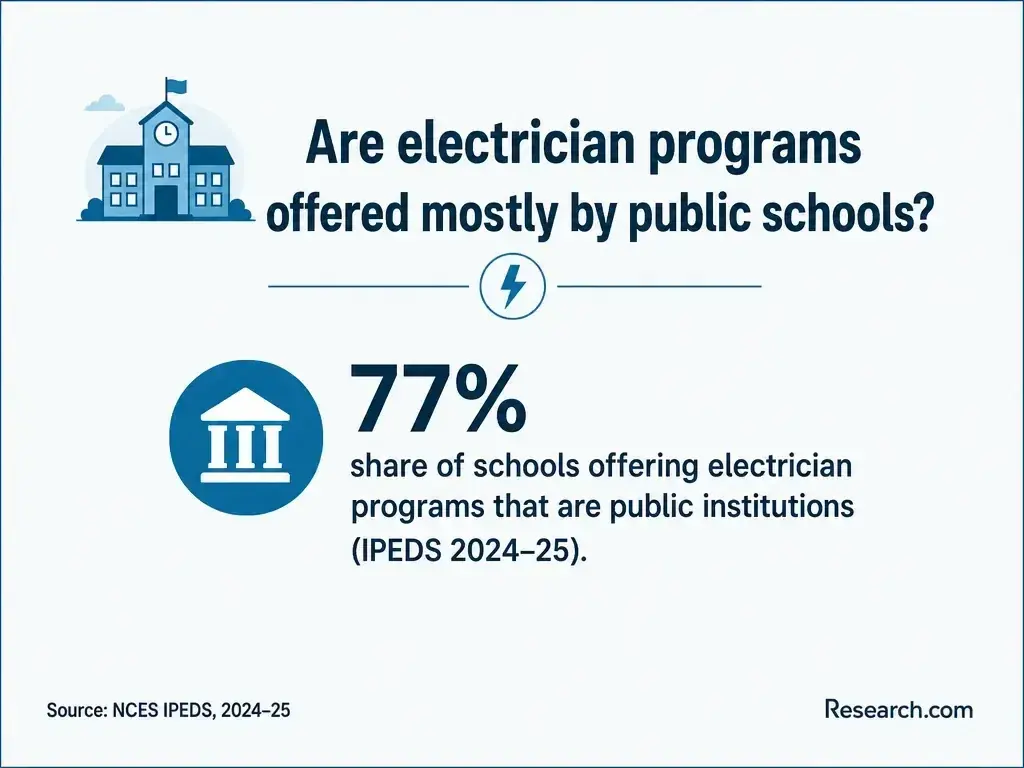
Research.com recognizes that investing in training is a significant decision. To make the ranking useful for Kansas applicants, its team compares programs with others in the same occupation and location and checks multiple education and cost sources. Only programs with completions reported to the Integrated Postsecondary Education Data System (IPEDS) are eligible; an unlisted apprenticeship or training provider is not necessarily a poor option.
The most affordable ranking uses tuition, cost of attendance, median student debt, and federal loan default rate. An entropy-based method assigns more weight to measures that differ more across eligible programs. Unlike Research.com's separate best-program rankings, affordability scores do not include accreditation or other quality measures. The ranking is therefore a cost comparison - not proof of licensing eligibility, sufficient lab time, or the lowest personal out-of-pocket bill. Readers can review the broader approach on the Research.com methodology page.
The following sources inform Research.com's ranking data and verification. Some cover other trades and do not constitute electrician-specific approval:
# 1 position
# 2 position
# 3 position
# 5 position
# 6 position
# 7 position

# 8 position
# 9 position

# 10 position

# 11 position
# 12 position

# 13 position

# 14 position
# 15 position

# 16 position

# 17 position

# 18 position
# 20 position

Not necessarily. A paid apprenticeship or employer-supported route may be available. Check the rules where you intend to work and the entry requirements of the sponsor or employer you want to join.
Do not assume so. A certificate documents school training; independent work may require documented experience, an examination, or a local license or registration. Confirm requirements with the relevant Kansas jurisdiction.
It may lower the amount you must finance because apprentices earn wages while training. Compare any instruction costs, tools, travel, starting pay, and the time it takes to obtain a position.
You can study some theory online, but installation, testing, troubleshooting, and supervised work require in-person practice. Confirm how a program provides and assesses those components.
Request its full cost, lab hours, exact credential, aid eligibility, and evidence that an employer, apprenticeship sponsor, or relevant local authority will recognize the training for your goal.