# 1 position
Southeastern Technical Institute - Electrician.
certificate or diploma

Audited and Verified:
Our Editorial and Data Verification Process
Research.com uses government datasets, official education statistics and primary institutional information to support its career and degree guides. Our review process checks factual accuracy, occupational definitions, source dates and the requirements associated with the credentials discussed.
How This Article Was Fact-Checked
Our editorial team verifies salary estimates, employment projections, education requirements and program information against original data providers and official organizations. Salary figures are checked against the relevant occupational definitions and reporting periods. Information about licensure, accreditation and required in-person training is reviewed separately.
Fact-checked and verified on:

Co-Founder and Chief Data Scientist

Reviewed by Karolina Broda
Fact-Checker and Data Verification
Choosing an electrician program in Massachusetts means checking more than tuition: will its instruction and hands-on training move you toward a state license? The U.S. Bureau of Labor Statistics projects electrician employment to grow 9.2% nationally from 2025 to 2035, making that question timely. For new entrants and career changers, this guide compares trade-school and apprenticeship routes, costs, credentials, and licensing steps. It also features a Best Electrician Trade Schools in Massachusetts for 2027 ranking created by the Research.com team of data scientists to help students identify programs worth considering.
Expect electrical theory alongside supervised practice: reading plans, working with circuits, installing wiring methods, using test instruments, and applying electrical-code and jobsite-safety rules. The important distinction is between learning a skill in a lab and earning qualifying practical experience through supervised work. Ask a provider to identify which hours are classroom education, which are lab hours, and which - if any - may count as practical experience under Massachusetts Board of State Examiners of Electricians rules.
Training routes serve different needs. This comparison separates the credential from the work experience still needed for licensing.
| Pathway | What it typically provides | Best fit and principal limitation |
| Pre-apprenticeship or short trade-school program | Foundational instruction and lab practice; often a completion credential | Useful for exploring the trade or strengthening an apprenticeship application; verify whether any instruction meets board requirements. |
| Longer technical-school or community-college program | Broader classroom and shop training; a certificate, diploma, or, where offered, an associate degree | Useful for structured preparation; a longer program can cost more and does not replace required supervised experience. |
| Registered apprenticeship | Paid, supervised work combined with related instruction and an apprenticeship completion credential | Useful for earning while training; entry depends on sponsor openings and selection requirements. |
| Employer-sponsored supervised training | Paid work with an electrician, potentially paired with separately approved instruction | Useful when a qualifying employer position is available; confirm how education and experience will be documented. |
A program is worth considering when its schedule, instruction, and connections to qualifying work make the full licensing route more achievable - not merely because it awards a credential quickly.
Electricians work for electrical contractors on construction and renovation projects and in maintenance roles at manufacturing, commercial, institutional, and public facilities (U.S. Bureau of Labor Statistics). Solar installations, building controls, and equipment upgrades can also shape the work available, but employers may require additional experience for specialized assignments. A school credential can help a candidate seek supervised entry-level work; it does not authorize independent licensed electrical work.
Location affects access to work-based training. A student considering a program around Greater Boston, another Massachusetts city, or a less densely served area should compare the commute to both classes and employer worksites. Before enrolling, ask where recent students found supervised positions and whether the program assists with placements rather than assuming nearby classes mean nearby jobs.
The U.S. Bureau of Labor Statistics reports a $63,190 national median annual wage for electricians in May 2025. This describes employed electricians across experience levels, not the likely pay of someone entering supervised training. Massachusetts applicants should compare current local apprentice wage schedules and employer offers before estimating their own earnings; hours, overtime, union agreements, specialization, and licensing status can change the result.
Pay is only one part of the decision. When comparing electrician training with other trades jobs that pay well, account for how long it takes to qualify, what you can earn while training, and the cost of reaching independent practice - not just the occupation's median wage.
A short school program may finish well before an apprenticeship, but program completion and licensing readiness are different timelines. Massachusetts' journeyman route calls for 600 hours of approved education and 8,000 hours of qualifying practical experience, generally accumulated over at least four years, before examination eligibility (Massachusetts Board of State Examiners of Electricians). Confirm current board rules and how a particular schedule satisfies them before treating an advertised completion date as a career-entry date.
Full-time instruction may get you into the field sooner, while evening study can let you keep earning as you train. Compare the date you could start supervised work, not only the date printed on a school's certificate. A search for a 1 year masters online addresses a different educational goal and should not be used to estimate the time required for this trade license.
Online instruction can suit electrical theory, calculations, code study, and some exam preparation. In-person instruction is needed to practice wiring, testing, troubleshooting, safe tool use, and other physical tasks; supervised experience must occur in qualifying work settings. A hybrid program can reduce classroom commuting without eliminating travel to labs or jobsites.
Before paying for an online course, obtain a written answer to two separate questions: whether its instruction is accepted toward Massachusetts' education requirement and where you will complete practical training. A course described as "electrician certification" is not, by that description alone, a route to state licensure (Massachusetts Board of State Examiners of Electricians).
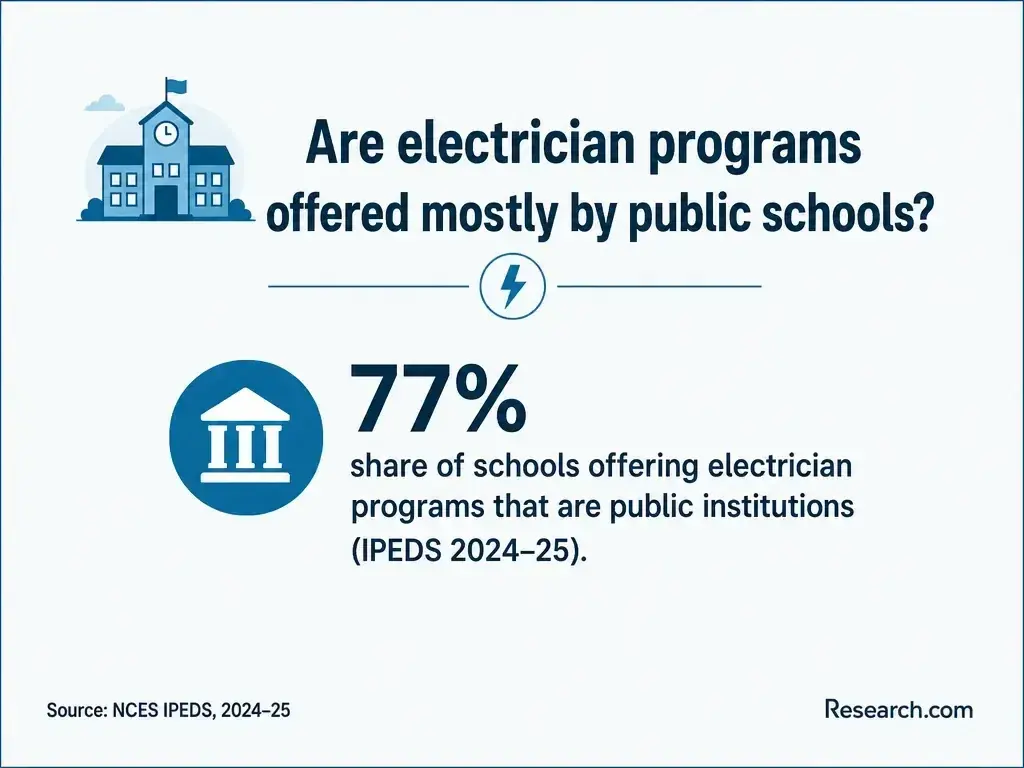
There is no single reliable statewide price for every electrician pathway: a short course, a longer technical program, and a paid apprenticeship have different charges and earnings patterns. Published tuition alone is therefore a poor comparison. Request a current, itemized estimate from each provider covering mandatory fees, books or software, tools, protective gear, consumable materials, travel to labs and worksites, and any examination or license-application costs. Confirm which purchases an employer or sponsor supplies.
To judge value, compare total out-of-pocket cost and foregone earnings with paid training, available grants, and the likelihood of completing and obtaining qualifying work. Check federal-aid eligibility with the provider and Federal Student Aid; it is not automatic for every trade course. Eligible Massachusetts residents can also ask participating public colleges about current state aid, including MassEducate, but should verify eligibility and covered expenses with the college (Massachusetts Department of Higher Education).
The award depends on the provider: it may be a pre-apprenticeship completion document, trade-school certificate or diploma, or an associate degree at a college offering that route. A registered apprenticeship has its own completion credential. None is the same as a Massachusetts journeyman electrician license. The state board determines licensing eligibility through required education, documented practical experience, and examination, not the title printed on a school credential (Massachusetts Board of State Examiners of Electricians).
Institutional accreditation concerns the institution; state school authorization concerns permission to operate; relevant approval of instruction concerns whether coursework meets licensing rules. Apprenticeship registration and individual occupational licensure are separate matters again. Ask which specific requirement a credential fulfills and request the provider's answer in writing. Searches for easiest online phd programs concern a different credential and offer no shortcut through these trade requirements.
Requirements vary by provider. Schools may ask for a secondary-school credential or equivalent, an application, and evidence of readiness for math used in electrical calculations; apprenticeships and employers may add interviews, aptitude assessments, driver's-license requirements, or jobsite eligibility checks. Request the current requirements directly rather than assuming that admission to a class secures an apprenticeship position.
If you already have electrical coursework or supervised experience, ask whether the school grants credit or advanced standing and, separately, whether the state board will recognize the underlying education or documented work. School credit does not automatically reduce Massachusetts' licensing requirements. A prospective apprentice should also ask the sponsor about selection dates and how related instruction is delivered.
Relevant training covers circuits and electrical calculations; blueprint and schematic reading; wiring methods, raceways, and equipment; testing and troubleshooting; electrical-code application; and safe work practices (U.S. Bureau of Labor Statistics; Massachusetts Board of State Examiners of Electricians). Shop exercises let students make and check installations before encountering the pace and hazards of an employer worksite.
Compare the actual lab and field components, not just course titles. For example, a troubleshooting-focused learner should look for supervised use of meters and fault-finding exercises, while a construction entrant needs practice reading plans and installing code-compliant systems. Ask to see the curriculum and required practical hours; similarly named certificates need not offer the same hands-on preparation.
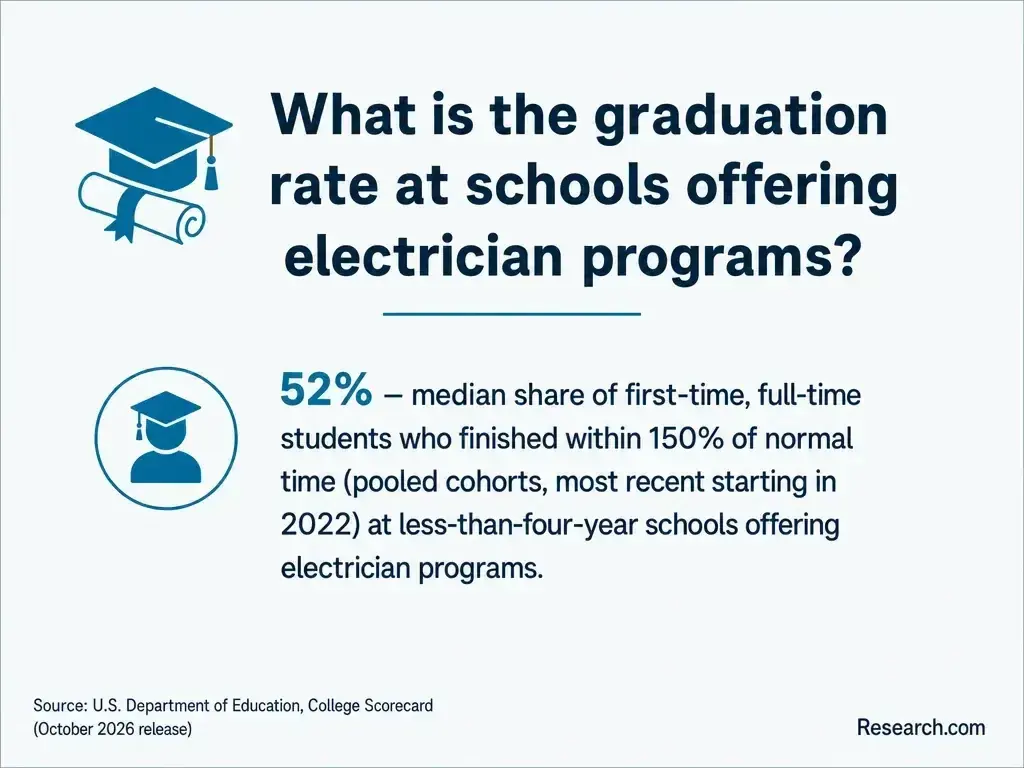
Massachusetts licenses electricians through its Board of State Examiners of Electricians. The journeyman pathway requires approved education, qualifying supervised practical experience, and a licensing examination; the board specifies 600 education hours and 8,000 practical hours for that route (Massachusetts Board of State Examiners of Electricians). Someone still accumulating experience should work within the applicable supervision and registration rules rather than assume a school certificate permits independent electrical contracting.
Journeyman licensure is a milestone, not the end of every career path. Further experience and board requirements apply to progression toward a master electrician license. An optional industry training certificate can demonstrate a skill, but it cannot replace a state license. If you may work across state lines, check the destination state's rules before assuming Massachusetts training or licensure transfers.
Start with the job you want and work backward from its licensing requirements. A school program makes sense if you need structured instruction or lab preparation and can connect it to qualifying supervised work. A registered apprenticeship may be a stronger financial fit if you can secure a place and want paid work integrated with instruction. Neither route is universally faster or cheaper.
Use these checks when speaking with admissions staff and apprenticeship coordinators; they reveal gaps a ranking or tuition figure cannot show.
A common mistake is to treat the highest-ranked or shortest program as automatically the best investment. Instead, weigh completion probability, debt, earnings while training, time to licensure, and the chance of securing supervised work. For example, a program at Southeastern Technical Institute or Benjamin Franklin Cummings Institute of Technology should be judged on its current, specific offering and documented fit with your route - not its name alone.
A realistic progression is supervised electrical work, journeyman licensure after meeting board requirements and passing the examination, and - if desired - further specialization, supervision, or master licensure. Construction, maintenance, controls, and renewable-energy work can call for different equipment familiarity and employer experience (U.S. Bureau of Labor Statistics). Starting training does not make every specialty immediately accessible.
Choose courses and worksites that build evidence for the work you want to do. Someone aiming for service troubleshooting may benefit from varied repair assignments; someone interested in large construction projects should ask about installation work and plan reading. Information about the highest paying master's degree addresses a different career investment and cannot predict returns from electrician training.
The U.S. Bureau of Labor Statistics projects 9.2% national growth in electrician employment from 2025 to 2035. That signals continuing occupational demand but is not a Massachusetts placement rate, an apprenticeship-opening count, or a guarantee of a job. Renovation, construction, and electrical-system upgrades may create different opportunities across local labor markets; compare employer openings and sponsor intake where you intend to work.
For a prospective student, the near-term constraint may be access to a qualifying supervised position rather than demand for fully trained electricians. Ask local sponsors and employers when they recruit, and consider whether you can commute to the worksites where experience is available. A search for a one year phd does not address that trade-specific bottleneck.
Education is a significant investment, so the Research.com team built the ranking to help readers compare electrician programs with other programs in the same occupation and location - not with unrelated schools nationwide. The team evaluates reported outcomes, costs, and quality indicators, while recognizing that a ranking cannot establish whether an individual program meets every student's licensing needs.
Best-program rankings assess student outcomes, including completion and full- and part-time retention; earnings and return on investment, including earnings one year after completion relative to annual attendance cost; costs and debt, including tuition, attendance cost, debt among students who withdrew, and federal loan default rates; and quality and recognition, including accreditation, relevant industry recognition, and student support. Relevant programmatic recognition receives 20% of the score, institutional accreditation 10%, and student support 10%. Outcomes, earnings, and costs share the remaining 60%, with weights distributed through an entropy-based method that gives more weight to indicators that differ more across programs. Most-affordable rankings instead score only tuition, attendance cost, median debt, and federal loan default rate using entropy-based weights; accreditation and other quality measures are not part of that score.
The ranking draws on the following databases and organizations. Some occupation-specific sources cover fields other than electrical work; their inclusion in the broader methodology does not make those credentials relevant to Massachusetts electrician licensure.
Only programs with completions reported to IPEDS enter the ranking. That boundary makes comparisons more consistent, but it excludes some union, employer-sponsored, and other apprenticeship training; exclusion does not mean a pathway is unapproved or inferior. Readers can use the ranking as a shortlist, then verify licensing alignment, current costs, and available training places. Research.com explains its approach further on its methodology page.
# 1 position
# 2 position

No. School can provide required instruction and practical preparation, but journeyman licensure also requires qualifying supervised experience and an examination (Massachusetts Board of State Examiners of Electricians).
Not necessarily. Registered apprenticeships combine work and instruction, and sponsors set their own entry criteria. Prior coursework may help an application, but confirm whether a sponsor recognizes it.
Do not assume so. Ask the Massachusetts board or provider whether the specific instruction qualifies, and arrange in-person practical training and supervised work separately.
It can lower foregone earnings because apprentices work while training, but compare sponsor charges, tools, travel, wages, and access to an opening against the school's full cost.
No. Accreditation, school authorization, approval of qualifying instruction, apprenticeship registration, and an individual electrician license serve different purposes. Verify each one that applies to your intended route.