# 1 position


Audited and Verified:
Our Editorial and Data Verification Process
Research.com uses government datasets, official education statistics and primary institutional information to support its career and degree guides. Our review process checks factual accuracy, occupational definitions, source dates and the requirements associated with the credentials discussed.
How This Article Was Fact-Checked
Our editorial team verifies salary estimates, employment projections, education requirements and program information against original data providers and official organizations. Salary figures are checked against the relevant occupational definitions and reporting periods. Information about licensure, accreditation and required in-person training is reviewed separately.
Fact-checked and verified on:

Co-Founder and Chief Data Scientist

Reviewed by Karolina Broda
Fact-Checker and Data Verification
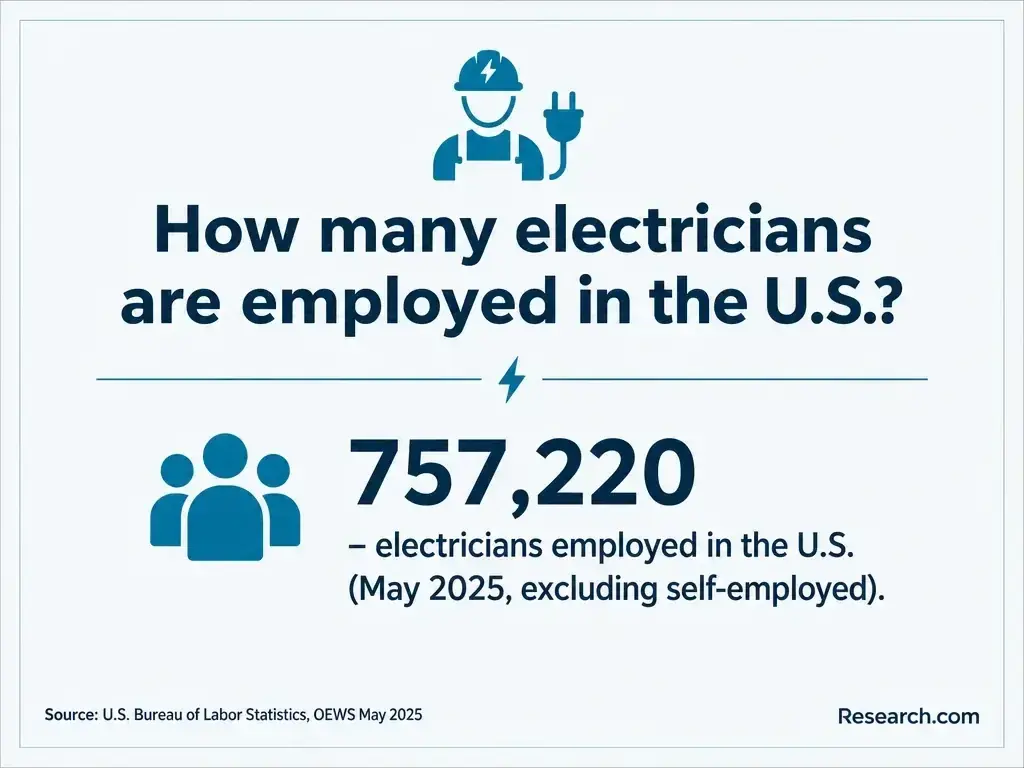
The cheapest electrician program is not necessarily the least expensive route to a Colorado license. Tuition matters, but so do paid work experience, classroom instruction, tools, and the time it takes to qualify for an exam. The Research.com team of data scientists created the Most Affordable Electrician Trade Schools in Colorado for 2027 ranking to help students identify programs worth considering. With U.S. electrician employment projected to grow 9.2% from 2025 to 2035, this guide helps you compare training costs against the requirements of the job you want (U.S. Bureau of Labor Statistics).
Expect a combination of electrical theory and physical practice: reading plans, applying the National Electrical Code, calculating circuits, installing conduit and wiring, using test instruments, and working safely around energized systems. A useful program lets you practice these tasks in a lab or shop, not merely watch demonstrations. Ask how much instruction is hands-on and whether the equipment reflects residential, commercial, or industrial work.
The crucial distinction is between school training and supervised employment. A certificate may prepare you to seek an apprentice position, while a registered apprenticeship combines related instruction with paid on-the-job training. Colorado's licensing board evaluates documented experience and other applicable qualifications, not a certificate title alone (Colorado State Electrical Board). If you already have an employer willing to train and supervise you, compare that route before paying for a standalone program.
Electrical contractors hire apprentices for residential and commercial construction; industrial employers and facilities teams need workers who can maintain electrical systems. Renewable-energy installations can also involve electrical work, though the tasks and supervision depend on the employer. Colorado's Front Range offers a different mix of job sites and commuting demands than smaller communities or mountain areas. Before choosing a campus, ask where its apprenticeship partners and worksites are: a nearby classroom is less useful if supervised work requires a costly daily drive.
Entry-level training does not authorize independent contracting or unsupervised electrical work. Confirm the applicable registration, supervision, and contractor-license rules with the Colorado State Electrical Board before accepting work or planning self-employment.
Colorado pay varies by experience, license, employer, specialty, and work location. For a reliable benchmark, the U.S. median annual wage for employed electricians was $63,190 in May 2025 (U.S. Bureau of Labor Statistics, Occupational Outlook Handbook). That is not a Colorado starting wage or an estimate of what a new apprentice will earn.
Compare local apprentice wage schedules and actual job postings with your expected school costs. A higher eventual journeyman wage cannot by itself justify a costly program if that program does not help you secure supervised hours. For broader career comparisons, highest paying job in trade school discussions are most useful when you also account for the time and licensing steps needed to reach experienced-worker pay.
A pre-apprenticeship or school certificate can finish sooner than an associate degree, but completion time is not the same as time to licensure. For Colorado journeyman eligibility, the board generally requires 8,000 hours of documented experience over at least four years, including a specified amount of commercial or industrial work, plus applicable classroom instruction and an examination (Colorado State Electrical Board). Verify the current requirements for your circumstances directly with the board.
Ask a program when you can begin paid, supervised work and how it documents classroom and field hours. An accelerated course may get you ready to apply for jobs sooner, but it cannot compress the board's minimum experience period. That is why comparisons with a top associate degree in 6 months online accredited do not describe the timeline for becoming a Colorado journeyman electrician.
Online instruction can work for code study, mathematics, plan reading, and exam preparation. Conduit bending, wiring, testing, troubleshooting, and safe work practices require physical equipment and supervised practice. A hybrid option may suit someone already employed in the trade if it schedules accessible labs and coordinates with their work-based training.
Before comparing online tuition, confirm where every required lab occurs and who verifies practical skills and work hours. An entirely online course should not be treated as a substitute for Colorado's experience and licensing requirements (Colorado State Electrical Board). Guides to which online college is the cheapest can inform a general price search, but electrical training also depends on the cost and availability of in-person practice.
There is no single responsible statewide price for "electrician trade school": a short certificate, an associate degree, and a paid apprenticeship have different lengths and funding structures. Published tuition also may exclude what you need to become job-ready. Request an itemized estimate for each option that includes the following costs:
Public-college resident rates may differ from nonresident rates; confirm your classification and the current program-specific price with the provider. Ask its aid office about federal aid eligibility and Colorado assistance, and ask apprenticeship sponsors what instruction or tools they pay for. Do not compare a school's tuition-only quote with an apprenticeship's wage-inclusive offer as though they measure the same cost.
The answer depends on the route. A school may award a certificate, diploma, or associate degree. A registered apprenticeship documents completion of its structured work and related instruction. Industry credentials, such as those associated with NCCER training, are separate from academic awards and from state occupational licenses (National Center for Construction Education and Research; U.S. Department of Labor).
Choose the credential for the work it enables, not its name. A short certificate can be worthwhile if it teaches practical entry skills and helps you obtain a supervised position. An associate degree may fit someone seeking broader technical coursework, provided its additional time and cost serve a clear goal. Research on certificates that pay well should not be read as evidence that any particular certificate grants independent electrical-work privileges in Colorado.
Schools set their own admission rules; apprenticeship sponsors and employers set separate hiring or entry criteria. Expect to check prerequisites in mathematics, reading, and physical job-site readiness, but do not assume every provider uses the same test or requires previous electrical experience. Ask whether you need tools before the first class and whether the schedule accommodates paid work.
For an apprenticeship, confirm how applicants are selected, when the next intake opens, whether employment is arranged or must be secured independently, and how apprentice registration is handled. School admission is not the same as apprenticeship placement or permission to perform unsupervised electrical work (Colorado State Electrical Board; U.S. Department of Labor).
Core instruction typically covers electrical theory, circuit calculations, blueprint reading, code interpretation, grounding, wiring methods, motor controls, testing, and job-site safety. The mix matters: someone targeting commercial work should ask for meaningful exposure to conduit, larger systems, and commercial plans, rather than assuming a residential-focused course is equivalent.
Request a syllabus and a lab schedule. Ask students to demonstrate or document actual installation and troubleshooting tasks, and ask the provider how instructors assess safe tool use. Code knowledge is essential, but an exam-preparation course alone does not supply the supervised field experience Colorado requires for a journeyman license (Colorado State Electrical Board).
Colorado regulates electrical work. An apprentice works under applicable registration and supervision rules; journeyman and other license categories have distinct experience and examination requirements. The Colorado State Electrical Board generally requires journeyman applicants to document 8,000 hours of experience over at least four years, including commercial or industrial work, as well as applicable classroom instruction. Requirements for residential-wireman and master licenses differ (Colorado State Electrical Board).
Do not confuse five separate checks: whether a school is authorized to operate; whether it holds institutional accreditation; whether an electrical curriculum has relevant industry recognition; whether an apprenticeship is registered; and whether you meet the board's licensing requirements. None automatically substitutes for another. Before enrolling, ask the board and provider how coursework and documented work experience will be evaluated for your intended license. If you may move, check the destination state's rules rather than assuming your training or eventual license transfers automatically.
Start with your target: entry into a paid apprenticeship, residential electrical work, or eventual journeyman licensure with commercial experience. Then compare the program's real contribution to that goal. An affordability ranking is a useful shortlist, but it cannot tell you whether a lab is strong or an employer will accept your training.
Use these questions when contacting each provider and an apprenticeship sponsor:
A common mistake is paying extra for speed without asking whether the program shortens the path to employment, rather than merely shortening classroom time. Another is treating accreditation as proof of licensing eligibility. Estimate value using completion likelihood, aid, debt, wages during training, expected earnings afterward, and the time required to reach licensure - not tuition or a salary headline alone. Searches for shortest masters programs online concern a different educational path; they cannot answer whether electrician training provides the required practical experience.
Many entrants begin with supervised apprentice work, then pursue a license suited to their documented experience and examination results. From there, work may branch into residential service, commercial construction, industrial maintenance, or specialized electrical systems. Supervisory work and independent contracting can require further experience and separate licensing or business compliance; neither follows automatically from finishing school (Colorado State Electrical Board).
A school-first route may suit someone who needs foundational practice before approaching employers. Direct entry into a paid apprenticeship may make more sense if an employer or sponsor will provide structured instruction and supervised hours. Ask about advanced standing for prior coursework or experience, but obtain a written explanation of what the sponsor accepts and what the licensing board will count.
The U.S. Bureau of Labor Statistics projects 9.2% growth in electrician employment from 2025 to 2035. This national projection signals continuing demand for the occupation, not a guaranteed opening in a particular Colorado community or a forecast for any one school's graduates.
For a local decision, compare current postings and apprenticeship intakes in the areas where you can realistically commute. Look at the type of work advertised - residential construction, commercial installation, or maintenance - because that affects which labs and work placements are most valuable. Check Colorado labor-market information for updated state projections before committing to a location or specialty.
Investing in electrician training is a consequential decision. Research.com's affordability ranking is designed to make costs and borrowing easier to compare among Colorado programs with electrician-program completions reported to the Integrated Postsecondary Education Data System (IPEDS). Programs are evaluated against other programs in the same occupation and location; providers without reported IPEDS completions are not included, even if they offer valid apprenticeship or employer training.
Most-affordable rankings use tuition, cost of attendance, median student debt, and federal loan default rates. Indicator weights are assigned through an entropy-based method, which gives more weight to measures that vary more across included programs. Accreditation, student outcomes, and industry recognition are not part of the affordability score. Research.com also produces separate best-program rankings using outcomes, earnings, costs, accreditation, recognition, and support services; readers should not mistake those quality measures for this ranking's criteria.
The Research.com team uses the following sources in its ranking research and verification. Some occupation-specific organizations in this shared source set do not assess electrician programs; their inclusion does not imply that they accredit or approve electrical training.
The ranking can help you narrow a cost-conscious shortlist, not determine whether a program meets Colorado licensing requirements or offers the best employment outcome. Check those questions separately before enrolling. Research.com explains its broader ranking approach on its methodology page.
# 1 position
# 2 position
Electrical and Power Transmission Installation/Installer, General
Delivery mode: On Campus (May Include Online Courses)
81.14
/ 100
Final score
Accreditation
The school is listed on Apprenticeship.gov as a Registered Apprenticeship partner. Institutional accreditation from Higher Learning Commission.
Red Rocks Community College earned a Research.com Affordability Score of 81.14/100, supported by $4,000 median student debt and 8% federal loan default rate. The school is listed on Apprenticeship.gov as a Registered Apprenticeship partner.
# 3 position
# 4 position
Electrician
Delivery mode: On Campus (May Include Online Courses)
80.44
/ 100
Final score
Accreditation
The school is listed by NCCER as a training center for this trade. Institutional accreditation from Higher Learning Commission.
Pikes Peak State College earned a Research.com Affordability Score of 80.44/100, supported by $4,662 annual in-state tuition and $4,000 median student debt. The school is listed by NCCER as a training center for this trade.
# 6 position

# 7 position
# 8 position
# 9 position
# 10 position
Electrician
Delivery mode: On Campus (May Include Online Courses)
25.19
/ 100
Final score
Accreditation
The school is listed by NCCER as a training center for this trade. Institutional accreditation from Accrediting Commission of Career Schools and Colleges.
Lincoln College of Technology-Denver received a Research.com Affordability Score of 25.19/100. The school is listed by NCCER as a training center for this trade.
No single school credential substitutes for Colorado's documented experience, applicable classroom instruction, examination, and licensing requirements. A registered apprenticeship or supervised employer route may be an alternative to a standalone school program (Colorado State Electrical Board).
No. Journeyman eligibility generally requires 8,000 documented experience hours over at least four years, including commercial or industrial experience, along with other board requirements (Colorado State Electrical Board).
It can reduce out-of-pocket tuition and provide wages while you train, but terms vary. Compare instruction charges, tools, travel, wages, and the availability of a position before deciding.
Some theory can be taught online. Installation, testing, safety practice, and supervised work require in-person participation; an online course alone does not establish Colorado licensing eligibility (Colorado State Electrical Board).
Get the total cost and refund terms in writing. Confirm the credential, hands-on schedule, employer connections, and how the provider's instruction fits your intended Colorado license pathway.