# 1 position

Audited and Verified:
Our Editorial and Data Verification Process
Research.com uses government datasets, official education statistics and primary institutional information to support its career and degree guides. Our review process checks factual accuracy, occupational definitions, source dates and the requirements associated with the credentials discussed.
How This Article Was Fact-Checked
Our editorial team verifies salary estimates, employment projections, education requirements and program information against original data providers and official organizations. Salary figures are checked against the relevant occupational definitions and reporting periods. Information about licensure, accreditation and required in-person training is reviewed separately.
Fact-checked and verified on:

Co-Founder and Chief Data Scientist

Reviewed by Karolina Broda
Fact-Checker and Data Verification
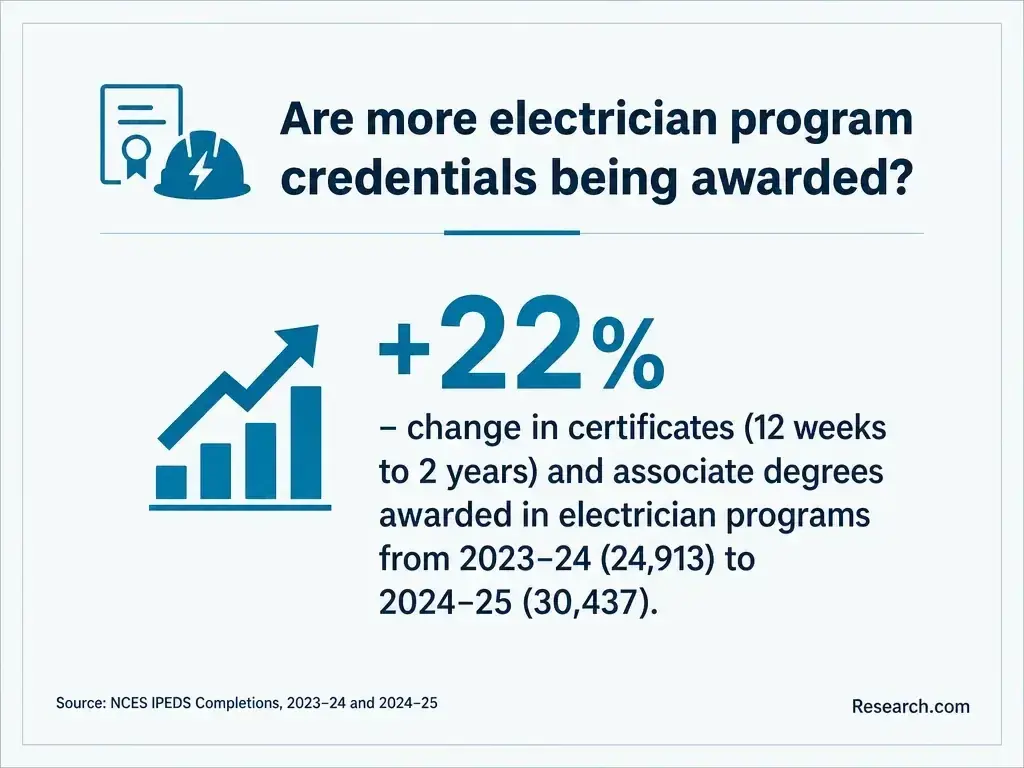
Choosing an electrician program in Minnesota means checking more than tuition: a school credential alone does not make you a licensed electrician. The U.S. Bureau of Labor Statistics projects 9.2% national growth in electrician employment from 2025 to 2035, making the training decision timely. This guide explains costs, apprenticeships, hands-on training, and Minnesota's licensing path. It also features a Best Electrician Trade Schools in Minnesota for 2027 ranking created by the Research.com team of data scientists to help students make an informed choice about programs worth considering.
Expect instruction in electrical theory, circuits, wiring methods, blueprint reading, code use, testing, and jobsite safety, followed by practice in a lab or shop. Some programs also cover motors, controls, or renewable-energy equipment. Ask to see the actual lab schedule: two programs with similarly named credentials can offer substantially different amounts of supervised practice.
A certificate or diploma can prepare you to seek work as an apprentice or registered unlicensed electrical worker; an associate degree may add broader technical coursework. Neither substitutes for the supervised experience and examination required for a Minnesota journeyworker license. A registered apprenticeship combines paid, supervised work with related instruction and may be a better first move if you can obtain a place and need income while training (Minnesota DLI; U.S. Department of Labor).
Training can lead to supervised work with electrical contractors on housing, commercial construction, renovations, and industrial installations. Maintenance teams in manufacturing and other large facilities may also use electrical skills, although their duties and applicable license classifications can differ. Minnesota DLI regulates electrical work by scope and license type, so confirm what an employer expects you to do - not just the job title.
Location affects access to experience. Twin Cities projects may offer a wider range of contractors and specialties, while a rural student may need to plan for travel to both a training site and an employer. Before enrolling, ask whether the program connects students with employers in the area where you can realistically work.
The U.S. Bureau of Labor Statistics reports a May 2025 national median annual wage of $63,190 for electricians. It describes workers across experience levels, not what a new Minnesota trainee should expect to earn. For a local decision, compare current Minnesota Department of Employment and Economic Development wage estimates for electricians with actual apprentice pay scales and job offers in your commuting area.
Apprentice wages commonly rise as workers complete training steps, but schedules depend on the sponsor or employer. A higher long-run wage can make training worthwhile without making a high upfront school bill worthwhile: compare expected pay during training, debt, time to licensure, and the likelihood that you will finish.
Program length depends on the credential and schedule; a short certificate, longer diploma, and associate degree should not be treated as interchangeable. Request each provider's published calendar, total instructional hours, lab hours, and part-time completion estimate. A compressed timetable may get you into the job market sooner, but it does not compress Minnesota's practical-experience requirement for journeyworker licensure (Minnesota DLI).
Registered apprenticeships generally span several years because they integrate related instruction with progressively skilled paid work (U.S. Department of Labor). When a school advertises a fast credential, distinguish time to finish school from time to qualify for an examination. Even a guide to a 6 month associate degree should not be used to estimate how quickly someone can become a licensed electrician.
Online delivery can make theory, mathematics, code study, and some assignments easier to fit around work. It cannot replace supervised installation, testing, troubleshooting, tool use, and safety practice on equipment. A hybrid option is useful only if its required labs are accessible and its pathway to supervised employment is credible.
For a working adult comparing cheapest online colleges for working adults, the advertised online price is not the complete electrician-training price. Add travel and time away from work for required labs, and ask Minnesota DLI how the particular instruction and work experience fit the license you seek. Do not assume an entirely online credential establishes licensing eligibility.
There is no single reliable average that covers Minnesota college programs, private training, and paid apprenticeships on comparable terms. Schools publish different credential lengths and charges, while an apprentice may earn wages during training. Instead of relying on a tuition-only average, request an itemized estimate for your specific route.
The table separates expenses that can change the apparent value of an otherwise affordable program. Ask for the amounts that apply to you before comparing offers.
| Cost or offset | Why it matters |
| Tuition, mandatory fees, books, and materials | Check the full program price and whether charges can change between terms. |
| Tools, protective equipment, and consumables | Determine what the school supplies and what an employer will expect you to own. |
| Travel, examination, and licensing costs | Labs and worksites may require separate trips; credential and application charges may come later. |
| Lost earnings and financial offsets | Compare reduced work hours with grants, eligible aid, employer support, and apprentice wages. |
Minnesota residents can investigate state and federal aid where a program is eligible; federal aid eligibility belongs to a qualifying school and program, not to every course advertised online (Federal Student Aid; Minnesota Office of Higher Education). A list of fafsa approved online schools is therefore no substitute for confirming aid eligibility for the exact electrician credential. For return on investment, weigh total cost, debt, completion probability, earnings while training, expected later earnings, and how long it may take to realize them.
Depending on the provider, you may earn a certificate, diploma, or associate degree. An apprenticeship instead provides a structured work-and-instruction pathway and, when completed, an apprenticeship completion credential (U.S. Department of Labor). The school credential documents education; Minnesota's occupational license documents authorization for a defined scope of electrical work. They are not equivalent (Minnesota DLI).
Ask whether prior electrical coursework or verified work experience can receive credit, and get any transfer or advanced-standing decision in writing. Do not assume one provider's credits will transfer to another or that a school-awarded credential automatically reduces the practical hours required for licensure.
Requirements vary by school and apprenticeship sponsor. Expect to check prerequisites in math and reading, application deadlines, physical and safety expectations, and any required assessment or interview. Apprenticeship entry may also depend on employer openings; admission to a school is not admission to an apprenticeship (U.S. Department of Labor).
Before paying a deposit, ask whether you must find your own employer, when supervised work can begin, and what registration is required for unlicensed electrical workers in Minnesota. DLI's worker registration and supervision rules matter at the point of employment even if a school does not make them an admissions condition (Minnesota DLI).
A useful curriculum connects calculations and code reading to tasks such as selecting materials, installing circuits, measuring electrical values, locating faults, and working safely around energized systems. Industrially oriented training may give more attention to motors and controls; construction-oriented training may emphasize installation methods and plan reading. Compare the emphasis with the jobs you intend to seek, not just the program title (U.S. Bureau of Labor Statistics).
Ask instructors to show how students demonstrate competence in a lab and how often they receive feedback. Simulated practice helps, but supervised work on actual jobsites develops the sequencing, communication, and safety judgment that a classroom alone cannot establish.
Yes, licensing rules matter - but a beginner does not need a journeyworker license before starting properly supervised training. Minnesota DLI regulates electrical licenses, registration of unlicensed electrical workers, supervision, qualifying practical experience, and examinations. The journeyworker electrician pathway generally calls for 8,000 hours of qualifying practical experience and passing the applicable examination. Have DLI confirm which experience and any approved education credit will count for your circumstances before choosing a program (Minnesota DLI).
Keep these distinctions clear: institutional accreditation evaluates a school; state authorization concerns whether a provider may operate; industry credentials can document particular skills; apprenticeship registration identifies a structured training program; and an occupational license authorizes regulated work. None automatically confers another. Later advancement to master electrician or operating an electrical contracting business carries additional requirements, so check the relevant DLI license category before planning that step.
Start with the license and type of electrical work you want, then compare programs against the experience and skills needed to get there. For example, examine the curriculum, labs, schedule, and employer relationships at Dakota County Technical College, Ridgewater College, Lake Superior College, Minnesota West Community and Technical College, or Northwest Technical College if their locations fit your commute. Verify current offerings directly; a ranking cannot tell you whether a lab schedule or apprenticeship opening fits your life.
Use these questions with both admissions staff and apprenticeship coordinators. They expose common problems before you commit:
A red flag is an assertion that accreditation, graduation, or an online credential alone makes you a licensed electrician. Another is a salary claim that treats the occupational median as guaranteed starting pay. Comparisons with highest paid master's degrees do not resolve the electrician decision: evaluate the actual training cost and route to qualifying work instead.
One route begins with school-based technical preparation, moves into registered and supervised electrical work, and progresses toward the appropriate journeyworker examination and license. Another starts directly with an employer or registered apprenticeship that combines wages and instruction. Experience can later support specialization in construction, industrial systems, maintenance, or controls; advancement to supervisory or contracting work depends on duties and additional Minnesota requirements (Minnesota DLI; U.S. Department of Labor).
Choose school first if you need structured labs or a stronger foundation before seeking an employer. Consider direct apprenticeship entry if a suitable opening is available and paid work is the priority. General comparisons of an easiest phd program offer no useful shortcut here: the relevant milestone is documented electrical experience that advances your intended career path.
The U.S. Bureau of Labor Statistics projects 9.2% growth in electrician employment nationwide from 2025 to 2035. That supports investigating the trade, but it is not a Minnesota hiring guarantee or a prediction of openings near a particular school. Check current regional projections from the Minnesota Department of Employment and Economic Development and ask prospective employers about apprentice openings before taking on training debt.
Demand can differ among construction projects, industrial maintenance, and local service work. A student willing to travel to an employer may have different options from one who needs work close to home; weigh that constraint alongside program quality.
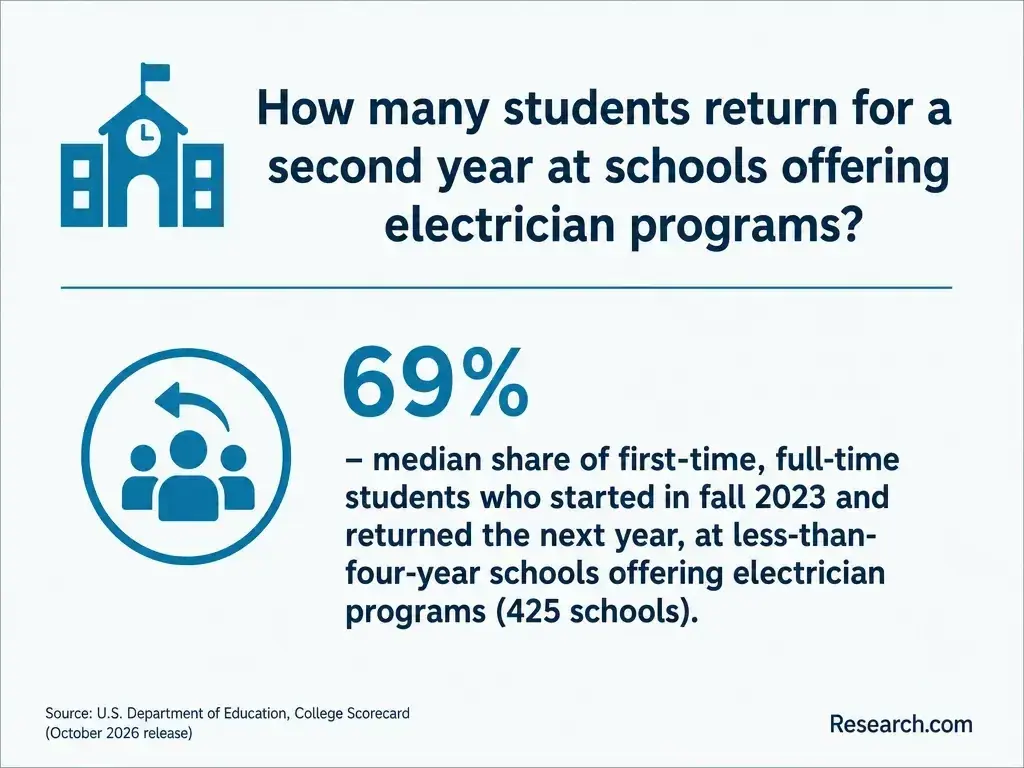
Investing in electrician training is a consequential decision. Research.com's ranking is designed to help readers compare programs with other options in the same occupation and location, rather than treating a school's reputation as a substitute for program-level evidence. The team evaluates student outcomes, earnings and return on investment, costs and debt, and quality and recognition. Only programs with completions reported to the Integrated Postsecondary Education Data System (IPEDS) are eligible; a missing apprenticeship or training provider should not be interpreted as a poor-quality option.
For best-program rankings, programmatic accreditation or relevant industry recognition carries 20% of the score, institutional accreditation 10%, and student support services 10%. Student outcomes, earnings, and costs account for the remaining 60%, with weights distributed through an entropy-based method that gives more weight to indicators that differ more across programs. Measures include completion and full- and part-time retention, earnings one year after completion, earnings relative to annual attendance cost, tuition, attendance cost, student debt - including debt among students who withdrew - and federal loan default rates. Most-affordable-program rankings instead score costs and debt alone; accreditation and other quality indicators are not part of that score.
The ranking draws on the following sources. Some databases cover other trades or health occupations and should not be mistaken for electrician-specific approval or licensing authorities:
These measures help narrow a shortlist, not establish that a particular program meets Minnesota licensing requirements. Readers should verify the current curriculum, costs, and experience-credit rules directly before enrolling. More detail on the ranking approach appears in Research.com's methodology.
# 1 position
# 2 position

# 3 position

# 5 position

# 6 position
# 7 position
# 8 position

# 9 position
# 10 position

# 11 position

# 12 position

No. Minnesota DLI requires qualifying practical experience and an examination for the journeyworker electrician license. Ask DLI whether any particular schooling can receive credit toward your requirements.
It depends on your access to an opening and your finances. An apprenticeship combines paid supervised work and instruction; school may offer structured preparation before you find an employer. Compare their costs, schedules, and routes to qualifying experience.
You may be able to study theory online, but practical electrical skills and qualifying supervised work require in-person participation. Confirm the labs and worksite arrangements before enrolling.
Choose the credential whose curriculum, lab time, cost, and employer connections fit your goal. None is automatically a substitute for Minnesota's licensing requirements.
No. Rankings help compare reported measures, but employment and earnings depend on completion, local opportunities, experience, and other factors. Request current program-specific outcomes and compare them with local apprentice opportunities.