# 1 position


Audited and Verified:
Our Editorial and Data Verification Process
Research.com uses government datasets, official education statistics and primary institutional information to support its career and degree guides. Our review process checks factual accuracy, occupational definitions, source dates and the requirements associated with the credentials discussed.
How This Article Was Fact-Checked
Our editorial team verifies salary estimates, employment projections, education requirements and program information against original data providers and official organizations. Salary figures are checked against the relevant occupational definitions and reporting periods. Information about licensure, accreditation and required in-person training is reviewed separately.
Fact-checked and verified on:

Co-Founder and Chief Data Scientist

Reviewed by Karolina Broda
Fact-Checker and Data Verification
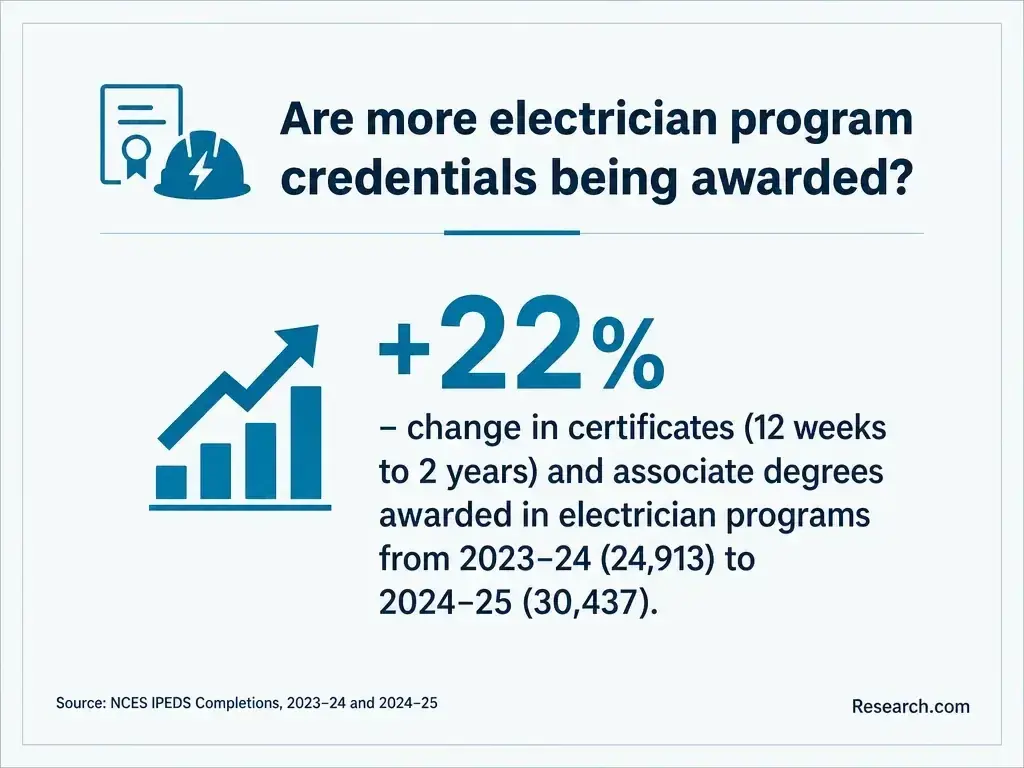
Choosing an electrician program in Iowa means looking beyond the classroom: you need a route to supervised work, the right license, and a cost you can manage. National employment of electricians is projected to grow 9.2% from 2025 to 2035, according to the U.S. Bureau of Labor Statistics. This guide explains how Iowa training pathways compare on time, practical experience, cost, and career entry. It accompanies the Best Electrician Trade Schools in Iowa for 2027 ranking, created by the Research.com team of data scientists to help students identify programs worth considering.
Expect applied instruction in circuits, wiring methods, blueprint reading, electrical calculations, and safe installation and troubleshooting. A worthwhile program lets you practice with tools and test equipment under supervision, not just watch demonstrations. Ask how many scheduled hours take place in a lab and whether an employer placement is included; similarly named credentials can offer very different amounts of practice.
The central distinction is between school-based preparation and work-based qualification. A college certificate or diploma may help you compete for an apprentice position, while a registered apprenticeship pairs related instruction with supervised, paid jobsite learning. Some employers hire and train entrants directly. Before paying for school, ask whether its instruction earns documented credit toward a sponsor's apprenticeship or otherwise helps meet Iowa's licensing requirements; do not assume it will.
Electrical contractors install and service wiring in homes, commercial buildings, and construction projects. Manufacturers, utilities, and facilities teams also employ people with electrical skills, although duties and hiring requirements differ. In Iowa, compare the jobs near your training site with those near your home: a rural student may have fewer nearby employers or worksites and a longer commute to accumulate supervised hours.
Residential work, commercial construction, and industrial maintenance use overlapping fundamentals but different equipment and troubleshooting skills. Ask employers or apprenticeship sponsors which setting their trainees actually work in before choosing electives or buying specialized tools. If you are comparing occupations rather than schools, best skilled trades careers offers a broader starting point; for electrician entry, local access to supervised work matters just as much as classroom fit.
Iowa pay varies by experience, license level, employer, specialty, and work location. For a current state-specific comparison, consult Iowa Workforce Development's electrician wage estimates and ask prospective sponsors for their actual starting wage and scheduled increases. A statewide occupational median is not an apprentice wage, and a posted wage may not reflect travel time or the availability of work.
For context, the U.S. Bureau of Labor Statistics reports a May 2025 national median annual wage of $63,190 for electricians. Use that as an occupational benchmark, not a promise of earnings after school. When comparing offers, consider paid instruction time, benefits, overtime expectations, commuting costs, and how wages change as you advance.
The answer depends on the credential and, more importantly, when supervised work begins. A short school program may prepare you to apply for an apprentice role sooner, but finishing classes is not the same as finishing the work experience required for independent practice. A registered apprenticeship generally extends over multiple years because trainees learn on jobsites while completing related instruction; the U.S. Department of Labor describes approximately 2,000 on-the-job hours and 144 instructional hours per year as a common model, not a substitute for checking a particular Iowa sponsor's requirements.
An associate degree can provide a broader technical curriculum than a shorter certificate, but more classroom time is worthwhile only if it serves your intended role and does not unnecessarily delay paid experience. Readers comparing easy associate degrees should pay particular attention to scheduled lab time and whether electrical coursework connects to an apprenticeship. Ask both the school and sponsor whether prior instruction receives credit, advanced standing, or neither.
Online study can be useful for theory, calculations, code concepts, and scheduling flexibility. It cannot replace supervised practice installing, testing, and troubleshooting electrical systems. A hybrid program makes sense when it has accessible labs or a verified jobsite arrangement; an entirely online course should not be treated as proof of practical competence or Iowa licensing eligibility.
The comparison below separates delivery format from the hands-on experience a student still needs.
| Format | Potential advantage | Critical check |
| On-campus | Regular access to instructors, tools, and electrical labs | Lab hours, equipment, and travel distance |
| Hybrid | Remote theory with scheduled practical sessions | Where and when required in-person sessions occur |
| Online theory | Flexible study alongside work | Separate access to labs, supervised employment, and any required instruction records |
Federal aid eligibility is another separate question: a school's online delivery format does not establish it. Use resources on accredited online colleges that accept FAFSA as a starting point, then confirm the specific electrician program's aid eligibility and practical-training arrangements with the provider.
There is no single reliable statewide price for an electrician pathway: college charges, program lengths, residency rules, and paid apprenticeships differ. Request a current, written cost of attendance for each program rather than comparing advertised tuition alone. For a registered apprenticeship, ask what instruction, books, tools, and fees the sponsor covers and when wages begin.
Build a job-ready budget that includes mandatory fees, books, tools, protective equipment, consumables, examination and license applications, transportation to labs and worksites, and earnings forgone while training. Grants, eligible federal or state aid, employer support, and apprenticeship wages may offset different portions. Confirm aid and eligibility with the school's financial aid office or the apprenticeship sponsor; do not assume every training provider participates in federal student aid.
To judge whether school is worth the cost, compare the complete pathway - not tuition divided by a projected salary. Account for program duration, completion likelihood, debt, wages you could earn without enrolling, expected post-training earnings, and how long it may take for the investment to pay off.
The award depends on the provider: it may be a certificate, diploma, or associate degree. A registered apprenticeship instead documents completion of a structured work-and-instruction program. None of these awards is automatically an Iowa occupational license. Institutional accreditation concerns the school; apprenticeship registration concerns the training arrangement; the Iowa Electrical Examining Board governs state licensing. Verify each separately.
The pathways below show what each award is most useful for and what it does not establish.
| Pathway | Typical outcome | Best fit | Limit to verify |
| Certificate or diploma | School-issued electrical training credential | Student seeking foundational skills before or alongside employment | Whether an apprenticeship sponsor recognizes the coursework |
| Associate degree | Academic degree with a broader technical curriculum | Student who values additional technical study | Whether added time and cost improve the intended career route |
| Registered apprenticeship | Documented completion of work-based training and related instruction | Student ready to learn while earning wages | Sponsor entry rules, work availability, and Iowa license requirements |
Requirements vary by school and sponsor. A college may ask for an application, prior school records, and placement information; an apprenticeship sponsor may also assess math readiness, interview applicants, and require access to worksites. Employers set their own hiring conditions. Ask for the current written requirements before assuming that admission to a class also secures an apprenticeship position.
For readers seeking supervised electrical work, Iowa's state registration and licensing rules are a separate step from school admission. Confirm the appropriate entry classification and supervision conditions with the Iowa Electrical Examining Board and prospective employer. If you already have related work or instruction, ask whether the school grants prior-learning credit and whether an apprenticeship sponsor independently grants advanced standing.
Strong entry-level training connects electrical theory to repeatable, safe work. Look for circuit calculations, reading plans, identifying materials and wiring methods, using meters, finding faults, and applying electrical-code and workplace-safety practices. Lab exercises should require you to build, inspect, test, and correct installations - not merely name components.
Ask instructors what equipment students handle and how performance is assessed. A student aiming for industrial maintenance may benefit from motor controls and troubleshooting; someone entering residential construction needs substantial practice with installation methods and jobsite sequencing. Coursework can establish fundamentals, but supervised fieldwork develops the pace, judgment, and coordination required on occupied sites or active construction projects.
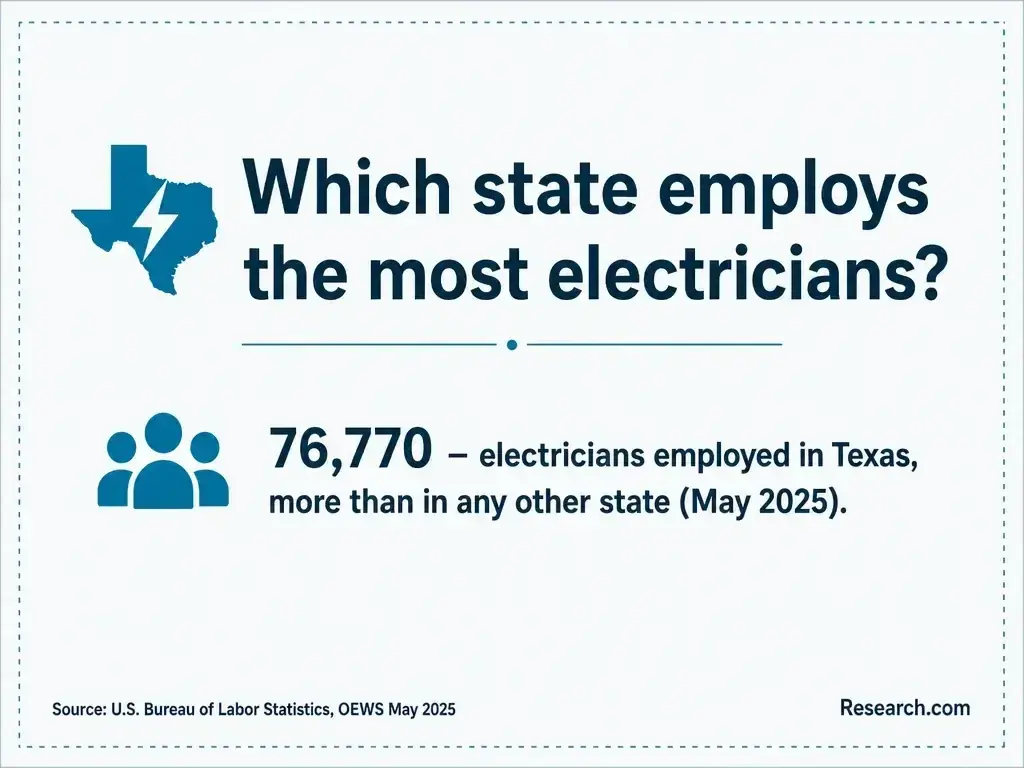
Yes, Iowa regulates electrical work through the Iowa Electrical Examining Board, but the appropriate registration or license depends on the work and the worker's stage of training. The board distinguishes supervised entry routes from journeyman, master, and contractor-level credentials. Completing a school program does not itself authorize independent electrical work; experience, examination, and other requirements may apply to advancement. Check the board's current rules for your intended classification before committing to a program.
Keep four concepts separate: school accreditation evaluates an institution, industry training recognition addresses a curriculum or credential, apprenticeship registration identifies a structured training program, and occupational licensure grants legal authority under state rules. An optional industry certificate may help demonstrate a skill, but it does not replace an Iowa license. If you expect to work across state lines, check the destination state's rules rather than assuming your Iowa training or license transfers automatically.
Choose the pathway that gets you to your intended work with credible practice and manageable total cost. Start by deciding whether you need foundational classes before applying for an apprenticeship or can enter paid, supervised training directly. Then compare the five named college options - Northwest Iowa Community College, Northeast Iowa Community College, Western Iowa Tech Community College, Iowa Lakes Community College, and Iowa Central Community College - only where their current electrical offerings match your goal. A ranking is a shortlist, not proof that every listed option offers the same credential or licensing route.
Before enrolling, get specific answers that let you compare programs on equal terms:
Be wary of promises that a short course alone produces a license or a particular wage. Someone comparing what are the best college majors for the future is making a different kind of education decision; for this trade, the decisive question is how training leads to supervised electrical work and eventual eligibility to advance.
A common progression is supervised entry-level work, additional work-based training, and - once the applicable state requirements are met - journeyman-level practice. With further experience and required credentials, some electricians move into master-level responsibilities, contracting, supervision, estimating, or specialized installation and maintenance. These are possible later steps, not automatic outcomes of a school certificate.
Choose early training with the next role in mind. Construction experience develops installation skills; industrial settings can emphasize controls, equipment, and fault-finding. Ask whether a proposed job will provide the supervised experience relevant to the license and specialty you want. Even a search for easiest phd to obtain addresses a different goal: electrician advancement is built around practical experience and applicable state credentials.
The U.S. Bureau of Labor Statistics projects electrician employment to grow 9.2% nationally from 2025 to 2035. That signals continuing demand across the occupation, but it does not predict openings in a particular Iowa county or guarantee an apprenticeship placement. Check Iowa Workforce Development's current occupational projections and local job postings, then ask nearby sponsors how often they recruit and where their worksites are.
For a student, the practical outlook question is whether there is enough accessible supervised work to begin and sustain training. Compare opportunities in the areas where you can realistically commute or relocate; a strong national projection offers little help if a chosen program has no workable route to local jobsite hours.
Investing in electrician training is a consequential decision. Research.com created its ranking to help readers compare programs against other programs in the same occupation and location, using documented measures rather than a school's reputation alone. Only programs with completions reported to IPEDS are eligible; that limitation means the ranking cannot capture every apprenticeship or employer training option.
Best-program rankings assess student outcomes; earnings and return on investment; costs and debt; and quality and recognition. Occupation-relevant programmatic accreditation or industry recognition carries 20% of the score, institutional accreditation 10%, and student support services 10%. The remaining 60% covers completion, retention, earnings, cost, debt, and loan-default indicators, weighted using an entropy-based method that gives more weight to indicators that distinguish programs. Most-affordable rankings instead score only tuition, attendance cost, debt, and loan-default measures. These methods help readers compare documented options, but a ranking does not establish Iowa licensing eligibility or predict an individual's results.
The team draws on the following sources across its trade-program rankings. Several occupation-specific organizations listed here concern other trades; their inclusion as methodology sources does not imply that they accredit electrician programs.
For more detail on how scores are developed, see Research.com's methodology. Use the ranking to build a shortlist, then verify current program costs, hands-on training, and licensing alignment directly before enrolling.
# 1 position
# 2 position
# 3 position
# 4 position

# 5 position

# 6 position
# 7 position
# 8 position

# 9 position

# 10 position
# 11 position

Not necessarily. Sponsors set entry requirements, and some train eligible beginners through paid work and related instruction. Ask the sponsor whether prior school coursework helps with admission or advanced standing.
Do not assume so. Online theory does not replace required practical experience, and a certificate is not a license. Verify the complete route with the Iowa Electrical Examining Board.
Choose college preparation if you need foundational skills or a specific curriculum that employers value. Consider direct apprenticeship if you can enter paid supervised training now. Compare total costs, wages while training, and whether school credits count toward the sponsor's requirements.
No. Ask the apprenticeship sponsor for a written decision on any credit or advanced standing, and confirm how experience and instruction are treated for Iowa licensing.
Request the full cost, hands-on schedule, credential name, employer connections, aid eligibility, and documented relationship - if any - between the program and the supervised experience needed for your intended license.