# 1 position
Washburn Institute of Technology - Electrician.
certificate or diploma

Audited and Verified:
Our Editorial and Data Verification Process
Research.com uses government datasets, official education statistics and primary institutional information to support its career and degree guides. Our review process checks factual accuracy, occupational definitions, source dates and the requirements associated with the credentials discussed.
How This Article Was Fact-Checked
Our editorial team verifies salary estimates, employment projections, education requirements and program information against original data providers and official organizations. Salary figures are checked against the relevant occupational definitions and reporting periods. Information about licensure, accreditation and required in-person training is reviewed separately.
Fact-checked and verified on:

Co-Founder and Chief Data Scientist

Reviewed by Karolina Broda
Fact-Checker and Data Verification
Choosing electrician training in Kansas means deciding whether to pay for a school program, pursue a paid apprenticeship, or combine the two - and checking whether that path meets local work requirements. The U.S. Bureau of Labor Statistics projects 9.2% growth in electrician employment nationally from 2025 to 2035. This guide explains credentials, hands-on training, costs, wages, and licensing questions. It also accompanies the Best Electrician Trade Schools in Kansas for 2027 ranking, created by the Research.com team of data scientists to help students make an informed choice about programs worth considering.
Expect a mix of electrical theory and supervised practice - not a classroom-only route to independent work. In a shop or lab, students may read plans, install conduit and wiring, use test instruments, and practice troubleshooting under safety procedures. Ask each provider which tasks students perform themselves, how much time is spent in the lab, and whether an employer placement is included.
The main pathways serve different purposes. A certificate or diploma can suit someone seeking entry-level skills before applying for electrical work or an apprenticeship. An associate degree adds broader technical or general coursework and may suit someone who wants a longer college pathway. A registered apprenticeship makes paid, supervised work the center of training, with related classroom instruction. School attendance is not necessarily an apprenticeship prerequisite: an applicant who can secure a paid place directly may avoid paying for overlapping instruction (U.S. Department of Labor, Apprenticeship.gov).
Among the Kansas institutions worth checking for current offerings are Washburn Institute of Technology, Kansas City Kansas Community College, Fort Hays Tech North Central, Pratt Community College, and Manhattan Area Technical College. A program name alone cannot establish its current curriculum, employer ties, or licensing value; request those details for the specific campus and intake.
Training can lead toward work with electrical contractors on homes and commercial buildings, industrial maintenance teams, construction projects, or facilities that maintain electrical systems. The right training differs: residential work emphasizes building wiring and service, while industrial roles may require more motor controls, equipment troubleshooting, and workplace safety instruction (U.S. Bureau of Labor Statistics, Occupational Outlook Handbook).
Location affects the search. A student near a larger employment center may be able to compare multiple contractors and apprenticeship sponsors; someone in a rural area should weigh travel to labs, jobsites, and related instruction. Ask employers serving your intended area whether they hire school graduates into supervised roles and whether they credit prior coursework toward training. Do not assume a school credential authorizes independent electrical work across Kansas.
The U.S. median annual wage for electricians was $63,190 in May 2025 (U.S. Bureau of Labor Statistics, Occupational Outlook Handbook). That is a national occupation-wide midpoint - not a Kansas wage quote, an apprentice rate, or a promise of post-program earnings. Pay depends on experience, employer, specialty, work location, and the terms of any apprenticeship agreement.
For a useful local comparison, request current starting rates from Kansas employers or apprenticeship sponsors and compare them with the cost of reaching that job. The best paying trade school jobs are worth comparing only if their entry costs, training time, and local opportunities also fit your goals.
A school certificate may take less time than an associate degree, but the published calendar length is not the same as time to independent employment. Confirm the program's actual clock or credit hours, lab hours, schedule, and whether its coursework can count toward a subsequent apprenticeship. Part-time study can make paid work easier to maintain while extending the completion date.
Registered apprenticeships generally take several years because trainees must develop skills through substantial supervised work as well as related instruction. U.S. Department of Labor apprenticeship guidance commonly describes 2,000 hours of on-the-job learning and 144 hours of related instruction per year as a traditional model, not a universal Kansas school or licensing requirement. Obtain the sponsor's written requirements and ask whether previous training qualifies for advanced standing (U.S. Department of Labor, Apprenticeship.gov).
Online study can cover some code concepts, calculations, and electrical theory. It cannot replace supervised practice with tools, circuits, conduit, testing equipment, and jobsite safety. A hybrid program may be practical if its required labs and work placements are within commuting distance; an entirely online course should not be treated as proof of hands-on competence or local licensing eligibility.
When comparing formats, get the location and schedule of every in-person requirement in writing. An online option may save commuting time for theory while creating separate travel costs for labs. If access to aid matters, check the school's eligibility and the specific program rather than assuming every online offering qualifies; the guide to best online colleges with financial aid is a starting point for understanding that distinction, not a substitute for checking electrician-specific practical training.
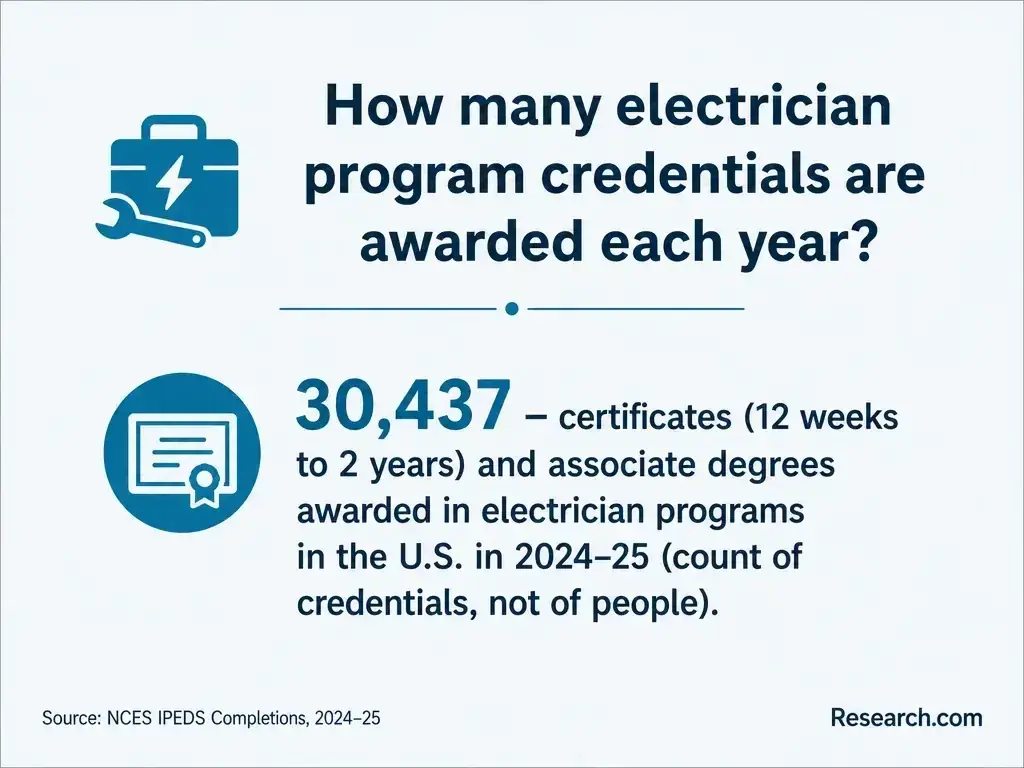
There is no single reliable price for every Kansas electrician pathway: a college program and a paid apprenticeship have different bills and different effects on earnings. Compare each school's current published cost for your residency and enrollment status, then request an electrician-program estimate. Tuition alone leaves out mandatory fees, books, tools, safety gear, consumable materials, travel to labs or jobsites, and any later exam or local application charges.
To judge whether training is worth the investment, account for aid and paid work as well as expense. Ask about eligible federal aid, scholarships, workforce funding, and employer-paid instruction; eligibility depends on the provider and program (Federal Student Aid; U.S. Department of Labor, Apprenticeship.gov). Compare your likely debt and lost earnings while training with a realistic local entry wage, the probability of completion, and the time it may take for higher earnings to repay the cost. A shorter program is not automatically cheaper if it provides too little practical preparation.
The award depends on the pathway: a school may issue a certificate, diploma, or associate degree; a registered apprenticeship leads to a nationally recognized completion credential when its requirements are met (U.S. Department of Labor, Apprenticeship.gov). An industry training credential, where offered, is a separate form of recognition. None is interchangeable with permission from the relevant local authority to perform licensed work.
Ask for the exact credential name and whether employers or apprenticeship sponsors recognize it. Among certificates that make the most money, the useful comparison is not the title alone but whether the training supplies the practical experience and next step your intended electrical job requires.
Requirements vary by provider and pathway. A school may ask for an application and evidence of readiness for technical math; an apprenticeship sponsor may also use an aptitude assessment, interview, and employer hiring process. Check the current requirements directly rather than assuming admission to a school secures an apprenticeship or a job.
Before applying, ask whether you need to supply tools or safety equipment, whether placement assistance is available, and when labs or work shifts occur. If you already have electrical coursework or supervised experience, request a written evaluation of transfer credit or apprenticeship advanced standing before enrolling. Credit granted by a school does not necessarily reduce a sponsor's work-hour requirements.
Relevant instruction typically includes electrical calculations, circuit fundamentals, blueprint reading, wiring methods, code use, testing, and safe work practices. Students should also practice measuring, identifying faults, communicating with supervisors, and documenting work. These skills matter because electricians install and maintain systems under safety and code requirements, not merely assemble components in a classroom (U.S. Bureau of Labor Statistics, Occupational Outlook Handbook).
Judge depth by the work you can demonstrate: Which installations and troubleshooting tasks do students complete under supervision? Are labs equipped for the type of residential, commercial, or industrial work you want? A similarly named credential with fewer practical opportunities may be a poorer fit even when its coursework looks comparable.
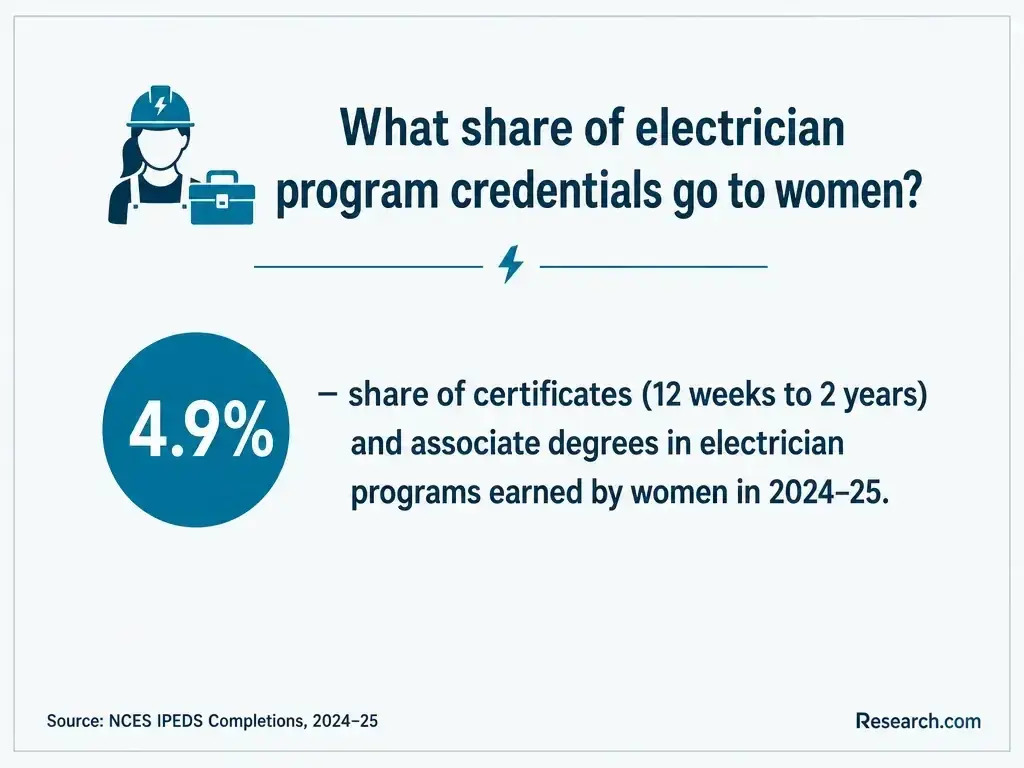
Kansas does not have one statewide electrician license that automatically covers electrical work in every locality; licensing and contractor requirements can be set locally. Before selecting training, contact the licensing or building authority for the city or county where you expect to work. Ask what supervised experience, examination, registration, or contractor credential applies to your intended role, and whether hours earned with a particular employer count (Kansas local licensing authorities).
Keep the distinctions clear: institutional accreditation concerns the school; an industry certificate documents specified training or skills; apprenticeship registration concerns a work-and-instruction program; occupational licensure is permission to perform regulated work. One does not replace another. If you expect to move between Kansas jurisdictions, verify portability with each destination authority rather than assuming a credential transfers.
Start with the job and locality you want, then work backward to the training they require. A school program can be a good investment if its labs, schedule, employer connections, and cost help you enter supervised work. Direct application to a registered apprenticeship may be better if a paid opening is available and you do not need preliminary instruction.
Use this short check before committing money; it catches the most consequential mismatches:
A ranking can identify options to investigate, but it cannot resolve your commute, placement prospects, or local licensing rules. Nor should an unrelated search such as cheapest masters online be used as a benchmark for the cost of becoming job-ready as an electrician.
An entry-level graduate may pursue a supervised electrical helper or apprentice role, then build experience toward work recognized under the applicable local rules. With further training and experience, electricians may specialize in commercial installation, industrial maintenance, controls, or other electrical work; supervisory or contracting responsibilities may bring additional local requirements (U.S. Bureau of Labor Statistics, Occupational Outlook Handbook; Kansas local licensing authorities).
Choose early coursework to match the first role you can realistically obtain, not a distant job title. Someone targeting industrial maintenance should look for meaningful motor-control and troubleshooting practice; someone seeking construction work should examine wiring labs and contractor connections. Optional industry credentials can strengthen a specialty, but check employer demand before paying for them.
National electrician employment is projected to grow 9.2% from 2025 to 2035 (U.S. Bureau of Labor Statistics, Employment Projections). That signals potential demand for training, but it is not a Kansas placement rate or a forecast for any particular town. Construction activity, facility maintenance, and employer hiring needs differ by area.
Use the projection as context, then test local opportunity before enrolling: look for current supervised openings within commuting distance and ask sponsors how often they recruit. A program's value rises when its timetable and practical training connect to jobs you can actually reach; a national growth figure alone cannot establish that return.
Investing in electrician training is a consequential decision, so Research.com compares eligible programs with others in the same occupation and location - not with unrelated schools nationwide. Its best-program rankings assess student outcomes; earnings and return on investment; costs and debt; and quality and recognition. Programmatic accreditation or relevant industry recognition accounts for 20% of the score, institutional accreditation for 10%, and student support for 10%. Outcomes, earnings, and costs make up the remaining 60%, with weights distributed through an entropy-based method. Most-affordable rankings instead score only tuition, cost of attendance, median debt, and federal loan default rates.
The Research.com team uses the following data sources to check program information and make comparisons more credible. Some occupation-specific sources in its broader methodology concern healthcare fields rather than electrician training; their inclusion here does not imply that healthcare accreditation applies to electricians.
Only programs with completions reported to IPEDS qualify for this ranking. That boundary makes the comparison more consistent, but it excludes some apprenticeships, employer training, and other valid routes. Use the ranking to narrow school options, then compare those options with local apprenticeship openings and verify current program details directly. Further information appears in Research.com's methodology.
# 1 position
# 2 position

# 3 position
# 4 position

# 5 position
# 7 position

# 8 position

# 10 position
# 11 position
# 12 position
# 13 position
# 14 position

# 15 position
# 16 position

# 17 position

# 18 position
# 19 position
# 20 position

Not necessarily. A registered apprenticeship can combine paid work and related instruction without a preceding school credential. Check the requirements for the locality and employer where you plan to work (U.S. Department of Labor, Apprenticeship.gov; Kansas local licensing authorities).
Do not assume so. A certificate documents completed training; local authorities may require additional supervised experience, an exam, or a license for particular work (Kansas local licensing authorities).
Online theory can supplement training, but installation, testing, and safe tool use require in-person practice. Verify the lab and supervised-work components before enrolling.
It may be if you can secure an opening and want to earn while training. School may suit you if you need foundational skills first or its schedule better fits your circumstances. Compare total costs, wages, practical experience, and the time to your target role.
Request the complete cost, exact credential, hands-on schedule, employer connections, and written explanation of whether prior training can receive credit. Confirm local work and licensing requirements independently.