# 1 position


Audited and Verified:
Our Editorial and Data Verification Process
Research.com uses government datasets, official education statistics and primary institutional information to support its career and degree guides. Our review process checks factual accuracy, occupational definitions, source dates and the requirements associated with the credentials discussed.
How This Article Was Fact-Checked
Our editorial team verifies salary estimates, employment projections, education requirements and program information against original data providers and official organizations. Salary figures are checked against the relevant occupational definitions and reporting periods. Information about licensure, accreditation and required in-person training is reviewed separately.
Fact-checked and verified on:

Co-Founder and Chief Data Scientist

Reviewed by Karolina Broda
Fact-Checker and Data Verification
Choosing electrician training in North Dakota means deciding more than where to take classes: you need a route to supervised work and eventual licensure. The U.S. Bureau of Labor Statistics projects 9.2% national growth in electrician employment from 2025 to 2035, making that choice timely. This guide compares school programs with paid apprenticeships, explains costs and state requirements, and helps prospective students and career changers judge their next step. It also features a Best Electrician Trade Schools in North Dakota for 2027 ranking created by the Research.com team of data scientists to help students identify programs worth considering.
Expect instruction in electrical theory, code use and safe installation, paired with supervised practice. A school certificate, diploma or associate degree can build skills and help you compete for an apprenticeship, but it is not a journeyman license. A registered apprenticeship combines instruction with paid, supervised work; direct entry with an employer may also be possible if the work and registration meet North Dakota's rules (North Dakota State Electrical Board; U.S. Department of Labor).
The pathways differ in when you earn wages and how you obtain qualifying experience. Confirm any school-to-apprenticeship credit with the North Dakota State Electrical Board and the prospective sponsor before paying a deposit.
| Pathway | What you receive | Best fit and main limitation |
| Short school program or pre-apprenticeship | Foundational classes and labs; a school credential if offered | Useful for exploring the trade or strengthening an application; supervised job hours still need a separate plan. |
| Longer technical-college program | Broader classroom and shop training; potentially a diploma or associate degree | Useful when you want substantial preparation before employment; check cost and whether experience credit is actually available. |
| Registered apprenticeship | Paid work, related instruction and an apprenticeship completion credential | Useful when earning while training is a priority; entry depends on a sponsor and available openings. |
North Dakota State College of Science is one school to investigate for electrical training. If considering Sitting Bull College, confirm the current program, credential and hands-on electrical offerings directly before treating it as an electrician pathway. Program names and availability can change.
Potential workplaces include building contractors, industrial facilities, utilities and maintenance operations. Construction work can involve changing jobsites; industrial and maintenance roles may emphasize troubleshooting installed equipment. The U.S. Bureau of Labor Statistics describes construction, maintenance and repair as major electrician work settings. Ask whether a prospective employer can provide the supervised experience you need, rather than choosing a first job solely for its title.
Location affects the training plan. A student outside Fargo, Bismarck or another employment center may have fewer nearby classes or worksites and face substantial travel. Compare the location of classroom instruction and the location of paid work before accepting a place; a workable commute over several years matters more than a convenient first semester.
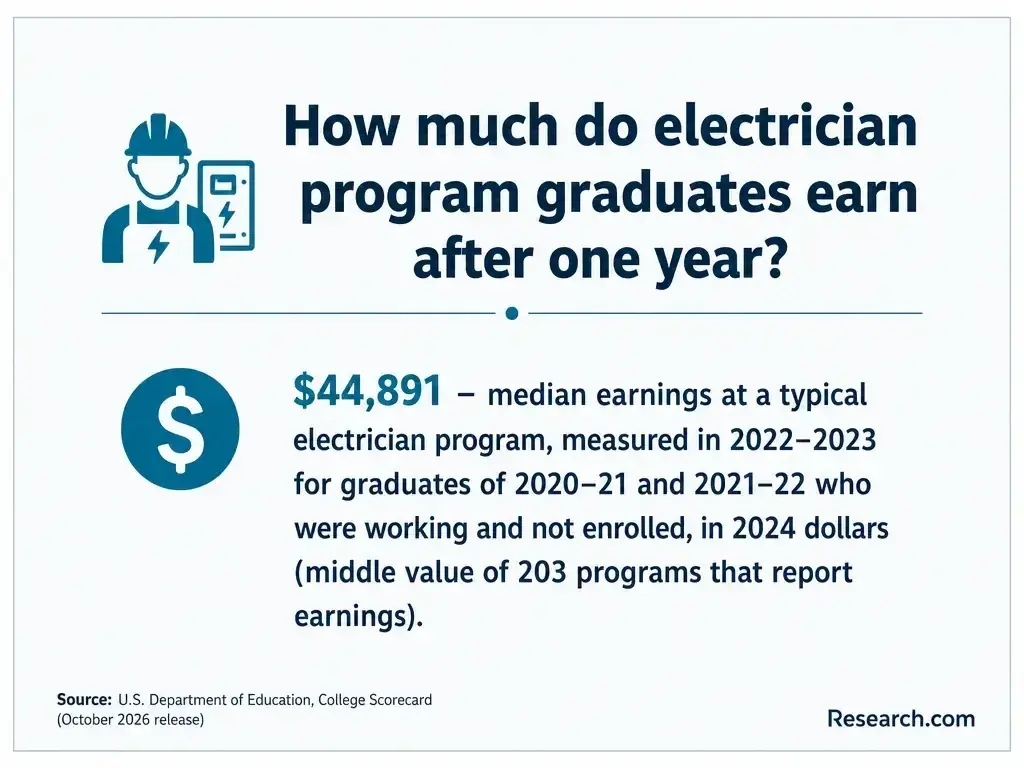
Use local job offers or current state occupational wage tables to estimate North Dakota pay. As a national benchmark, the median annual wage for electricians was $63,190 in May 2025 (U.S. Bureau of Labor Statistics). That is the midpoint for employed electricians across experience levels, not a North Dakota wage or an expected apprentice starting salary. Apprentice pay typically rises with training progress, while hours available and employer practices affect actual earnings.
For a return-on-investment comparison, estimate earnings during training as well as afterward. Compare each route's tuition, aid, debt and likely completion time with paid apprenticeship wages and the earnings you would forgo while studying. Then test the result against your current pay, the chance of completing training and the time it may take to qualify for higher-paid work; a shorter program is not automatically the better investment.
A school program may take less time than the full route to journeyman eligibility. The North Dakota State Electrical Board generally requires 8,000 hours of qualifying experience for a journeyman electrician application. That makes supervised employment a central part of the timeline even if you first complete a certificate or diploma. Verify the Board's current rules on eligible experience, school credit and examinations before assuming a program shortens that requirement.
Full-time classes can get you into the field sooner than part-time classes, but only if you can secure qualifying work afterward. Paid apprenticeship usually takes multiple years because work experience and related instruction run together (U.S. Department of Labor). For an accelerated school option, ask when graduates typically start supervised work; the class end date alone is not the career-entry date. Readers comparing fast-track college programs should apply that same distinction between finishing coursework and meeting occupational requirements.
Online study can accommodate electrical theory, calculations and code-reading assignments. Wiring methods, equipment use, testing and safe work practices require supervised physical practice; qualifying apprenticeship experience takes place on worksites. An entirely online course should therefore be treated as supplemental preparation, not assumed to satisfy North Dakota's experience or licensing requirements (North Dakota State Electrical Board).
A hybrid program may suit a rural student if its in-person labs are realistically reachable. Before enrolling, get the lab schedule and location in writing, then ask who arranges work placements and whether they qualify under Board rules. Advice about online admissions cannot answer those electrician-specific questions.
There is no single reliable statewide price covering school programs and paid apprenticeships: their charges, durations and wage arrangements differ. Request a current, itemized quote from each school or sponsor rather than relying on a tuition figure. Public-school resident and nonresident rates may differ, and eligibility for federal aid depends on the institution and program, not simply on being an electrician student (Federal Student Aid).
A job-ready budget needs more than published tuition. Compare these costs and offsets over the entire training period:
Ask a financial-aid office about program-specific eligibility and a workforce office about available assistance before borrowing. A shorter course may limit lost earnings, but shorter training options are worthwhile only if they also provide useful practice and a credible route into qualifying work.
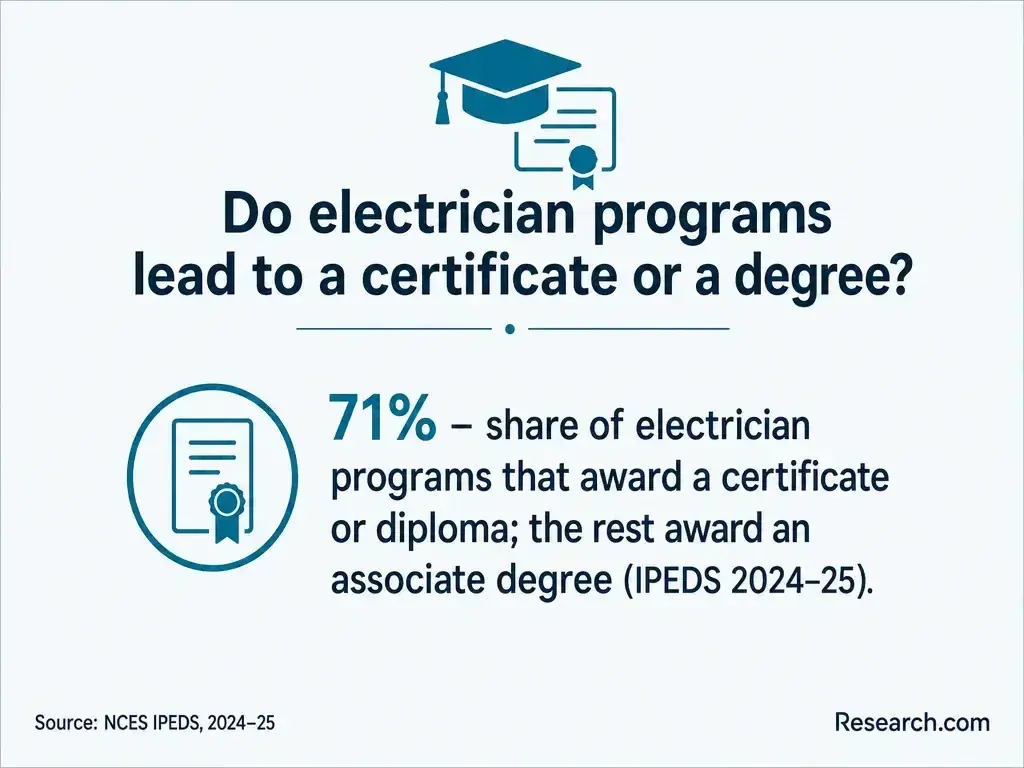
The answer depends on the provider: a school may award a certificate, diploma or associate degree, while a registered apprenticeship has its own completion credential. None is the same as an occupational license issued by the North Dakota State Electrical Board. A construction-training certificate, such as one aligned with NCCER, may document skills but does not replace Board requirements (NCCER; North Dakota State Electrical Board).
Compare the credential with the goal on your application: entry into an apprenticeship, credit for prior training or eventual licensure. If a provider advertises advanced standing, ask both the apprenticeship sponsor and the Board what they will accept, how much credit is available and what documentation you must retain. Institutional accreditation, industry recognition and Board acceptance answer different questions.
Requirements vary by school and apprenticeship sponsor. Expect to check the provider's rules for prior schooling, math preparation, application deadlines and any assessment or interview. An apprenticeship or employer may also require that you can perform work safely at jobsites. Admission to classes is not the same as acceptance into paid training or registration for supervised electrical work.
Before applying, ask whether classes start on a fixed schedule, whether a sponsor has open positions and who handles the registration needed for your intended work. If you have related experience, ask what records are needed to assess prior learning; do not assume that informal experience or transfer credit will count toward Board experience requirements (North Dakota State Electrical Board).
A useful curriculum connects circuit theory and electrical calculations to reading plans, selecting materials, installing wiring and diagnosing faults. Code interpretation, lockout and other safe-work procedures should be practiced rather than memorized in isolation. Electricians also need to communicate with coworkers and follow specifications accurately on active jobsites (U.S. Bureau of Labor Statistics).
Ask to see the shop competencies and assessments, not just a course catalog. Practice with meters, panels and wiring assemblies is more relevant to an installation goal than a theory-only course; someone aiming for industrial maintenance should also look for troubleshooting practice. Emerging controls and electrified equipment may change the mix of tasks, but the value of a program still rests on demonstrated fundamentals and access to supervised work.
North Dakota regulates electrical work through the North Dakota State Electrical Board. The Board distinguishes apprentice registration from journeyman and master licensing; a school credential or optional industry certification is not a substitute for the required experience and examination. Its journeyman pathway generally calls for 8,000 hours of qualifying experience. Confirm current registration, experience-credit and exam rules directly with the Board before starting work or choosing a program.
If you expect to work across state lines, ask the Board about current reciprocity or other application provisions before relying on a North Dakota credential elsewhere. Licensure rules belong to the jurisdiction where you intend to work; a credential's name alone does not establish portability.
Start with your intended role and work backward: installation, maintenance and industrial troubleshooting call for overlapping but not identical practice. Use the ranking to identify schools to investigate, then compare them with apprenticeships and employer-sponsored routes that may not appear in IPEDS-based rankings. Neither a high rank nor institutional accreditation establishes that a program meets Board licensing requirements.
These checks turn a shortlist into a decision you can defend:
Warning signs include a promise of automatic licensure, an online-only route marketed as sufficient for hands-on qualification, or a quoted price that excludes tools and travel. If you want to earn immediately and can secure a suitable sponsor, paid apprenticeship may be a better first move; if you need structured fundamentals before applying, a school program may justify its cost.
Training commonly begins with supervised apprentice work and can lead, after the required experience and examination, to journeyman practice (North Dakota State Electrical Board). With further experience, an electrician may pursue master-level licensure, supervision or a business role subject to applicable Board rules. Installation, service and industrial maintenance offer different day-to-day work; ask which jobs a training provider's graduates actually enter before choosing a specialization.
The work is hands-on and often collaborative, even when troubleshooting requires sustained independent concentration. Someone exploring jobs for introverts should judge electrician roles by their real mix of solo diagnosis, customer contact and crew coordination rather than by a personality label. If your interests extend beyond electrical work, use a career comparison only as a starting point; compare actual training costs and entry requirements before changing direction.
The U.S. Bureau of Labor Statistics projects 9.2% growth in electrician employment nationally from 2025 to 2035. This supports considering the trade, but it is not a North Dakota forecast or a guarantee of an opening where you live. Construction cycles and the availability of local apprenticeship sponsors can matter more to your immediate entry prospects than a national projection.
Before committing, check current North Dakota labor-market information and ask sponsors where apprentices are being hired. Compare opportunities near your home with the commute or relocation you would accept. For a rural applicant, the decisive question may be whether a qualifying worksite and classroom schedule are both accessible - not whether demand exists somewhere in the state.
Investing in training is an important decision, so Research.com evaluates eligible programs against others in the same occupation and location rather than treating every trade as interchangeable. The ranking is intended to help readers compare measurable outcomes, costs and quality; it cannot replace a check of current program availability or North Dakota licensing rules. Only programs with completions reported to IPEDS are included, which means registered apprenticeships and other training providers may be absent without being inferior options.
Best-program rankings consider student outcomes, including completion and full-time and part-time retention; earnings one year after completion and earnings relative to annual attendance cost; tuition, attendance cost, debt and federal loan default rates; and accreditation, relevant industry recognition and student support. Programmatic accreditation or relevant industry recognition receives 20% of the score, institutional accreditation 10%, and student support 10%. The remaining 60% covers outcomes, earnings and costs, with weights assigned through an entropy-based method that gives more weight to indicators that vary more across programs. Most-affordable-program rankings instead score only tuition, attendance cost, median debt and federal loan default rates using that method; accreditation and other quality indicators do not enter that score.
The following databases and organizations were used in developing the rankings. Recognition sources are applied where relevant to an occupation; a health or dental credentialing body is not an electrician licensing authority.
These sources help make comparisons more consistent, but reported earnings are not guaranteed individual outcomes, and college-oriented datasets do not cover every union or employer-sponsored route. Readers can find further detail on Research.com's methodology.
# 1 position
# 2 position
Not necessarily. A qualifying apprenticeship or supervised employer route may provide instruction and experience without first completing a separate school program. Check registration and licensing requirements with the North Dakota State Electrical Board.
No. A school credential documents training; journeyman licensing has separate qualifying-experience and examination requirements set by the North Dakota State Electrical Board.
Online coursework can cover theory, but electrical installations and supervised work require in-person practice. Ask how any online program arranges labs and qualifying work experience.
It can reduce foregone earnings because you are paid while training, but compare wages, required purchases, travel and any instruction charges. Availability and fit matter as much as the advertised price.
Ask for the full cost, credential awarded, lab hours, work-placement arrangements and written details of any claimed credit toward apprenticeship or licensure. Verify licensing claims with the state Board rather than relying on advertising.