# 1 position


Audited and Verified:
Our Editorial and Data Verification Process
Research.com uses government datasets, official education statistics and primary institutional information to support its career and degree guides. Our review process checks factual accuracy, occupational definitions, source dates and the requirements associated with the credentials discussed.
How This Article Was Fact-Checked
Our editorial team verifies salary estimates, employment projections, education requirements and program information against original data providers and official organizations. Salary figures are checked against the relevant occupational definitions and reporting periods. Information about licensure, accreditation and required in-person training is reviewed separately.
Fact-checked and verified on:

Co-Founder and Chief Data Scientist

Reviewed by Karolina Broda
Fact-Checker and Data Verification
The cheapest electrician program is not necessarily the least expensive route to a New Hampshire license. You also need supervised work, classroom instruction, and an exam. National electrician employment is projected to grow 9.2% from 2025 to 2035, according to the U.S. Bureau of Labor Statistics (BLS). For career starters and working adults, this guide explains the costs, credentials, and training routes behind that opportunity. It also accompanies the Most Affordable Electrician Trade Schools in New Hampshire for 2027 ranking, created by the Research.com team of data scientists to help students make an informed choice about programs worth considering.
Expect instruction in electrical theory, the National Electrical Code, safe work practices, blueprint reading, and installation techniques. A useful program pairs that instruction with supervised practice using tools, circuits, and test equipment. It should explain precisely which classroom hours it documents and how students obtain qualifying work experience.
These routes lead to different credentials and levels of worksite access. Compare them by what you still need after finishing the program.
| Route | What it provides | Best fit and principal limitation |
| Pre-apprenticeship or short certificate | Entry-level instruction; sometimes shop practice and employer connections | Useful before applying for a job or apprenticeship; does not replace required supervised experience |
| College certificate or associate degree in electrical technology | Structured classroom and lab instruction; an academic credential | Fits students wanting a scheduled curriculum; ask which hours the board will accept |
| Registered or employer-sponsored apprenticeship | Paid supervised work alongside related instruction | Fits learners ready to work while training; entry and scheduling depend on a sponsor |
A school can be worthwhile if its documented instruction, labs, and employer connections help you enter or progress through qualifying employment. If you already have a sponsor offering paid instruction, buying a separate introductory credential may add cost without shortening your path. For a wider view of what three careers trade school can prepare you for, compare each occupation's work requirements before switching tracks.
Potential workplaces include electrical contractors, commercial construction sites, industrial facilities, building-maintenance departments, and companies installing power or control systems. Apprentices perform electrical work under appropriate supervision; completing a school program alone does not authorize independent electrical contracting (New Hampshire Electricians' Board).
Location affects the practicality of a training offer. Construction work may require travel among jobsites, while an industrial or facilities role may have a fixed location. Before committing to a program or sponsor, compare the commute to both the classroom and the likely worksites - particularly if you live far from a training center or depend on evening classes.
The BLS reports a $63,190 national median annual wage for electricians in May 2025. That figure describes employed electricians across experience levels, not newly trained workers in New Hampshire. To assess a local offer, compare its hourly rate, expected hours, benefits, travel, and scheduled apprentice raises with the latest New Hampshire electrician estimates in the BLS Occupational Employment and Wage Statistics series.
Pay can change substantially as an apprentice gains experience, earns a journeyman license, or moves into specialized or supervisory work. For an investment decision, use a realistic starting offer and wage progression - not the occupation-wide median - as your earnings assumptions.
A short preparatory program may end well before a student is eligible for licensure. New Hampshire's journeyman pathway requires 8,000 hours of qualifying practical experience and 600 hours of electrical schooling, as well as an examination (New Hampshire Electricians' Board). Those work and classroom requirements make the full route a multi-year commitment, even when a school credential can be completed sooner.
Ask a provider to separate its program length from the time needed to meet board requirements. Full-time classes can speed up the school portion but may compete with paid work; evening instruction may make it easier to accumulate work hours concurrently. If you have prior electrical experience or coursework, ask the board - not just an admissions representative - whether and how it can be credited.
Online instruction can be convenient for electrical theory, code study, and some assignments. It cannot, by itself, demonstrate safe installation, troubleshooting, or supervised worksite experience. A hybrid option is useful only if its in-person labs and work arrangements are accessible from where you live and its instruction is documented for the intended licensing pathway.
Ask exactly where hands-on sessions occur, whether attendance is mandatory, who supervises practical work, and what record of classroom hours you receive. Do not assume that an advertised "online electrician certificate" satisfies New Hampshire licensing requirements; confirm the specific training and experience with the Electricians' Board before paying.
There is no single defensible statewide price for all electrician training routes: a college program, a short course, and a paid apprenticeship charge and compensate learners differently. Published tuition is a starting point, not the cost of becoming job-ready. Request a program-specific estimate covering mandatory fees, books or code materials, tools, safety gear, transport to classes and jobsites, and eventual exam and license expenses.
Compare net cost after applicable grants, employer support, or apprenticeship wages. Federal aid depends on the student's and program's eligibility; being inexpensive or online does not make a program aid-eligible (Federal Student Aid). The same check matters when browsing most affordable online schools that accept FAFSA: verify the particular electrical program's eligibility and required in-person work. New Hampshire workforce offices can also advise eligible applicants about available workforce-training assistance (New Hampshire Employment Security).
For return on investment, compare the full training period, forgone earnings, aid, borrowing costs, likelihood of finishing, and plausible apprentice-to-journeyman earnings over time. A cheaper course is poor value if it does not supply usable instruction or a route into supervised employment.
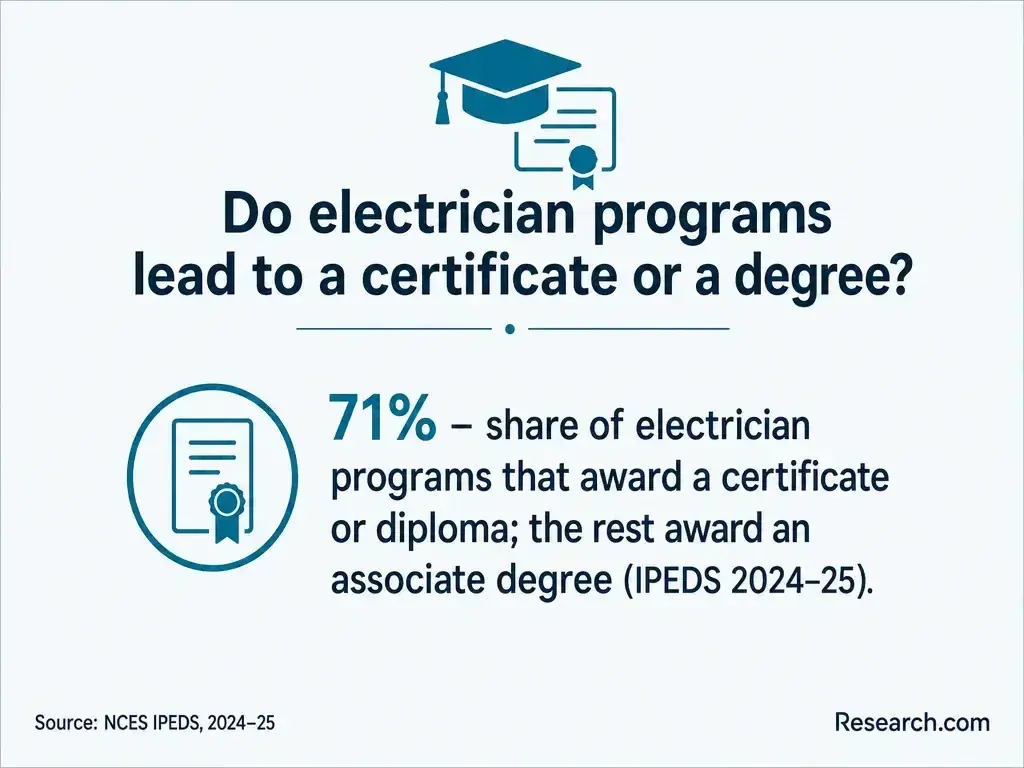
Depending on the provider, you may earn a completion certificate, diploma, associate degree, or registered-apprenticeship completion credential. These are evidence of different kinds of training; none is automatically a New Hampshire journeyman license. A school certificate may document classroom learning, while an apprenticeship combines related instruction with supervised work (New Hampshire Electricians' Board; U.S. Department of Labor).
Ask for the exact credential title, a transcript or record of instructional hours, and any documentation the employer or board will require. Institutional accreditation concerns the school; state authorization concerns its permission to operate; apprenticeship registration concerns the training arrangement; occupational licensure comes from the state board. Do not treat these as interchangeable approvals.
School admissions and apprenticeship hiring are separate decisions. Providers set their own educational and placement requirements; employers or sponsors may also assess applicants' ability to travel to jobsites, follow safety procedures, and meet work schedules. Ask directly about prerequisites, application windows, required equipment, and whether a paid placement is offered or merely suggested.
Before enrolling, confirm whether you must arrange an employer yourself and what apprentice registration or supervision rules apply to your planned work (New Hampshire Electricians' Board). A program that accepts you quickly is not necessarily the faster route to qualifying hours if work opportunities are uncertain.
Core training should build from electrical calculations and circuit fundamentals to reading plans, applying code, selecting materials, making connections, and using meters to diagnose faults. Labs should require students to demonstrate safe procedures rather than only recognize answers on a screen. The BLS identifies troubleshooting, physical work, and safety awareness as important to electricians' work (BLS, Occupational Outlook Handbook).
Ask to see a course outline and the lab schedule. A program emphasizing only exam preparation may fit an experienced worker differently from a beginner who needs substantial supervised tool practice. Also check whether instruction addresses the systems used by your intended employer - such as building wiring, industrial controls, or maintenance - without assuming a specialty course substitutes for core licensing requirements.
Yes, plan for state licensing to work independently as a journeyman electrician. New Hampshire's Electricians' Board requires qualifying supervised experience, electrical schooling, and an examination for that license. Apprentices can work while learning under applicable supervision and registration rules; graduation from trade school is not itself a license (New Hampshire Electricians' Board).
Industry training certificates may help demonstrate a skill, but they do not replace board licensure. If you expect to work across state lines, check the destination state's rules before choosing a program or relying on license portability. Requirements can differ, and a credential recognized by an employer is not necessarily recognized by another state's licensing board.
Start with your intended outcome: entry into supervised work, completion of required classroom instruction, or advancement toward licensure. An affordability ranking can identify programs to investigate, but it cannot establish that a program's schedule, labs, and employer access fit your situation. The following checks turn a low advertised price into a more useful comparison.
A common mistake is choosing the lowest tuition without a workable plan for accumulating qualifying hours. Another is treating broad lists of most in demand college majors as evidence about electrician hiring; for this decision, local sponsors, licensing requirements, and actual job offers are more relevant.
A typical progression is supervised apprentice work, eligibility for the journeyman examination after meeting requirements, and then licensed work with greater independence. With further qualifying experience and the applicable licensing steps, some electricians pursue master-level responsibility or contracting; others specialize in maintenance, controls, or supervision (New Hampshire Electricians' Board; BLS, Occupational Outlook Handbook).
Choose early training with that progression in mind. If your goal is hands-on electrical work, compare the cost and time of a school-plus-employer route with a paid apprenticeship - not lists about what bachelor degree makes the most money. Likewise, information about easy phd programs to get into does not answer whether an electrical program documents qualifying instruction or connects you to supervised work. Those are the decisive questions for this trade.
Nationally, BLS projects electrician employment to grow 9.2% from 2025 to 2035. That projection supports considering the trade, but it does not predict openings in a particular New Hampshire town or guarantee a placement after school (BLS, Employment Projections).
For a local decision, ask apprenticeship sponsors and employers where they expect to place trainees, how far worksites may be from home, and whether positions are available when your training ends. Compare those answers with current New Hampshire labor-market information. A program with a credible route to supervised work may be more useful than a faster classroom-only option, even when both teach similar material.
Investing in electrician training is a consequential decision, so Research.com designed its ranking to help readers compare programs with other programs in the same occupation and location. The team checks multiple education and cost sources for credibility and accuracy. Only programs with completions reported to the Integrated Postsecondary Education Data System (IPEDS) are eligible; a registered apprenticeship or employer program absent from IPEDS is not necessarily unavailable or lower quality.
The most affordable ranking scores costs and debt - not overall program quality - using tuition, cost of attendance, median student debt, and federal loan default rates. An entropy-based method gives more weight to measures that vary more among eligible programs. Accreditation, licensing alignment, and hands-on training must therefore be checked separately. Research.com's broader best programs rankings also consider completion and retention, earnings and return on investment, student support, institutional accreditation, and occupation-relevant recognition; those quality measures are not part of the affordability score.
These are the data sources used in Research.com's trade-program ranking work. Occupation-specific sources matter most when interpreting an electrician listing; sources focused on healthcare or dental training do not establish electrician-program quality.
Use the ranking to narrow your search, then request a written cost estimate and confirm how each program connects to New Hampshire's experience and classroom requirements. More detail about the ranking approach is available in Research.com's methodology.
# 1 position
# 2 position
No. New Hampshire's journeyman pathway also requires qualifying supervised practical experience and an examination. Confirm how the school documents any classroom hours with the Electricians' Board.
It may be cheaper out of pocket because apprentices earn wages while training, but compare instruction charges, tools, travel, and the availability of a position before deciding.
Online coursework may cover theory or code. Practical skills and qualifying supervised work require in-person participation; check any proposed online instruction with the board.
Not necessarily. The affordability ranking measures cost and debt, not whether you can secure qualifying work or whether a program's labs and schedule fit your needs.
Ask for the full cost, exact credential, documented instructional hours, hands-on schedule, and a clear explanation of how students obtain supervised employment.