# 1 position
Ocean County Vocational-Technical School - Electrician.
certificate or diploma

Audited and Verified:
Our Editorial and Data Verification Process
Research.com uses government datasets, official education statistics and primary institutional information to support its career and degree guides. Our review process checks factual accuracy, occupational definitions, source dates and the requirements associated with the credentials discussed.
How This Article Was Fact-Checked
Our editorial team verifies salary estimates, employment projections, education requirements and program information against original data providers and official organizations. Salary figures are checked against the relevant occupational definitions and reporting periods. Information about licensure, accreditation and required in-person training is reviewed separately.
Fact-checked and verified on:

Co-Founder and Chief Data Scientist

Reviewed by Karolina Broda
Fact-Checker and Data Verification
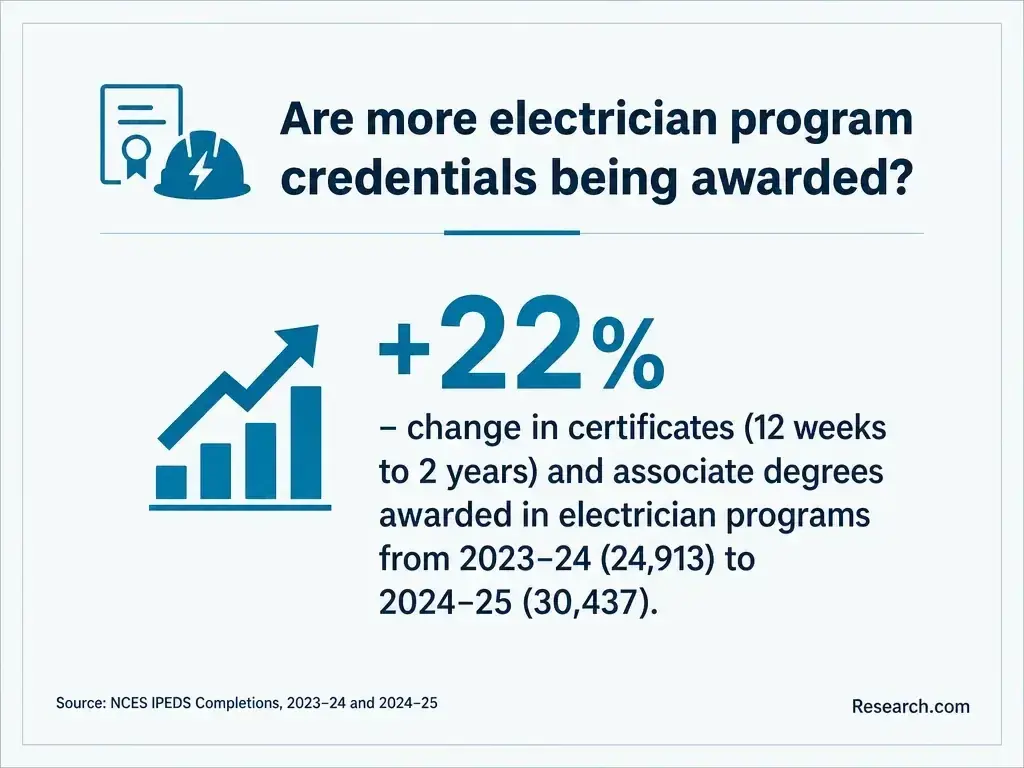
The cheapest electrician program is not necessarily the least expensive route to a job: tools, travel, unpaid training time, and apprenticeship requirements can change the calculation. The U.S. Bureau of Labor Statistics projects electrician employment to grow 9.2% nationally from 2025 to 2035. For prospective students and career changers, the Research.com team of data scientists created a Most Affordable Electrician Trade Schools in New Jersey for 2027 ranking to help identify programs worth considering. This guide explains how to compare their costs, practical training, credentials, and routes to paid work.
Expect instruction in electrical theory, code, safety, blueprint reading, wiring, and testing, paired with shop practice. The decisive question is what happens after the classroom portion: does the provider help you enter a registered apprenticeship or obtain supervised work, or must you arrange that yourself? A certificate can demonstrate preparation without replacing the practical experience required for career progression.
The pathways below differ most in how they connect instruction to paid, supervised work. Ask providers to identify the exact credential and work arrangement they offer rather than comparing program names alone.
| Pathway | Typical credential or result | Best fit and principal trade-off |
| Vocational or adult-education program | School certificate or completion record | Fits someone seeking foundational shop skills; confirm whether the program leads to an apprenticeship interview or placement. |
| Private career-school program | Certificate or diploma, depending on provider | May offer a focused schedule; compare the full price and employer connections before paying. |
| Registered apprenticeship through a union or employer sponsor | Documented work experience and related instruction; completion credential | Fits someone ready to work while learning; entry can depend on openings and sponsor selection. |
| Direct entry with an electrical contractor | Paid experience, potentially leading into an apprenticeship | May minimize upfront school cost; verify who supervises training and whether hours will count toward your goal. |
A school-based program makes the most sense when its lab access, schedule, and route into supervised work solve a problem you cannot solve through direct employment or apprenticeship. Request a description of shop equipment, instructor feedback, and employer partnerships before enrolling.
Electrical contractors hire for residential and commercial construction, renovation, and service work. Industrial facilities and building-maintenance teams also use electrical skills, although a maintenance job may have different duties and advancement requirements from an electrician apprenticeship (U.S. Bureau of Labor Statistics, Occupational Outlook Handbook). Training alone does not authorize someone to operate an electrical contracting business.
Location affects the practical value of an offer. A jobsite or apprenticeship classroom may be far from home, and assignments can move between sites. Compare the commute, work hours, and sponsor's service area alongside pay. Ask whether a position provides documented electrical experience under appropriate supervision, particularly if your goal is eventual New Jersey registration or contractor licensure.
For a reliable benchmark, the U.S. Bureau of Labor Statistics reports a May 2025 national median annual wage of $63,190 for electricians. This is the midpoint across employed electricians with different experience levels - not a starting-pay quote, a New Jersey wage estimate, or a return promised by any school. Apprentices commonly begin below experienced electricians and progress according to their employer's or sponsor's wage schedule.
When comparing local opportunities, request the actual starting wage, scheduled raises, expected weekly hours, benefits, and travel or tool expenses in writing. A paid apprenticeship may improve your finances during training even if a school advertises a shorter classroom schedule. For broader pay context, highest paying trade school jobs can help you compare occupations, but use electrician-specific offers for your own budget.
A school's published course length describes its classes, not the time needed to become an experienced electrician or qualify for a license. Short introductory training may help you seek an entry-level position; a registered apprenticeship combines related instruction with supervised work over multiple years (U.S. Department of Labor, Apprenticeship.gov). Part-time classes can fit an existing job but may postpone the point at which you can apply new skills at work.
Before choosing an accelerated schedule, ask how many supervised shop hours it includes and whether an apprenticeship sponsor will credit any instruction. Do not assume that finishing classes quickly shortens New Jersey's separate experience requirements. Search results for accelerated bachelor's programs address a different educational goal, not faster entry into electrical contracting.
Online lessons can cover theory, calculations, code concepts, and reading diagrams. They cannot by themselves demonstrate safe tool use, wiring installation, testing, or troubleshooting in a shop or at a supervised jobsite. A hybrid program may be workable if its in-person sessions are accessible and substantial; an entirely online course should be treated as supplemental unless a prospective employer or apprenticeship sponsor confirms its value.
Check where labs take place, who evaluates practical skills, and whether the provider arranges supervised work. Unlike browsing affordable online universities, comparing electrician training requires accounting for trips to a shop and the eventual jobsite. The lowest online price is not useful if you must separately buy the hands-on preparation needed to get hired.
There is no single defensible average for all New Jersey electrician pathways: school tuition, employer-sponsored instruction, and paid apprenticeships have different cost structures, and college-oriented datasets do not capture every sponsor. Request a current, itemized, all-in quote from each provider rather than treating a ranking position as your personal bill.
The comparison below identifies costs that can change which option is genuinely affordable. Confirm which items are included and when payment is due.
| Cost or offset | What to check | Why it changes the comparison |
| Tuition and required fees | Published price for your residency and schedule | Advertised tuition may omit mandatory charges. |
| Tools, PPE, and materials | Required purchases and whether a sponsor supplies them | Upfront equipment needs vary by training route. |
| Travel and foregone earnings | Trips to classes and jobsites; hours away from paid work | A shorter or nearer program may lower indirect costs. |
| Aid and wages during training | Confirmed grant eligibility, employer support, or apprentice pay | These can reduce the amount you must finance yourself. |
Include any applicable examination and application fees in your longer-term plan. Ask whether the specific program qualifies for federal aid; institutional accreditation alone does not establish that a particular course is aid-eligible (U.S. Department of Education, Federal Student Aid). New Jersey residents can also ask the state workforce agency about eligibility for training assistance. Compare likely completion and paid-work prospects, debt, and lost earnings over the period you expect to work - not just the first bill.
A vocational or career-school program may award a certificate or diploma; a registered apprenticeship documents completion of a structured combination of instruction and supervised employment. Those credentials describe training completed. New Jersey journeyman electrician registration and electrical contractor licensure are separate state processes with their own experience and other requirements (New Jersey State Board of Examiners of Electrical Contractors).
Ask the school for the credential's exact name, awarding organization, and whether prospective employers or apprenticeship sponsors recognize it. If you already have related training, ask a sponsor whether it grants advanced standing or instruction credit - and get the decision in writing. Do not assume that similarly named certificates carry identical shop hours or apprenticeship credit.
Entry rules depend on the provider. A school may assess math or reading readiness and require safety orientation; an apprenticeship sponsor may have its own application window, eligibility documents, assessment, and interview. Requirements for admission are not the same as requirements for later journeyman registration or contractor licensure.
Obtain the current checklist directly from each school or sponsor before paying an application fee. Ask whether you need to purchase tools before the first class, whether you can attend required shop sessions around work, and whether any prior electrical experience can be evaluated. If an advertisement implies admission includes an apprenticeship position, request the sponsor's written explanation of how selection actually works.
Relevant training connects electrical theory to safe installation and diagnosis: circuit calculations, reading plans, installing devices and wiring, using test instruments, and applying the electrical code. Shop exercises should require students to build and troubleshoot circuits, not only watch demonstrations. Safety instruction matters because electricians work around energized systems and construction hazards (U.S. Bureau of Labor Statistics, Occupational Outlook Handbook).
Look for a curriculum that names its lab equipment, practical assessments, and code edition. Ask how instructors correct mistakes and whether students practice skills applicable to the residential, commercial, or industrial work they want. A course focused solely on theory may be useful preparation, but it is not equivalent to supervised field experience.
You do not need an electrical contractor license merely to begin learning as a supervised employee. New Jersey separately regulates journeyman electrician registration and electrical contractor licensure. The State Board of Examiners of Electrical Contractors sets experience, application, and examination requirements for the relevant credential; completing a school program does not automatically satisfy them or permit independent contracting.
Before enrolling, tell the board and any prospective apprenticeship sponsor your intended role, then check which classroom instruction and documented work experience they will accept. Confirm who will supervise your work and keep records of hours and duties. Institutional accreditation, school authorization, an industry training certificate, apprenticeship registration, journeyman registration, and a contractor license serve different purposes; none should be advertised as interchangeable.
Start with the job you want, then compare programs by their ability to get you into relevant, documented work. For each shortlisted provider, use the same questions so an attractive tuition figure does not obscure a weak training-to-employment connection.
A warning sign is a promise that a short course alone makes you a licensed electrician. Another is an "online electrician" offer that cannot identify where practical skills are assessed. Rankings can help narrow the search, but they cannot verify your commute, eligibility for aid, or acceptance by a particular sponsor. Results for degree programs for seniors online likewise should not be mistaken for a route to supervised electrical work.
One route begins with supervised electrical work, continues through an apprenticeship and documented experience, and may lead to journeyman registration or, after meeting separate requirements, electrical contractor licensure. Electricians may concentrate on construction, service calls, or industrial systems as their experience grows. Supervising work or operating a contracting business introduces responsibilities beyond finishing a training course (New Jersey State Board of Examiners of Electrical Contractors; U.S. Bureau of Labor Statistics, Occupational Outlook Handbook).
If your goal is to work with electrical systems rather than pursue independent contracting, compare maintenance positions as well - but check their actual duties and advancement paths. Additional coursework can help with specialization, yet quick masters programs are not a substitute for the supervised electrical experience relevant to New Jersey registration or licensure.
The U.S. Bureau of Labor Statistics projects 9.2% national growth for electricians from 2025 to 2035. That points to demand across the occupation, but it does not forecast openings in your county or guarantee a place with an apprenticeship sponsor. Construction schedules, contractor hiring, and the distance between jobsites can make local opportunities uneven.
Use the national outlook as context, then test your plan against current New Jersey apprenticeship openings and local employer postings. Compare the work requested - service, construction, or industrial maintenance - with the equipment and field experience a program actually provides. The strongest investment is one that gives you usable skills and a realistic entry point into paid, supervised work.
Choosing where to invest in training is consequential, so the Research.com team assembled the ranking to make local cost comparisons more useful and transparent. Programs are compared with others in the same occupation and location; only programs reporting completions to IPEDS are eligible. The most affordable ranking scores tuition, cost of attendance, median student debt, and federal loan default rate, with weights assigned using an entropy-based method. Accreditation and other quality measures are not part of that affordability score.
This differs from Research.com's best-program rankings, which also assess student outcomes, earnings, student support, accreditation, and occupation-relevant recognition. To check the credibility and coverage of the ranking, the team draws on the following sources:
The allied-health and dental sources support the broader trade-ranking research process; they do not establish that an electrician program meets New Jersey licensing requirements. Likewise, IPEDS does not cover every union, employer-sponsored, or apprenticeship route. Use the ranking to shortlist schools, then verify each program's current price and training arrangement directly. Research.com explains its approach further on its methodology page.
# 1 position
# 2 position
# 3 position

# 4 position

# 5 position

# 6 position

# 7 position

# 8 position

# 9 position
# 10 position

# 11 position
# 12 position

# 13 position

Not necessarily. An apprenticeship or appropriately supervised employer route can combine instruction with paid work. Confirm the experience and instruction requirements for your intended state credential with the New Jersey State Board of Examiners of Electrical Contractors.
No. A school certificate records training; journeyman registration and electrical contractor licensure are separate state processes.
You can study some theory online, but practical wiring, testing, and supervised jobsite skills require in-person participation. Ask where and how a hybrid provider assesses them.
It can reduce upfront school spending and provide wages during training. Compare any required supplies, travel, entry requirements, and time to completion before deciding.
Request the total required price, hands-on training details, the exact credential, and written information about apprenticeship connections. Check directly whether your intended sponsor recognizes the training.