# 1 position

Audited and Verified:
Our Editorial and Data Verification Process
Research.com uses government datasets, official education statistics and primary institutional information to support its career and degree guides. Our review process checks factual accuracy, occupational definitions, source dates and the requirements associated with the credentials discussed.
How This Article Was Fact-Checked
Our editorial team verifies salary estimates, employment projections, education requirements and program information against original data providers and official organizations. Salary figures are checked against the relevant occupational definitions and reporting periods. Information about licensure, accreditation and required in-person training is reviewed separately.
Fact-checked and verified on:

Co-Founder and Chief Data Scientist

Reviewed by Karolina Broda
Fact-Checker and Data Verification
Choosing affordable electrician training in Calmar means looking beyond tuition: a short program and a paid apprenticeship can have very different costs and routes to licensure. The U.S. Bureau of Labor Statistics projects electrician employment to grow 9.2% nationally from 2025 to 2035. For career starters and working adults, this guide compares credentials, practical training, Iowa licensing, and total costs. It also features the Most Affordable Electrician Trade Schools in Calmar for 2027 ranking, created by the Research.com team of data scientists to help students make an informed choice about programs worth considering.
Expect a mix of electrical theory and physical practice: interpreting plans, calculating loads, selecting materials, installing circuits, testing work, and following the electrical code and safety procedures. Ask Northeast Iowa Community College which electrician-related credentials and lab sessions are currently available at its Calmar campus; a program listing alone does not establish that every course is offered there each term.
A school-based certificate or diploma can help a beginner build skills before seeking an electrical employer. A registered apprenticeship instead combines paid, supervised work with related instruction and is a more direct way to accumulate occupational experience. An associate program may add broader technical coursework, but its value depends on whether those courses serve your intended work and whether an apprenticeship sponsor recognizes any prior training. None of these credentials independently authorizes unsupervised electrical work in Iowa (Iowa Electrical Examining Board; U.S. Department of Labor).
If you are comparing what certificate makes the most money, keep the comparison occupation-specific: an electrician certificate's payoff depends heavily on whether it helps you enter supervised work and progress toward licensure.
Potential workplaces include electrical contractors, construction sites, manufacturing facilities, farms, and building-maintenance operations. Northeast Iowa's rural setting can make travel between job sites - or a commute to a sponsor or employer outside Calmar - an important part of the decision. Before enrolling, ask where recent students found supervised placements and whether a reliable vehicle and travel between sites are expected.
Training can support an application for supervised work, but the employer decides whom to hire and the Iowa Electrical Examining Board determines licensing status. Residential, commercial, and industrial jobs also use different equipment; compare a program's labs with the work you want to pursue.
The U.S. Bureau of Labor Statistics reports a $63,190 national median annual wage for electricians in May 2025. That figure covers experienced workers as well as newer ones and should not be used as an apprentice pay estimate or a Calmar wage quote. A locally useful comparison is the actual wage schedule offered by prospective apprenticeship sponsors and employers, including how pay changes with experience.
For return on investment, compare likely earnings during training as well as afterward. A paid apprentice may receive wages while completing required instruction; a full-time school student may give up working hours. Factor in aid, debt, the likelihood of finishing, and how long you expect to work in the trade rather than dividing tuition by the national median wage.
Length depends on the credential and schedule. A short school program can deliver introductory skills sooner than a longer diploma or associate program, but finishing school is not the same as completing the supervised experience needed to qualify for independent work. Registered apprenticeships combine related instruction with substantial on-the-job training over multiple years; confirm the specific sponsor's schedule and Iowa licensing alignment (U.S. Department of Labor; Iowa Electrical Examining Board).
Ask each provider for its required classroom and lab contact hours, full-time and part-time completion timelines, and whether prior coursework receives credit. Do not assume a school certificate shortens an apprenticeship: obtain the sponsor's written advanced-standing policy first. Even if you are also researching the easiest degree to get, electrician training should be judged by the practice and supervised experience it provides, not speed alone.
Online coursework can be useful for theory, calculations, or code study. It cannot replace practicing with tools, assembling circuits, troubleshooting equipment, or completing supervised work at an employer site. A hybrid option makes sense when its required labs are accessible from Calmar and its schedule fits your job; an entirely remote course may be useful preparation but should not be assumed to meet apprenticeship or Iowa licensing requirements.
Before paying for remote instruction, get a written breakdown of online hours, in-person lab hours, and who arranges work experience. A list of best accredited non-profit online universities does not answer whether an electrician program supplies local practical training or meets Iowa's occupational requirements.
There is no reliable single average that captures Calmar school programs and paid apprenticeships on the same basis. Published tuition may exclude substantial job-entry expenses, while an apprenticeship may pay wages even though the learner still buys tools or travels to instruction. Request a current, itemized estimate for the exact credential, attendance status, and campus before comparing offers.
This comparison shows which costs to request; amounts and who pays them depend on the provider or sponsor.
| Cost or offset | School-based program | Paid apprenticeship |
| Instruction | Tuition and mandatory fees; check resident rates and aid eligibility | Ask about instruction charges, dues, and employer or sponsor coverage |
| Practical supplies | Tools, materials, and personal protective equipment may be additional | Confirm which tools and protective equipment the sponsor provides |
| Time and travel | Budget for labs, commuting, and work hours forgone | Budget for job-site and classroom travel; include apprentice wages |
| Later entry costs | Check applicable examinations and license application costs separately |
Ask Northeast Iowa Community College about current aid eligibility and ask Iowa workforce staff about available training assistance. Federal aid depends on the student's and program's eligibility; it should not be assumed for every short course (Federal Student Aid; Iowa Workforce Development). An affordable choice is the one with a manageable net cost and a credible route to supervised work, not necessarily the smallest advertised tuition.
The answer depends on the specific offering: school-based electrician training may award a certificate, diploma, or associate credential, while a registered apprenticeship leads to an apprenticeship completion credential upon satisfying its requirements. Verify the exact award and any transfer or apprenticeship credit in writing (Northeast Iowa Community College; U.S. Department of Labor).
Institutional accreditation concerns the school; state school authorization concerns permission to operate; apprenticeship registration concerns a training arrangement; and occupational licensure concerns legal authority to perform regulated work. An industry training credential can demonstrate skills but does not substitute for an Iowa electrical license. Ask which of these applies to your intended job rather than treating similarly named credentials as interchangeable (U.S. Department of Education; U.S. Department of Labor; Iowa Electrical Examining Board).
School entry requirements and apprenticeship hiring requirements are separate decisions. Confirm the current program's application requirements, math preparation, placement process, and any prerequisites directly with Northeast Iowa Community College. An apprenticeship sponsor may also assess applicants and set employment-related conditions; admission to a school course is not an apprenticeship job offer.
Before applying, ask whether tools or protective equipment are needed on day one, whether classes meet in Calmar, and whether the schedule permits paid work. If your goal is apprenticeship, contact prospective sponsors early: a school course is worth paying for only if its skills or recognized credit improve your intended route into the trade.
Relevant instruction covers electrical safety, circuits, wiring methods, blueprint reading, measurements, testing, and code use. Strong training gives students supervised time to build and troubleshoot installations - not just identify components in a video. Electrical work also demands communication with other trades and careful documentation of faults and repairs (U.S. Bureau of Labor Statistics, Occupational Outlook Handbook).
Compare programs by asking to see a current course sequence and lab description. If you want industrial maintenance work, look for applicable motors, controls, and troubleshooting practice; for construction work, check installation and plan-reading practice. A broad course title does not establish that either set of competencies is covered in depth.
Electrical work in Calmar is governed by Iowa requirements, not by a national electrician license. Iowa's Electrical Examining Board administers electrical licenses and distinguishes supervised apprentice work from higher levels of licensed practice. Review the board's current apprentice, experience, examination, and journeyman requirements for the work you intend to perform before selecting training; graduation does not automatically confer a license (Iowa Electrical Examining Board).
Ask a school or sponsor how it documents supervised hours, whether its instruction is accepted toward your intended route, and who is responsible for any required registration. Institutional accreditation, optional industry certification, and registered-apprenticeship status answer different questions; none alone replaces the board's licensing decision. If you plan to work outside Iowa, check that state's rules separately rather than assuming an Iowa credential transfers.
Start with your intended job and work backward to the credential, hands-on practice, supervised experience, and Iowa licensing route it requires. A low-cost course can be worthwhile for building entry skills; it is a poor investment if you expect it to replace an apprenticeship that the course does not provide.
Use these questions with both school representatives and apprenticeship sponsors so you can compare the same decision points:
Check school accreditation and aid eligibility separately from Iowa licensing rules; then compare completion prospects, debt, paid-training access, and earnings over a realistic time horizon. Do not rely on an affordability ranking or a national wage alone. Someone weighing most profitable bachelor degrees is making a different education decision; for electrician entry, verified practical training and licensing alignment take priority.
A common route is supervised electrical work followed, when Iowa's requirements are met, by examination and progression to licensed practice. Experience can lead toward residential or commercial installation, industrial electrical work, supervision, or qualifying for additional license categories. Specific duties and authority depend on the license held and the employer's needs (Iowa Electrical Examining Board; U.S. Bureau of Labor Statistics).
Choose training for the setting you want, not a promised job title. Industrial troubleshooting and construction installation call for overlapping fundamentals but different practice. If you are exploring best high paying careers for introverts, remember that electrical work includes independent problem-solving and coordination with customers, supervisors, and other trades.
National electrician employment is projected to grow 9.2% from 2025 to 2035, according to the U.S. Bureau of Labor Statistics. That signals demand for the occupation nationally, not a forecast of Calmar openings or a guarantee of work after a particular course.
For a local decision, compare current openings and apprenticeship recruitment across the area you can realistically commute to. Ask employers which credentials they recognize and whether they hire beginners for supervised positions. That evidence is more useful for choosing between school first and apprenticeship first than a national growth projection alone.
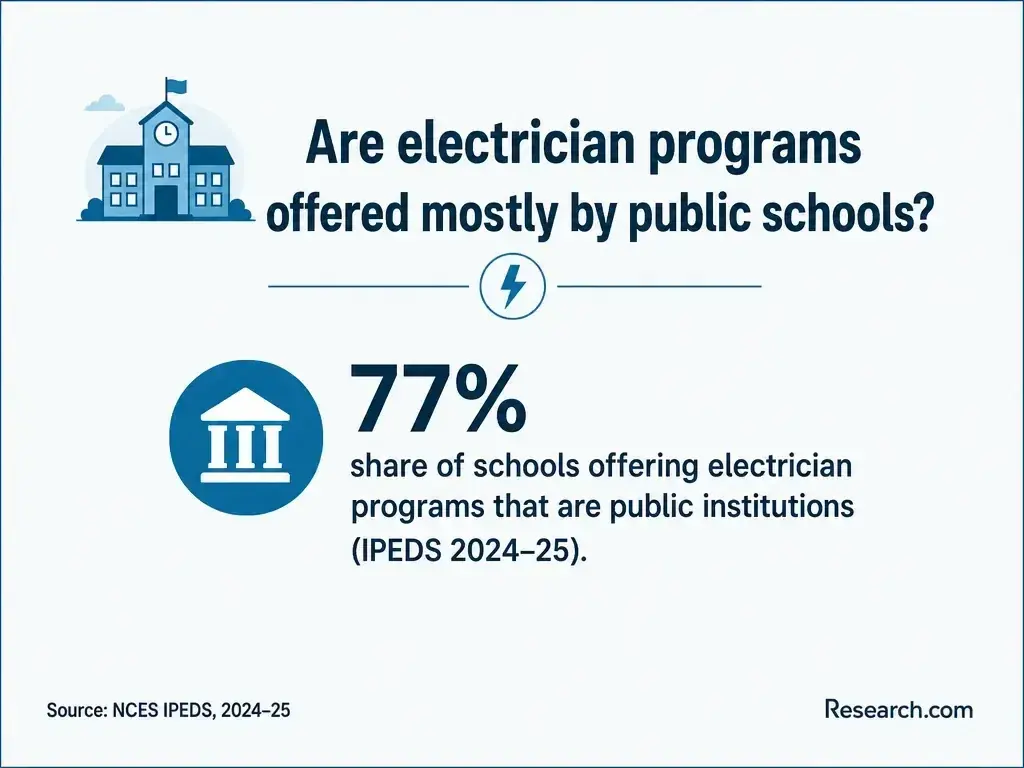
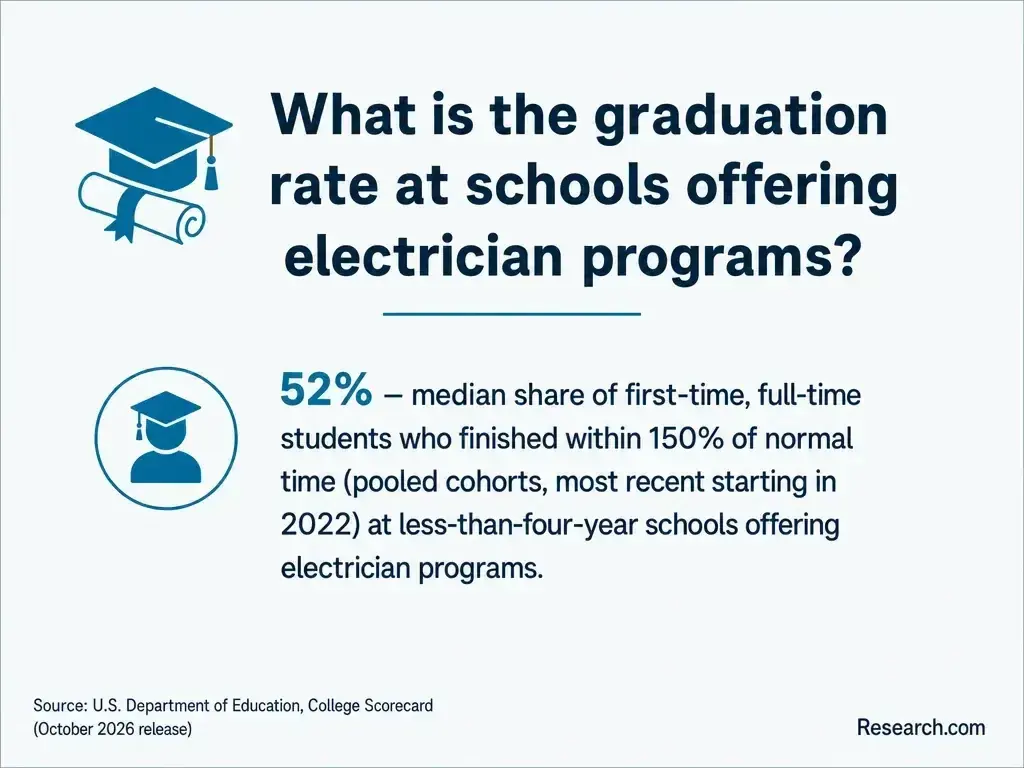
Investing in electrician training is a consequential decision. Research.com's team checks program and institutional records to make the ranking credible and useful for comparing eligible programs against other options in the same occupation and location. Only programs with completions reported to the Integrated Postsecondary Education Data System (IPEDS) can appear; an apprenticeship or employer program missing from the ranking may still be a strong option.
The most affordable ranking scores tuition, cost of attendance, median student debt, and federal loan default rate. An entropy-based method gives more weight to measures that vary more across eligible programs. Unlike Research.com's separate best-program rankings, this affordability score does not include accreditation, recognition, support services, completion, or earnings. Readers should check those factors independently before enrolling.
The following data sources were used in the ranking research. Some are relevant to other trades rather than electrician training; their inclusion does not mean they determine an electrician program's score or Iowa licensing eligibility.
The ranking helps narrow the cost search, not decide whether a program supplies the supervised experience needed for an Iowa license. See Research.com's methodology for more about how rankings are created.
# 1 position
# 2 position
Not necessarily. A sponsor may accept beginners into paid training. Ask prospective sponsors whether prior coursework improves admission or receives advanced standing before paying for it (U.S. Department of Labor).
Online study can cover theory, but it does not replace hands-on practice or supervised electrical work. Verify how any course fits Iowa licensing requirements with the Iowa Electrical Examining Board.
No. A school certificate and an occupational license are different credentials. Check the Iowa Electrical Examining Board's current requirements for the level of work you plan to perform.
Compare net training costs, wages during training, required travel and tools, completion likelihood, and whether each route supplies recognized experience. Tuition alone misses the largest practical differences.
No. In addition to confirming its current Calmar offerings, investigate registered apprenticeships and employer-sponsored entry routes. An option absent from a college-based ranking may still be suitable if it meets your training and licensing goals.